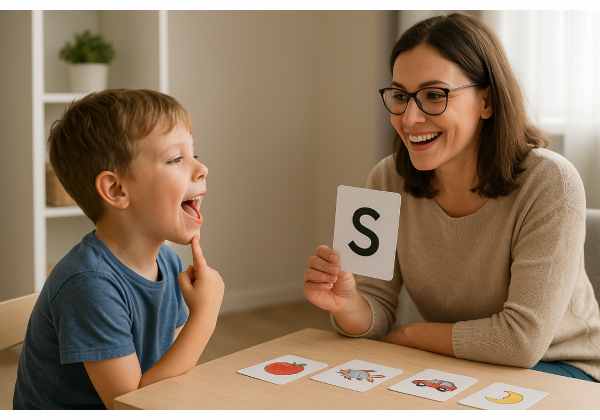
Speech sound disorder is a communication disorder in which a child has persistent difficulty producing speech sounds clearly enough for their age, language background, and developmental level. Some children leave sounds out, replace one sound with another, distort sounds, or use speech patterns that make them hard to understand. Occasional pronunciation mistakes are normal in early childhood, but speech sound disorder becomes a concern when the pattern is persistent, developmentally unexpected, and interferes with communication, learning, social participation, or daily functioning.
The condition is often identified in preschool or early school years, when speech becomes important for classroom participation, peer relationships, phonics, early reading, and self-confidence. It is not the same as having an accent, speaking a dialect, or learning more than one language. A careful evaluation considers the child’s speech sounds, language development, hearing, oral structures, motor speech skills, family history, and the languages or dialects used at home and school.
Table of Contents
- What speech sound disorder means
- Symptoms and everyday signs
- Types of speech sound difficulties
- Causes and risk factors
- Diagnostic context and assessment
- Co-occurring developmental concerns
- Effects and complications
- When speech changes need urgent attention
What speech sound disorder means
Speech sound disorder means that speech sound production is less clear, accurate, or intelligible than expected for the person’s age and developmental stage. In children, the issue is usually noticed when speech remains difficult to understand after the age when most peers can produce enough sounds clearly for everyday communication.
Speech depends on several systems working together. The child must hear speech sounds, recognize sound contrasts, plan the sound sequence, move the lips, tongue, jaw, palate, and breath stream accurately, and use sounds according to the rules of the language being spoken. A breakdown in one or more of these areas can affect intelligibility.
The term “speech sound disorder” is broad. It can include:
- Trouble making a specific sound, such as /r/, /s/, or /l/
- Sound substitutions, such as saying “tat” for “cat”
- Omissions, such as saying “poon” for “spoon”
- Distortions, such as a lisped /s/
- Phonological patterns, such as replacing many back sounds with front sounds
- Inconsistent production, where the same word is said different ways at different times
- Reduced intelligibility in conversation, especially with unfamiliar listeners
Speech sound disorder is usually discussed in childhood, but speech sound difficulties can sometimes persist into adolescence or adulthood. Adults may have residual childhood speech sound errors, or speech may be affected by neurological injury, hearing changes, structural differences, or medical conditions. This article focuses mainly on developmental speech sound disorder in children, while noting when sudden or acquired speech changes need prompt medical attention.
A key distinction is that a speech sound disorder is not simply “talking late.” A child may have age-appropriate speech sounds but limited vocabulary, short sentences, or difficulty understanding language. That points more toward a language concern than a speech sound concern. The two can also occur together, which is one reason assessment often looks at both speech and language.
It is also not a disorder when a child’s speech reflects a home language, regional accent, cultural speech pattern, or dialect. For example, a child learning two languages may use sound patterns from one language while speaking another. That pattern can be typical language transfer rather than a disorder. The concern is stronger when the child’s speech is hard to understand compared with other children of the same age who share the same language or dialect background.
Symptoms and everyday signs
The main symptom of speech sound disorder is persistent difficulty producing speech sounds clearly enough for effective communication. The signs are often easiest to notice in ordinary situations: talking to relatives, answering a teacher, playing with peers, telling a story, or being understood by someone outside the immediate family.
Common signs include:
- People frequently ask the child to repeat words or sentences.
- Familiar adults understand the child much better than unfamiliar listeners do.
- The child leaves off beginning or ending sounds in words.
- One sound is regularly substituted for another.
- Several different words sound the same because sound contrasts are missing.
- Speech is much less clear in long sentences than in single words.
- The child avoids certain words because they are hard to say.
- The child becomes frustrated when others do not understand.
- Speech clarity seems behind peers of the same age and language background.
The pattern matters more than one isolated mispronunciation. Many young children say “wabbit” for “rabbit,” “nana” for “banana,” or “tat” for “cat” at some point. Some sound errors are typical at certain ages and become concerning only if they persist beyond the expected developmental period, occur across many sounds, or make the child hard to understand.
| Observed sign | Plain-language example | Why it matters |
|---|---|---|
| Substitution | “tat” for “cat” | The child replaces one sound with another, which may reduce word clarity. |
| Omission | “cool” for “school” | Leaving sounds out can make words harder to recognize. |
| Distortion | A slushy or lisped /s/ sound | The sound is attempted but produced inaccurately. |
| Reduced intelligibility | Only close family can understand much of the child’s speech | The issue is affecting real communication, not just sound accuracy. |
| Inconsistent errors | The same word is pronounced different ways | This may suggest a more complex speech planning or phonological pattern. |
Speech sound disorder can be mild, moderate, severe, or profound. A mild pattern may involve only one or two later-developing sounds while overall conversation remains understandable. A more severe pattern may affect many consonants, word shapes, and sound contrasts, making speech difficult even for familiar listeners.
Age expectations must be used carefully. Sound development varies across languages, dialects, and individual children. Some sounds naturally emerge later than others. What matters is whether the child’s speech is understandable enough for age, whether errors are typical or unusual for the child’s language community, whether the pattern is persistent, and whether it interferes with participation.
Types of speech sound difficulties
Speech sound disorder is not one single pattern; it can reflect different kinds of speech sound difficulty. Understanding the broad types helps explain why two children with the same diagnosis may sound very different.
An articulation difficulty involves trouble producing a particular sound accurately. The child may know which sound is intended but have difficulty placing the tongue, lips, teeth, jaw, or airflow in the right way. A common example is a lisp affecting /s/ or /z/. Another is persistent difficulty with /r/. Articulation patterns often affect a small number of sounds, although the impact can still be meaningful if the sound occurs often in speech or draws unwanted attention.
A phonological difficulty involves the sound system of language. The child may be able to produce some sounds in isolation but use sound patterns that collapse important contrasts between words. For example, replacing many back sounds with front sounds can make “key” sound like “tea” and “go” sound like “do.” In this pattern, the issue is not only physical placement of one sound but how the child organizes and uses sound contrasts to create meaning.
Motor speech disorders are different. Childhood apraxia of speech involves difficulty planning and sequencing the movements needed for speech. Dysarthria involves weakness, abnormal tone, or reduced coordination in the speech muscles, often related to neurological conditions. These are not the same as common developmental articulation or phonological disorders, but they can affect speech sound production and must be considered when speech is unusually inconsistent, effortful, slow, weak, or affected by broader motor signs.
Structural or sensory factors can also affect speech sounds. Cleft palate, dental or jaw differences, enlarged tonsils, hearing loss, recurrent middle ear problems, and some genetic or neurological conditions can alter how speech sounds are heard or produced. In those cases, the speech sound pattern may be part of a broader medical or developmental picture.
Speech sound disorder also differs from stuttering, voice disorders, and language disorders:
- Stuttering affects fluency, such as repetitions, prolongations, or blocks.
- Voice disorders affect pitch, loudness, vocal quality, or voice use.
- Language disorders affect vocabulary, grammar, comprehension, narrative ability, or the ability to use language meaningfully.
- Social communication difficulties affect how language is used in conversation and social contexts.
These categories can overlap. A child may have speech sound disorder plus language delay, autism-related communication differences, attention difficulties, hearing loss, or learning problems. When broader developmental concerns are present, evaluation may need to look beyond speech clarity alone. For example, persistent speech sound concerns alongside reduced social communication, restricted interests, or unusual play may lead clinicians to consider autism screening in toddlers or a broader developmental workup.
Causes and risk factors
In many children, the exact cause of speech sound disorder is not known. This is often called idiopathic or functional speech sound disorder, meaning the child has speech sound difficulties without a clearly identified structural, neurological, sensory, or medical cause.
Even when no single cause is found, several risk factors are associated with a higher likelihood of speech sound difficulties. These factors do not mean a child will definitely develop the disorder, and the absence of risk factors does not rule it out. They simply help explain patterns clinicians often consider during assessment.
Commonly discussed risk factors include:
- Family history of speech, language, or reading difficulties
- Male sex, with speech and language disorders reported more often in boys than girls
- Prematurity, low birth weight, or complications around birth
- Recurrent or persistent middle ear problems, especially when hearing is affected
- Hearing loss or inconsistent access to speech sounds
- Structural differences affecting the palate, teeth, jaw, tongue, or oral mechanism
- Neurological or motor conditions affecting speech movement
- Developmental conditions such as intellectual disability, autism spectrum disorder, cerebral palsy, or genetic syndromes
- Co-occurring language difficulties
- Limited access to timely developmental, hearing, or speech-language evaluation
Hearing is especially important because children learn speech partly by listening. If a child has fluctuating hearing from middle ear fluid or undetected hearing loss, some speech sounds may be harder to hear consistently. This can affect how sounds are learned, monitored, and produced. Hearing issues do not explain every speech sound disorder, but they are important enough that hearing screening is often part of the evaluation.
Family history matters because speech, language, reading, and phonological processing skills can cluster in families. A child with a parent or sibling who had speech sound difficulty, developmental language disorder, dyslexia, or persistent reading challenges may have a higher chance of related developmental vulnerabilities. This does not mean the child has the same condition, but it supports taking concerns seriously.
Environmental and social factors can influence outcomes without being simple “causes.” Access to health care, hearing checks, early childhood education, language-rich interaction, and appropriate assessment can affect when a concern is identified and how much it interferes with learning and participation. It is inaccurate and unfair to assume that speech sound disorder is caused by poor parenting, bilingualism, or a child being lazy.
Bilingual and multilingual development deserves particular care. Learning more than one language does not cause speech sound disorder. Children may produce certain sounds differently depending on the sound systems they are learning. A concern is stronger when difficulties appear across the child’s languages, are unusual for the child’s speech community, or significantly reduce intelligibility compared with peers who share similar language exposure.
Diagnostic context and assessment
Diagnosis depends on whether the child’s speech sound pattern is developmentally unexpected, persistent, and functionally important. A speech-language assessment usually looks at much more than whether a child can say a single sound correctly.
In diagnostic terms, speech sound disorder is considered when persistent difficulty with speech sound production interferes with speech intelligibility or prevents clear verbal communication. The difficulty typically begins in the early developmental period and is not better explained by another condition such as hearing loss, cleft palate, dysarthria, or a broader neurological problem. In practice, clinicians still assess for those possibilities because they can shape the diagnostic picture.
A comprehensive assessment may include:
- Parent or caregiver concerns and examples of unclear speech
- Family history of speech, language, hearing, or reading difficulties
- Pregnancy, birth, developmental, and medical history
- History of ear infections, hearing concerns, or hearing test results
- Languages and dialects spoken at home, school, and in the community
- How understandable the child is to familiar and unfamiliar listeners
- A speech sound sample using single words and connected speech
- Oral mechanism examination of lips, tongue, jaw, teeth, and palate
- Screening or assessment of hearing when needed
- Language assessment, especially if vocabulary, grammar, comprehension, or storytelling are also concerns
- Observation of participation, frustration, avoidance, or classroom impact
Speech-language pathologists may describe the type of errors, the number of sounds affected, whether the errors follow a pattern, whether the child can imitate the sound with a model, and how intelligibility changes across contexts. A child may sound clearer in single words than in fast conversation, or clearer with family than with teachers and peers.
Assessment also distinguishes screening from diagnosis. A screening can flag a possible concern, but it does not fully define the condition. A diagnostic assessment examines the pattern, severity, context, and possible explanations. This distinction is similar to broader mental health and developmental testing, where screening and diagnosis serve different purposes.
School-based evaluation may consider whether speech sound difficulties affect classroom participation, early literacy, social interaction, or educational access. In some situations, children with speech sound concerns and academic difficulties may also be considered for psychoeducational testing or more specific learning disability testing, especially when reading, spelling, writing, or attention concerns are present.
Diagnosis should not be based on accent, dialect, or second-language influence alone. A fair assessment considers the sound rules of the child’s speech community and, when needed, uses interpreters, bilingual assessment methods, or language-specific norms.
Co-occurring developmental concerns
Speech sound disorder can occur on its own, but it often overlaps with other developmental, learning, or communication concerns. Recognizing these overlaps helps avoid missing a broader pattern.
Language difficulties are one of the most important co-occurring concerns. A child may have trouble producing speech sounds and also have a smaller vocabulary, shorter sentences, difficulty following directions, weak storytelling, or trouble understanding questions. Because speech sounds and language both support classroom communication, the combined impact can be greater than either issue alone.
Reading and spelling concerns can also emerge, especially when speech sound difficulties persist into the years when children are learning phonics. Speech sound skills are related to phonological awareness, which is the ability to notice and work with sound units in words. A child who has difficulty recognizing or using sound contrasts may also have trouble connecting letters with sounds, segmenting words, or spelling words in ways that reflect accurate sound patterns.
Attention, behavior, and emotional responses can complicate the picture. Some children avoid speaking because they are embarrassed or tired of being misunderstood. Others may become frustrated, withdraw in group settings, or act out when communication repeatedly breaks down. These reactions do not mean the speech sound disorder is “behavioral.” They may be understandable responses to the strain of not being understood.
Autism spectrum disorder can include speech sound differences, language delay, atypical prosody, motor planning differences, or broader social communication differences. A child with speech sound disorder alone may be socially engaged and communicative but hard to understand. A child with autism may have additional differences in social reciprocity, play, sensory patterns, restricted interests, or nonverbal communication. When those broader signs are present, child autism testing may be relevant.
Hearing loss is another important consideration. Even mild or fluctuating hearing issues can affect access to speech sounds. A child may seem inattentive, mishear instructions, or produce sounds inaccurately because certain sound contrasts are not consistently clear. This is why hearing history and hearing screening are often part of speech sound evaluation.
Developmental coordination differences, intellectual disability, genetic syndromes, cleft palate, cerebral palsy, and neurological conditions may also affect speech sound production. In these situations, the speech sound pattern may be part of a broader developmental or medical profile rather than an isolated articulation or phonological disorder.
The practical point is that unclear speech should be understood in context. A child’s sound errors, language skills, hearing, learning profile, motor development, social communication, and emotional functioning all help clarify what the speech sound difficulty means.
Effects and complications
The main complication of speech sound disorder is not the sound error itself but the way reduced intelligibility can affect communication, learning, social participation, and self-confidence. The impact varies widely by severity, age, setting, and whether other language or learning difficulties are present.
For some children, a mild residual sound error causes little functional impairment. A child with only one later-developing sound error may be understood easily and participate fully. For others, speech sound disorder can make daily communication difficult. When a child’s speech is hard to understand, even simple interactions can require repetition, guessing, correction, or adult interpretation.
Possible effects include:
- Reduced participation in classroom discussion
- Avoidance of speaking in groups
- Frustration when peers or adults misunderstand
- Teasing, social withdrawal, or lowered confidence
- Difficulty forming peer relationships
- Trouble showing what the child knows verbally
- Increased risk of reading, spelling, or phonological awareness difficulties
- Family stress around communication breakdowns
- Greater difficulty in noisy or fast-moving environments
- Persistent speech differences into adolescence or adulthood in some cases
School effects can be subtle. A child may know the answer but avoid raising a hand. They may use shorter words or simpler sentences to avoid sounds they cannot produce. They may be judged as less mature, less attentive, or less capable than they are. In early literacy, speech sound weaknesses may overlap with trouble hearing, identifying, or manipulating the sounds inside words.
Social effects often depend on listener response. Patient, familiar listeners may understand the child well, while unfamiliar peers may not. The child may rely on parents, siblings, or teachers to translate. Over time, repeated communication breakdowns can affect confidence, independence, and willingness to speak.
Emotional effects are not inevitable, but they matter. Some children are barely bothered by their speech differences. Others become self-conscious, angry, anxious, or quiet. A child may say “never mind,” stop trying to tell stories, or become upset when asked to repeat. These reactions can be especially strong when the child is otherwise aware, socially motivated, and frustrated by the gap between what they want to say and what others understand.
Complications are more likely when speech sound difficulties are severe, persist into school age, occur with language disorder, involve phonological awareness, or coexist with reading and spelling difficulties. They are also more likely when the child has limited access to appropriate evaluation, hearing assessment, or educational supports.
Speech sound disorder should be taken seriously without being framed catastrophically. Many children improve substantially, and not every speech sound error predicts long-term difficulty. The concern rises when the pattern is persistent, affects intelligibility, causes distress, or interferes with learning and participation.
When speech changes need urgent attention
Most developmental speech sound concerns are not emergencies, but certain speech changes need prompt medical or specialist evaluation. The key distinction is whether the speech pattern is long-standing and developmental or sudden, progressive, or accompanied by other concerning signs.
Urgent medical attention is important when speech changes appear suddenly or occur with symptoms such as:
- New weakness of the face, arm, or leg
- Sudden slurred speech
- Trouble swallowing, drooling, or choking
- Confusion, severe headache, seizure, or loss of consciousness
- Speech change after a head injury
- New difficulty walking, poor coordination, or loss of balance
- Sudden hearing loss
- Breathing difficulty or severe fatigue during speaking
- Rapid loss of previously acquired speech or language skills
A developmental evaluation is also important when a young child loses words, stops babbling, stops using sounds they previously used, or shows regression in social communication, play, movement, or understanding. Regression is different from slow development and should not be dismissed as a normal phase.
Non-urgent but timely evaluation is reasonable when a child is much harder to understand than same-age peers, strangers understand little of the child’s speech after the preschool years, sound errors are unusual for the child’s language background, the child shows frustration or avoidance, or speech concerns occur with language, hearing, learning, social, or motor concerns.
Parents and caregivers sometimes hear that a child will “grow out of it.” Some children do outgrow certain age-typical errors, especially mild patterns involving later-developing sounds. But persistent reduced intelligibility, broad sound-pattern errors, inconsistent speech, or co-occurring developmental concerns deserve a closer look. Waiting without assessment can allow communication, literacy, or social effects to build.
For adults, new speech sound changes should be treated differently from lifelong pronunciation differences. Sudden slurred speech, new articulation problems, facial weakness, or speech change after neurological symptoms may reflect a medical issue rather than developmental speech sound disorder.
Speech clarity is only one part of communication, but it is an important one. When speech is persistently hard to understand, careful evaluation can clarify whether the pattern is typical development, language transfer, a speech sound disorder, hearing-related, motor-based, structural, neurological, or part of a broader developmental profile.
References
- Speech Sound Disorders: Articulation and Phonology 2025 (Practice Portal)
- Speech sound disorders – overview 2024 (Guidance)
- Screening for Speech and Language Delay and Disorders in Children Age 5 Years or Younger: An Evidence Review for the U.S. Preventive Services Task Force 2024 (Evidence Review)
- Outcome measures for children with speech sound disorder: an umbrella review 2024 (Umbrella Review)
- Methods of Diagnosing Speech Sound Disorders in Multilingual Children 2025 (Review)
- Are Speech Sound Difficulties Risk Factors for Difficulties in Language and Reading Skills? A Systematic Review and Meta-Analysis 2025 (Systematic Review and Meta-Analysis)
Disclaimer
This article is for general educational purposes only and is not a substitute for professional medical advice, diagnosis, or treatment. Concerns about a child’s speech clarity, hearing, language development, regression, or sudden speech change should be discussed with an appropriately qualified health or speech-language professional.
Thank you for reading; sharing this article may help another family recognize when unclear speech is part of typical development and when it deserves closer attention.