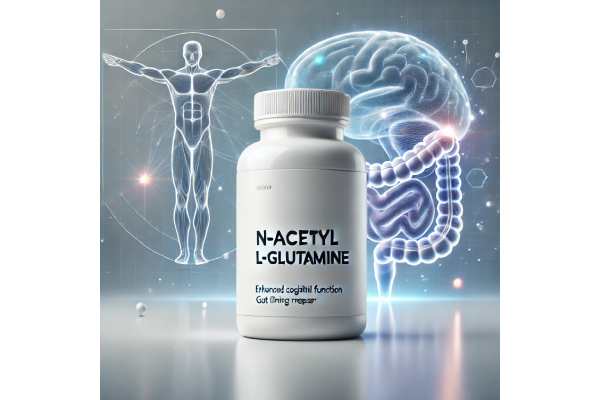
N-acetyl-L-glutamine (often shortened to NAG or called acetylglutamine or aceglutamide) is an acetylated form of the amino acid L-glutamine. It was developed to solve a practical problem: free glutamine is unstable in water, which limits its use in hospital nutrition formulas and ready-to-drink supplements. By adding an acetyl group, chemists created a more stable molecule that can be added to liquids while still acting as a glutamine source in the body.
Beyond nutrition support, N-acetyl-L-glutamine has been used in some countries as an injectable “brain-support” medicine and appears in animal studies as a neuroprotective agent. It is also sold globally as a sports and recovery supplement, although the quality of evidence in healthy athletes is much weaker than in clinical and animal settings.
This article walks through what N-acetyl-L-glutamine actually does, how it differs from standard glutamine, how it is used, realistic dosage ranges, safety considerations, and what current research really supports.
Quick Overview for N-acetyl-L-glutamine
- N-acetyl-L-glutamine is a more stable, water-soluble form of glutamine used in clinical nutrition, injections, and sports supplements.
- It acts mainly as a prodrug, breaking down to glutamine and related metabolites that support gut, immune, and nervous system function.
- Oral supplement products typically provide about 1–5 g per day, while clinical regimens use carefully controlled doses based on body weight and route.
- The compound has shown good tolerability in animals and small human studies, but long-term, high-dose use in healthy people is not well characterized.
- Individuals with serious liver or kidney disease, pregnant or breastfeeding people, and children should avoid self-supplementation and use N-acetyl-L-glutamine only under medical supervision.
Table of Contents
- What is N-acetyl-L-glutamine?
- What are the main benefits of N-acetyl-L-glutamine?
- How does N-acetyl-L-glutamine work in the body?
- How to take N-acetyl-L-glutamine and typical dosage
- Is N-acetyl-L-glutamine safe and who should avoid it?
- What does the research say about N-acetyl-L-glutamine?
What is N-acetyl-L-glutamine?
N-acetyl-L-glutamine is a derivative of the conditionally essential amino acid L-glutamine. Chemically, it is L-glutamine with an acetyl group attached to the nitrogen on the side chain. That small change shifts several important properties: it improves stability in water, alters acidity, and modifies how the molecule is transported and metabolized in the body.
You will see N-acetyl-L-glutamine referred to by several names:
- N-acetyl-L-glutamine
- Acetylglutamine
- Aceglutamide
- N-alpha-acetyl-L-glutamine
Unlike standard glutamine, which breaks down fairly quickly in aqueous solution and under heat, N-acetyl-L-glutamine can remain stable for months in mildly acidic to neutral liquids. This stability is why it has been studied as a glutamine source for parenteral (intravenous) nutrition and liquid enteral formulas.
In the body, N-acetyl-L-glutamine belongs to a family of N-acyl amino acids. It can be found as an endogenous metabolite in human biofluids, and it is also manufactured pharmaceutically and as a nutritional ingredient. After administration, it is ultimately converted back to glutamine and other metabolites by enzymes called acylases and amidases, so it acts primarily as a pro-form of glutamine.
In some countries, injectable preparations containing N-acetyl-L-glutamine are used in hospital settings, often together with other active compounds, to support recovery after brain injury, stroke, or hepatic encephalopathy. In sports nutrition, powdered N-acetyl-L-glutamine is marketed as a “water-stable glutamine” that can be mixed into drinks for gut, immune, and muscle support.
The key point is that N-acetyl-L-glutamine is not an entirely new nutrient; it is a modified, more stable delivery form of an amino acid that the body already uses heavily in metabolism and tissue repair.
What are the main benefits of N-acetyl-L-glutamine?
N-acetyl-L-glutamine’s potential benefits mostly come from two roles:
- A stable source of glutamine for nutrition and gut support.
- A neuroactive compound with promising, but still early-stage, data for brain and nerve health.
From a nutrition perspective, glutamine is one of the most abundant amino acids in the body and a major fuel for rapidly dividing cells, especially those in the intestinal lining and immune system. During illness, injury, or severe physical stress, the body’s glutamine demand rises and internal production might not keep up. Free glutamine, however, is difficult to incorporate into ready-to-use liquid products because it degrades. N-acetyl-L-glutamine solves that problem by remaining intact in solution and then releasing glutamine after administration.
Animal studies using N-acetyl-L-glutamine in enteral formulas have shown:
- Better maintenance of body weight during protein-energy malnutrition.
- Improved intestinal immune markers compared with formulas lacking glutamine or using some alternative protein sources.
- Good apparent digestibility, with efficient conversion to glutamine and related metabolites.
In parenteral nutrition research, N-acetyl-L-glutamine has supported:
- Adequate nitrogen balance and muscle glutamine levels.
- Appropriate plasma amino acid profiles, suggesting effective utilization as a glutamine precursor.
On the neurological side, injectable N-acetyl-L-glutamine has been used in some regions for conditions such as cerebral ischemia, brain trauma, and sequelae of stroke. In animal models, acetylglutamine has:
- Improved functional recovery after traumatic nerve injuries.
- Reduced markers of neuroinflammation and cell death.
- Helped preserve motor neuron survival and myelin integrity.
These findings suggest that N-acetyl-L-glutamine may exert neuroprotective and anti-inflammatory effects in the central nervous system, beyond its role as a basic nutrient. Whether these animal and regional clinical experiences translate into broad, evidence-based indications in humans will depend on future controlled trials.
For healthy users and athletes, the likely benefits are much more modest and mostly tied to what glutamine already does: supporting gut barrier function, general immune resilience, and possibly aiding recovery from intensive exercise or short-term overreaching. Direct, high-quality studies of N-acetyl-L-glutamine powder in sports or wellness contexts are still scarce, so claims in that space should be viewed as extrapolations rather than proven outcomes.
How does N-acetyl-L-glutamine work in the body?
N-acetyl-L-glutamine primarily functions as a prodrug or carrier form of glutamine, with some additional features linked to its specific metabolism in the brain.
When N-acetyl-L-glutamine is ingested enterally (for example, in a drink or tube-feeding formula), studies in animals show that:
- The compound is absorbed through the intestinal wall,
- It is largely hydrolyzed (deacetylated) within the intestinal mucosa,
- Very little intact N-acetyl-L-glutamine reaches the bloodstream,
- The glutamine generated behaves similarly to free glutamine delivered directly.
In other words, N-acetyl-L-glutamine serves as a stable transport form that survives in the liquid product but is largely converted back to glutamine before or during absorption. This allows formulas to deliver glutamine’s benefits while avoiding degradation and off-flavors that limit use of free glutamine in liquids.
When N-acetyl-L-glutamine is given intravenously, as in early human studies and current injection products, more of the intact molecule is present in circulation. Pharmacokinetic work in animals indicates that:
- N-acetyl-L-glutamine distributes into the brain as well as blood.
- It is gradually metabolized to glutamic acid and gamma-aminobutyric acid (GABA), both key neurotransmitters.
- It shows a moderate residence time in brain tissue before being cleared.
This opens a second layer of action. In the nervous system, the breakdown of N-acetyl-L-glutamine can:
- Provide glutamine as a precursor for both excitatory (glutamate) and inhibitory (GABA) neurotransmitters.
- Help buffer nitrogen and support energy metabolism in neurons and glial cells.
- Modulate inflammatory signaling and cell death pathways, as seen in rodent models of nerve injury and ischemia.
At the whole-body level, the glutamine released from N-acetyl-L-glutamine participates in the same key functions as dietary glutamine:
- Fuel for intestinal epithelial cells, helping maintain barrier integrity.
- Substrate for immune cells, particularly lymphocytes and macrophages.
- Carrier of nitrogen and carbon between tissues, important in recovery from catabolic stress.
Because N-acetyl-L-glutamine is more stable than glutamine in solution and can cross certain biological barriers efficiently, it is a versatile tool: nutrition scientists view it as a convenient glutamine source, while neurologists and pharmacologists are exploring its potential as a neuroprotective agent.
How to take N-acetyl-L-glutamine and typical dosage
There is no single “standard” dose of N-acetyl-L-glutamine, because amounts and regimens vary widely depending on the context:
- Intravenous hospital use
- Inclusion in enteral or parenteral nutrition formulas
- Over-the-counter sports and wellness supplements
It is important to separate these contexts because they differ greatly in strength, monitoring, and goals.
In early clinical work on parenteral nutrition, healthy volunteers received around 9 g of N-acetyl-L-glutamine intravenously over several hours as part of a balanced nutrition solution under close medical supervision. The compound was well tolerated, and metabolic measurements suggested efficient utilization as a glutamine source. In patients receiving postoperative or long-term parenteral nutrition, similar concepts have been explored, with doses adjusted for body weight and overall nitrogen needs.
In enteral nutrition research, animal models often use several grams per day per animal in liquid formulas to evaluate digestion, gut function, and immune parameters. These doses are typically scaled to mimic the glutamine content of human clinical formulas rather than to define human supplement amounts directly.
For oral supplements in healthy adults, product labels commonly recommend:
- Single servings around 1–2 g of N-acetyl-L-glutamine powder,
- Total daily intakes in the range of 1–5 g per day,
- Use once or twice daily, often around exercise or with a recovery shake.
These ranges are influenced more by practical formulation and analogy to glutamine dosing than by formal trials specifically testing N-acetyl-L-glutamine powders in healthy users.
If you are considering an oral N-acetyl-L-glutamine supplement and are otherwise healthy, a cautious approach would be:
- Start with about 500–1,000 mg once daily to check tolerance.
- If well tolerated and still desired, consider 2–4 g per day, split into two doses, for short-term use (for example, several weeks during periods of heavy training or recovery from illness).
- Avoid stacking high doses of N-acetyl-L-glutamine on top of high-dose free glutamine without professional guidance, to limit unnecessary nitrogen load.
Hospital-grade injectable N-acetyl-L-glutamine and fixed combinations (such as certain injections for cerebral or hepatic indications) should only be used under a physician’s direction. They are not equivalent to sports supplements and are designed for specific medical situations, with dosing based on body weight, route, and comorbidities.
Regardless of form, always consider:
- Total protein and amino acid intake from diet and other supplements.
- Kidney and liver function, which affect nitrogen handling.
- Other medications or medical conditions that may interact with nitrogen metabolism or brain neurotransmission.
When in doubt, particularly if you have chronic illness, discuss any new supplement or change in intake with a healthcare professional who understands your full clinical picture.
Is N-acetyl-L-glutamine safe and who should avoid it?
Available data suggest that N-acetyl-L-glutamine has a generally favorable safety profile at doses used in research and clinical nutrition. However, safety data are not as extensive as for basic nutrients like standard glutamine, especially for long-term, high-dose use in healthy people.
From animal toxicology and nutrition studies, N-acetyl-L-glutamine:
- Has been tolerated at relatively high doses in enteral and parenteral formulations without obvious organ toxicity.
- Supported normal growth and nitrogen balance in long-term feeding experiments.
- Did not cause major behavioral or neurological abnormalities at experimentally relevant doses.
In small human studies and clinical experience with injections:
- Intravenous acetylglutamine has been administered to healthy volunteers and postoperative patients without serious acute adverse events.
- Clinical reports describe good overall tolerability when used as part of comprehensive therapy for brain or liver-related conditions, though these patients are closely monitored and typically receive acetylglutamine for limited periods.
Potential side effects, when they occur, are usually mild and may include:
- Gastrointestinal discomfort, such as nausea, bloating, or loose stools.
- Headache or lightheadedness.
- Rare hypersensitivity reactions to the compound or excipients.
- Local reactions at injection sites for parenteral products.
Because N-acetyl-L-glutamine ultimately feeds into glutamine–glutamate–GABA pathways, extremely high doses might, in theory, influence brain excitability or ammonia handling, particularly in people with advanced liver disease or urea cycle problems. This has not been systematically studied for supplement-level doses, so caution is warranted.
People who should avoid unsupervised N-acetyl-L-glutamine use include:
- Individuals with significant liver disease or hepatic encephalopathy, unless therapy is clearly prescribed and monitored by a specialist.
- People with chronic kidney disease, due to altered nitrogen and amino acid handling.
- Those with a history of seizures or serious neurologic conditions, where shifts in glutamate/GABA balance could be problematic.
- Pregnant or breastfeeding people, because there are no robust safety data for this population.
- Children and adolescents, unless N-acetyl-L-glutamine is being used within a medically supervised nutrition or therapeutic plan.
Even for healthy adults, long-term use at the upper end of supplement dosing without breaks or supervision is not well studied. A reasonable strategy is to use the smallest effective dose, limit continuous use to defined periods (for example, an intensive training block or recovery phase), and reassess regularly.
If you experience persistent digestive upset, unusual fatigue, neurological symptoms, or any other concerning change after starting N-acetyl-L-glutamine, it is wise to stop the supplement and speak with a healthcare professional.
What does the research say about N-acetyl-L-glutamine?
Research on N-acetyl-L-glutamine spans several decades and can be organized into three main areas: parenteral and enteral nutrition, neuroprotection and brain-related therapies, and analytical or stability studies.
In nutrition support, early work investigated whether N-acetyl-L-glutamine could safely replace or complement free glutamine in clinical formulas. Experiments in rats and pigs showed that:
- N-acetyl-L-glutamine is biologically available as a glutamine source.
- It supports growth, nitrogen retention, and maintenance of plasma and muscle amino acid pools.
- It can partially prevent loss of body weight and preserve intestinal immune cell populations during protein-energy malnutrition.
These findings, together with the compound’s stability in solution, laid the groundwork for its use in specialized nutrition products and as part of intravenous regimens.
In enteral absorption studies, N-acetyl-L-glutamine was compared directly with free glutamine in animal models. Both were effectively digested and absorbed, but N-acetyl-L-glutamine was almost completely hydrolyzed during passage through the intestinal wall, with little intact molecule detected in blood. This supports the view that it functions as a delivery form, ultimately providing glutamine rather than acting as a fundamentally different nutrient.
On the neuroscience side, several lines of evidence have emerged:
- Pharmacokinetic experiments in rodents show that acetylglutamine reaches the brain, where it and its metabolites exhibit measurable concentrations over time.
- Animal models of nerve injury and cerebral ischemia have demonstrated improved motor recovery, reduced neuropathic pain, diminished neuroinflammation, and better survival of vulnerable neurons when acetylglutamine is given, often alongside standard therapies.
- Some regional clinical practice uses acetylglutamine-containing injections as part of treatment for stroke, brain trauma, or hepatic coma, based on a combination of mechanistic rationale, animal data, and accumulated bedside experience.
In addition, stability and analytical studies have defined how N-acetyl-L-glutamine behaves under different pH and temperature conditions, which degradation products form, and how best to measure it and its metabolites in biological fluids. These technical advances make it easier to design and interpret pharmacokinetic and pharmacodynamic research.
Despite all of this, several gaps remain:
- There are very few large, randomized, controlled human trials directly testing N-acetyl-L-glutamine in specific indications such as stroke recovery, chronic liver disease, or post-surgical outcomes.
- Data on chronic, high-dose oral supplementation in healthy people are minimal; most safety extrapolations come from shorter-term clinical use or analogies to glutamine.
- It is not yet clear which patient groups, if any, would derive unique benefits from N-acetyl-L-glutamine compared with other stable glutamine sources, such as dipeptides used in modern parenteral nutrition.
In summary, N-acetyl-L-glutamine is more than just a marketing twist on glutamine: it is a chemically and pharmacologically distinct way of delivering glutamine and related metabolites, with promising neuroprotective and nutrition-support applications. At the same time, the evidence is still evolving, and its role in general supplementation and performance enhancement remains to be clearly defined by well-designed human studies.
References
- A Study on Acetylglutamine Pharmacokinetics in Rat Blood and Brain Based on Liquid Chromatography-Tandem Mass Spectrometry and Microdialysis Technique 2020 (Preclinical pharmacokinetics)
- Acetylglutamine facilitates motor recovery and alleviates neuropathic pain after brachial plexus root avulsion in rats 2023 (Preclinical neuroprotection)
- N-acetyl-L-glutamine, a liquid-stable source of glutamine, partially prevents changes in body weight and on intestinal immunity induced by protein energy malnutrition in pigs 2007 (Animal nutrition study)
- Absorption of enterally administered N-acetyl-l-glutamine versus glutamine in pigs 2004 (Enteral absorption and digestibility)
- Utilization of intravenously administered N-acetyl-L-glutamine in humans 1989 (Human parenteral nutrition study)
Disclaimer
This article is for informational and educational purposes only and does not constitute medical advice, diagnosis, or treatment. N-acetyl-L-glutamine may be used as a specialized ingredient in clinical nutrition and pharmaceutical products, and its safety and effectiveness depend on individual health status, dose, route of administration, and concurrent therapies. Do not start, stop, or change any medication, injection, or supplement containing N-acetyl-L-glutamine without consulting a qualified healthcare professional who understands your medical history and current treatment plan. If you have existing liver, kidney, neurological, or metabolic conditions, or if you are pregnant, planning pregnancy, or breastfeeding, seek personalized medical guidance before using N-acetyl-L-glutamine in any form.
If you found this article useful, you are welcome to share it on Facebook, X (formerly Twitter), or any platform you prefer, and to follow our updates on social media. Your thoughtful sharing helps support our work and allows us to continue producing clear, evidence-informed content for readers, patients, and professionals.