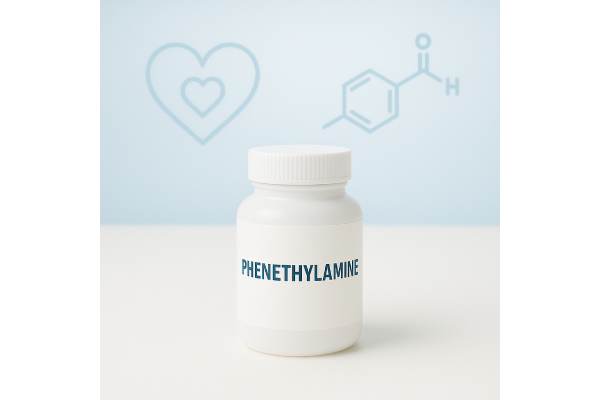
Phenethylamine (often shortened to PEA) is a naturally occurring “trace amine” found in the brain, made from the amino acid phenylalanine. It helps regulate classic neurotransmitters such as dopamine and norepinephrine, and for that reason it is sometimes called an “endogenous amphetamine.” Interest in phenethylamine as a supplement has grown among people looking for sharper focus, better mood, support for training, or an extra boost in motivation.
At the same time, phenethylamine is rapidly broken down by monoamine oxidase B (MAO-B), which means any effects from oral doses are usually very short lived. When combined with medications that inhibit MAO-B or other stimulants, blood levels can rise far beyond the natural range, which may increase the risk of side effects such as high blood pressure, palpitations, anxiety, or even more serious cardiovascular problems. This guide walks you through how phenethylamine works, what is known about possible benefits, typical dosage patterns, and the main safety concerns so you can have a grounded discussion with your health professional.
Essential Insights for Phenethylamine
- Phenethylamine (PEA) is a trace amine in the brain that can briefly enhance mood, alertness, and motivation.
- Human evidence for phenethylamine supplements is limited and mostly involves small studies or combinations with prescription medicines.
- Common supplemental intakes range roughly from 100–500 mg per day, often divided, while clinical protocols have used lower doses (around 10–60 mg per day) together with a monoamine oxidase B inhibitor under medical supervision.
- Phenethylamine can raise heart rate and blood pressure and may aggravate anxiety, bipolar disorder, or psychosis, especially when combined with other stimulants or antidepressants.
- People with cardiovascular disease, hypertension, arrhythmias, serious psychiatric disorders, or those who are pregnant, breastfeeding, or taking monoamine oxidase inhibitors or stimulant medications should generally avoid phenethylamine supplements unless specifically advised by a physician.
Table of Contents
- What is phenethylamine and how does it work?
- What are the main benefits people seek from phenethylamine?
- How to take phenethylamine safely in daily life?
- Phenethylamine dosage: how much do people usually use?
- Side effects, risks, and who should avoid phenethylamine
- What does the science really say about phenethylamine supplements?
What is phenethylamine and how does it work?
Phenethylamine (beta-phenylethylamine or 2-phenylethylamine) is a small molecule built from a benzene ring attached to a two-carbon chain ending in an amino group. In the body, it is produced mainly by decarboxylation of the amino acid L-phenylalanine. It occurs at very low concentrations in the brain and other tissues, in the nanomolar range, which is why it is called a “trace amine.”
Phenethylamine is not a classic neurotransmitter like dopamine or serotonin, but it modulates how those systems behave. One of its main targets is trace amine associated receptor 1 (TAAR1), a G protein coupled receptor found in monoamine neurons and other cells. When phenethylamine activates TAAR1, it increases intracellular cyclic AMP and influences how dopamine, norepinephrine, and serotonin are released and reabsorbed at synapses. Experimental work suggests that phenethylamine helps fine tune monoaminergic tone rather than acting as the primary chemical messenger.
Phenethylamine is also a substrate for monoamine transporters and can promote the release of stored monoamines at higher concentrations. In animal models, elevated phenethylamine produces behavioural effects similar to amphetamine, including increased locomotion and stereotyped behaviours, which is why it is sometimes described as an “endogenous amphetamine.”
However, there is one crucial difference between naturally occurring phenethylamine and many synthetic stimulants: phenethylamine is cleared extremely fast. It is metabolised primarily by monoamine oxidase B (MAO-B), with a plasma half life measured in minutes. When you take phenethylamine by mouth, a large fraction is broken down in the gut and liver before it can reach the brain. That is why standalone phenethylamine supplements often produce very brief subjective effects, if any, and why some clinical protocols combined phenethylamine with a selective MAO-B inhibitor to prolong its activity.
Because phenethylamine can influence blood vessel tone and heart rate through its sympathomimetic actions, it is also considered a stimulant at higher doses. This dual identity – neuromodulator at trace levels and stimulant at higher levels – sits at the core of both its potential benefits and its safety concerns.
What are the main benefits people seek from phenethylamine?
People are typically interested in phenethylamine for its possible effects on mood, motivation, focus, and physical performance. Most of these expectations come from its role in monoamine signalling and from early clinical observations, rather than from large, modern randomised trials.
The most discussed potential benefits include:
- Mood and motivation support
Observational work has linked lower levels of phenethylamine metabolites to depressive states and higher levels to more activated mood patterns. Small clinical series, usually combining oral phenethylamine with a monoamine oxidase B inhibitor, have reported rapid improvements in depressive symptoms in some patients. These reports, however, involve selected individuals under close psychiatric supervision rather than the general population using over the counter supplements. - Perceived energy and mental focus
Because phenethylamine can increase dopaminergic and noradrenergic activity, some users report short lived boosts in alertness, concentration, and drive. In practice, these effects often come on quickly and fade within an hour due to rapid metabolism. The experience may resemble a mild stimulant surge rather than a smooth, sustained focus. - Exercise performance and training intensity
Supplement formulas that include phenethylamine, particularly pre-workouts, market it as a way to enhance workout intensity, mental drive, and sometimes thermogenesis. Mechanistically, phenethylamine might increase sympathetic nervous system activity and catecholamine release, which can elevate heart rate and change perceived exertion. However, controlled human data specifically examining phenethylamine alone for athletic performance are lacking. - Weight loss and appetite control
Some weight loss supplements include phenethylamine on the theory that stimulant-like effects on catecholamines may reduce appetite or increase energy expenditure. Evidence for meaningful, sustained weight loss from phenethylamine itself is limited and complicated by the fact that products almost always combine it with caffeine, other phenethylamines, or additional stimulants.
Across all these areas it is important to separate plausible mechanisms from proven outcomes. The biological rationale for phenethylamine’s influence on mood and arousal is fairly strong, and animal studies support antidepressant-like and pro-motivation effects when levels are experimentally increased. The human evidence, by contrast, is small, older, and often confounded by other medications. There is not yet robust, long term data showing that phenethylamine supplements, taken on their own, reliably improve depression, focus, performance, or weight control in a durable and safe way.
How to take phenethylamine safely in daily life?
If you and your clinician decide to experiment with phenethylamine, it is essential to approach it deliberately rather than simply copying aggressive supplement label suggestions. Phenethylamine is not a basic vitamin; it is a bioactive neuromodulator and stimulant, especially when combined with other compounds.
Common supplement forms
Most products use phenethylamine hydrochloride (PEA HCl), a crystalline salt with better stability and solubility than the free base. It is typically sold in:
- Single ingredient capsules or powders
- Pre-workout blends with caffeine, yohimbine, or other stimulants
- Weight loss formulations combined with herbal extracts and sympathomimetic compounds
Labels may list it as phenethylamine, beta phenylethylamine, 2-phenylethylamine, or simply PEA.
Timing and administration
Because phenethylamine is broken down quickly, timing is usually geared toward situations where a short, sharp effect is acceptable:
- Taken 20–30 minutes before a planned workout, important task, or social event
- Usually on an empty stomach or with a light snack to speed absorption
- Avoiding late evening doses to reduce the risk of insomnia or sleep fragmentation
Many people find that if phenethylamine has any subjective effect for them, it tends to be felt within 15–30 minutes and largely dissipates within one to two hours.
Combinations and “stacks”
From a safety standpoint, the most important principle is to avoid stacking phenethylamine with other agents that raise catecholamines or serotonin, unless this is being done under specialist medical guidance. That includes:
- Prescription monoamine oxidase inhibitors (MAOIs), including selective MAO-B inhibitors
- High dose caffeine and additional stimulant alkaloids
- Decongestants such as pseudoephedrine or phenylephrine
- Recreational stimulants or new psychoactive phenethylamine derivatives
Some pre-workout formulas combine several of these categories in one product. Even if each ingredient is individually legal and commonly used, their combined sympathetic load may be substantial, especially in people with undiagnosed cardiovascular risk.
Practical safety steps
If you trial phenethylamine, work with your healthcare provider and:
- Start with the lowest available capsule size rather than a large powder scoop.
- Do not use it every day at the beginning; try spaced, single test doses to understand how you respond.
- Monitor your resting heart rate and blood pressure for several hours after first doses and after any change in dose.
- Stop use immediately and seek medical advice if you notice chest pain, marked palpitations, severe anxiety, shortness of breath, intense headache, or neurological symptoms.
Given the limited clinical data and the potential for interaction with many common medications, phenethylamine is better viewed as an experimental adjunct used under professional supervision than as an everyday wellness supplement.
Phenethylamine dosage: how much do people usually use?
There is no universally accepted “standard dose” of phenethylamine, and this is one of the biggest gaps in the evidence base. What we know comes from three main sources: small clinical protocols in depression, typical supplement label ranges, and anecdotal user patterns.
Doses used in clinical settings
Older clinical work in depression used relatively modest amounts of phenethylamine, often in combination with a selective monoamine oxidase B inhibitor such as selegiline. In those settings:
- Phenethylamine doses around 10–60 mg per day were given orally
- They were split into one or more doses alongside the prescribed MAO-B inhibitor
- Treatment was supervised by psychiatrists, with blood pressure and mood monitored regularly
These regimens are fundamentally different from self directed supplement use. They are lower in phenethylamine dose, combined with a prescription drug, and used in people with diagnosed depression, not healthy individuals seeking focus or performance.
Doses found in supplements
Over the counter phenethylamine products typically recommend much higher amounts, for example:
- 100–300 mg per serving as a standalone phenethylamine capsule
- 150–500 mg total phenethylamine per day if following the upper end of label directions
- Sometimes more when people combine multiple products that all contain phenethylamine or related stimulants
These ranges are based more on marketing, pilot experience, and subjective effects than on controlled clinical trials. They may produce noticeable stimulation in some users, especially when taken with caffeine, but also increase the likelihood of adverse cardiovascular or psychiatric reactions.
A cautious, stepwise approach
If, after consulting your clinician, you still plan to trial phenethylamine:
- Consider starting at 50–100 mg once to assess sensitivity, even if the label suggests more.
- If tolerated, some individuals cautiously move toward 100–200 mg before a workout or demanding task, avoiding repeat doses the same day.
- Staying below 300 mg per day, and not using phenethylamine daily, is a conservative ceiling many practitioners recommend in the absence of better long term data.
People with lower body weight, higher baseline anxiety, or a history of sensitivity to stimulants may need to stay well below even these conservative ranges or avoid phenethylamine entirely.
Why “more” is not better
Because phenethylamine acts through monoamine systems that are already tightly regulated, simply pushing levels higher does not guarantee more benefit. Instead, it can:
- Overstimulate the sympathetic nervous system, raising blood pressure and heart rate
- Increase anxiety, irritability, or agitation
- Interact unpredictably with antidepressants, ADHD medications, and other psychoactive drugs
Until more rigorous dose finding and safety studies are carried out, any phenethylamine dosage should be considered provisional and handled with the same caution you would apply to a prescription stimulant.
Side effects, risks, and who should avoid phenethylamine
Phenethylamine influences both the brain and the cardiovascular system, so its safety profile spans psychological, neurological, and heart related effects. The risk increases with higher doses, prolonged use, combination with other stimulants, and in people with underlying vulnerabilities.
Commonly reported side effects
At low to moderate supplemental doses, people may experience:
- Increased heart rate and stronger heartbeat
- Mild elevation in blood pressure
- Jitteriness, restlessness, or internal “buzzing”
- Anxiety, unease, or irritability
- Headache, flushing, or a sensation of warmth
- Nausea, stomach discomfort, or reduced appetite
- Difficulty falling asleep if taken later in the day
These effects often mirror a short lived stimulant response and typically fade as phenethylamine is rapidly metabolised. However, they are a signal that the sympathetic nervous system is being activated.
More serious or concerning reactions
When phenethylamine is taken at higher doses, used repeatedly in one day, or combined with other stimulants or monoamine oxidase inhibitors, more serious problems become possible, including:
- Significant hypertension (dangerously high blood pressure)
- Palpitations, irregular heart rhythm, or chest pain
- Severe anxiety attacks, panic, or agitation
- Marked insomnia with next day fatigue and mood changes
- Neurological symptoms such as tremor, confusion, or, rarely, seizures
- Exacerbation of mania, hypomania, or psychosis in susceptible individuals
Regulatory and analytical investigations have highlighted phenethylamine in some weight loss and performance supplements as a compound with amphetamine like effects and potential cardiovascular toxicity, especially when combined with caffeine and other stimulants. This is one reason it is prohibited by some anti doping agencies in sport.
Who should avoid phenethylamine supplements?
Because of its mechanism of action and interaction profile, phenethylamine should generally be avoided by:
- People with known cardiovascular disease, uncontrolled hypertension, arrhythmias, structural heart problems, or previous heart attack or stroke
- Anyone with bipolar disorder, schizoaffective disorder, schizophrenia, or a history of psychosis, unless a psychiatrist explicitly supervises its use
- Individuals taking monoamine oxidase inhibitors, including MAO-B selective agents, or other potent antidepressants and psychoactive medications
- People already using stimulant medications (for example, for ADHD or narcolepsy), strong decongestants, or other sympathomimetic supplements
- Pregnant or breastfeeding women, due to lack of safety data and potential risks to the fetus or infant
- Children and adolescents, for whom the risk benefit balance is particularly unfavourable
If you have liver or kidney disease, are scheduled for surgery, or have a complex medication regimen, it is especially important to discuss phenethylamine with your healthcare providers before using it. Even a “natural” molecule can produce clinically meaningful interactions in these contexts.
The safest course for many people is to focus on better studied strategies for mood, focus, and performance – such as sleep optimisation, structured exercise, psychotherapy, and well researched medications or supplements – and reserve phenethylamine for carefully supervised, short term trials when there is a strong rationale.
What does the science really say about phenethylamine supplements?
From a research perspective, phenethylamine sits in an interesting position: it is well characterised as an endogenous neuromodulator and experimental tool, but surprisingly under studied as a modern dietary supplement.
What is well established
Several lines of evidence are quite solid:
- Phenethylamine is present in the mammalian brain at low concentrations and turns over rapidly.
- It is synthesised from phenylalanine and degraded primarily by monoamine oxidase B.
- It activates trace amine associated receptor 1 (TAAR1) and, at higher levels, interacts with monoamine transporters, influencing dopamine, norepinephrine, and serotonin systems.
- Trace amine signalling, including phenethylamine, modulates locomotion, reward, mood related behaviours, and responses to psychostimulants in animal models.
There is also a substantial medicinal chemistry literature on phenethylamine derivatives used as decongestants, antidepressants, appetite suppressants, and psychedelics, which builds on this basic scaffold but does not directly validate simple phenethylamine supplements.
Evidence for mood and depression
Small clinical series and open label observations from psychiatric settings suggest that raising phenethylamine levels, usually by combining oral phenethylamine or L-phenylalanine with a monoamine oxidase B inhibitor, can produce rapid antidepressant effects in some patients. Reports describe mood elevation and increased energy, along with changes in phenethylamine metabolites in biological fluids.
However:
- These data come from small, highly selected samples.
- Many studies lacked blinded, placebo controlled designs.
- The protocols involved prescription MAO-B inhibitors, not phenethylamine alone.
Modern animal work has reinforced the idea that phenethylamine can exert antidepressant like effects by modulating hippocampal function and neurotrophic signalling, but this still needs translation into robust human trials.
Evidence for supplements in the real world
In the supplement marketplace, phenethylamine appears in pre-workouts and weight loss products. Analytical surveys have found that some weight loss formulations contain phenethylamine at levels sufficient to produce pharmacological effects and that it is still present despite being prohibited in certain regulatory and anti doping frameworks. Safety concerns include nephrotoxicity, vasoconstriction, elevated blood pressure, and myocardial ischemia, particularly when phenethylamine is combined with other stimulants such as caffeine.
On the other hand, mainstream medical reference sources classify oral phenethylamine as possibly unsafe at supplemental doses, noting that it can cause rapid heart rate, anxiety, and agitation and that it may precipitate mania or worsen psychosis in vulnerable individuals. They also highlight potential interactions with antidepressants, dextromethorphan, and other serotonergic medications, which can raise the risk of serotonin related toxicity.
Bottom line
- Phenethylamine clearly plays a real role in brain chemistry and may contribute to mood regulation.
- Most of the promising mood data involve combinations with prescription monoamine oxidase inhibitors under clinical supervision, not standalone supplements.
- Long term, large scale, placebo controlled trials of phenethylamine as a supplement for depression, attention, weight loss, or performance are lacking.
- Safety concerns, particularly around cardiovascular and psychiatric effects and drug interactions, are credible and supported by pharmacology and post market surveillance.
For now, phenethylamine supplements should be regarded as experimental. If you are considering them for mood, focus, or performance, it is wise to prioritise better studied interventions and to involve a knowledgeable healthcare professional in any trial use.
References
- Trace Amines and the Trace Amine-Associated Receptor 1: Pharmacology, Neurochemistry, and Clinical Implications 2016 (Review)
- Phenylethylamine modulation of affect: therapeutic and diagnostic implications 1995 (Clinical report)
- 2-Phenylethylamine (PEA) Ameliorates Corticosterone-Induced Depression-Like Phenotype via the BDNF/TrkB/CREB Signaling Pathway 2020 (Animal study)
- 2-Phenethylamines in Medicinal Chemistry: A Review 2023 (Review)
- Monitoring of the prohibited 2-phenethylamine in dietary supplements using a t-Butyl calix[8]arene/Ag/CuO composite-based potentiometric sensor 2024 (Analytical study)
Medical Disclaimer
The information in this article is intended for general educational purposes only and does not constitute medical advice, diagnosis, or treatment. Phenethylamine can interact with medications and underlying health conditions in complex ways, and its use as a supplement remains incompletely studied. Always speak with a qualified healthcare professional who knows your medical history before starting, stopping, or changing any supplement, especially those that affect the nervous system or cardiovascular system. Never disregard professional medical advice or delay seeking it because of something you have read here.
If you found this guide helpful, you are welcome to share it with others on Facebook, X (formerly Twitter), or any social platform you use, and to follow our future work on social media. Your thoughtful sharing helps support our team in continuing to create careful, evidence based articles like this one.