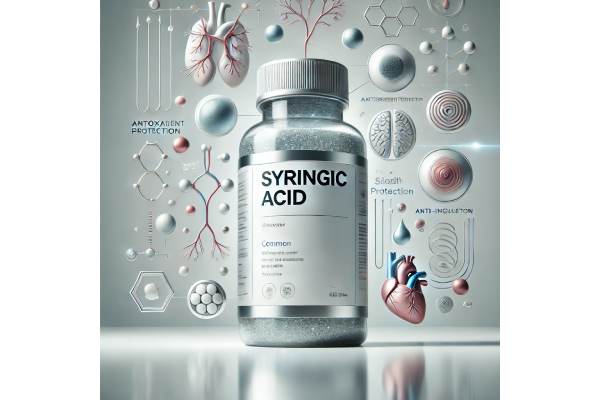
Syringic acid is a naturally occurring phenolic acid that appears in many plant-based foods and traditional herbal preparations. It belongs to the hydroxybenzoic acid family and is formed both directly in plants and as a breakdown product of more complex polyphenols in the gut. Because it shows antioxidant, anti-inflammatory, and metabolic effects in experimental models, syringic acid is increasingly discussed as a potential nutraceutical for metabolic syndrome, cardiovascular health, and organ protection.
At the same time, syringic acid is not an approved drug, and human clinical trials are still limited. Most of the information comes from studies in cells and animals, plus a small number of safety evaluations. This means it should be treated as an interesting complementary compound, not a stand-alone treatment. In this guide, you will learn what syringic acid is, how it may work, what benefits researchers are exploring, realistic dosage ideas, possible side effects, and how to approach it cautiously with your healthcare professional.
Quick Summary
- Syringic acid is a plant-derived phenolic compound with antioxidant and anti-inflammatory actions that may support metabolic and cardiovascular health.
- Experimental work suggests potential benefits for blood sugar control, organ protection, vascular function, and wound healing, mainly in animal models.
- Many supplements provide a total daily dose in the approximate range of 50–200 mg, but no standard evidence-based human dosage has been defined.
- People who are pregnant or breastfeeding, have significant cardiovascular or kidney disease, or take blood sugar, blood pressure, or anticoagulant medications should avoid syringic acid supplements without medical approval.
- Syringic acid should complement, not replace, lifestyle measures and prescribed therapies for chronic conditions.
Table of Contents
- What is syringic acid and how it works
- Syringic acid benefits for health
- Dietary sources and supplement forms
- Syringic acid dosage and how to take it
- Side effects interactions and who should avoid it
- Research summary and practical takeaways
What is syringic acid and how it works
Syringic acid (4-hydroxy-3,5-dimethoxybenzoic acid) is a small organic acid that belongs to the hydroxybenzoic acid subgroup of phenolic compounds. It is present in many fruits, vegetables, grains, spices, and medicinal plants, as well as in beverages such as coffee, some teas, and red wine. In addition, gut bacteria can generate syringic acid when they break down larger polyphenols, so its levels in the body partly reflect overall polyphenol intake and microbiome activity.
From a biochemical standpoint, syringic acid is considered pleiotropic, meaning it can influence several systems at once. In experimental models, it has been shown to:
- Neutralise reactive oxygen species, limiting oxidative damage to cell membranes, proteins, and DNA.
- Increase the activity or expression of internal antioxidant enzymes, such as superoxide dismutase, catalase, and glutathione peroxidase.
- Interfere with key inflammatory pathways, including NF-κB, and reduce pro-inflammatory cytokines like TNF-α and IL-6.
- Influence enzymes and signalling mechanisms involved in glucose handling and lipid metabolism.
Because oxidative stress and chronic low-grade inflammation are central to many “civilization diseases” such as type 2 diabetes, cardiovascular disease, and fatty liver disease, these actions make syringic acid an attractive candidate for further study.
It is important to remember, though, that most of these mechanisms have been demonstrated in cells and animals at doses that may not be identical to what humans obtain from diet or modest supplementation. In humans, syringic acid will undergo absorption, metabolism (including conversion to other metabolites), and excretion, all of which shape its real-world activity. Until more human pharmacokinetic and dose–response data are available, we should interpret mechanistic findings as promising but not definitive.
Syringic acid benefits for health
The potential benefits of syringic acid can be grouped into several main domains. These are best described as emerging or experimental benefits, since most supporting data come from non-human studies.
Metabolic health and blood sugar
In diabetic animal models, syringic acid has repeatedly been shown to:
- Lower fasting blood glucose and improve glucose tolerance.
- Improve insulin sensitivity in tissues such as the liver and skeletal muscle.
- Decrease the formation of advanced glycation end products (AGEs), which contribute to vascular and organ damage.
These actions suggest that syringic acid might help buffer some of the metabolic stress of high blood sugar and insulin resistance. It is being explored as a potential adjunct to lifestyle changes and medications in the management of metabolic syndrome and early-stage diabetes, though human clinical evidence is still limited.
Cardiovascular and organ protection
Chronic high blood sugar and oxidative stress damage not only the pancreas but also the heart, liver, kidneys, and nervous system. In rodent models, syringic acid:
- Reduces oxidative markers and inflammatory signals in these organs.
- Limits structural changes such as fibrosis in the heart and liver.
- Helps preserve kidney function in models of diabetic nephropathy.
- Appears to support normal nerve function, reducing neuropathic changes in some experiments.
Some research also points to blood pressure-lowering effects in animals with impaired nitric oxide signalling, suggesting that syringic acid may support vascular function and endothelial health.
Neuroprotective and vascular effects
In models of brain and spinal cord ischemia, syringic acid has demonstrated:
- Reduced neuronal cell death after restricted blood supply and reperfusion.
- Better maintenance of mitochondrial function.
- Lower levels of pro-inflammatory molecules within neural tissue.
In vascular endothelium (the inner lining of blood vessels), syringic acid may help maintain nitric oxide availability and reduce oxidative modifications that contribute to atherosclerosis. These findings are encouraging but need confirmation in human studies before syringic acid can be recommended for specific neurological or vascular conditions.
Other emerging actions
Additional animal and cell studies have explored syringic acid in:
- Diabetic wound healing, where it may accelerate tissue repair and reduce infection-related complications.
- Adipogenesis and fat storage, with some evidence that it may help limit fat accumulation under high-calorie conditions.
- Cancer biology, where syringic acid can inhibit the growth of certain cancer cell lines in vitro, often at higher concentrations than would be achieved through standard supplementation.
Altogether, the evidence paints syringic acid as a broad-acting support compound rather than a disease-specific cure. It may be particularly relevant in settings where oxidative stress, chronic inflammation, and metabolic disruption cluster together.
Dietary sources and supplement forms
For most people, syringic acid exposure comes from everyday foods and beverages rather than from capsules. Adopting a plant-rich dietary pattern is the simplest way to increase intake.
Common food sources of syringic acid include:
- Dark-coloured berries such as blueberries, blackberries, and certain currants.
- Grapes and grape products, including red wine.
- Coffee and some herbal or black teas.
- Olives, olive oil, and specific olive-based foods.
- Whole grains and bran portions of cereals like wheat and oats.
- A range of culinary and medicinal herbs used in traditional practices around the world.
Because syringic acid levels depend on plant species, ripeness, growing conditions, processing, and storage, it is difficult to give an exact daily intake figure for the average person. Nonetheless, diets high in fruits, vegetables, whole grains, and plant-based beverages usually provide a steady background amount.
Supplement forms
Syringic acid is also sold as a dietary supplement. It may appear as:
- A purified, stand-alone syringic acid ingredient in capsules or tablets.
- A named component within a polyphenol blend that includes ferulic acid, caffeic acid, or resveratrol.
- One of many active constituents in complex plant extracts or multi-herb formulas.
Product labels usually state the total amount of syringic acid per serving when it is a main selling point. Common daily amounts fall in a rough range of 50–200 mg for adults, although some formulas may provide more or less.
When evaluating a syringic acid supplement, consider:
- Standardisation: Does the label clearly state the syringic acid content and not only the plant extract weight?
- Quality: Is the product third-party tested for purity and contaminants?
- Simplicity: Are there many other active compounds or stimulants included that might complicate interpretation of effects or increase interaction risks?
- Regulatory status: In most regions, syringic acid is regulated as a dietary supplement, which means quality and claims may vary between brands.
For many people, prioritising syringic acid through food and, where appropriate, through traditional herbal preparations may be more prudent than relying heavily on high-dose, single-ingredient syringic acid supplements.
Syringic acid dosage and how to take it
No official or universally accepted dosage for syringic acid exists yet. Regulatory bodies have not set a recommended daily intake, and well-controlled human clinical trials defining optimal doses are still scarce. Most of what we know comes from animal research, small safety studies, and the dose ranges commonly used in commercial products.
Experimental and preclinical doses
In laboratory and animal studies, syringic acid is typically given:
- At doses measured in mg per kg of body weight.
- For durations ranging from several days to several weeks, depending on the model.
- Often at levels that, when scaled directly to human body weight, would be much higher than the amounts found in typical supplements.
These high experimental doses are useful for detecting effects and mechanisms but do not automatically translate into safe or necessary amounts for humans.
Practical supplement ranges
Commercial syringic acid supplements commonly provide total daily amounts in the approximate range of 50–200 mg for adults, sometimes divided into one to three servings per day. Polyphenol blends may supply similar levels of syringic acid while emphasising the combined contribution of multiple phenolic compounds.
A cautious, practical approach if you and your clinician decide to trial syringic acid could include:
- Starting at the low end of the label dose. Begin with the smallest recommended daily amount, especially if you have chronic health conditions.
- Taking it with food. Consuming syringic acid with meals may improve tolerance and align with how the body usually encounters it (alongside other nutrients).
- Avoiding dose stacking. Do not combine several syringic acid-containing products unless your healthcare professional confirms that the total daily intake remains reasonable.
- Limiting trial duration. Consider a defined evaluation period of four to eight weeks, with regular check-ins on how you feel and any relevant lab markers, instead of open-ended use.
Children, pregnant or breastfeeding individuals, and people on complex medication regimens should not use syringic acid supplements unless a clinician with knowledge of their case explicitly recommends and supervises it.
Remember that syringic acid is not a required nutrient; there is no obligation to take it long term. Food-based intake within a diverse, plant-focused diet remains the safest foundation.
Side effects interactions and who should avoid it
Short-term studies in animals suggest that syringic acid is reasonably well tolerated when given orally within defined dose ranges. A subacute oral toxicity assessment in rats, for example, found no major organ damage or severe clinical toxicity at the tested doses, although some biochemical changes emerged at higher exposures. This provides preliminary reassurance but does not prove long-term safety in humans.
Possible side effects
Because systematic human data are limited, side effects must be inferred from mechanisms, animal work, and general experience with phenolic supplements. Potential effects may include:
- Mild digestive upset, such as nausea, bloating, or looser stools, particularly when starting or increasing the dose.
- Headache or lightheadedness in sensitive individuals.
- Small changes in blood sugar or blood pressure, especially in people already taking medications that target these systems.
- Rare allergic reactions in people sensitive to specific plant sources used in the supplement.
If you notice new or worsening symptoms after starting a syringic acid product, stop taking it and discuss what you experienced with your healthcare professional.
Potential interactions
Because syringic acid can influence oxidative stress, inflammation, and metabolism, there is a theoretical risk of interaction with several common drug classes:
- Antidiabetic medications. If syringic acid further improves insulin sensitivity or glucose disposal, it may potentiate blood sugar-lowering effects and, in rare cases, increase the risk of hypoglycaemia in people on strong medications.
- Antihypertensives and cardiovascular drugs. Any compound that alters vascular tone or endothelial function could, in theory, interact with blood pressure or heart medications.
- Anticoagulants and antiplatelet drugs. Some phenolic compounds affect platelet activity or clotting pathways; until more is known, caution is wise with blood thinners.
- Other antioxidant or polyphenol supplements. Combining many high-dose polyphenols may place additional demands on liver metabolism or skew redox signalling in ways that are not fully understood.
For these reasons, it is important to tell your clinician about all supplements you use and to treat syringic acid as a pharmacologically active compound rather than a neutral “plant extract.”
Who should avoid syringic acid supplements
The following groups should generally avoid concentrated syringic acid supplements unless a specialist clearly advises otherwise:
- Pregnant or breastfeeding individuals.
- Children and adolescents.
- People with advanced cardiovascular, kidney, or liver disease.
- Individuals taking anticoagulants or multiple medications for chronic conditions.
- Anyone with a known allergy to plant sources commonly used to produce syringic acid extracts.
For these populations, obtaining syringic acid through normal dietary patterns is usually safer and better supported by broader nutrition research.
Research summary and practical takeaways
In recent years, researchers have compiled a growing library of studies on syringic acid, and several high-quality reviews now summarise this work. These reviews generally agree on a few key points.
First, syringic acid is consistently active in laboratory and animal models of oxidative stress and inflammation. Across many tissues, it reduces oxidative damage, boosts antioxidant defences, and dampens inflammatory signalling. These effects, in turn, correlate with improvements in markers of organ health in models of chronic hyperglycaemia, high-fat diets, and chemically induced damage.
Second, syringic acid appears to influence multiple aspects of metabolic health. In preclinical models, it helps control blood sugar, improves insulin sensitivity, enhances lipid profiles, and mitigates tissue changes typical of diabetic complications. This has led to proposals that syringic acid might serve as a supportive agent for metabolic syndrome and diabetes prevention, especially when combined with diet and exercise.
Third, formal safety data, though still limited, do not indicate severe toxicity at doses near those typically used in supplements, at least in the short term. However, these studies are not yet sufficient to define safe upper limits for long-term human use or for vulnerable groups.
At the same time, major gaps remain:
- Well-designed human clinical trials are still scarce. We lack clear evidence on real-world outcomes such as reduced cardiovascular events, improved diabetic control beyond standard care, or slowed progression of fatty liver disease.
- Optimal dosing, timing, and formulation (for example, purified syringic acid versus whole plant extracts) have not been established.
- Long-term effects, including subtle interactions with medications and chronic disease states, are not well characterised.
Given this mixture of promise and uncertainty, a balanced, practical stance is appropriate:
- Emphasise a diet rich in plant foods naturally containing syringic acid and other phenolic compounds.
- Treat syringic acid supplements as optional, experimental tools that should be used thoughtfully and with professional guidance.
- Focus on established lifestyle foundations—nutrition, physical activity, sleep, stress management—because they deliver much larger and better-proven benefits than any single nutraceutical.
- Be cautious about any marketing claims that portray syringic acid as a cure for diabetes, heart disease, or other chronic conditions; the evidence does not yet support such statements.
Used within these boundaries, syringic acid can be considered an interesting part of the broader conversation about plant-based compounds and metabolic health, rather than a magic bullet.
References
- Nutraceutical Properties of Syringic Acid in Civilization Diseases—Review 2024 (Systematic Review)
- Syringic acid, a promising natural compound for the prevention and management of metabolic syndrome: A systematic review 2025 (Systematic Review)
- Safety evaluation of syringic acid: subacute oral toxicity studies in Wistar rats 2019 (Toxicology Study)
- Syringic Acid Ameliorates Cardiac, Hepatic, Renal and Neuronal Damage Induced by Chronic Hyperglycaemia in Wistar Rats: A Behavioural, Biochemical and Histological Analysis 2022 (Preclinical Study)
Disclaimer
The information in this article is intended for general educational purposes and does not replace personalised medical advice, diagnosis, or treatment. Syringic acid is not approved as a medicine for any disease, and most data discussed here originate from laboratory and animal research, not large human trials. You should not start, stop, or adjust any medication or supplement, including syringic acid, without consulting a qualified healthcare professional who knows your medical history and current treatment plan. If you experience unwanted symptoms after beginning any new supplement, stop using it and seek medical guidance.
If you found this guide useful, please consider sharing it on Facebook, X (formerly Twitter), or any other platform you prefer, and follow us on social media. Your support in sharing our work helps our team continue to create and update high-quality, evidence-informed health content.