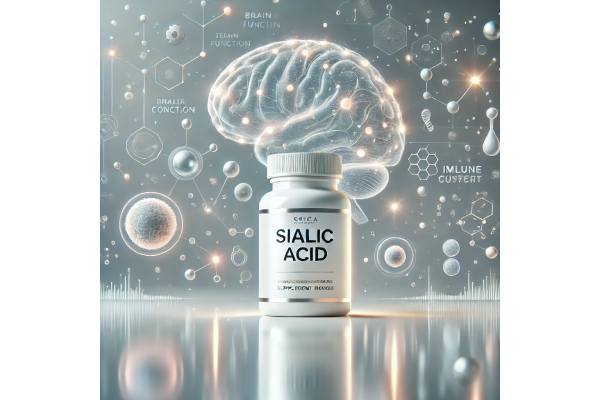
Sialic acid is not a typical vitamin or mineral, but a family of negatively charged sugars that sit at the very edges of many cell surfaces in the body. They help cells “recognize” each other, protect tissues, and fine-tune immune and nervous system signaling. One form in particular, N-acetylneuraminic acid (Neu5Ac), is the main sialic acid humans make and use. It is especially concentrated in the brain, where it contributes to cell membranes, synapses, and the insulation around nerve fibers.
Because of its structural and regulatory roles, there is growing interest in sialic acid as a supplement—on its own, in sialylated milk oligosaccharides, and in specialized products for infant nutrition, metabolic disorders, and brain health. Early research suggests potential benefits for neurodevelopment, immune balance, and metabolic health, though evidence in healthy adults is still limited and emerging. At the same time, regulators have evaluated synthetic Neu5Ac for safety in foods and formulas, and researchers continue to explore how much extra sialic acid is useful, and for whom.
Key Insights on Sialic Acid
- Sialic acid (mainly Neu5Ac) is a structural sugar that supports brain development, cell communication, and healthy immune function.
- Research suggests possible benefits for infant neurodevelopment, stress resilience, and metabolic health, but evidence in healthy adults remains preliminary.
- Adult supplement products commonly provide about 100–500 mg Neu5Ac per day; higher intakes should only be used under medical supervision.
- People who are pregnant or breastfeeding, have active cancer, serious kidney or liver disease, or rare sialic acid metabolism disorders should not self-prescribe sialic acid supplements.
Table of Contents
- What is sialic acid and why it matters
- How sialic acid may benefit brain and body
- Sources of sialic acid in food and supplements
- How much sialic acid per day is reasonable
- Sialic acid side effects and safety profile
- What the research on sialic acid actually shows
What is sialic acid and why it matters
Sialic acids are a group of more than 50 related nine-carbon sugars that usually sit at the outer ends of glycoproteins and glycolipids on cell surfaces and in secreted fluids. In humans, the dominant form is N-acetylneuraminic acid (Neu5Ac). Another form, N-glycolylneuraminic acid (Neu5Gc), is found mainly in other mammals and can enter the human body from foods such as beef, lamb, and pork. Humans no longer synthesize Neu5Gc, which may be one reason it sometimes triggers immune responses.
Sialic acid residues carry a negative charge. When many of them line a cell membrane, they create a kind of electrostatic “coat” that affects how cells stick to each other, how proteins fold and circulate, and how immune cells distinguish self from non-self. In the bloodstream, sialic acids help determine how long hormones, clotting factors, and other glycoproteins stay in circulation before the liver clears them. In the nervous system, they are an essential part of gangliosides and polysialylated neural cell adhesion molecules, which help guide brain development, synapse formation, and plasticity across the lifespan.
Because of this wide reach, sialic acid is involved in many processes:
- Brain development and remodeling
- Immune recognition and inflammation control
- Fertility and reproduction
- Vascular health and blood clotting
- Cell growth and, in some cases, cancer biology
The body can synthesize Neu5Ac from basic building blocks such as glucose and amino acids. However, sialic acid can also be provided by diet—especially human milk in infancy, and certain animal foods later in life—or by supplements that contain Neu5Ac or sialylated oligosaccharides.
Rather than acting like a stimulant, sialic acid is best understood as a structural and regulatory nutrient. Most people with a varied diet probably have sufficient baseline levels, but specific life stages (like early infancy), health conditions, or dietary patterns may increase interest in targeted supplementation.
How sialic acid may benefit brain and body
Most of the excitement around sialic acid supplements comes from three areas: brain development and cognition, immune and gut function, and metabolic health. The strength of the evidence, however, varies by context.
Brain development and cognitive function
Human milk is naturally rich in sialylated oligosaccharides that deliver Neu5Ac to the infant gut and circulation. Observational and experimental work suggests that these sialic acid–containing components support brain development and may influence later cognitive performance. Animal studies in piglets and rodents show that sialylated milk oligosaccharides or added sialic acid can improve learning and memory, alter brain sialic acid content, and shift brain imaging measures in regions related to cognition.
In humans, direct trials of Neu5Ac supplementation for healthy adults are limited. Available evidence mostly comes from:
- Formula studies in infants, where formulas enriched with sialylated oligosaccharides aim to resemble human milk more closely.
- Trials in rare metabolic disorders where sialic acid synthesis is impaired, testing whether oral Neu5Ac can correct deficits.
These studies support the importance of adequate sialic acid for brain structure and function, but they do not yet prove that extra supplementation improves cognition in otherwise healthy adults.
Immune regulation and host defense
Sialic acids on cell surfaces interact with specific receptors such as Siglecs and selectins, which help tune immune activation and trafficking. Reviews of sialylation in human health highlight how these interactions can either dampen excessive inflammation or enable pathogens and tumor cells to hide from immune attack, depending on the pattern of sialylation.
From a supplement standpoint, this means:
- Adequate sialic acid supports normal immune recognition and complement regulation.
- Excessive or altered sialylation in disease states (such as some cancers) can be harmful, but this usually reflects disease-driven changes in enzymes, not dietary intake.
Gut health and microbiome
Sialylated milk oligosaccharides can act as prebiotics for certain beneficial gut bacteria. Experimental models of infant undernutrition show that sialylated oligosaccharides promote microbiota-dependent growth and may strengthen the intestinal barrier. Early human studies of formulas containing sialylated oligosaccharides suggest they are well tolerated and may subtly shift the microbiome toward patterns closer to breastfed infants, but long-term clinical outcomes are still being studied.
Metabolic and stress-related effects
Emerging work suggests sialic acid may influence metabolic health, oxidative stress, and response to psychological stress. Animal studies report improvements in fatty liver, insulin resistance, and stress behavior when Neu5Ac or sialylated compounds are added to the diet. Early human data are still sparse, so these findings should be treated as promising but preliminary.
Overall, sialic acid appears to be:
- Clearly important for infant brain development and immune balance
- Potentially helpful in specific metabolic or genetic conditions
- Still under-researched as a general brain or wellness supplement in healthy adults
Sources of sialic acid in food and supplements
The body’s sialic acid pool comes from both internal synthesis and external sources. Understanding where it comes from helps you decide whether a dedicated supplement makes sense.
Endogenous production
Most people synthesize Neu5Ac from glucose and amino acids via a dedicated pathway in cells. Enzymes convert these basic nutrients into N-acetyl-mannosamine and then into Neu5Ac, which is activated and attached to glycoconjugates. Only rare genetic disorders that affect this pathway cause true sialic acid shortage.
Dietary sources
Dietary sialic acid is mainly found in animal-derived foods, typically attached to proteins or oligosaccharides:
- Human milk: very high in sialylated oligosaccharides, especially in early lactation.
- Dairy products: contain sialylated sugars and glycoproteins, though at much lower concentrations than human milk.
- Eggs and certain fish: provide sialylated glycoproteins.
- Red meat and organ meats: rich in Neu5Gc, a non-human form that can be incorporated into human tissues and may interact with anti-Neu5Gc antibodies in some individuals.
Plant foods contain very little sialic acid, though they may influence sialylation indirectly by providing micronutrients and substrates.
Supplement forms
Current supplement and functional food ingredients tend to fall into three categories:
- Neu5Ac (N-acetylneuraminic acid) powder or capsules
- Produced synthetically or by fermentation.
- Marketed as “sialic acid” or “N-acetylneuraminic acid” for brain or immune support.
- Sialylated milk oligosaccharides
- Specific molecules such as 3′-sialyllactose (3′-SL) and 6′-sialyllactose (6′-SL).
- Added to infant formulas and sometimes to adult functional foods to mimic aspects of human milk.
- Complex “sialic acid–rich” extracts
- For example, colostrum-derived products, whey glycomacropeptide concentrates, or bird’s nest extracts, which naturally contain sialylated glycoconjugates.
- Composition can be variable and is less standardized than purified Neu5Ac.
Regulatory status in foods and formulas
In several regions, synthetic Neu5Ac and specific sialylated oligosaccharides have been assessed as novel food ingredients for use in infant formula, follow-on formula, and certain foods for general consumers. Safety opinions generally conclude that intended use levels are unlikely to pose a risk, provided overall exposure remains within defined thresholds.
When choosing a product, practical points include:
- Prefer supplements that clearly state the amount of Neu5Ac (in mg) per serving.
- For infants and children, use only products and formulas that are specifically approved for that age group.
- For adults, consider whether your diet already provides moderate amounts from dairy and eggs before adding concentrated Neu5Ac capsules.
In many cases, focusing on a nutrient-dense diet with adequate protein, healthy fats, and breastfeeding or well-designed formula in infancy will cover most needs, reserving targeted sialic acid supplementation for specific indications under professional guidance.
How much sialic acid per day is reasonable
There is no established recommended daily intake for sialic acid, and human data on optimal supplemental doses are still limited. Dosage guidance therefore relies on regulatory opinions, clinical studies in special populations, and the amounts typically supplied by the diet.
Intakes in infancy and diet context
Breastfed infants naturally consume tens to a few hundred milligrams of sialic acid per day, primarily as sialylated oligosaccharides in human milk. Infant formulas enriched with sialylated oligosaccharides are usually designed to approximate these levels, not to greatly exceed them.
In adults, habitual dietary intake estimates are more variable but likely fall in the low hundreds of milligrams per day for those who consume dairy, eggs, and meat regularly.
Regulatory safety benchmarks
Key safety assessments of synthetic Neu5Ac as a novel food ingredient have concluded that proposed uses in infant formula, foods for young children, and food supplements for the general population are safe when total daily intake stays within the evaluated exposure ranges.
Separately, risk assessments for specific sialylated oligosaccharides such as 3′-sialyllactose have also supported their use in foods and supplements at defined maximum levels.
These evaluations are based on margins of safety relative to animal studies and human tolerance data, not on demonstrated benefits from higher intakes.
Data from clinical studies
In rare genetic disorders such as NANS-related congenital glycosylation defects, oral Neu5Ac has been explored at gram-level doses. Short-term trials in children and adults have used escalating doses to study absorption, metabolism, and safety. While these studies indicate that relatively high doses are tolerated under close supervision, they are not directly transferable to general wellness use.
Practical dosage ranges for adults
For otherwise healthy adults considering Neu5Ac supplements:
- Conservative range commonly found in products:
- About 100–500 mg Neu5Ac per day.
- Upper range sometimes used in advanced formulas or research settings:
- Up to about 1,000 mg per day, usually divided into two or three doses, under professional supervision.
A prudent approach is:
- Start at the lower end (around 100–200 mg Neu5Ac per day).
- Use the same brand for a few weeks and monitor for digestive tolerance, headaches, or any unusual symptoms.
- Avoid combining multiple sialic acid–fortified products (for example, a Neu5Ac capsule plus several servings of fortified drinks) without calculating total daily intake.
- Discuss any higher-dose regimen or use alongside chronic disease or multiple medications with a physician or clinical dietitian.
For infants, children, pregnant or breastfeeding people, and anyone with rare metabolic conditions, dosage decisions should always be made by a specialist with access to the latest evidence and regulatory guidance.
Sialic acid side effects and safety profile
Overall, sialic acid appears to have a favorable safety profile at doses used in foods, formulas, and most supplements, but several nuances are important.
Short-term tolerance
Human studies in both healthy volunteers and individuals with sialic acid–related disorders find that orally administered Neu5Ac is absorbed, metabolized, and excreted largely through the kidneys. Reported side effects are generally mild and include:
- Digestive discomfort, such as nausea, soft stools, or diarrhea, especially at higher doses
- Occasional headache or fatigue in some participants
These effects usually resolve with dose reduction or discontinuation.
Infant formula trials with added sialylated oligosaccharides report good overall tolerance, with similar growth patterns and gastrointestinal symptoms compared with control formulas, though trial sizes are still modest.
Long-term safety and theoretical concerns
Several longer-term questions remain:
- Renal load: Because sialic acid and its metabolites are cleared partly by the kidneys, people with significantly reduced kidney function may not handle high supplemental doses as well as healthy individuals.
- Cancer biology: Many tumors display altered sialylation that helps them evade immune detection. While this is driven by enzyme changes within the tumor, some researchers raise theoretical concerns that drastically increasing free sialic acid availability in the circulation might, in specific contexts, influence tumor behavior. Current evidence does not show that dietary sialic acid causes cancer, but caution is sensible in those with active malignancy.
- Neu5Gc from red meat: High intake of Neu5Gc-rich red meat has been linked in some observational studies to chronic inflammation and increased risk of certain cancers, potentially through anti-Neu5Gc antibodies. This concern does not apply directly to Neu5Ac supplements, which contain the human form, but it is relevant when considering red meat as a “sialic acid source.”
Who should be especially cautious or avoid self-supplementation
Self-prescribed sialic acid supplements are generally not advisable for:
- Infants and young children, except via appropriately regulated formulas or under specialist care
- People with known sialic acid metabolism disorders unless guided by a metabolic specialist
- Individuals with moderate to severe kidney or liver disease
- People with active cancer or a history of highly sialylation-dependent tumors, unless cleared by their oncology team
- Pregnant or breastfeeding people, due to limited long-term data on high-dose supplemental Neu5Ac
For most healthy adults, occasional use within conservative dosage ranges is unlikely to pose major risks, but the absence of clear long-term outcome data means supplementation should remain targeted rather than routine.
If you notice persistent digestive upset, unusual fatigue, changes in urination, or other unexpected symptoms after starting sialic acid, discontinue the supplement and discuss this with a healthcare professional.
What the research on sialic acid actually shows
Because sialic acid is deeply embedded in human biology, the research spans structural biochemistry, immunology, neurology, oncology, and nutrition. Recent high-quality reviews help clarify what is firmly established and what is still speculative.
What is well supported
- Core biology and mechanisms
Modern reviews describe how sialic acids shape cell–cell communication, immune recognition, vascular function, and neural development. They emphasize that Neu5Ac is the main human form and that sialylation is a key post-translational modification affecting protein stability, trafficking, and signaling. - Importance for infant brain and gut development
Analyses of human milk oligosaccharides conclude that sialylated structures contribute significantly to the neurodevelopmental advantages of breastfeeding and to shaping a healthy infant gut microbiome. Animal work consistently shows that sialic acid or sialylated oligosaccharide supplementation during early life can improve learning and memory outcomes. - Safety in regulated uses
Regulatory assessments of synthetic Neu5Ac and specific sialylated oligosaccharides conclude that these ingredients are safe at defined levels in infant formulas, foods for young children, and general food supplements, using conservative margins of safety.
What is promising but not definitive
- Cognitive enhancement in healthy individuals
Animal data linking sialic acid supplementation to improved learning and memory are strong, but human trials in healthy adults are scarce and mostly indirect (for example, formula composition studies). It is reasonable to say that adequate sialic acid is important for brain health, but it is premature to claim that supplements boost cognition in everyone. - Metabolic and anti-stress effects
Several animal and early human studies explore sialic acid’s role in non-alcoholic fatty liver disease, insulin sensitivity, and stress resilience, with encouraging results. However, sample sizes are small, follow-up is short, and doses are often much higher than typical consumer products.
What remains unclear
- Long-term high-dose use in the general population
There are still limited data on taking gram-level Neu5Ac or high levels of sialylated oligosaccharides for years, especially in people with chronic conditions or on multiple medications. - Individual variability
Genetic differences in sialyltransferases, sialidases, and immune receptors like Siglecs may influence who benefits most—or least—from extra sialic acid. These interactions are only beginning to be explored. - Cancer and autoimmune contexts
Because tumor cells and some autoimmune processes hinge on altered sialylation, researchers are actively investigating drugs that target sialylation, not supplements that increase it. Until this field matures, it is wise for people with complex immune or oncologic conditions to consult specialists before introducing concentrated Neu5Ac.
Taken together, the evidence portrays sialic acid as a crucial structural and regulatory sugar, clearly important in infancy and in certain rare diseases, and potentially useful in select adult scenarios. For most people, focusing on overall dietary quality, appropriate infant feeding, and management of underlying health conditions should come first, with sialic acid supplements used cautiously and with clear goals in mind.
References
- Biological function of sialic acid and sialylation in human health and disease 2024 (Systematic Review)
- Sialic Acids in Health and Disease 2025 (Systematic Review)
- Sialic acid, the secret gift for the brain 2023 (Systematic Review)
- Current perspective of sialylated milk oligosaccharides in mammalian milk: implications for brain and gut health of newborns 2021 (Systematic Review)
- Safety of synthetic N-acetyl-D-neuraminic acid as a novel food pursuant to Regulation (EC) No 258/97 2017 (Guideline/Safety Opinion)
Disclaimer
The information in this article is for general educational purposes and is not a substitute for personal medical advice, diagnosis, or treatment. Sialic acid supplements, including Neu5Ac and sialylated oligosaccharides, should not be started, stopped, or combined with other treatments without discussing your individual situation with a qualified healthcare professional who knows your medical history, medications, and laboratory results. Nutritional and supplement needs vary widely by age, health status, pregnancy, and underlying conditions, and what is safe or appropriate for one person may not be safe or effective for another. If you have any symptoms, chronic illness, or concerns about sialic acid metabolism or related disorders, seek guidance from your physician, pediatrician, or a specialist in metabolic or nutritional medicine.
If you found this guide useful, please consider sharing it on Facebook, X (formerly Twitter), or any platform you prefer, and follow our work on social media. Your support in sharing our articles helps our team continue to research, write, and maintain high-quality, evidence-informed health content for readers worldwide.