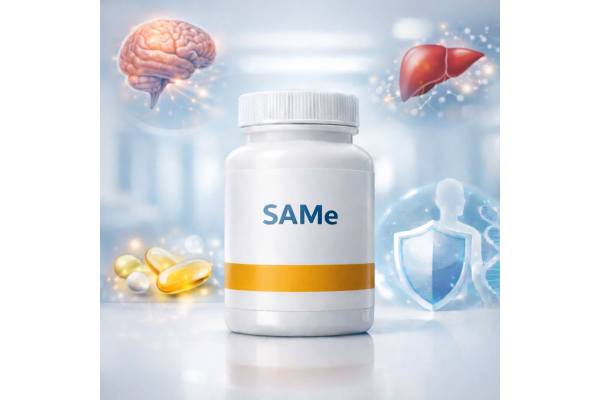
S-adenosyl-L-methionine (SAMe) is a naturally occurring compound made in your body from the amino acid methionine and ATP (your cells’ energy currency). It acts as a major “methyl donor,” helping switch genes on and off, build neurotransmitters like serotonin and dopamine, support joint cartilage, and protect the liver’s detox pathways.
As a supplement, SAMe is most often used for mood support in mild to moderate depression, for osteoarthritis-related joint pain, and as an adjunct in certain liver conditions. Some people also take it for low energy, cognitive fog, or to support overall emotional resilience during stress.
At the same time, SAMe is a biologically active compound with real pharmacological effects. It can interact with medications, provoke side effects, and in some cases worsen underlying conditions such as bipolar disorder. This guide walks you through what SAMe is, how it seems to work, potential benefits, dosage ranges typically used in research, and who should be cautious or avoid it altogether.
Key Insights
- SAMe is a natural methyl donor involved in neurotransmitter production, joint cartilage maintenance, and liver detox pathways.
- Clinical trials suggest SAMe may help mild to moderate depression and osteoarthritis pain, with some supportive evidence in certain liver disorders.
- Common supplement doses range from 400–1,600 mg per day (in divided doses), usually on an empty stomach.
- Side effects most often include nausea, digestive upset, headache, anxiety, or insomnia, and it may trigger mania in people with bipolar disorder.
- People with bipolar disorder, those on antidepressants or other serotonergic drugs, and anyone pregnant, breastfeeding, or with serious medical conditions should use SAMe only under medical supervision or avoid it.
Table of Contents
- What is SAMe and how does it work?
- SAMe benefits for mood and brain health
- SAMe for joint and liver support
- How to take SAMe: dosage and forms
- Side effects, interactions, and precautions
- What the evidence says overall
What is SAMe and how does it work?
SAMe is a compound your cells make continuously from methionine (an essential amino acid from protein foods) and ATP. It is present in almost every tissue, but the liver, brain, and joints are especially dependent on it. Because SAMe carries an activated methyl group, it participates in hundreds of “methylation” reactions, which influence DNA expression, neurotransmitter synthesis, phospholipid production in cell membranes, and detoxification.
Three main pathways explain most of SAMe’s proposed benefits:
- Methylation reactions: SAMe donates methyl groups to help produce and regulate neurotransmitters such as serotonin, norepinephrine, and dopamine. This is one reason it is studied in depression, fatigue, and cognitive symptoms.
- Transsulfuration and antioxidant capacity: After donating its methyl group, SAMe eventually helps form cysteine and glutathione, one of the body’s major antioxidants. This can support the liver’s ability to process toxins and limit oxidative stress.
- Polyamine synthesis: Polyamines are involved in cell growth and repair, including in cartilage. SAMe’s role in polyamine pathways may help explain its effects in osteoarthritis and joint health.
Supplemental SAMe is typically made via fermentation and then stabilized as a salt (often tosylate or butanedisulfonate). The raw SAMe molecule is unstable and degrades easily in heat and moisture, so quality manufacturing and proper storage matter.
Because SAMe overlaps with folate, vitamin B12, and vitamin B6 pathways, deficiencies in these nutrients may blunt its effects or increase homocysteine, a sulfur-containing amino acid. Many clinicians prefer to correct B-vitamin status first or in parallel when SAMe is used longer term.
While SAMe is available over the counter in many countries, in others it is regulated as a prescription medication, reflecting its potency and potential for drug-like effects rather than a simple “vitamin.”
SAMe benefits for mood and brain health
Most people first hear about SAMe in the context of mood. Research has explored it as a stand-alone option for mild to moderate depression and as an add-on to standard antidepressant therapy in major depressive disorder.
Because SAMe participates in the production of serotonin, norepinephrine, and dopamine, it can influence brain circuits involved in emotional regulation, motivation, and cognitive flexibility. In several clinical trials, SAMe showed antidepressant effects that appeared comparable to some prescription antidepressants for mild to moderate depression, especially when doses reached the higher end of studied ranges.
Common patterns observed in studies:
- Symptom improvement often appears after 1–2 weeks, sometimes sooner.
- Benefits may include increased energy, reduced rumination, improved motivation, and better overall mood.
- Some trials found that SAMe, when added to an SSRI or SNRI that was only partially effective, helped more patients reach response or remission criteria than antidepressant alone.
There is also interest in SAMe for cognitive symptoms associated with depression, mild cognitive impairment, and neurodegenerative conditions. The rationale is that methylation and phospholipid synthesis are essential for myelin, cell membranes, and normal neurotransmission. Early research suggests possible benefits in attention, processing speed, and executive function, but the evidence remains far less robust than for mood.
Important caveats for mood support:
- SAMe should not be treated as a self-directed substitute for medical care in moderate to severe depression, suicidal thoughts, or complex psychiatric histories.
- In people with bipolar disorder or a strong personal/family history of bipolar spectrum conditions, SAMe may trigger hypomania or mania.
- When used alongside antidepressants or other serotonergic drugs, SAMe may theoretically contribute to serotonin-related adverse reactions, so medical supervision is strongly recommended.
Overall, SAMe can be a tool in mood management for some individuals, but it is best viewed as part of a broader treatment plan rather than a stand-alone cure.
SAMe for joint and liver support
Beyond mood, SAMe has a long history of use for osteoarthritis and certain liver conditions. These uses relate to its roles in cartilage metabolism and in protecting liver cells from damage.
For osteoarthritis and joint pain, research has tested SAMe primarily in knee and hip osteoarthritis. Trials have compared it with placebo and with nonsteroidal anti-inflammatory drugs (NSAIDs):
- Pain reduction and functional improvement with SAMe often emerge gradually over several weeks.
- In some studies, SAMe performed similarly to NSAIDs for pain relief, although it tended to act more slowly.
- Unlike NSAIDs, SAMe does not appear to increase risks of stomach ulcers or bleeding, but it can still cause gastrointestinal upset in some users.
Possible mechanisms include support for proteoglycan synthesis in cartilage, improved joint lubrication via methylation-dependent pathways, and reduced oxidative stress in joint tissues. While SAMe is not a proven disease-modifying therapy, it may be a reasonable adjunct for individuals who cannot tolerate NSAIDs or who prefer to combine lifestyle strategies with lower doses of conventional pain medications.
For the liver, SAMe is of interest in cholestatic conditions (where bile does not flow correctly) and in certain drug- or alcohol-related liver injuries. The liver consumes large amounts of SAMe for detoxification and glutathione production. In some studies, SAMe supplementation improved biochemical markers such as bilirubin and liver enzymes and reduced itching in cholestasis.
However:
- Evidence for hard outcomes like progression to cirrhosis, need for transplant, or survival is limited and mixed.
- Many liver trials are relatively small or short term, and often used SAMe alongside other medications, making it harder to isolate its specific effect.
- Because serious liver disease is complex, SAMe should only be used in this context under specialist supervision.
Some people also take SAMe hoping to support general “detox” or protect the liver from lifestyle stress. While its biochemical roles make this plausible, human outcome data for healthy or mildly stressed livers are sparse. Basic strategies such as limiting alcohol, maintaining healthy weight, and managing metabolic risk factors are far more important, and any supplement should be secondary to these foundations.
How to take SAMe: dosage and forms
Because SAMe is chemically fragile, formulation and dosing matter. Most supplements use stabilized salt forms such as SAMe tosylate or butanedisulfonate and package them in enteric-coated tablets or capsules to help the compound survive stomach acid and reach the small intestine for absorption.
General practical guidelines commonly used in research and clinical practice:
- Starting dose: 200–400 mg per day, usually split into 1–2 doses.
- Typical mood-support range: 800–1,600 mg per day, divided into 2–3 doses.
- Typical joint-support range: 600–1,200 mg per day, divided into 2–3 doses.
- Liver-support protocols: Often 800–1,600 mg per day, always under medical supervision.
Key usage principles:
- Timing with food
SAMe is often better absorbed on an empty stomach or at least away from heavy meals. Many people take it 30–60 minutes before breakfast, and if using multiple doses, again midday. Taking it late in the day can increase the chance of insomnia or restlessness in some individuals. - Titration
It is usually wise to start low and increase slowly every 3–7 days if needed, watching for benefits and side effects. Some people respond well at 400–800 mg per day and do not need or tolerate higher amounts. - Consistency and trial duration
For mood or joint support, a fair trial is often at least 4–6 weeks at a stable, well-tolerated dose. Some people notice changes within 1–2 weeks; others require longer. If there is no meaningful benefit after an adequate trial, continuing indefinitely is unlikely to be helpful. - B vitamins and homocysteine
Because SAMe metabolism is tied to folate, vitamin B12, and vitamin B6, clinicians often check and correct deficiencies or combine SAMe with B-complex support, especially for long-term use. This can help maintain normal homocysteine levels and optimize methylation. - Form and quality
Look for products from reputable manufacturers that specify the SAMe salt form and actual SAMe content per tablet (some labels list the salt weight rather than the active SAMe). Proper blister packaging and attention to expiration dates help reduce degradation.
For individuals already taking prescription medications, especially antidepressants, mood stabilizers, or drugs affecting the liver, any change in SAMe dose should be planned with a healthcare professional, not done impulsively.
Side effects, interactions, and precautions
Although SAMe is a naturally occurring molecule, supplemental doses are pharmacologic and can cause side effects or interact with medications. Most side effects are mild to moderate and reversible with dose reduction or discontinuation, but serious reactions are possible in vulnerable individuals.
Commonly reported side effects:
- Nausea, abdominal discomfort, bloating, or loose stools
- Headache or lightheadedness
- Feeling jittery, overstimulated, or anxious
- Insomnia, particularly when taken late in the day
- Sweating or palpitations in sensitive users
These effects often improve when the dose is lowered or when dosing is shifted earlier in the day. Taking SAMe with a small snack (while still allowing for reasonable absorption) may lessen digestive issues.
Less common but more serious concerns:
- Mania or hypomania: In people with bipolar disorder or strong bipolar predisposition, SAMe can precipitate mood elevation, racing thoughts, decreased need for sleep, impulsivity, or risk-taking. This risk makes unsupervised use in bipolar disorder inappropriate.
- Serotonin-related reactions: Because SAMe supports serotonin synthesis, theoretical and occasional clinical concerns exist when it is combined with SSRIs, SNRIs, MAO inhibitors, certain migraine medications, or other serotonergic agents. Symptoms to watch for include agitation, restlessness, sweating, tremor, or unusual gastrointestinal distress.
- Worsening anxiety or panic symptoms: A subset of users find SAMe too stimulating, especially at higher doses.
Who should avoid SAMe or use only under specialist care:
- People with bipolar disorder, schizoaffective disorder, or a history of mania or psychosis
- Anyone with moderate to severe depression, particularly with suicidal thoughts, without close professional oversight
- Individuals on prescription antidepressants, mood stabilizers, antipsychotics, or complex psychiatric regimens
- People with significant liver or kidney disease unless a specialist has recommended SAMe
- Those who are pregnant, planning pregnancy, or breastfeeding, because safety data are limited
- Children and adolescents, unless under the care of a pediatric specialist experienced with SAMe
Allergic reactions to SAMe are rare but possible. Any symptoms such as rash, swelling, difficulty breathing, or severe dizziness require immediate medical attention.
As with any supplement, SAMe should be stored out of reach of children and not shared with others, especially those with unrecognized mood disorders or serious health conditions.
What the evidence says overall
When you step back and look at the full body of research, SAMe emerges as a promising but not magical option with its strongest evidence in two areas: mood disorders and osteoarthritis, and a more modest, suggestive role in certain liver conditions.
For mood and depression:
- Multiple trials and reviews indicate that SAMe can improve symptoms of mild to moderate depression, with effect sizes in the range of standard antidepressants for some people.
- As an add-on to antidepressants, SAMe appears to help a portion of individuals who have only partially responded to medication alone.
- There is less data on long-term relapse prevention, and SAMe is rarely used as the sole strategy in more severe or treatment-resistant cases.
For joint health:
- Clinical trials show pain relief and functional improvement in osteoarthritis roughly comparable to some NSAIDs after several weeks, though SAMe’s onset of action may be slower.
- SAMe is not proven to rebuild damaged cartilage, but may support comfort and function as part of a multimodal plan that includes exercise, weight management, and other therapies.
For liver support:
- Evidence suggests biochemical improvements in some cholestatic conditions and certain types of liver injury, especially related to drugs or pregnancy.
- Data on long-term outcomes and broad use in chronic liver disease remain limited, so SAMe should not replace standard medical therapy.
For other uses:
- There is interest in SAMe for cognitive symptoms, fibromyalgia, chronic fatigue, and general “anti-aging” benefits, but evidence ranges from preliminary to inconclusive.
- Marketing claims often exceed what clinical trials can clearly support.
In practical terms, SAMe can be considered when:
- Foundational health behaviors are being addressed (sleep, nutrition, physical activity, stress).
- Standard medical evaluation has ruled out urgent issues.
- A clinician familiar with psychiatric, rheumatologic, or hepatic conditions agrees it may be a reasonable adjunct.
- The individual understands both potential benefits and risks and is willing to monitor mood, sleep, and side effects carefully.
Used thoughtfully, SAMe may offer meaningful support for some people. Used casually or as a do-it-yourself replacement for professional care, particularly in serious mental health or liver disease, it can be risky.
References
- S-adenosyl-L-methionine – Health Professional Fact Sheet 2022 (Guideline)
- S-adenosyl-L-methionine (SAMe) 2023 (Guideline)
- S-Adenosylmethionine (SAMe) for neuropsychiatric disorders: A clinician-oriented review 2017 (Systematic Review)
- S-Adenosylmethionine (SAMe) in major depressive disorder (MDD): a clinician-oriented systematic review 2020 (Systematic Review)
- S-Adenosylmethionine in liver health, injury, and cancer 2012 (Review)
Disclaimer
The information in this article is for general educational purposes only and is not intended to provide medical advice, diagnose any condition, or replace the individualized guidance of a qualified healthcare professional. Decisions about starting, stopping, or changing any supplement or medication, including SAMe, should be made with a licensed clinician who can consider your full medical history, medications, mental health status, and laboratory findings. Never delay seeking professional advice or disregard medical recommendations because of something you have read online.
If you found this guide helpful, you are welcome to share it with others on Facebook, X (formerly Twitter), or any platform you prefer, and to follow our work on social media. Your thoughtful sharing and support help us continue creating careful, evidence-informed health content.