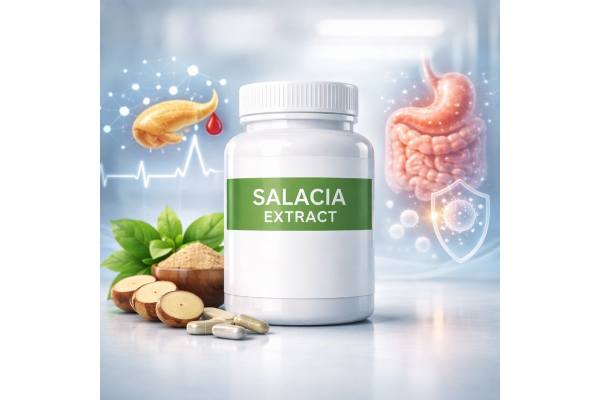
Salacia extract comes from woody climbing plants traditionally used in Ayurvedic medicine to support healthy blood sugar and weight control. Modern supplements usually draw on species such as Salacia reticulata, Salacia oblonga, and Salacia chinensis. These plants contain unusual sulfur-containing sugars and polyphenols that slow carbohydrate breakdown in the gut and may improve several markers of metabolic health.
Interest in Salacia extract has grown as more people look for natural options to help manage post-meal blood sugar spikes, insulin resistance, and associated weight gain. Human clinical trials suggest Salacia can modestly reduce postprandial glucose and insulin when taken with carbohydrate-rich meals, with additional data hinting at benefits for lipids and body weight. However, it is not a stand-alone treatment for diabetes and should be used cautiously alongside conventional medications.
This guide explains what Salacia extract is, how it appears to work, evidence-based benefits, practical dosage guidance, potential side effects, and who should avoid it.
Key Insights for Salacia extract
- Salacia extract may reduce post-meal blood sugar and insulin spikes when taken with carbohydrate-containing meals.
- It may modestly support weight management and blood lipids as part of a broader lifestyle program, but evidence is still limited.
- Typical studied oral doses range from about 200–1,000 mg per day of standardized extract, usually taken with meals.
- People with diabetes using glucose-lowering medications, those who are pregnant or breastfeeding, and those with significant liver or kidney disease should only use Salacia extract under professional supervision.
Table of Contents
- What is Salacia extract and how it works?
- Evidence based benefits of Salacia extract
- How to take Salacia extract dosage and forms
- Using Salacia extract for blood sugar and weight
- Side effects, interactions, and who should avoid
- What the research still does not clarify
What is Salacia extract and how it works?
Salacia is a genus of woody climbing shrubs native to South Asia, particularly Sri Lanka and southern India, where it has a long history in Ayurvedic medicine. The best-studied species for metabolic health are Salacia reticulata, Salacia oblonga, and Salacia chinensis. Traditional preparations often used decoctions of the root or stem bark to manage “sweet urine” (diabetes), obesity, joint discomfort, and certain skin problems.
Modern Salacia supplements are usually standardized extracts produced from the roots, stems, or sometimes leaves. They concentrate specific bioactive compounds, including:
- Thiosugar sulfonium compounds such as salacinol and kotalanol.
- Related molecules like neokotalanol and neosalacinol.
- Polyphenols such as mangiferin and various tannins and triterpenes.
The best-characterized mechanism of Salacia extract is inhibition of intestinal carbohydrate-digesting enzymes, especially alpha-glucosidase and, to a lesser extent, alpha-amylase. By slowing the breakdown of complex carbohydrates and disaccharides into absorbable glucose, Salacia can:
- Blunt the rise in blood glucose after a meal.
- Reduce the corresponding surge in insulin.
- Shift more carbohydrate fermentation to the colon, where gut bacteria produce short-chain fatty acids.
In animal and cell studies, Salacia extracts also appear to:
- Improve insulin sensitivity, partly by modulating adipokines such as adiponectin.
- Reduce lipogenesis (fat storage) and promote lipolysis (fat breakdown) in fat cells.
- Exhibit antioxidant and mild anti-inflammatory effects in metabolic tissues.
- Support more favorable lipid profiles, including triglycerides and cholesterol, in some models.
Different species, plant parts, and extraction methods yield different profiles of active compounds. As a result, not all Salacia products are equivalent. Many clinical trials specify a particular standardized extract, often at defined salacinol or mangiferin content, which may not match every supplement on the market.
Overall, Salacia extract is best viewed as a botanical alpha-glucosidase inhibitor with additional metabolic effects, occupying a similar niche to certain prescription drugs but with a different and less well-defined evidence base.
Evidence based benefits of Salacia extract
Most of the human data on Salacia focuses on blood sugar control, post-meal responses, and related metabolic markers. While study sizes are generally modest, several consistent themes emerge.
First, Salacia extract can reduce postprandial (after-meal) blood sugar and insulin spikes. In healthy volunteers, single doses of Salacia chinensis extract in the range of 200–500 mg taken with a sucrose load lowered insulin responses and modestly attenuated glucose rise over several hours, without serious adverse events reported. Similar studies using Salacia preparations in healthy or overweight adults suggest dose-dependent reductions in insulin area-under-the-curve after carbohydrate challenges.
Second, there is emerging evidence in people with type 2 diabetes. Clinical trials using Salacia reticulata in tea or capsule form have reported improvements in fasting and post-meal glucose, as well as modest reductions in HbA1c over periods of about 6 weeks to 3 months. A recent crossover study in people with type 2 diabetes used biscuits containing Salacia reticulata extract and found better post-meal glycemic control compared with placebo biscuits, again without major safety concerns in the study setting.
Third, Salacia may offer benefits beyond glucose:
- Lipids: Some human and animal studies show improvements in triglycerides and certain cholesterol measures, particularly in individuals with coexisting dyslipidemia.
- Weight and body composition: Trials combining Salacia with lifestyle measures, or with vitamin D, have noted modest reductions in body weight, body mass index, or waist measures. Results are not uniform, and benefits tend to be modest rather than dramatic.
- Insulin resistance: Changes in markers such as fasting insulin, HOMA-IR, and adipokine profiles point to possible improvements in insulin sensitivity, though data remain limited.
Most trials are short term, involve tens rather than hundreds of participants, and use specific branded or standardized extracts. There is very little information on long-term outcomes such as diabetes complications, cardiovascular events, or sustained weight maintenance. Still, taken together, the evidence suggests Salacia extract can play a supportive role in improving post-meal glucose and related metabolic parameters, especially when combined with medical care and lifestyle changes.
How to take Salacia extract dosage and forms
Salacia extract is sold in several forms, often as part of “blood sugar support” or “metabolic health” blends. Understanding the options and how dosing has been used in studies helps you use it more safely and effectively.
Common forms include:
- Capsules or tablets containing standardized Salacia extract alone.
- Combination formulas with other botanicals (for example, bitter melon, gymnema, banaba) or nutrients (such as chromium or vitamin D).
- Powders designed to be mixed into beverages.
- Traditional teas made from Salacia root or stem bark, though dosing is less standardized here.
Typical studied dosage ranges for standardized extracts:
- Single-meal studies in healthy adults have used about 200–500 mg of Salacia extract taken shortly before or with a carbohydrate-rich meal.
- Some longer interventions in people with prediabetes, mild hyperlipidemia, or type 2 diabetes have used total daily doses in the range of about 240–1,000 mg, usually divided with meals.
Because products vary widely, practical guidance often includes:
- Follow label directions first. Reputable brands state the species (for example, Salacia reticulata or Salacia chinensis), plant part, and standardization (such as % salacinol or mangiferin).
- Start low and assess tolerance, especially regarding digestive comfort and blood sugar responses. For instance, a starting point might be 100–200 mg with one main meal, then gradually extending to other meals if tolerated.
- Take it with carbohydrate-containing meals, not on an empty stomach, since the main mechanism is slowing carbohydrate digestion.
For teas or decoctions, the quantity of active constituents is harder to estimate. Traditional practices may involve simmering a piece of root or stem in water and drinking the resulting tea once or several times daily. If you use Salacia in this more traditional way and have blood sugar issues, self-monitoring (for example, finger-stick glucose if advised by your clinician) becomes even more important.
Because supplements are not tightly regulated in many regions, quality control matters. Choose products from companies that provide:
- Clear species identification and plant part.
- Standardization levels or at least extraction ratios.
- Third-party testing for purity and contaminants where available.
Finally, Salacia extract should never be used to change or stop prescribed diabetes medications without direct guidance from your healthcare professional, as dosage adjustments require careful monitoring.
Using Salacia extract for blood sugar and weight
In practice, most people consider Salacia extract for two main goals: smoothing post-meal blood sugar spikes and supporting weight or fat loss. While it is not a magic solution, it can be a useful adjunct when integrated thoughtfully into a comprehensive plan.
For blood sugar:
- The strongest data support its use with carbohydrate-containing meals to blunt rapid rises in glucose and insulin.
- People with prediabetes or early type 2 diabetes who are already focusing on carbohydrate quality, portion control, and physical activity may see additional improvements in post-meal readings.
- If you self-monitor glucose, you can compare post-meal results (for example, 1 or 2 hours after a meal) on days with and without Salacia to see if it makes a meaningful difference for you.
For weight and metabolic health:
- By reducing post-meal glucose and insulin, Salacia may reduce the tendency toward reactive hunger and fat storage, which can indirectly help with appetite control.
- Some trials report small reductions in weight, waist circumference, or body fat when Salacia is combined with calorie management and movement.
- On its own, however, Salacia is unlikely to cause substantial weight loss. It works best as a helper, not a replacement, for core strategies such as diet quality, calorie awareness, resistance training, and adequate sleep.
Practical integration tips:
- Align with meals that are hardest to control. Many people select the meal with the highest carbohydrate load (for example, dinner with rice, pasta, or bread) to pair with Salacia.
- Combine with low-glycemic eating. Emphasizing fiber-rich vegetables, legumes, whole grains, and intact fruit can synergize with Salacia’s enzyme-blocking action.
- Monitor for low glucose, especially if you use medications that can cause hypoglycemia. Early warning signs include shakiness, sweating, dizziness, or confusion.
- Reassess regularly. After several weeks, evaluate whether Salacia is providing enough benefit (on glucose readings, energy, cravings, or weight trends) to justify ongoing use.
Working with a clinician or nutrition professional experienced in both conventional and integrative care can help tailor Salacia use to your specific medications, lab values, and goals.
Side effects, interactions, and who should avoid
Salacia extract has generally been well tolerated in short-term human studies, but that does not mean it is risk-free. Understanding potential side effects and interactions is essential, especially for people with existing health conditions.
Common, usually mild side effects:
- Digestive symptoms such as gas, bloating, loose stools, or abdominal discomfort. These are consistent with increased carbohydrate reaching the colon, where gut bacteria ferment it.
- Mild nausea or a feeling of fullness in some individuals, particularly at higher doses or when first starting.
Potential but less well-studied concerns:
- Low blood sugar (hypoglycemia) when combined with diabetes medications that also lower glucose, particularly insulin or sulfonylureas. The risk appears higher if diet is inconsistent or if doses are not adjusted appropriately.
- Effects on absorption of other nutrients or medications. By slowing carbohydrate digestion and altering gut transit, Salacia could theoretically influence absorption of certain orally administered drugs, though robust data are limited.
- Long-term liver or kidney safety has not been extensively evaluated, especially at higher supplement doses or in people with existing organ impairment.
Groups that should avoid Salacia extract unless advised and monitored by a healthcare professional:
- People with diabetes who take insulin or oral hypoglycemic agents, particularly those prone to hypoglycemia.
- Individuals with significant liver or kidney disease.
- Pregnant or breastfeeding women, due to a lack of safety data.
- Children and adolescents, unless specifically directed by a pediatric specialist.
- Anyone with known allergy to Salacia species or to components in the supplement formulation.
Key interaction considerations:
- Combining Salacia with other alpha-glucosidase inhibitors (such as acarbose) could increase the risk of digestive side effects and hypoglycemia.
- Stacking multiple “blood sugar” botanicals (for example, berberine, bitter melon, gymnema) alongside Salacia and conventional medications may make glucose responses harder to predict.
- If you take time-sensitive medications (such as certain thyroid hormones or antibiotics), it is prudent to separate them from Salacia by at least a couple of hours until more is known about potential absorption effects.
If you decide to use Salacia extract, discuss it with your healthcare team and monitor carefully for any change in symptoms, glucose readings, or lab values. Any signs of jaundice, persistent abdominal pain, unexplained fatigue, or changes in kidney function tests require prompt medical review and likely discontinuation of the supplement.
What the research still does not clarify
Despite promising data, there are important gaps in the evidence on Salacia extract that limit how confidently it can be recommended.
First, most human studies are short, typically ranging from a single test meal up to a few months. This leaves questions about long-term safety and sustained efficacy. It is unclear whether benefits on blood sugar or weight persist over years, or whether the body adapts over time.
Second, the extracts used in clinical trials are not uniform. Different studies use different species (such as Salacia reticulata, Salacia oblonga, or Salacia chinensis), plant parts, extraction solvents, and standardization markers. Commercial supplements may not match any of the well-studied preparations, which complicates translating research doses directly into product recommendations.
Third, there is very little data on hard clinical outcomes. For people living with diabetes, the questions that matter most include:
- Does adding Salacia reduce the risk of complications such as kidney disease, nerve damage, or cardiovascular events?
- Can it meaningfully delay progression from prediabetes to diabetes when combined with lifestyle interventions?
At present, the available studies are too small and short to answer these questions.
Fourth, environmental and sourcing issues are under-discussed. Some Salacia species are considered vulnerable or threatened in the wild due to overharvesting of roots and stems. Sustainable cultivation, responsible sourcing, and quality assurance are needed to ensure that increased supplement use does not harm wild populations or encourage adulteration.
Finally, Salacia extract interacts with complex human behavior. If people view it as a substitute for dietary changes, physical activity, or evidence-based medical therapy, the net effect could be negative. Used appropriately—as an adjunct under professional guidance—it may offer modest but meaningful benefit. Misused as a stand-alone “fix,” it can delay more effective strategies.
In summary, Salacia extract is a promising botanical option for post-meal blood sugar support and related metabolic goals, but it should be approached with realistic expectations and with attention to overall health care, not as a replacement for it.
References
- A Comprehensive Review of Salacia reticulata: Botanical, Ethnomedicinal, Phytochemical, and Pharmacological Insights 2023 (Systematic Review)
- Salacia reticulata (Kothala himbutu) revisited; a missed opportunity to treat diabetes and obesity? 2015 (Systematic Review)
- Salacia Extract Improves Postprandial Glucose and Insulin Response: A Randomized Double-Blind, Placebo Controlled, Crossover Study in Healthy Volunteers 2016 (RCT)
- The Effect of Salacia Reticulata Extract Biscuits on Blood Sugar Control of Type 2 Diabetes Mellitus Patients: A Two-Period, Two-Sequence, Crossover, Randomized, Triple-Blind, Placebo-Controlled, Clinical Trial 2023 (RCT)
- Antidiabetic and Antilipidemic Activity of Root Extracts of Salacia oblonga against Streptozotocin-Induced Diabetes in Wistar Rats 2020 (Animal Study)
Disclaimer
The information in this article is intended for general educational purposes only and does not constitute medical advice, diagnosis, or treatment. Salacia extract can affect blood sugar and other aspects of metabolism, and its use may not be appropriate for everyone. Always consult a qualified healthcare professional before starting, stopping, or changing any supplement, medication, or treatment plan, especially if you have diabetes, take prescription drugs, are pregnant or breastfeeding, or have any chronic medical condition. Never disregard professional medical advice or delay seeking it because of something you have read here.
If you found this guide helpful, you are warmly invited to share it with others—on Facebook, X (formerly Twitter), or any platform you prefer—and to follow our work on social media. Your thoughtful sharing helps support our team in continuing to create clear, evidence-informed resources for people who want to take an active role in their health.