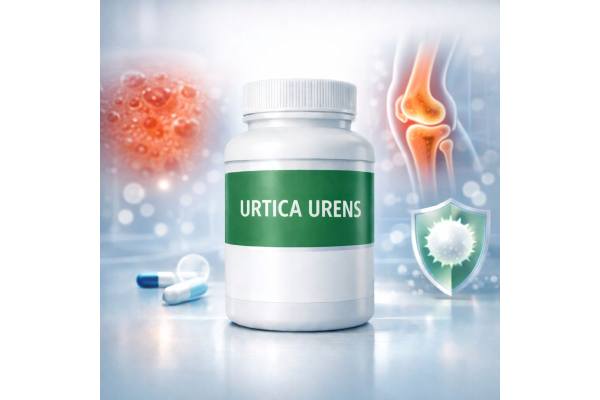
Urtica urens—often called small nettle—is a stinging plant with a long history in European herbal practice. In supplements, it’s commonly used alongside its better-known relative Urtica dioica (stinging nettle), and products may use the aerial parts (herb or leaf), the root, or a standardized extract. People typically reach for Urtica urens to support urinary comfort (especially when “flushing” with extra fluids is advised), to ease minor joint aches, or to help with certain seborrhoeic (oilier, flaky) skin concerns.
What makes nettle practical is its flexibility: it can be prepared as a tea, taken as a capsule, or used in liquid extracts, with dosage ranges that can be matched to the goal and the form. At the same time, nettle is not a “more is better” herb—hydration, product quality, and medication interactions matter. This guide walks you through what it is, what it can realistically do, how to use it well, and when to avoid it.
Core Points for Urtica urens
- May help relieve minor urinary complaints when paired with sufficient fluid intake.
- Can support minor joint pain as part of a broader inflammation-smart routine.
- Typical adult oral ranges include 4.5–6 g/day dried herb as tea or 300–450 mg extract 3–4 times/day (product-specific).
- Avoid raw fresh nettle ingestion and stop if you develop rash, swelling, wheeze, or severe stomach upset.
- Often best avoided in pregnancy or breastfeeding, and with conditions where fluid restriction is advised.
Table of Contents
- What is Urtica urens and what part matters?
- What benefits are realistic to expect?
- How to use it day to day
- How much should you take?
- Common mistakes and interactions
- Side effects and who should avoid it
- What the evidence quality looks like
What is Urtica urens and what part matters?
Urtica urens is an annual nettle species known for its stinging hairs. Those hairs are tiny needles that deliver irritating compounds on contact—useful for the plant’s defense, unpleasant for your skin. In supplements, however, nettle is typically dried, extracted, or processed in ways that remove or neutralize the sting. The first practical point is this: when you buy a nettle product, the plant part is often more important than the species name on the front label.
Most nettle supplements fall into three buckets:
- Herb or leaf (aerial parts): Commonly used for minor urinary complaints (as part of “flushing therapy” with extra fluids), for minor joint discomfort, and sometimes for seborrhoeic skin concerns.
- Root (radix): Traditionally used for lower urinary tract symptoms related to benign prostatic hyperplasia (BPH) in adult men, after serious causes are excluded.
- Topical or cosmetic nettle preparations: Often marketed for scalp oiliness or dandruff-like flaking, where nettle is one ingredient among many.
You will also see mixed labeling: some products say “nettle,” some specify Urtica dioica, some specify Urtica urens, and many rely on a mixture or hybrids. That’s not automatically a red flag—many formal herbal standards treat these nettles together for specific uses—but it does mean you should read the Supplement Facts panel carefully.
Key properties and common constituents described for nettle preparations include polyphenols (such as flavonoids), minerals, chlorophyll-rich plant compounds, and plant proteins and polysaccharides that may influence inflammatory signaling. The exact profile varies with the plant part, harvest timing, and extraction method. That variability is why choosing a product with a clearly stated DER (drug-extract ratio), solvent, or standardized marker can matter more than chasing a single “magic molecule.”
What benefits are realistic to expect?
Nettle gets talked about as if it does everything—energy, detox, hormones, joints, allergies, skin, and more. A more useful approach is to narrow it to where nettle has the most consistent traditional rationale and the clearest “how would I notice?” outcomes.
1) Urinary comfort (with adequate fluids)
For many adults, the most realistic use of nettle herb is supporting urinary comfort when you have minor urinary complaints and your clinician agrees that “flushing” with fluids is appropriate. In this context, nettle is not a substitute for evaluating infection, fever, flank pain, blood in the urine, or worsening symptoms. The benefit you’re looking for is typically a mild, supportive change—less “irritated” feeling, improved comfort, and a sense that the urinary tract is calmer while you keep up fluid intake.
2) Minor joint pain support
Nettle herb is also used for minor articular pain, especially when combined with fundamentals that lower the load on joints: consistent movement, sleep, weight management when relevant, and an overall anti-inflammatory diet pattern. Think of nettle as a “supporting player,” not a stand-alone pain solution. People who respond often describe a gradual improvement over weeks rather than a dramatic same-day effect.
3) Seborrhoeic skin conditions (supportive, not curative)
Nettle herb appears in some traditional frameworks for seborrhoeic issues. In practice, many people try it as an adjunct to a scalp-friendly routine: gentle cleansing, avoiding harsh fragrances, and addressing obvious triggers like overly aggressive styling products.
4) BPH-related urinary symptoms (root, not leaf)
If your goal is BPH-related lower urinary tract symptoms, nettle root is the relevant plant part. The realistic expectation here is symptom relief over time, not immediate improvement. Importantly, BPH-like symptoms can overlap with other issues that require evaluation.
Across all these uses, the “advantage” of nettle is its versatility of forms (tea, capsules, tincture) and its generally tolerable profile when used at appropriate doses. The main limitation is that results, when they happen, tend to be modest, and they depend heavily on correct matching of the form and plant part to your goal.
How to use it day to day
Using Urtica urens well is mostly about choosing the right form, setting the right timeline, and avoiding the common pitfalls that make people think “it didn’t work” (or that lead to unnecessary side effects).
Step 1: Match the form to the goal
- For minor urinary complaints, many people start with tea (dried comminuted herb) because it naturally pairs with the “increase fluid intake” approach.
- For minor joint pain, tea can work, but capsules or liquid extracts are often easier for consistent daily dosing.
- For BPH-related symptoms, choose root (radix) products, not leaf.
- For seborrhoeic scalp issues, consider whether you’re using nettle orally as support, topically, or both. If you’re already using medicated shampoos or scalp treatments, keep changes simple so you can tell what’s helping.
Step 2: Pick a “readable” label
A strong nettle label tells you:
- The plant part (herb/leaf vs root).
- The extract details (for extracts): DER, solvent, and amount per dose in mg.
- Clear daily serving guidance.
If a product just says “nettle blend” without plant part or dosing details, it’s harder to use confidently.
Step 3: Start low, then normalize the routine
For many adults, a sensible pattern is:
- Start at the lower end of the suggested range for 3–7 days.
- If tolerated, move toward the full labeled dose.
- Track one or two outcomes only (for example: nighttime urination frequency, joint morning stiffness duration, scalp itch scale 1–10). Too many metrics makes it impossible to interpret.
Step 4: Use an appropriate timeline
- Urinary comfort support may be noticed within days, but persistent symptoms should never be “managed away” with supplements alone.
- Joint support is often a 2–4 week evaluation window.
- BPH-related symptom support is generally assessed over weeks to months.
Step 5: Build in stop rules
Stop and seek medical guidance if you develop fever, blood in urine, urinary retention, significant rash, facial swelling, wheezing, or persistent worsening symptoms.
How much should you take?
Dosage depends on (1) plant part, (2) preparation type, and (3) your goal. Below are practical, commonly used adult ranges aligned with formal herbal dosing patterns for nettle herb and root. Use these as a framework, then follow the specific product label unless your clinician advises otherwise.
Nettle herb (aerial parts): common adult dosing patterns
For minor urinary complaints (with sufficient fluid intake):
- Herbal tea: 1.5 g dried comminuted herb infused in about 150 ml boiling water, 3–4 times daily (daily total about 4.5–6 g dried herb).
- Dry extract (water-based, typical oral products): often used in ranges like 300–450 mg, 3–4 times daily (daily total about 1200–1350 mg, depending on the product).
- Expressed juice preparations: commonly dosed in ml ranges taken 2–4 times daily, depending on concentration and formulation.
For minor articular pain:
- Herbal tea: often used at higher dried-herb amounts, such as 3–6 g infused in about 200 ml, 3 times daily (daily total about 9–18 g).
- Liquid extracts or tinctures: commonly measured in ml, taken up to 3 times daily, depending on strength and ethanol content. If you avoid alcohol, choose non-alcoholic forms.
For seborrhoeic skin conditions (oral support):
- Some regimens use powdered herb in the hundreds-of-mg range, taken multiple times per day. In practice, this is usually a secondary strategy after you have the basics of scalp care in place.
Nettle root (radix): BPH-related symptom support (adult men)
For lower urinary tract symptoms related to BPH, nettle root products are typically used as:
- Herbal infusion: around 2 g comminuted root in water, 2–3 times daily.
- Standardized dry extracts: often in the hundreds of mg per day, sometimes divided, depending on the extract type and DER. Some products use “front-loaded” dosing early in the course, then a maintenance dose.
Practical dosage tips
- Choose one form first (tea or capsules) so you can judge tolerance.
- If you’re using nettle for urinary support, do not “out-supplement” poor hydration. The supplement and the fluid plan work together.
- More is not always better: higher doses can increase gastrointestinal upset or trigger unwanted diuresis.
If you have chronic symptoms, are on multiple medications, or are treating BPH-related symptoms, it’s worth confirming your plan with a clinician who can evaluate red flags and interactions.
Common mistakes and interactions
Many disappointing nettle experiences come from simple mismatches: the wrong plant part, the wrong expectation, or an avoidable interaction. Here are the most common mistakes—and how to fix them.
Mistake 1: Using leaf for a root problem (or vice versa)
If your goal is BPH-related lower urinary tract symptoms, the relevant material is root. If your goal is minor urinary complaints with a flushing approach or minor joint pain, the relevant material is typically herb/leaf. “Nettle” on the front label is not enough information.
Mistake 2: Taking nettle without adjusting the context
- For urinary support, nettle is usually paired with sufficient fluid intake. If you are deliberately restricting fluids for medical reasons, nettle may be a poor fit.
- For joint pain, nettle works best when combined with movement habits that reduce flare frequency: daily walking, mobility work, and strength training as tolerated.
Mistake 3: Expecting immediate, medication-level results
Nettle is often a slow-burn support. If you need rapid symptom control, consider it adjunctive and discuss stronger options with your clinician.
Mistake 4: Using raw fresh nettle orally
Fresh nettle can sting the mouth and throat. Supplement forms are processed for a reason. Culinary nettle is typically cooked and handled safely; supplement experimentation with raw fresh plant is not a good idea.
Mistake 5: Overlapping diuretic effects
If you combine nettle (especially herb used for urinary support) with other diuretics—prescription or supplemental—you may increase urination too much and feel lightheaded. Watch for:
- Dizziness on standing
- Muscle cramps
- Unusual fatigue
- Thirst that feels out of proportion
Medication interaction watch list (discuss with your clinician or pharmacist):
- Diuretics and blood pressure medications (additive effects).
- Anticoagulants or antiplatelet drugs (caution is reasonable with many herbs that can influence bleeding risk).
- Diabetes medications (if nettle affects glucose handling for you, monitor for lows).
- Lithium (any diuretic-like effect can potentially affect lithium levels).
If you are managing a complex health condition or taking multiple prescriptions, the safest approach is to bring the bottle (or the label photo) to a clinician and ask specifically whether the combination is appropriate.
Side effects and who should avoid it
Most people who tolerate nettle well describe it as “mild,” but mild does not mean risk-free. Side effects and suitability depend on the preparation and your health context.
Common side effects
- Gastrointestinal upset: nausea, heartburn, fullness, gas, or diarrhea can occur, especially at higher doses or when taken on an empty stomach.
- Allergic reactions: itching, rash, or hives are possible in sensitive individuals.
- Increased urination: expected in urinary-support use; undesirable if it disrupts sleep or contributes to dizziness.
- Topical irritation: nettle-containing cosmetics can irritate very sensitive skin, especially if fragranced or combined with other active ingredients.
Serious “stop now” reactions
Stop nettle and seek medical care if you experience:
- Facial swelling, throat tightness, wheezing, or trouble breathing
- Severe widespread rash
- Fainting, severe dizziness, or signs of dehydration
- Urinary symptoms with fever, blood in urine, severe pain, or urinary retention
Who should avoid, or use only with clinical guidance
- Pregnancy and breastfeeding: safety is not established; avoidance is the cautious choice.
- Children: many nettle dosing patterns are designed for adults; pediatric use should be clinician-guided.
- People advised to restrict fluids (for example, certain heart or kidney conditions): nettle herb used in a “flushing” context may be inappropriate.
- Significant kidney disease or heart failure: discuss with a clinician before use, especially if you are on diuretics.
- People on anticoagulants, antiplatelets, or complex cardiovascular regimens: interactions may be clinically meaningful.
- People with diabetes using glucose-lowering medication: monitor glucose more closely when starting.
Safety realities worth remembering
Nettle is often used as a supportive herb, not a replacement for diagnosis. If urinary symptoms are new, recurrent, or worsening, treat that as a medical problem first and a supplement question second. Likewise, if joint pain comes with swelling, redness, fever, or a sudden change in function, it needs evaluation rather than self-treatment.
What the evidence quality looks like
It helps to separate “what nettle is traditionally used for” from “what has strong clinical proof.” Urtica urens is widely mentioned in traditional herbal frameworks, and formal herbal monographs describe specific uses and dosing patterns for nettle herb and nettle root. Those monographs matter because they reflect long-standing use, manufacturing expectations, and safety framing. But “recognized traditional use” is not the same as “proven to work like a prescription drug.”
Here’s how to think about the evidence, without overselling it:
Where the evidence is most structured
- Traditional-use indications for nettle herb (minor urinary complaints with sufficient fluid intake, minor joint pain, seborrhoeic skin conditions) and nettle root (BPH-related lower urinary tract symptoms after serious causes are excluded) are described in formal European herbal documentation. These sources provide dosage ranges and clear safety warnings, which is often what supplement users need most.
Where modern trials are mixed
- For BPH-related symptoms, clinical research often focuses on nettle root extracts, sometimes alone and sometimes in combination with other botanicals. Results vary by product, dose, and study design. In real-world terms, that means you should not assume that one nettle product will behave like another.
- For joint pain, nettle appears in multiple forms (oral and topical traditions). Human data can be limited or inconsistent, and benefit—when present—may be modest.
- For metabolic, allergy, or broad anti-inflammatory claims, the science often includes laboratory and animal findings that do not always translate into meaningful outcomes in people.
Why product details matter more than headlines
If a study uses a specific extract (with a defined DER and solvent), that does not automatically apply to a random “nettle powder” capsule. This is why your best evidence-based move is to choose products that declare:
- Plant part (herb/leaf vs root)
- Extract method and amount
- A realistic daily dose range
A grounded way to use the evidence
Treat nettle as a reasonable option when your goal matches the traditional-use framework, you can follow the safety rules, and you’re willing to evaluate results honestly over a set window (often 2–4 weeks for herb uses, longer for root uses). If you need certainty, rapid relief, or treatment for a serious condition, use nettle only as an adjunct and keep your clinician in the loop.
References
- Assessment report on Urtica dioica L.; Urtica urens L., herba Final – Revision 1 2025 (Guideline-Style Assessment)
- European Union herbal monograph on Urtica dioica L.; Urtica urens L., radix Final – Revision 1 2025 (Monograph)
- Urtica dioica-Derived Phytochemicals for Pharmacological and Therapeutic Applications – PMC 2022 (Review)
- Stinging Nettle – LiverTox – NCBI Bookshelf 2023 (Safety Review)
- Benign Prostatic Hyperplasia and Complementary and Integrative Approaches: What the Science Says | NCCIH 2022 (Clinical Digest)
Disclaimer
This article is for educational purposes only and does not provide medical advice, diagnosis, or treatment. Herbal supplements like Urtica urens can affect people differently and may interact with medications or health conditions. If you are pregnant or breastfeeding, have kidney or heart disease, have diabetes, take blood thinners, or have persistent or worsening urinary or joint symptoms, speak with a qualified health professional before using nettle products. Seek urgent care for severe allergic reactions, fever with urinary symptoms, blood in urine, or urinary retention.
If you found this guide useful, please consider sharing it on Facebook, X (formerly Twitter), or any platform you prefer, and follow us on social media. Your support through sharing helps our team continue producing high-quality, trustworthy content.