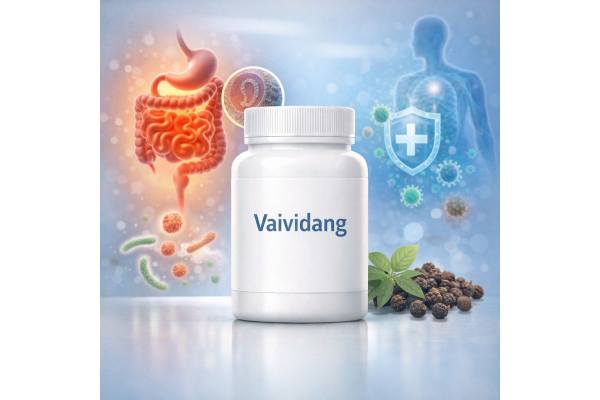
Vaividang, better known in Ayurveda as Vidanga, is a fruit-based herbal remedy traditionally used to support gut cleanliness, comfortable digestion, and metabolic balance. It is most commonly associated with Embelia ribes—a plant whose dried berries have a peppery-bitter taste and a long reputation for helping the body “clear out” what does not belong, especially in the digestive tract. Today, interest in Vaividang also extends to its antioxidant and anti-inflammatory potential, largely linked to a key constituent called embelin.
What makes Vaividang worth understanding is not hype, but practicality: people choose it for real problems—bloating, sluggish appetite, recurring “gut heaviness,” and weight-management routines—yet the strength of evidence varies by use case and product form. This guide covers what Vaividang is, what benefits are most realistic, how to use it, sensible dosage ranges, and the side effects and safety steps that matter most.
Quick Overview for Safe, Effective Use
- Vaividang is traditionally used for intestinal “cleansing” and digestion support, and it may also support metabolic routines.
- Avoid during pregnancy, and do not self-prescribe high doses for long periods.
- A studied adult regimen included 3 g twice daily (6,000 mg/day) of Vidanga churna for 12 weeks in an obesity-focused program.
- Start low if you are sensitive; digestive irritation is a common early sign the dose is too high.
- Avoid if you have active ulcers, are pregnant or breastfeeding, or take medicines strongly affected by liver enzymes.
Table of Contents
- What is Vaividang and what is it used for
- Benefits people use Vaividang for
- Active compounds and how Vaividang may work
- How to take Vaividang in real life
- Vaividang dosage ranges and cycling
- Side effects, interactions, and who should avoid
What is Vaividang and what is it used for
Vaividang (Vidanga) usually refers to the dried fruit of Embelia ribes. You may also see it described as “false black pepper” because the berries resemble peppercorns, although the plant is different from culinary pepper. In Ayurveda, Vaividang is best known for its use in Krimi (a broad category that includes intestinal worms and unwanted organisms), and for supporting digestion when the gut feels heavy, gassy, or sluggish.
A helpful modern way to think about Vaividang is as a targeted digestive and metabolic herb. It is rarely used as a standalone “forever” supplement. More often, it is used:
- as a short, deliberate cycle for gut cleansing routines,
- as part of a broader metabolic plan (diet, movement, sleep, and sometimes multi-herb formulas),
- or as a digestion primer when appetite is inconsistent and bloating is frequent.
Vaividang’s “advantage” is not that it does everything. It is that it has a clear traditional purpose and a chemistry that makes sense for that purpose: the fruit contains compounds with antimicrobial, antioxidant, and metabolism-influencing activity, with embelin being the best-studied.
Because Vaividang is sold in many forms, it helps to read labels carefully. A product may be:
- pure churna (powdered fruit),
- capsules/tablets of powder,
- extracts (potentially stronger per gram),
- or included in classic-style preparations and combinations aimed at digestion or weight management.
Your results depend on these details. Two products labeled “Vidanga” can feel very different if one uses whole-fruit powder and the other uses a concentrated extract, or if quality control is weak. If the brand cannot clearly state the botanical name, plant part (fruit), and basic testing standards, you are taking a bigger risk than most people realize.
Benefits people use Vaividang for
Vaividang’s benefits are best described as supportive rather than dramatic. People tend to notice it most when their symptoms match the traditional target: digestive heaviness, recurring bloating, or a sense that appetite and elimination are out of rhythm.
1) Intestinal cleansing and parasite support
This is Vaividang’s most recognizable traditional role. In real-life use, people typically look for:
- reduced bloating and “swollen” feeling after meals,
- less intermittent nausea linked to gut heaviness,
- improved regularity and stool comfort during a short cycle.
Important nuance: self-treating suspected parasites is not always wise. True parasitic infections can require testing and specific treatment. Vaividang may be supportive, but it should not be used as a substitute for diagnosis when symptoms are severe, persistent, or include weight loss, anemia, blood in stool, or fever.
2) Digestive comfort and appetite steadiness
Vaividang is often used when digestion feels slow or “stuck.” Practical benefits people report include:
- improved appetite timing (hunger feels more predictable),
- less gas pressure,
- less heaviness after richer meals.
If you already struggle with burning acidity or an irritated stomach, Vaividang can be too sharp unless the dose is small and taken with food.
3) Metabolic and weight-management routines
Vaividang is frequently used in metabolic programs, especially when paired with diet and activity changes. In clinical practice settings, Vidanga churna has been studied as part of an obesity-management regimen, with improvements in measures such as BMI and waist circumference reported in that context. The realistic benefit is not “fat melting,” but support for appetite regulation, digestion, and adherence to a structured plan.
4) Antioxidant and inflammation support
Research reviews describe a broad range of biological activities for Embelia ribes and embelin, including antioxidant and anti-inflammatory effects. For everyday users, this often translates into a general sense of improved “lightness” and better tolerance to heavy meals or sluggish days—again, assuming dose and timing are appropriate.
A grounded expectation: Vaividang is most useful when you pick one goal, run a short trial, and track a few concrete outcomes (bloating score, meal comfort, cravings, waist measurement, stool regularity). If you try to use it for everything at once, it becomes difficult to tell whether it is helping.
Active compounds and how Vaividang may work
Vaividang’s properties come from a mix of phytochemicals in the fruit, but most modern discussions center on embelin, a naturally occurring benzoquinone found in Embelia species. Understanding “how it works” does not require complex biochemistry—what matters is how the actions map to real-world effects and safety.
Embelin as the headline compound
Embelin is studied for a wide range of biological activities. In review literature, it is discussed in relation to antioxidant defenses, inflammatory signaling, metabolic pathways, and antimicrobial effects. That breadth helps explain why Vaividang shows up in so many traditional formulas: one compound can influence multiple systems that often travel together—digestion, inflammation, and metabolism.
Digestive effects: why bitter and pungent can feel useful
Many digestive herbs work through sensory signaling. Bitter and pungent tastes can stimulate digestive readiness—helping the body coordinate appetite, gut motility, and secretion patterns. Vaividang’s sharp taste is part of its traditional identity as a clearing herb. When it fits, people may notice:
- appetite becomes more “clean” rather than chaotic,
- less fermentation-like gas,
- more comfortable elimination.
When it does not fit, the same sharpness can show up as irritation, loose stools, or burning.
Metabolic support: what “support” likely means
Metabolic claims often get exaggerated. A more careful interpretation is that Vaividang may support metabolism indirectly by improving digestive comfort and reducing the stop-start pattern of eating that comes from bloating, cravings, and fatigue. In structured programs where Vidanga is used with diet and routine changes, improvements in weight-related metrics can reflect a combined effect rather than a single-herb miracle.
Safety-relevant pharmacology: enzymes and individual sensitivity
Safety data on embelin includes findings that matter for supplement users. Toxicology work has reported potential effects relevant to pregnancy and suggests embelin may influence drug metabolism pathways such as CYP2D6, which is one reason cautious users should avoid stacking Vaividang with multiple medications without professional guidance. Even if you never notice a problem, this is the kind of “quiet interaction” that makes conservative dosing and short trials the smarter approach.
The practical takeaway: Vaividang’s activity is real enough to respect, but not precise enough to treat casually. If you use it, use it as a defined experiment with clear boundaries.
How to take Vaividang in real life
Most people do best with Vaividang when they treat it like a tool with a specific job: digestive clearing, appetite steadiness, or metabolic support during a structured routine. The “how” depends on form, timing, and what you are trying to accomplish.
Common forms and when each makes sense
- Churna (powder): Best for traditional use and flexible dosing. The taste is strong, which can be a built-in safety feature because it discourages overuse.
- Capsules/tablets: Convenient and consistent, but quality matters. If the label does not specify the plant part (fruit) and sourcing, it is harder to trust.
- Extracts: Potentially stronger per gram and easier to overdo. Choose only if the brand provides clear standardization and you are comfortable starting very low.
Timing basics
- After meals: Often better tolerated, especially for people prone to stomach irritation. A studied obesity program used Vidanga churna after meals, which aligns with this conservative approach.
- With warm water: A simple, traditional-style carrier that keeps the routine easy and consistent.
- Avoid late-night dosing: Not because it is a stimulant in the classic sense, but because sharp digestive herbs can disrupt sleep in sensitive users, especially if they trigger reflux.
Three practical use patterns
- Digestive comfort trial (7–14 days)
Pick one meal that regularly causes bloating. Use a modest dose after that meal. Track gas pressure, heaviness, and stool comfort. - Metabolic routine support (8–12 weeks with lifestyle changes)
If your plan includes regular meals, daily movement, and consistent sleep, Vaividang may be layered in more safely because you can interpret results. This is the context where longer protocols have been studied. - Short “clearing” cycle, then stop and reassess
Vaividang is rarely a good idea as an indefinite daily habit. If you cannot articulate what it is doing for you within a few weeks, the safest move is to stop and rethink.
Mistakes that reduce benefits and raise risk
- Increasing the dose quickly because you want faster results
- Combining an extract with powder without calculating total intake
- Using it despite clear irritation signs (burning, nausea, loose stools)
- Treating suspected parasites without medical testing when red-flag symptoms exist
Vaividang works best when you keep it simple: one goal, one form, a conservative dose, and consistent tracking.
Vaividang dosage ranges and cycling
There is no single perfect Vaividang dose for everyone. The most responsible way to dose it is to use (1) what has been used in structured programs, (2) conservative starting ranges, and (3) a time limit that prevents “dose creep.”
A studied reference point you can anchor to
In a 12-week obesity-management program, participants were administered Vidanga churna (VDC) 3 g twice daily after meals (6 g/day total), alongside another Ayurvedic formulation. That gives a real-world, human-used benchmark for a whole-herb powder regimen in adults under monitored conditions.
Practical adult dosage ranges
For most adults using Vaividang fruit powder, a cautious approach is:
- Start: 1,000–2,000 mg/day total (1–2 g/day)
- Typical short-term range: 2,000–6,000 mg/day total (2–6 g/day), split into 1–2 doses
- Upper benchmark used in a longer program: 6,000 mg/day total, split as 3,000 mg twice daily
If you use capsules, convert the label to total daily milligrams so you know what you are actually taking.
How long to use it
- Digestive or “clearing” goal: 7–14 days, then stop and reassess.
- Metabolic goal with lifestyle changes: up to 8–12 weeks may be used in structured programs, but self-directed use should still include breaks and monitoring.
A simple cycling approach many cautious users prefer is:
- 2–4 weeks on, 1–2 weeks off, then reassess whether benefits return when you restart.
Adjustments that keep you safe
Reduce dose or stop if you notice:
- burning in the stomach or throat,
- nausea that persists beyond a few days,
- loose stools or cramping,
- dizziness, unusual fatigue, or mood changes.
If you take it and feel nothing, do not assume you need more. It may simply be the wrong tool for your goal, or your product quality may be poor. Increasing dose without clarity is how minor side effects become bigger problems.
Side effects, interactions, and who should avoid
Vaividang is not inherently “dangerous,” but it is active enough to deserve real caution—especially if you are pregnant, have digestive inflammation, or take multiple medications.
Common side effects
Most side effects are dose-related and digestive in nature:
- stomach irritation or burning
- nausea
- loose stools or cramping
- dry mouth or throat discomfort (less common)
These are not signs you should “push through.” They usually mean the dose is too high, the timing is wrong, or the herb does not fit your current digestive state.
Potential interactions
Embelin has been discussed in toxicology research as having potential effects on drug metabolism pathways, including CYP2D6. In practical terms, this means extra caution is warranted if you take medications where small blood-level shifts matter. Without trying to guess your personal medication list, the safer rule is:
- If you take daily prescriptions—especially for mood, heart rhythm, pain, or neurological conditions—consult a clinician or pharmacist before using Vaividang regularly.
Also be cautious when combining Vaividang with other strong digestive herbs, stimulant-heavy weight-loss products, or multiple herbal extracts. Stacking increases unpredictability.
Who should avoid Vaividang unless supervised
Avoid self-directed use if you are:
- pregnant or trying to conceive
- breastfeeding
- dealing with active ulcers, severe reflux, or inflammatory bowel flare-ups
- managing significant liver disease
- taking multiple medications affected by metabolic enzymes, unless a clinician confirms compatibility
Pregnancy deserves special emphasis. Developmental toxicity research on embelin has reported findings that support the recommendation to avoid embelin-rich plants during pregnancy. Even if your product is “just a herb,” pregnancy is not the time for experimentation.
Quality and contamination safety
Herbal safety is not only about the plant. It is also about what else can come with it:
- heavy metals from poor sourcing,
- microbial contamination from bad drying/storage,
- adulteration or substitution.
Buy from brands that can describe identity testing and contaminant testing. If the product tastes unusually chemical, causes rapid irritation, or seems far stronger than expected, stop and reassess.
Vaividang is best used with clear limits, conservative dosing, and respect for the fact that “traditional” does not automatically mean “risk-free.”
References
- Reviewing the Traditional/Modern Uses, Phytochemistry, Essential Oils/Extracts and Pharmacology of Embelia ribes Burm – PubMed 2022 (Review)
- Medicinal potential of embelin and its nanoformulations: An update on the molecular mechanism and various applications – PubMed 2024 (Review)
- Acute and developmental toxicity of embelin isolated from Embelia schimperi Vatke fruit: In vivo and in silico studies – PubMed 2023 (Safety Study)
- Clinical Safety and Efficacy of Ayurveda Multi-Herbal Formulation in the Management of Obesity – PubMed 2025 (Clinical Study)
Disclaimer
This article is for educational purposes only and does not provide medical advice, diagnosis, or treatment. Herbal products can vary widely in identity, potency, and contamination risk. Vaividang (Vidanga, commonly associated with Embelia ribes) may cause digestive irritation and may interact with medications through effects on metabolic pathways. If you are pregnant, breastfeeding, taking prescription medications, or living with a medical condition, consult a licensed healthcare professional before using Vaividang. Seek urgent medical care if you develop signs of an allergic reaction, severe abdominal pain, fainting, or other serious symptoms.
If you found this guide helpful, please share it on Facebook, X (formerly Twitter), or any platform you prefer, and follow us on social media. Your support through sharing helps our team continue producing high-quality, practical health content.