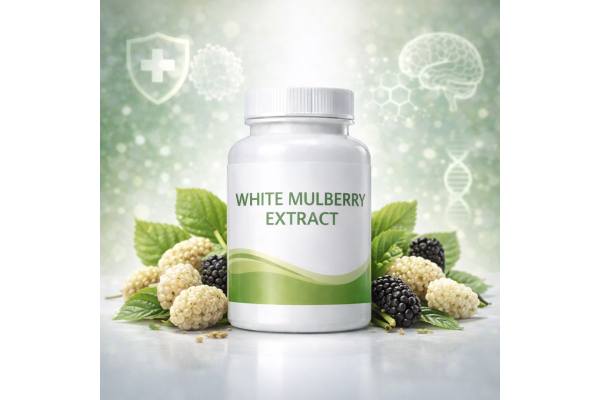
White mulberry extract is a concentrated form of Morus alba leaf compounds best known for helping soften post-meal blood sugar spikes. Its “signature” ingredient, 1-deoxynojirimycin (DNJ), slows the breakdown of certain carbohydrates so glucose enters the bloodstream more gradually. That single mechanism shapes most real-world uses: pairing the extract with carb-containing meals, supporting appetite control by reducing the crash that follows a sharp spike, and complementing broader lifestyle work for metabolic health.
Unlike many “metabolism” supplements that rely on vague claims, white mulberry has a practical, measurable target: the postprandial (after-eating) glucose curve. Still, effects vary with the product’s DNJ content, timing, and meal composition, and it is not a substitute for diabetes care. This guide walks you through benefits, properties, smart use cases, dosage ranges, and safety.
Essential Insights for White Mulberry Extract
- May reduce post-meal glucose and insulin rises when taken shortly before carbohydrate-containing meals.
- Effects tend to be most noticeable with fast-digesting carbs (bread, rice, sweets) rather than high-fiber meals.
- Typical studied ranges include 200–250 mg before a meal or 300 mg twice daily, depending on the extract.
- Can cause gastrointestinal upset; combining with diabetes medicines may increase low-blood-sugar risk.
- Avoid if pregnant or breastfeeding, or if you have frequent hypoglycemia or complex diabetes regimens without clinician guidance.
Table of Contents
- What is white mulberry extract?
- Does it actually help blood sugar?
- Can it support cholesterol and metabolic markers?
- Best uses and how to take it
- How much should you take?
- Side effects, interactions, and who should avoid
What is white mulberry extract?
White mulberry extract usually comes from the leaves of Morus alba. You will see it sold as capsules, tablets, powders, and sometimes as “mulberry leaf tea,” though teas are typically less standardized than capsules. The most important difference between products is not the form—it is whether the extract is standardized, meaning it reliably contains a known amount or percentage of key compounds.
The compound most associated with white mulberry’s metabolic effects is 1-deoxynojirimycin (DNJ). DNJ is a naturally occurring “iminosugar” that acts as an alpha-glucosidase inhibitor—a mouthful that simply means it slows enzymes that break down certain carbohydrates in the small intestine. When carb digestion slows, glucose tends to enter the blood more gradually, which can reduce the size of a post-meal spike.
White mulberry leaf extract also contains supportive plant compounds that may matter depending on the product:
- Flavonoids and phenolics (such as quercetin-related compounds) that may influence oxidative stress pathways
- Chlorogenic acid–type compounds that appear in many plant foods and can affect glucose handling
- Polysaccharides and fibers that can modestly alter digestion and satiety
- Micronutrients in small amounts (generally not the main reason to use the extract)
A helpful way to think about white mulberry is that it is meal-coupled. Many supplements are taken “daily and hope for the best.” Mulberry is different: its best-supported use is timed around eating, especially around meals that would normally raise glucose quickly.
Finally, “white mulberry” is used casually to describe the plant, but supplements can vary widely by leaf source, extraction method, and DNJ concentration. Two bottles can share the same front label and perform very differently. If you remember one rule from this section: standardization and timing are the difference between a meaningful trial-like use and random supplementation.
Does it actually help blood sugar?
For many people, the most noticeable and measurable potential benefit of white mulberry extract is a smaller post-meal glucose rise, especially after meals rich in refined or fast-digesting carbohydrates (white bread, rice, cereal, sweets, fruit juice). This aligns with its DNJ-driven mechanism: slowing carbohydrate breakdown so glucose appears in the bloodstream more gradually.
In controlled human studies, mulberry leaf extract has repeatedly shown the ability to reduce post-meal glucose and insulin responses under specific conditions—typically when taken shortly before a carbohydrate challenge or a mixed meal. In one randomized, double-blind, placebo-controlled study design, adding mulberry leaf extract to a sucrose load lowered glycemic and insulinemic responses meaningfully, suggesting a direct “digestive braking” effect rather than a slow, vague metabolic change.
A practical expectation to set: mulberry is not usually a “fasting glucose miracle.” Fasting glucose and HbA1c (a longer-term marker) can improve in some people—especially when baseline glucose is high and the supplement is used consistently with carb-heavy meals—but the most reliable effect remains the after-eating curve. This is why people using continuous glucose monitors (CGMs) often describe mulberry as a “spike smoother.”
To make the effect more likely, match the supplement to the scenario:
- Best-case meal: high glycemic load (refined carbs), low-to-moderate fiber
- Harder-to-notice meal: high-fiber, high-protein meals that already blunt spikes
- Most consistent timing: shortly before the first bites (not hours earlier)
It is also important to keep mulberry in the right role. If you have prediabetes, it may help reduce the “glucose roller coaster” that drives cravings and fatigue after carb-heavy meals. If you have type 2 diabetes, it may be a helpful adjunct—but it is not a replacement for medication, nutrition, movement, sleep, and clinician monitoring.
Finally, if your goal is measurable improvement, treat it like a mini-experiment. Use the same breakfast for several days, measure glucose (or pay attention to symptoms), then compare with and without mulberry. The supplement is most useful when you can actually see or feel the difference it creates.
Can it support cholesterol and metabolic markers?
White mulberry extract is often marketed for “metabolic health,” which can include cholesterol, triglycerides, inflammatory markers, oxidative stress, and insulin sensitivity. The reality is nuanced: the strongest and most direct evidence is for post-meal glucose handling, while cardiometabolic markers may improve more modestly—and often depend on duration, dose, and baseline risk.
Some clinical trials in people with type 2 diabetes have reported improvements in specific markers (for example, changes in insulin-related measures and select lipid parameters), while other markers remain unchanged. This mixed pattern is common in nutrition studies: when an intervention mainly affects digestion and post-meal physiology, downstream markers may shift only when the intervention is sustained long enough or when baseline values are meaningfully abnormal.
From an “outcomes logic” standpoint, lipid improvements—when they occur—may be explained by a few overlapping pathways:
- Lower post-meal insulin peaks may reduce signals that promote fat storage and triglyceride production in the liver.
- Polyphenols and flavonoids may influence oxidative stress and inflammatory signaling (effects tend to be small but plausible).
- Improved glycemic variability (fewer sharp spikes and crashes) may support better dietary choices and energy regulation over time, indirectly benefiting weight and lipids.
When people ask, “Will it lower my cholesterol?” a responsible answer is: it might help, but it is not as predictable as dedicated lifestyle steps (fiber intake, saturated fat reduction, weight loss when appropriate) or lipid-lowering medications when needed. If cholesterol is your primary concern, white mulberry should be considered a secondary tool—useful if you also care about glucose spikes and carb tolerance.
Where it may be most useful is the overlap zone: people with higher post-meal glucose responses often also have elevated triglycerides, central adiposity, and insulin resistance. In that cluster, smoothing glucose and insulin responses around meals can support a broader metabolic strategy.
A practical way to position it:
- Primary strength: post-meal glucose and insulin control
- Potential secondary benefits: modest support for lipids and inflammation in higher-risk groups when used for weeks to months
- Not ideal as a stand-alone: isolated high LDL cholesterol without glucose issues
If you choose to try it for cardiometabolic support, give it a fair window (often 8–12 weeks) and track the markers that matter: fasting glucose, HbA1c (if applicable), triglycerides, HDL, and how you feel after meals.
Best uses and how to take it
White mulberry extract shines when you use it with clear intent instead of taking it “because it is healthy.” The most practical uses revolve around predictable situations: carb-heavy meals, eating out, sweet cravings, and periods when your routine is less structured.
Here are high-value use cases that match how the ingredient works:
- Carb-heavy meals you cannot easily change. If you are eating pasta, rice, bread, dessert, or a sweetened beverage, mulberry may blunt the spike that follows. This can be especially useful during travel, social events, or busy workdays.
- Post-meal fatigue or cravings. Many people experience a dip 1–3 hours after a high-carb meal. Smoother glucose curves often feel like steadier energy and fewer urgent snack cravings.
- Prediabetes support alongside lifestyle changes. If you are already improving diet and activity, mulberry can be a tactical aid—especially when used as a bridge while habits are forming.
- A “carb tolerance” tool for experimentation. If you are testing how your body reacts to different breakfasts, mulberry can be part of a structured approach (same meal, different conditions).
How to take it well (the details matter):
- Time it close to the meal. Many studies use intake shortly before the carbohydrate load. In real life, aim for 5–15 minutes before eating, or immediately before the first bites if that is easier.
- Pair it with the meals that need it. You do not necessarily need it with a high-protein, high-fiber meal that already produces a gentle glucose curve.
- Start low and learn your response. Begin with the lower end of the label’s range for a few days, especially if you are sensitive to gastrointestinal changes.
- Do not “stack” it thoughtlessly. If you also take berberine, alpha-lipoic acid, or prescription glucose-lowering drugs, the combined effect can be stronger than expected.
- Treat it as a support, not permission. The best long-term results usually come from using mulberry to reduce damage from an occasional high-carb meal, not to justify a pattern of highly refined eating.
A key advantage of this supplement is behavioral: when you can reduce the spike-crash cycle, you may find it easier to maintain steady eating patterns. That does not show up on a label, but it is often the difference between a supplement that “works in theory” and one that changes daily life.
How much should you take?
The right dose depends on the product’s DNJ content, whether it is standardized, and whether you are using it for acute post-meal control or longer-term metabolic support. Because labels can vary, it is best to anchor dosing to patterns used in human studies and then adapt cautiously.
Common study-informed dosing patterns include:
- Before a single meal (acute use): 200–250 mg of a standardized mulberry leaf extract taken shortly before eating has been studied in a mixed-meal challenge context. This approach is “surgical”: use it when you expect a spike.
- Daily, longer-term use: Some trials in type 2 diabetes have used 300 mg twice daily (total 600 mg/day) for 12 weeks, suggesting a structured daily regimen may influence selected metabolic markers beyond the immediate meal window.
- Higher daily intakes in broader reviews: Meta-analytic evidence across mulberry interventions suggests that daily intakes above ~300 mg/day are commonly represented in studies where cardiometabolic markers shift, though exact outcomes vary by population and product type.
A practical dosing framework you can actually follow:
- If your goal is post-meal glucose control: start with 200 mg before your highest-carb meal for 3–7 days. If tolerated and you want more support, consider 250 mg before that meal or before two carb-heavy meals per day.
- If your goal is broader metabolic support (weeks to months): consider a consistent routine such as 300 mg twice daily with meals, only if your product matches what has been studied and you tolerate it well.
- If you are already on glucose-lowering medication: avoid self-escalation. Use conservative dosing, monitor glucose, and discuss with a clinician.
Timing tips that improve results:
- Take it right before the first bites, especially for refined carbohydrates.
- If the meal is slow (multi-course), take it near the first carbohydrate-containing course rather than long before sitting down.
- If you forget until after eating, taking it late is less likely to help because the digestive enzymes have already done much of their work.
Quality and label considerations:
- Prefer products that specify standardization (for example, DNJ-related standardization or a branded standardized extract).
- Avoid “proprietary blends” that do not disclose exact amounts.
- If you are using tea, treat it as a gentle food habit rather than a precise dosing tool unless the product provides verified content.
The best dose is the smallest one that produces a meaningful effect you can tolerate. With white mulberry, consistency and timing often matter more than chasing a bigger number.
Side effects, interactions, and who should avoid
White mulberry extract is generally well tolerated in studies, but “natural” does not mean risk-free. Most side effects relate to digestion or to blood sugar lowering that becomes too strong when combined with other glucose-lowering tools.
Common side effects (usually mild to moderate):
- Gastrointestinal discomfort (bloating, cramping, nausea)
- Changes in bowel habits (diarrhea or constipation)
- Headache or light dizziness in some users, sometimes related to lower glucose or reduced appetite
Why side effects happen: slowing carbohydrate digestion can increase the amount of carbohydrate that reaches later parts of the gut, which can change fermentation patterns and water movement. For many people this is mild and temporary, but it can be uncomfortable if you start high or combine multiple gut-active supplements.
Interactions and higher-risk combinations:
- Diabetes medications (highest importance): If you use insulin or insulin secretagogues (such as sulfonylureas), adding mulberry can increase the risk of hypoglycemia. Even with metformin, the combination may feel “stronger” around meals for some people. Monitoring matters.
- Multiple glucose-lowering supplements: Stacking mulberry with berberine, bitter melon, gymnema, alpha-lipoic acid, or high-dose cinnamon can intensify effects unpredictably.
- Pre-surgery or fasting situations: If you are fasting, have low appetite, or are preparing for surgery, lowering post-meal glucose is not the priority—stability and safety are.
Who should avoid (or use only with clinician guidance):
- Pregnancy and breastfeeding: safety data are not strong enough for confident routine use.
- Children: pediatric dosing and safety are not well established.
- People with frequent hypoglycemia or very tight glucose targets (including those on complex insulin regimens).
- People with significant gastrointestinal disorders where changing carbohydrate digestion can worsen symptoms.
- Anyone with unexplained symptoms (fainting, persistent vomiting, severe diarrhea): stop and seek medical advice.
How to lower risk if you still want to try it:
- Start low (for example, 200 mg before one meal) and increase only if needed.
- Do not combine with new glucose-lowering changes all at once. If you also change diet or start a new medication, introduce mulberry later so you can attribute effects correctly.
- Track glucose if you can. Even a few finger-stick checks around the target meal can prevent unpleasant surprises.
- Stop if you feel “too low.” Shakiness, sweating, confusion, or unusual irritability after meals can signal hypoglycemia, especially in medicated diabetes.
A final point on expectations: white mulberry extract can be a useful adjunct, but it should never delay diagnosis, monitoring, or evidence-based treatment of diabetes or cardiovascular risk factors. Use it as a tool within care, not a substitute for care.
References
- Effect of mulberry leaf or mulberry leaf extract on glycemic traits: a systematic review and meta-analysis 2023 (Systematic Review and Meta-Analysis)
- Understanding the Impact of Different Doses of Reducose® Mulberry Leaf Extract on Blood Glucose and Insulin Responses after Eating a Complex Meal: Results from a Double-Blind, Randomised, Crossover Trial 2024 (RCT)
- Morus Alba leaf extract affects metabolic profiles, biomarkers inflammation and oxidative stress in patients with type 2 diabetes mellitus: A double-blind clinical trial 2022 (RCT)
- Mulberry leaf extract improves glycaemic response and insulaemic response to sucrose in healthy subjects: results of a randomized, double blind, placebo-controlled study 2021 (RCT)
- Impact of mulberry consumption on cardiometabolic risk factors: A systematic review and meta-analysis of randomized-controlled trials 2022 (Systematic Review and Meta-Analysis)
Disclaimer
This article is for educational purposes only and does not provide medical advice, diagnosis, or treatment. Dietary supplements such as white mulberry extract can affect blood sugar and may interact with prescription medicines, especially diabetes medications. If you are pregnant or breastfeeding, have a chronic medical condition, or use medications that influence glucose, lipids, or blood pressure, consult a licensed clinician before starting this supplement. Stop use and seek medical care if you develop concerning symptoms such as signs of low blood sugar, severe gastrointestinal distress, or allergic reactions.
If you found this guide helpful, please consider sharing it on Facebook, X (formerly Twitter), or any platform you prefer, and follow us on social media. Your support through sharing helps our team keep producing clear, evidence-informed health content.