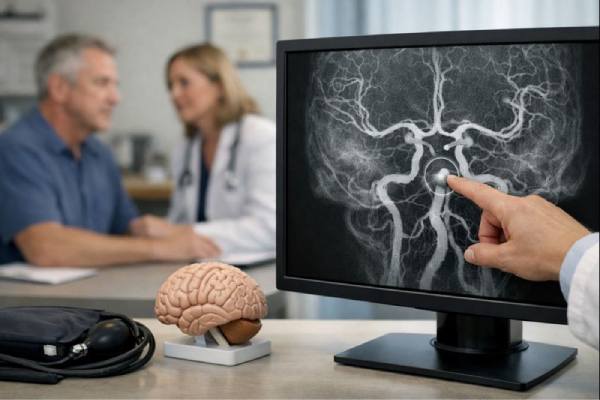
A basilar artery aneurysm is a weakened, bulging area in a major blood vessel at the base of the brain. Because the basilar artery supplies the brainstem and vital pathways for breathing, swallowing, balance, and consciousness, problems here can become serious quickly. Many aneurysms are found incidentally during scans done for headaches or dizziness, and most unruptured aneurysms cause no symptoms at all. The main concern is rupture, which can lead to a sudden brain bleed called subarachnoid hemorrhage. Basilar aneurysms can also press on nearby nerves or trigger small clots that affect blood flow. If you have been told you have one, the next steps are usually about sizing up risk, choosing the right imaging, and deciding between careful monitoring and a procedure. Good care focuses on preventing rupture while avoiding unnecessary treatment risks.
Table of Contents
- What is a basilar artery aneurysm
- Why do basilar aneurysms form
- Symptoms of unruptured and ruptured aneurysms
- How doctors diagnose basilar aneurysms
- Treatment options and procedure risks
- Recovery, monitoring and preventing rupture
What is a basilar artery aneurysm
A basilar artery aneurysm is a balloon-like outpouching in the wall of the basilar artery, a central vessel formed by the two vertebral arteries joining at the base of the skull. From there, the basilar artery runs along the brainstem and branches into vessels that feed the back of the brain, including areas responsible for vision, coordination, and life-sustaining reflexes.
Where basilar aneurysms usually occur
Basilar aneurysms are often described by location, because location affects both rupture risk and treatment strategy:
- Basilar tip (apex) aneurysm: at the fork where the basilar artery divides into the posterior cerebral arteries
- Basilar trunk aneurysm: along the main segment of the artery
- Branch-point aneurysms: near smaller perforator branches that supply the brainstem
Most are saccular (berry-shaped) aneurysms. Others are fusiform or dissecting aneurysms, where a longer segment of the artery is involved and the vessel wall may split or weaken in a more diffuse way. Those shapes behave differently and may require different treatment approaches.
Why this location matters
The basilar artery sits in a crowded neighborhood. Small perforator arteries leave it to supply the brainstem, and several cranial nerves run nearby. That is why basilar aneurysms can cause symptoms even without rupture, either by pressing on nerves or by affecting blood flow. It is also why treatment can be technically demanding: a procedure must protect tiny branches that cannot be replaced if blocked.
What clinicians mean by “ruptured” and “unruptured”
- Unruptured aneurysm: the vessel wall bulge is present but has not bled. The focus is estimating future rupture risk and deciding on surveillance or preventive repair.
- Ruptured aneurysm: the aneurysm has bled, usually causing a sudden, severe headache and other neurologic symptoms. This is a medical emergency that typically requires urgent aneurysm securing and intensive monitoring.
A practical way to think about basilar artery aneurysm care is risk balancing. The condition itself carries risk, but so do procedures in this region. A good plan is individualized and built around your aneurysm’s size, shape, growth, symptoms, and your overall health profile.
Why do basilar aneurysms form
Aneurysms form when the inner layers of an artery wall weaken and gradually bulge under pulsating blood pressure. In the basilar artery, this tends to happen at branch points where blood flow strikes the wall with higher shear stress. Over years, that stress can contribute to structural wear in the vessel wall, especially when combined with inherited or acquired vulnerabilities.
Common contributing causes
For many people, there is no single cause. Instead, several factors add up:
- Long-term high blood pressure: increases stress on artery walls and can accelerate weakening
- Smoking or nicotine exposure: damages the endothelium (the vessel’s inner lining) and promotes inflammation
- Atherosclerosis and vascular aging: can change vessel wall integrity and flow patterns
- Genetic tendency: aneurysms can cluster in families even without a named syndrome
- Vessel wall disorders: certain connective tissue conditions can increase risk, though they are uncommon
- Prior vessel injury: rare causes include trauma, infection-related aneurysms, or inflammatory vessel disease
- Dissection-related aneurysm: a tear in the vessel wall can evolve into a dissecting aneurysm, sometimes after sudden neck movements or as part of an underlying arteriopathy
Risk factors that raise concern for rupture or growth
Not every basilar aneurysm behaves the same. Clinicians often pay extra attention when one or more of these features are present:
- Larger size, especially as an aneurysm approaches double-digit millimeter measurements
- Irregular shape, such as a lobulated contour or a small “daughter sac”
- Documented growth on follow-up imaging
- Posterior circulation location (which includes the basilar artery)
- Previous aneurysm rupture elsewhere in the brain
- Ongoing smoking, uncontrolled blood pressure, or stimulant drug exposure
- Symptoms attributed to the aneurysm, such as nerve compression signs
Triggers versus true causes
People often ask whether a specific event “caused” an aneurysm. In most cases, aneurysms develop slowly. A sudden spike in blood pressure, intense exertion, or severe straining may be discussed as potential triggers for rupture, but they are not usually the root cause. The more meaningful prevention targets are the ongoing factors that influence vessel health over time: blood pressure control, smoking cessation, and managing vascular risk.
If you are newly diagnosed, an important early step is classification: saccular versus fusiform or dissecting, basilar tip versus trunk, and stable versus growing. Those details shape the entire conversation about next steps.
Symptoms of unruptured and ruptured aneurysms
Many basilar artery aneurysms cause no symptoms and are found by chance. When symptoms do occur, they usually come from one of three mechanisms: pressure on nearby nerves or brain tissue, disturbed blood flow with small clots, or rupture with bleeding around the brain.
Symptoms of an unruptured basilar aneurysm
Unruptured aneurysms can become symptomatic if they are large, irregular, or positioned where they irritate nearby structures. Possible symptoms include:
- New or worsening headaches that feel different from your usual pattern
- Double vision, drooping eyelid, or trouble moving one eye normally
- Facial numbness, tingling, or pain
- Dizziness, imbalance, or unsteady walking
- Slurred speech, difficulty swallowing, or hoarseness
- Episodes that resemble transient ischemic attacks, such as brief weakness, vision changes, or speech difficulty, especially if small clots form near the aneurysm
Because these symptoms can have many causes, clinicians typically focus on whether symptoms match the aneurysm’s location and whether imaging shows compression or flow changes.
Warning signs of rupture
Rupture usually causes subarachnoid hemorrhage, which often presents dramatically. Seek emergency care immediately for:
- Sudden, severe “worst headache of my life,” often peaking within seconds to a minute
- Neck stiffness, sensitivity to light, vomiting, or collapse
- Confusion, fainting, seizure, or sudden extreme sleepiness
- New neurologic deficits such as weakness, numbness, vision loss, or trouble speaking
A key point: the absence of prior symptoms does not rule out rupture risk. Some aneurysms rupture without warning.
Complications to understand
Complications differ for ruptured versus unruptured aneurysms.
For ruptured aneurysms, early dangers include rebleeding, acute hydrocephalus (fluid buildup), and medical instability. Later complications can include vasospasm (narrowing of brain arteries), delayed brain injury, and longer-term cognitive or functional changes.
For unruptured aneurysms, the main concerns are growth, rupture, and less commonly, stroke-like events from thromboembolism. Large basilar aneurysms can also compress the brainstem over time, leading to progressive balance problems, swallowing difficulty, or cranial nerve deficits.
If you have been diagnosed and your symptoms change suddenly—especially vision changes, worsening imbalance, fainting, or severe headache—treat that as urgent until proven otherwise.
How doctors diagnose basilar aneurysms
Diagnosis usually starts with brain imaging and then becomes more detailed as clinicians define the aneurysm’s anatomy and risk profile. Because basilar artery aneurysms sit deep in the skull near critical branches, precise imaging is not a luxury—it is the basis for safe decision-making.
Imaging tests commonly used
- CT angiography (CTA): fast, widely available, and often the first detailed look. CTA helps estimate size and shape and can detect blood if rupture is suspected.
- MR angiography (MRA): useful for follow-up without ionizing radiation. Depending on the technique, it may or may not require contrast.
- Digital subtraction angiography (DSA): considered the most detailed test for aneurysm anatomy. It can show small branches and perforators and is often used when a procedure is being planned. DSA is invasive, so clinicians weigh benefit and risk carefully.
In an emergency setting, a non-contrast CT scan is typically used first to check for bleeding. If bleeding is present or strongly suspected, further vascular imaging follows quickly to identify the source.
What clinicians measure and why
A diagnosis is not just “you have an aneurysm.” A useful report describes:
- Size: maximum diameter and neck width
- Shape: smooth versus irregular or lobulated
- Location: basilar tip versus trunk, and relationship to branching vessels
- Type: saccular versus fusiform or dissecting
- Evidence of growth: comparison with prior imaging
- Associated findings: thrombus inside the aneurysm, vessel narrowing, or nearby brainstem compression
These details inform rupture-risk estimation and treatment feasibility. For example, a wide-neck basilar tip aneurysm may be technically difficult to coil without additional support devices, while a fusiform basilar trunk aneurysm may require a reconstructive approach rather than a simple “fill the sac” strategy.
Medical evaluation alongside imaging
Clinicians also assess the person, not only the aneurysm:
- Blood pressure patterns and vascular risk factors
- Smoking status and medication history, including blood thinners
- Family history of aneurysms or sudden brain hemorrhage
- Neurologic symptoms, eye exam findings, and swallow or balance changes
- For ruptured aneurysm: overall clinical grade, hydrocephalus signs, and complications risk
If an aneurysm is unruptured, many teams schedule repeat imaging at an interval based on initial risk features, balancing the need to detect growth against the burden of frequent scans. If it is ruptured, the diagnostic process compresses into hours because treatment decisions must be made quickly.
Treatment options and procedure risks
Treatment decisions for a basilar artery aneurysm depend on rupture status, size and shape, symptoms, growth, patient age and health, and the technical risk of intervention. In many cases, the “best” choice is not universal; it is the one that offers the greatest risk reduction with the least added danger.
Emergency treatment after rupture
A ruptured basilar aneurysm is usually treated urgently to prevent rebleeding. The two main ways to secure the aneurysm are:
- Endovascular therapy: a catheter-based approach through an artery, often using coils, stent-assisted coiling, or other devices depending on anatomy
- Microsurgical clipping: open surgery to place a clip across the aneurysm neck, isolating it from blood flow
In the basilar region, endovascular approaches are often favored because the anatomy is deep and surrounded by critical structures. Still, surgery may be considered in select cases depending on aneurysm configuration and local expertise.
Preventive treatment for unruptured aneurysms
For unruptured aneurysms, the question is whether treatment risk is lower than the estimated rupture risk over time. Options may include:
- Endovascular coiling: filling the aneurysm sac to promote clotting inside it
- Stent-assisted coiling: a scaffold across the neck to keep coils in place for wide-neck aneurysms
- Flow diversion: a stent-like device that redirects blood away from the aneurysm and encourages the vessel wall to remodel over time. In the posterior circulation, careful selection is essential because small perforator branches can be affected.
- Microsurgical approaches: used selectively, typically in specialized centers with experience in complex posterior circulation aneurysms
Risks to discuss clearly
All procedures carry risk, and basilar aneurysms have some unique ones because of brainstem perforators and nearby cranial nerves. Important risks include:
- Stroke from clotting or vessel blockage, including small perforator strokes that can cause major disability
- Bleeding during the procedure or delayed hemorrhage
- Cranial nerve injury, leading to double vision, swallowing problems, or facial weakness
- Need for long-term antiplatelet therapy when stents or flow diverters are used, which increases bleeding risk from other causes
- Incomplete occlusion or recurrence, sometimes requiring retreatment
A practical planning point is medication readiness. If a stent-based strategy is likely, clinicians may start or adjust antiplatelet therapy beforehand and confirm platelet response. For ruptured aneurysms, teams must balance securing the aneurysm quickly with the bleeding risks of antiplatelets, which can complicate decision-making.
The best outcomes tend to come from a center that regularly treats posterior circulation aneurysms and can offer both endovascular and surgical perspectives. The goal is not simply “treat it,” but “treat it in the safest way for this anatomy and this person.”
Recovery, monitoring and preventing rupture
Management does not end after a diagnosis or a procedure. Long-term safety comes from structured follow-up, risk-factor control, and a clear plan for new symptoms.
If your aneurysm is monitored without a procedure
Active surveillance typically includes periodic imaging to detect growth or new irregularities. Your clinician may recommend different intervals depending on aneurysm features and your risk profile. A helpful monitoring plan usually answers:
- Which scan will be used for follow-up (CTA or MRA)
- How often imaging will be repeated if stable
- What change would trigger treatment discussion (growth, new symptoms, or shape change)
- What symptoms should prompt urgent evaluation
Risk reduction focuses on what you can control:
- Keep blood pressure in a healthy range with a consistent plan, not sporadic treatment
- Stop smoking and avoid nicotine in all forms
- Avoid stimulant drugs and be cautious with decongestants that raise blood pressure
- Treat sleep apnea if present, since it can worsen blood pressure swings
- Maintain regular medical follow-up for cholesterol, diabetes, and vascular health
After endovascular treatment or surgery
Recovery depends on rupture status. After elective treatment of an unruptured aneurysm, many people return to normal routines within weeks, but they may need:
- Follow-up imaging to confirm durable aneurysm occlusion
- Monitoring for headache changes, new neurologic symptoms, or access-site complications
- Medication adherence, especially antiplatelet therapy after stent-based treatment
- Guidance on activity, travel, and return to work based on individual healing
After a ruptured aneurysm, recovery can be longer and less predictable. Rehabilitation may address fatigue, balance, memory, mood, and return to independence. People often benefit from staged goals rather than a single “back to normal” timeline.
When to seek urgent care
Call emergency services or seek immediate evaluation for:
- Sudden severe headache, collapse, seizure, or new confusion
- New weakness, numbness, speech trouble, double vision, severe dizziness, or swallowing difficulty
- A sudden, sustained spike in blood pressure with neurologic symptoms
- After a procedure: severe headache, new neurologic deficit, or uncontrolled bleeding
Living with a basilar artery aneurysm can feel psychologically heavy because the brain’s most vital functions are involved. Many people do better when they have a written plan, a realistic understanding of risk, and a care team that treats uncertainty with structure rather than reassurance alone. With consistent monitoring and risk reduction, many unruptured aneurysms remain stable, and many treated aneurysms remain secure.
References
- 2023 Guideline for the Management of Patients With Aneurysmal Subarachnoid Hemorrhage: A Guideline From the American Heart Association/American Stroke Association 2023 (Guideline)
- European Stroke Organisation (ESO) guidelines on management of unruptured intracranial aneurysms 2022 (Guideline)
- Flow Diversion of Posterior Circulation Aneurysms: Systematic Review of Disaggregated Individual Patient Data 2021 (Systematic Review)
- Efficacy and safety of flow diverters in basilar artery aneurysms: a single-center retrospective cohort study 2025 (Clinical Study)
- The Management of Intracranial Aneurysms: Current Trends and Future Directions 2024 (Review)
Disclaimer
This article is for educational purposes only and does not provide medical advice, diagnosis, or treatment. Basilar artery aneurysms can be life-threatening, especially if rupture occurs, and treatment decisions require individualized evaluation by qualified clinicians. If you develop sudden severe headache, fainting, seizure, new weakness, vision changes, speech trouble, confusion, or trouble swallowing, seek emergency care immediately. Always follow the guidance of your neurology, neurosurgery, or stroke team for imaging schedules, medication use (including antiplatelets or blood thinners), and activity recommendations.
If you found this article helpful, please share it on Facebook, X (formerly Twitter), or any platform you prefer, and follow us on social media. Your support through sharing helps our team continue producing high-quality content.