Femoropopliteal disease is a form of poor circulation that affects the large arteries running through the thigh and behind the knee. When these vessels narrow, your leg muscles may not get enough blood during activity, which can turn a normal walk into a stop-and-start routine. Many people first notice it as a tight, cramping ache in the calf that reliably appears after a certain distance and eases with rest. Others have no early warning and only discover the problem when a foot sore will not heal. Because this condition often travels with heart and brain artery disease, it matters beyond the leg: it can signal a higher risk of heart attack and stroke. The goal of this guide is to make the condition understandable, highlight symptoms that require urgent care, and explain the options that can improve walking, protect the limb, and reduce future risk.
Table of Contents
- What femoropopliteal disease means in your leg
- Why these arteries narrow or block
- Symptoms: from calf cramps to limb threat
- How doctors confirm the diagnosis
- Treatments that improve blood flow and walking
- Living with it: prevention and follow-up
What femoropopliteal disease means in your leg
“Femoropopliteal” describes a stretch of artery that starts in the thigh (the superficial femoral artery) and continues behind the knee (the popliteal artery). These vessels feed smaller branches that supply the calf and foot. Femoropopliteal disease usually means the inner lining of this artery has developed plaque—fatty, inflamed buildup that narrows the channel. The result is a bottleneck: at rest, the leg may still get enough blood, but during walking or climbing stairs, the working muscles demand more oxygen than the narrowed artery can deliver.
This part of the leg is a common trouble spot for three reasons. First, the artery bends and twists with every step, which puts mechanical stress on plaques and on any stents placed there. Second, calcification (hard mineral buildup) is frequent in the thigh arteries, especially in diabetes and kidney disease, making the vessel stiff and harder to treat. Third, blockages here often occur in long segments rather than a single short pinch point.
It also helps to know the typical patterns:
- Stenosis (narrowing): Blood still passes through, but flow is limited under stress.
- Occlusion (complete blockage): Blood must detour through “collateral” side vessels. Collaterals can protect the leg at rest, but may not keep up during activity or when a wound needs extra blood to heal.
- Chronic total occlusion: A long-standing blockage that the body has partially adapted to. Symptoms may be stable for months, then worsen.
- Acute on chronic: A previously narrowed segment suddenly clots, causing a rapid change in symptoms.
Finally, femoropopliteal disease is part of peripheral artery disease (PAD). That matters because PAD is rarely isolated. If plaque is significant enough to limit leg blood flow, it may also exist in coronary (heart) or carotid (neck) arteries. A good treatment plan therefore aims at two outcomes: better leg function now and better cardiovascular protection long term.
Why these arteries narrow or block
Most femoropopliteal disease develops from atherosclerosis, but the “why” is more specific than simply “cholesterol.” Plaque forms when the artery lining is repeatedly irritated—by tobacco toxins, high blood pressure, high blood sugar, inflammation, and abnormal cholesterol particles. Over time, the wall thickens, the channel narrows, and the surface can become rough. That roughness matters because it can trigger clotting and sudden symptom changes.
Common drivers include:
- Smoking: A powerful accelerator of plaque and artery spasm. Even a few cigarettes per day can keep the artery inflamed and less able to widen during exertion.
- Diabetes: Raises plaque risk and makes arteries more calcified. It also reduces pain sensation, which can delay recognition of a wound or worsening circulation.
- High LDL cholesterol: Promotes plaque growth and instability.
- High blood pressure: Increases mechanical stress on the vessel wall.
- Kidney disease: Often brings severe calcification and faster progression.
Beyond these core causes, several mechanisms can worsen or “tip” the condition:
- Inflammatory surges: A major infection, surgery, or flare of an inflammatory illness can increase clotting tendency and narrow already tight segments.
- Dehydration and low blood pressure: Less circulating volume can reduce flow through a narrowed artery, revealing symptoms that were previously silent.
- Progression of plaque to clot: When plaque surface cracks, platelets stick to it and a clot can grow quickly. This is one reason a stable walking pattern can suddenly change over days.
- Stent restenosis: After a stent is placed, scar tissue can grow inside it, or plaque can progress at its edges. This may cause a gradual return of symptoms.
- In-stent thrombosis: A sudden stent clot can cause abrupt, severe symptoms, especially if antiplatelet medication was interrupted.
Less common causes exist but deserve mention because they change management: artery injury after catheter procedures, trauma to the thigh/knee region, radiation-related artery damage, and rare vessel inflammation disorders. These are usually suspected when symptoms begin after a clear trigger or when the person lacks typical risk factors.
A practical takeaway: femoropopliteal disease reflects both “plumbing” (the degree of narrowing) and “biology” (how inflamed and clot-prone the system is). That’s why treatment combines circulation-improving strategies with medications and lifestyle steps that stabilize plaque and lower overall cardiovascular risk.
Symptoms: from calf cramps to limb threat
Symptoms depend on how tight the narrowing is, how active you are, and how many collateral vessels you’ve developed. Many people notice patterns long before they think of an artery problem.
Typical early symptom: intermittent claudication
This is a cramping, tight, or aching discomfort in the calf (sometimes thigh or buttock) that:
- starts after a predictable walking distance or hill climb
- improves within a few minutes of rest
- returns when you resume the same pace
People often describe it as “my calf locks up,” “a deep squeeze,” or “like my leg runs out of fuel.” A useful clue is repeatability: the symptom tends to appear at about the same distance for weeks or months.
Other common symptoms
- Leg fatigue or heaviness that limits walking before pain becomes obvious
- Coldness in one foot compared with the other
- Slower toenail growth or less hair on the lower leg
- Color change when the leg is down (darker or reddish) or when elevated (paler)
When it becomes more serious: chronic limb-threatening ischemia (CLTI)
CLTI means the leg cannot meet the basic needs of the tissues even at rest. Signs include:
- Rest pain in the foot, often worse at night
- Non-healing sores on toes, heel, or foot edges
- Skin breakdown or black tissue (gangrene)
Rest pain often improves when the foot is dangled off the bed because gravity helps blood reach the foot. That pattern—worse when elevated, better when down—is a strong clue that circulation is the issue.
Danger signs: acute limb ischemia
Seek emergency care if you develop sudden, severe symptoms such as:
- intense new leg or foot pain
- numbness or tingling that is spreading
- weakness or trouble moving the foot/toes
- a foot that becomes noticeably cold or pale
These can mean a sudden clot has formed on top of chronic disease.
Conditions that can mimic it
- Spinal stenosis (nerve compression): leg pain with walking that improves with bending forward or sitting, not just stopping.
- Arthritis: joint pain with stiffness rather than deep muscle cramp.
- Peripheral neuropathy: burning, numbness, or tingling that is not distance-dependent.
A helpful self-check is the “pattern test”: if the discomfort is reliably tied to exertion and reliably relieved by rest in minutes, circulation climbs higher on the list.
How doctors confirm the diagnosis
Diagnosis starts with listening to the story, examining the legs, and then measuring blood flow in a way that matches the symptom pattern. The goal is not only to confirm femoropopliteal disease, but to map where it is and how severe it is—because those details guide treatment choices.
1) History and focused exam
Clinicians ask:
- how far you can walk before symptoms start
- how quickly symptoms stop with rest
- whether one leg is consistently worse
- whether you have foot sores, rest pain, or nighttime pain
- smoking history, diabetes control, cholesterol, blood pressure, kidney disease, and prior vascular procedures
On exam they check skin temperature, capillary refill, foot color, and wounds. They also feel for pulses in the groin, behind the knee, and at the ankle. A normal-feeling pulse does not always rule out disease, but reduced pulses increase suspicion.
2) Ankle-brachial index (ABI): the usual first measurement
ABI compares ankle blood pressure to arm blood pressure. It is quick and noninvasive. A low ABI supports PAD and can help grade severity. In some people—especially with diabetes or kidney disease—arteries can be stiff and harder to compress, which can make ABI falsely normal or high. When that happens, clinicians may use:
- Toe-brachial index (TBI): toe pressures are less affected by calcification.
- Segmental pressures and pulse volume recordings: help localize the level of disease (thigh vs calf vs below-knee).
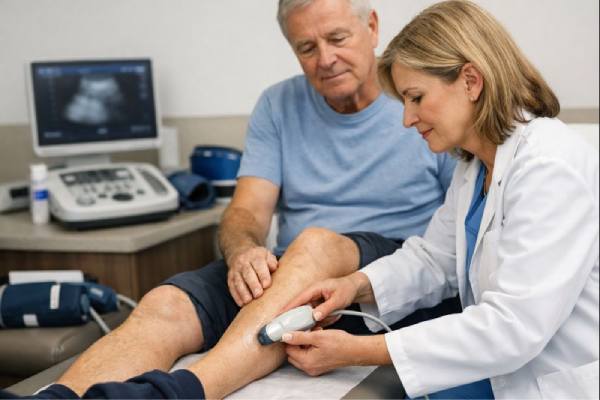
3) Duplex ultrasound: the workhorse test for mapping
Ultrasound can visualize the artery and measure flow speed. Higher speeds often indicate tighter narrowing. It can identify:
- the exact segment (superficial femoral vs popliteal)
- whether narrowing is focal or long
- whether there is complete occlusion
- how much flow reaches the lower leg
4) Cross-sectional angiography when planning intervention
If symptoms are severe, worsening, or associated with tissue loss, clinicians often order:
- CT angiography (CTA): fast, detailed mapping of the arterial tree
- MR angiography (MRA): another mapping option in selected cases
These tests help choose between endovascular therapy (catheter-based) and surgery, and they anticipate technical challenges such as long occlusions and heavy calcium.
5) Catheter angiography when diagnosis and treatment may happen together
This is done in a procedure suite and can both diagnose and treat in the same session. It is often used when an intervention is likely.
A useful mindset: tests are chosen not only to “label” the condition, but to answer practical questions—how much blood is getting to the foot, how long the diseased segment is, and whether there is a safe path to restore flow.
Treatments that improve blood flow and walking
Treatment usually combines three tracks: improving walking ability, protecting the limb, and reducing future cardiovascular events. The right mix depends on symptom severity and whether there is tissue loss.
1) Foundational therapy for most patients
- Smoking cessation: Often the highest-impact step for slowing progression and improving symptoms over time.
- Structured walking program: Supervised or structured walking is one of the most effective symptom treatments for claudication. A common approach is interval walking: walk until moderate discomfort, rest until it eases, repeat for a set session time, and gradually increase total walking time over weeks.
- Risk-factor control: Blood pressure, diabetes, and cholesterol management are not “background tasks”—they directly affect plaque stability and long-term outcomes.
2) Medications
A clinician may recommend:
- Antiplatelet therapy to reduce clot-related events
- High-intensity statin to lower LDL cholesterol and stabilize plaque
- Blood pressure therapy tailored to the individual
- Glucose-lowering therapy for diabetes, with attention to overall cardiovascular risk
- Symptom-targeted medication: In some cases, medications can improve walking distance in claudication, especially when exercise therapy is limited by pain.
Medication plans are individualized based on bleeding risk, heart rhythm issues, prior stents, and history of stroke or heart attack.
3) When procedures become the better choice
Procedures are considered when:
- claudication remains lifestyle-limiting despite exercise and medical therapy
- there is rest pain, tissue loss, or a non-healing wound
- symptoms worsen quickly, suggesting advancing disease or new clotting
Endovascular options (catheter-based)
- Balloon angioplasty: opens the narrowed segment.
- Drug-coated balloons: deliver medication to reduce tissue regrowth inside the artery after dilation.
- Stents (including specialized designs): provide scaffolding when the artery recoils or dissects after ballooning.
- Atherectomy: removes plaque in selected situations, often when calcium is heavy, though it is not necessary for everyone.
Femoropopliteal arteries move with walking, so long segments, heavy calcium, and chronic occlusions can influence the device choice and durability.
Surgical options
- Bypass surgery: routes blood around long or complex disease, often using a vein graft when possible.
- Endarterectomy (selected segments): removes plaque from specific areas, more common at the groin than mid-thigh, but sometimes part of a broader plan.
What to expect after revascularization
Many people notice improved walking distance within days to weeks. Wounds may take weeks to months to heal, depending on size, infection status, and diabetes control. Follow-up testing is often used to detect re-narrowing early, when it is easier to treat.
Living with it: prevention and follow-up
Living well with femoropopliteal disease is about building a repeatable routine that protects both the leg and the heart. Symptoms can improve substantially when daily habits and medications work together—and when warning signs are acted on early.
A practical weekly plan
- Walking sessions most days: Many people do best with 30–50 minutes per session using intervals (walk, rest, repeat). If time is tight, shorter sessions still help when done consistently.
- Strength and balance twice weekly: Simple leg strength work (as advised by a clinician or therapist) can improve walking mechanics and reduce fall risk.
- Foot checks daily: Look for blisters, cracks, redness, swelling, or drainage—especially between toes and at pressure points. Use a mirror for the sole if needed.
Footwear and skin care that prevent trouble
- Choose shoes with a wide toe box and avoid tight seams.
- Keep skin moisturized, but avoid lotion between toes where moisture can promote fungal growth.
- Trim nails carefully; if vision or flexibility is limited, consider professional foot care.
Medication follow-through
Consistency matters more than perfection. People often miss doses when traveling, when prescriptions run out, or when side effects go unreported. If you feel dizzy, bruise easily, develop muscle aches, or have stomach upset, tell your clinician rather than stopping on your own—there are usually alternatives.
Follow-up and surveillance
After a procedure, follow-up may include symptom checks and periodic ultrasound or pressure tests. The purpose is early detection of re-narrowing before it becomes a full blockage. Even without a procedure, periodic assessment helps adjust the plan as risk factors change.
When to seek urgent care
Go to emergency evaluation for:
- sudden severe leg or foot pain
- a foot that becomes cold, pale, or numb
- new weakness in the foot or toes
- rapidly worsening symptoms over minutes to hours
Call your clinician soon (within days) for:
- a noticeable drop in walking distance over 1–2 weeks
- new rest pain, especially at night
- a foot sore that is not improving
- signs of infection around a wound (spreading redness, drainage, fever)
A final perspective
Femoropopliteal disease can feel discouraging because it limits independence in a very concrete way—how far you can walk. The most successful plans are the ones that are realistic: a walking schedule you can keep, medications you can take consistently, and a clear rule for when to escalate care. Small, steady improvements compound over months and can meaningfully change both mobility and long-term risk.
References
- 2024 ACC/AHA/AACVPR/APMA/ABC/SCAI/SVM/SVN/SVS/SIR/VESS Guideline for the Management of Lower Extremity Peripheral Artery Disease: A Report of the American College of Cardiology/American Heart Association Joint Committee on Clinical Practice Guidelines 2024 (Guideline). ([PubMed][1])
- 2024 ESC Guidelines for the management of peripheral arterial and aortic diseases 2024 (Guideline). ([PubMed][2])
- Editor’s Choice – European Society for Vascular Surgery (ESVS) 2023 Clinical Practice Guidelines on Antithrombotic Therapy for Vascular Diseases 2023 (Guideline). ([PubMed][3])
- Comparison of clinical outcomes of drug-coated balloons angioplasty vs. plain old balloons angioplasty for peripheral arterial disease: an umbrella meta-analysis 2024 (Umbrella Meta-analysis). ([PMC][4])
Disclaimer
This article is for general education and does not replace medical advice, diagnosis, or treatment. Peripheral artery problems can become urgent. Seek immediate medical care if you develop sudden severe leg pain, a cold or pale foot, new numbness, or new weakness. Discuss your personal risks, medications (especially antiplatelets or anticoagulants), and procedure options with a licensed clinician who can evaluate you directly.
If you found this guide helpful, please consider sharing it on Facebook, X (formerly Twitter), or any platform you prefer, and follow us on social media. Your support through sharing helps our team continue producing clear, trustworthy health content.