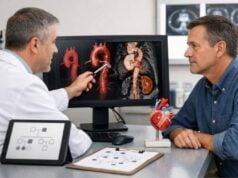
Femoral vein thrombosis is a blood clot that forms in the large deep vein running through the thigh. It is usually considered a proximal deep vein thrombosis (a clot in a major deep leg vein), which matters because proximal clots are more likely to break off and travel to the lungs. That complication—pulmonary embolism—can become life-threatening quickly, even when leg symptoms seem mild.
Many people expect a clot to be obvious, yet femoral vein thrombosis can start subtly: one leg feels heavy, swollen, or sore, or the discomfort is mistaken for a muscle strain. The best outcomes come from recognizing the warning signs early, confirming the diagnosis with the right imaging, and starting treatment promptly. With timely care, most people recover well and can reduce the chance of recurrence through targeted prevention and follow-up. This article explains what’s happening in the body, why it occurs, and how treatment and daily management typically work.
Table of Contents
- What femoral vein thrombosis is
- What causes it and why it forms
- Risk factors you can and can’t change
- Symptoms, complications, and urgent red flags
- How it’s diagnosed and what tests show
- Treatment and long-term management
What femoral vein thrombosis is
Femoral vein thrombosis is a clot in the deep venous system of the thigh. Clinicians often group it under “deep vein thrombosis” (DVT), but the exact location matters. A clot in the common femoral vein or femoral vein (sometimes confusingly called the “superficial femoral vein,” which is actually a deep vein) is treated as a proximal DVT. Proximal clots carry a higher risk of causing a pulmonary embolism than clots limited to the small calf veins.
Where the femoral vein sits—and why that changes risk
Blood returns from the leg through deep veins that run alongside arteries. In the groin, the femoral vein becomes the external iliac vein and then drains toward the heart. Because this pathway is wide and high-flow, a clot here can:
- Grow upward into larger veins (extension)
- Shed fragments that travel to the lungs (embolization)
- Damage valves that prevent backflow, increasing long-term swelling
What the clot does inside the vein
A clot partially or completely blocks flow. That blockage raises pressure in the veins below it, causing fluid to seep into tissues. The leg may swell, ache, feel tight, and look red or warm. In some cases, the vein is not fully blocked and symptoms are mild—yet the embolism risk can still be meaningful.
Why “unprovoked” vs “provoked” matters
Doctors often classify a femoral DVT as:
- Provoked: triggered by a temporary risk factor, such as surgery, immobilization, or a long hospitalization.
- Unprovoked: no clear temporary trigger is found.
This distinction influences how long treatment should continue and how aggressively clinicians look for underlying causes like inherited clotting tendencies, cancer, or chronic inflammatory disease.
The central goal of treatment
Treatment aims to do three things:
- Prevent the clot from growing.
- Prevent pulmonary embolism.
- Reduce long-term leg damage (post-thrombotic syndrome).
Understanding that “femoral” usually means “higher-risk DVT” helps explain why clinicians move quickly once it is suspected.
What causes it and why it forms
A femoral vein clot forms when the body’s normal clotting system shifts out of balance. Many cases can be explained using a practical framework: a clot is more likely when blood flow slows, the vein lining is irritated, or the blood becomes more prone to clotting. These factors often overlap.
Slowed flow: when blood pools in the leg
The leg veins rely on movement—especially calf and thigh muscle contractions—to push blood back toward the heart. Flow slows when someone:
- Is on bed rest or has limited mobility after surgery or illness
- Sits for long periods without standing or walking (including long travel)
- Has a cast or brace that reduces leg muscle pumping
- Has paralysis or significant weakness affecting the leg
Sluggish flow gives clotting proteins more time to interact and form a stable clot.
Vein injury: when the lining becomes “sticky”
The inner vein lining usually discourages clots. It becomes more clot-friendly with:
- Major surgery (especially orthopedic or pelvic surgery)
- Trauma to the leg or pelvis
- A central venous catheter in the groin region
- Severe local inflammation or infection
- Prior DVT, which can leave scarring and distorted flow patterns
Hypercoagulability: when blood is primed to clot
Some conditions make clotting more likely, including:
- Active cancer and some cancer treatments
- Pregnancy and the postpartum period
- Estrogen exposure (some birth control pills and hormone therapy)
- Chronic inflammatory diseases
- Nephrotic syndrome and certain kidney disorders
- Inherited clotting tendencies (thrombophilias), especially in younger patients or those with strong family history
Dehydration alone is rarely the sole cause, but it can worsen risk when combined with immobility or illness.
Why femoral clots can appear “out of nowhere”
Sometimes, a seemingly minor chain of events lines up: a long drive, a viral illness with dehydration, a few days of reduced activity, and a genetic tendency that no one knew about. The clot may not form during the trip—it can form days later as swelling and inflammation evolve.
A useful takeaway is that a femoral vein thrombosis is rarely “random.” If the trigger is not obvious, clinicians often look harder for persistent risk factors because that changes prevention and treatment duration.
Risk factors you can and can’t change
Risk factors help answer two questions: “How likely is a clot right now?” and “How likely is it to happen again?” Some risks are fixed, but many are modifiable with planning and preventive care.
Higher-impact risk factors
These are strongly associated with proximal DVT and often prompt preventive anticoagulation in hospitals:
- Recent major surgery (especially hip or knee surgery)
- Recent hospitalization with reduced mobility
- Active cancer or ongoing chemotherapy
- A prior DVT or pulmonary embolism
- Pregnancy and the first weeks after delivery
- Major trauma or fractures
- Prolonged immobilization (casts, braces, bed rest)
Medical and lifestyle factors that compound risk
These raise risk further, especially when combined with immobility:
- Age over 60
- Obesity
- Smoking
- Heart failure or chronic lung disease (often linked to reduced activity)
- Inflammatory bowel disease or other chronic inflammatory conditions
- Varicose veins and chronic venous insufficiency (usually smaller effect, but relevant in combination)
- Recent long-distance travel with limited movement
Medication-related risks
Certain medicines increase clot risk, particularly in people with additional risk factors:
- Estrogen-containing birth control pills
- Estrogen-based hormone therapy
- Some cancer therapies
- Drugs that increase dehydration or immobility indirectly (for example, sedating medicines in frail patients)
If you need these medications, clinicians often focus on mitigating the “other half” of the equation: movement, hydration, compression during travel, and individualized prophylaxis when warranted.
Inherited and family risks
Genetic tendencies may be suspected when there is:
- A DVT at a young age (for example, under 50) without a clear trigger
- Recurrent clots
- Clots in unusual sites
- A strong family history of DVT, pulmonary embolism, or unexplained sudden death
Testing for inherited thrombophilia is not automatic for every patient because results do not always change management. It is most helpful when the outcome would alter treatment duration, influence pregnancy planning, or guide testing in relatives.
How risk factors guide real decisions
Clinicians typically use risk factors to decide:
- Whether the clot was provoked or unprovoked
- How long anticoagulation should continue
- Whether extended prevention is appropriate
- What future situations need prophylaxis (such as surgery, long flights, or postpartum)
A clear risk profile turns prevention into a plan rather than a guess.
Symptoms, complications, and urgent red flags
Femoral vein thrombosis can range from mild discomfort to severe swelling and limb-threatening venous congestion. Symptoms also do not reliably predict the most important risk: pulmonary embolism can occur even when leg symptoms are subtle.
Common leg symptoms
Typical symptoms affect one leg more than the other:
- Swelling in the thigh, calf, or entire leg
- Pain or tenderness, often worse when standing or walking
- Warmth and redness over the area
- A heavy, tight sensation
- Visible surface veins that look more prominent than usual
Pain may feel like a pulled muscle, and swelling may be blamed on “water retention,” which is why a one-sided pattern matters.
Less typical presentations
Some people have minimal leg findings, especially if the clot is partial or collateral veins compensate. Others present with:
- Groin discomfort (when the clot involves the common femoral vein)
- Sudden worsening of chronic leg swelling
- Symptoms after a clear trigger has ended (for example, days after travel)
Complications to know about
The most serious complication is pulmonary embolism, when part of the clot travels to the lungs. This can reduce oxygen levels and strain the heart. Another common long-term complication is post-thrombotic syndrome, caused by valve damage and persistent outflow obstruction. It can lead to chronic swelling, aching, skin discoloration, and sometimes venous ulcers months to years later.
A rarer but urgent complication is severe venous outflow blockage causing intense swelling, pain, and bluish discoloration of the leg. This can threaten tissue viability and requires emergency evaluation.
Urgent red flags: when to seek emergency care
Get emergency help immediately for:
- Sudden shortness of breath, chest pain, or coughing up blood
- Fainting, severe lightheadedness, or new confusion
- A fast heartbeat with breathlessness
- New one-sided leg swelling with severe pain or blue/pale color change
- Worsening symptoms while already on anticoagulation
A practical “don’t wait” rule
If one leg becomes noticeably more swollen than the other, especially with pain and warmth, and you have any risk factor (recent surgery, travel, illness, pregnancy, cancer, estrogen use), it is safer to be evaluated promptly. Early treatment is most effective at preventing escalation and pulmonary embolism.
How it’s diagnosed and what tests show
Because leg symptoms are not specific, diagnosis relies on structured assessment and imaging. The goal is to confirm the clot quickly without over-testing people who are unlikely to have DVT.
Clinical probability comes first
Clinicians often begin with a standardized risk assessment (commonly the Wells approach for DVT) that considers features such as:
- Leg swelling and tenderness along deep veins
- Recent surgery or immobilization
- Cancer
- Prior DVT
- Whether another diagnosis is more likely
This step matters because it guides which tests are most appropriate next.
D-dimer: a useful rule-out test in the right context
A D-dimer is a blood test that detects clot breakdown products. It is most helpful when the clinical probability is low to intermediate:
- A negative D-dimer in a low-risk patient can often rule out DVT without imaging.
- A positive D-dimer does not confirm DVT; it simply increases the need for imaging.
D-dimer can be elevated for many reasons (recent surgery, infection, pregnancy, inflammation), so it is not a standalone diagnostic tool.
Compression ultrasound: the main diagnostic test
Duplex ultrasound is typically the first-line imaging test for suspected femoral vein thrombosis. It assesses:
- Whether the vein can be compressed (a clot often prevents compression)
- Flow patterns and direction
- Extension into adjacent segments
For a suspected proximal DVT, a “whole-leg” ultrasound may be performed, or a proximal scan may be repeated after several days if initial results are negative but suspicion remains.
When additional imaging is needed
Sometimes ultrasound is limited by body habitus, severe swelling, or difficult anatomy. Additional options may include:
- CT or MR venography for complex cases or suspected pelvic/iliac extension
- Imaging to evaluate alternative diagnoses (such as muscle tear, Baker’s cyst, cellulitis, or hematoma)
Baseline labs for treatment planning
Once DVT is diagnosed, clinicians often obtain labs that help choose and dose anticoagulation safely, such as kidney function, liver function, and a complete blood count. These do not diagnose the clot, but they prevent avoidable complications.
A well-run workup moves briskly: estimate probability, test appropriately, confirm with imaging, then start treatment without delay.
Treatment and long-term management
Treatment has immediate goals—prevent clot growth and pulmonary embolism—and longer-term goals—reduce recurrence and minimize chronic leg symptoms. Most patients with femoral vein thrombosis need therapeutic anticoagulation unless there is a major contraindication.
Anticoagulation: the cornerstone
Common options include:
- Direct oral anticoagulants (DOACs) for many non-pregnant adults
- Low-molecular-weight heparin (LMWH), especially in pregnancy or selected cancer scenarios
- Warfarin in patients who cannot use DOACs (requires monitoring and bridging at initiation in many cases)
Clinicians choose based on kidney function, bleeding risk, drug interactions, cost/coverage, pregnancy status, cancer type, and patient preference.
How long is treatment?
Duration depends on why the clot happened:
- A first DVT with a clear temporary trigger (like surgery) is often treated for about 3 months.
- Unprovoked DVT or persistent risk factors may require longer therapy, sometimes extended or indefinite, when recurrence risk outweighs bleeding risk.
- Recurrent DVT, potent thrombophilia, or active cancer often pushes decisions toward extended treatment.
Rather than focusing on a single number, the best plan is individualized and revisited at follow-up.
When clot-removal procedures are considered
Most femoral DVTs do not need invasive procedures. However, selected patients—especially with extensive iliofemoral clot burden, severe symptoms, or threatened limb circulation—may be evaluated for:
- Catheter-directed thrombolysis (clot-dissolving therapy)
- Mechanical thrombectomy (clot extraction)
- Venous stenting when an anatomic compression contributes to obstruction
These choices require careful bleeding-risk assessment and experienced centers.
Compression, mobility, and pain control
Helpful measures may include:
- Early, safe ambulation once anticoagulation is started (often encouraged)
- Elevating the leg to reduce swelling
- Graduated compression stockings in selected patients with persistent symptoms (not universally required for everyone)
- Avoiding dehydration and prolonged immobility during recovery
Severe pain should prompt reassessment to ensure the clot is not extending or that another diagnosis is not present.
Prevention and follow-up: the part that protects your future
After an acute DVT, good long-term management typically includes:
- A follow-up visit to reassess duration of anticoagulation
- Education on bleeding precautions and drug interactions
- A plan for high-risk situations (future surgery, long travel, pregnancy/postpartum)
- Monitoring for post-thrombotic syndrome (persistent swelling, skin changes, heaviness)
When to seek care while on treatment
Urgent evaluation is needed for:
- Signs of pulmonary embolism (sudden breathlessness, chest pain, fainting)
- Major bleeding (vomiting blood, black stools, heavy unexplained bruising, severe headache after a fall)
- Rapidly worsening leg swelling or pain
With appropriate anticoagulation and a prevention plan, most people return to normal activities—often with more confidence, not less—because they understand their risk triggers and how to respond.
References
- Antithrombotic Therapy for VTE Disease: Second Update of the CHEST Guideline and Expert Panel Report 2021 (Guideline)
- Editor’s Choice – European Society for Vascular Surgery (ESVS) 2021 Clinical Practice Guidelines on the Management of Venous Thrombosis 2021 (Guideline)
- Venous thromboembolic diseases: diagnosis, management and thrombophilia testing 2023 (Guideline)
- Management of Deep Vein Thrombosis: An Update Based on the Revised AWMF S2k Guideline 2024 (Guideline Summary)
Disclaimer
This article is for general education and does not replace medical advice, diagnosis, or treatment. Femoral vein thrombosis can lead to pulmonary embolism, which can be life-threatening. Seek emergency care immediately for sudden shortness of breath, chest pain, coughing up blood, fainting, severe lightheadedness, or a rapidly worsening painful swollen leg. Anticoagulants reduce clot risk but can cause serious bleeding, so dosing and duration must be individualized based on your condition, kidney and liver function, other medications, and personal bleeding risk. Always follow guidance from your clinician, and do not start, stop, or change anticoagulants without medical supervision.
If you found this article helpful, please share it on Facebook, X (formerly Twitter), or any platform you prefer, and follow us on social media. Your support through sharing helps our team continue producing quality content.