An intracardiac thrombus is a blood clot inside the heart. It can form quietly and be found by chance, or it can cause sudden, serious problems when a piece breaks off and blocks blood flow to the brain, lungs, or other organs. The risk is higher when blood moves too slowly through a heart chamber, when the heart’s inner lining is irritated, or when the blood is more likely to clot than usual.
Because “mass in the heart” can mean several different things, the first priority is usually to confirm what the finding is and whether it is dangerous. The good news is that many clots respond well to treatment once the cause is addressed. The key is early evaluation, careful imaging, and a plan that reduces both clot risk and bleeding risk.
Table of Contents
- What is an intracardiac thrombus?
- Why do these clots form?
- Symptoms and possible complications
- How doctors confirm the diagnosis
- Treatment options and what to expect
- Living with risk, prevention, and when to seek care
What is an intracardiac thrombus?
An intracardiac thrombus is a clot that forms within a heart chamber (or on a heart structure such as a valve or device lead). It is not a diagnosis by itself—it is a finding that usually signals an underlying problem that makes clotting more likely.
Where can it occur?
Common locations include:
- Left atrium (often in the left atrial appendage): typically linked to atrial fibrillation, where the atrium quivers instead of squeezing effectively.
- Left ventricle: often after a heart attack or in weakened heart muscle, especially near areas that don’t move well.
- Right atrium or right ventricle: can occur with central venous catheters, device leads, inherited clotting tendencies, or clots “in transit” from the legs toward the lungs.
Why location matters
Location helps predict what might happen if a clot embolizes (travels):
- Left-sided clots can send fragments to the brain (stroke), kidneys, spleen, or limbs.
- Right-sided clots most often travel to the lungs, causing a pulmonary embolism.
Not every “mass” is a clot
Imaging may show a “mass,” but possibilities include:
- Thrombus (clot)
- Tumor (benign such as myxoma, or malignant)
- Vegetation (infected material on a valve, seen in infective endocarditis)
- Normal variants (structures that can look like a mass on some views)
A practical way to think about it: a clot is often a risk marker (something is driving clot formation) and also a risk source (it can break off). Both parts must be addressed to protect the patient.
Why do these clots form?
Most intracardiac clots form when one or more elements of Virchow’s triad are present: slow blood flow, injury to the heart lining, or a blood chemistry tendency to clot.
1) Slow or turbulent blood flow
When blood pools, it clots more easily. Common reasons include:
- Atrial fibrillation or atrial flutter: the atrium doesn’t contract strongly, especially in the left atrial appendage.
- Weak pumping function (heart failure): lower ejection fraction increases the chance of left ventricular clot, particularly after a large heart attack.
- Enlarged chambers or aneurysm areas: regions that barely move can become “stagnant zones.”
2) Injury or irritation inside the heart
The inner heart lining can become a surface that encourages clot formation:
- Recent myocardial infarction (heart attack): damaged tissue changes flow patterns and surfaces.
- Inflammation of the heart muscle (myocarditis) or certain cardiomyopathies.
- Prosthetic valves, patches, or repaired congenital heart disease: altered anatomy can create areas of turbulence and stasis.
3) Blood that clots too readily (hypercoagulability)
Some conditions make clots more likely anywhere in the body, including inside the heart:
- Cancer
- Recent major surgery or trauma
- Pregnancy and the postpartum period
- Inherited clotting disorders (especially when there’s a personal/family history of clots)
- Certain autoimmune conditions (for example, antiphospholipid syndrome)
Device- and catheter-related factors
Leads from pacemakers/ICDs and long-term central venous catheters can act as a scaffold for clot formation, especially if there is infection, inflammation, or reduced mobility.
A useful clinical insight
When a clot is found, clinicians often ask two questions right away:
- Why did this person form a clot here, now? (the driver)
- How likely is this clot to embolize soon? (the danger)
Those answers guide urgency, imaging strategy, and the intensity and duration of anticoagulation.
Symptoms and possible complications
An intracardiac thrombus may cause no symptoms until it embolizes or interferes with normal heart function. Symptoms depend on clot location, size, mobility, and the organ affected if a fragment travels.
Symptoms from the underlying rhythm or heart problem
Some people first notice issues related to the condition that caused the clot:
- Palpitations, fatigue, reduced exercise tolerance (often with atrial fibrillation)
- Shortness of breath, leg swelling, weight gain from fluid (often with heart failure)
- Chest pain or pressure (possible ischemia or recent heart attack)
Symptoms suggesting embolization
These are “don’t wait” symptoms because time-sensitive treatment may prevent permanent damage.
Possible stroke or TIA (mini-stroke):
- Sudden face droop, arm weakness, or speech difficulty
- Sudden vision loss or double vision
- Sudden severe dizziness, imbalance, or confusion
Possible pulmonary embolism (often from right-sided clot or clot in transit):
- Sudden shortness of breath, chest pain worse with breathing
- Fast heart rate, coughing (sometimes with blood)
- Fainting or near-fainting (can signal a large clot)
Possible limb or organ ischemia (often from left-sided clot):
- Sudden cold, painful, pale limb
- Severe abdominal pain out of proportion to exam
- Flank pain or blood in urine (kidney involvement)
Symptoms from obstruction inside the heart
Large, mobile clots can sometimes interfere with valves or blood flow:
- Fainting or near-fainting with exertion
- Sudden drops in blood pressure
- Worsening shortness of breath when lying flat
Complications beyond embolism
- Recurrent clots if the cause is not corrected
- Bleeding complications from necessary blood thinners (especially if dosing or follow-up is inconsistent)
- Delayed procedures (for example, cardioversion or ablation may be postponed if a left atrial appendage clot is present)
A practical takeaway: if symptoms point to stroke or pulmonary embolism, treat it as an emergency and seek urgent care immediately.
How doctors confirm the diagnosis
Confirming an intracardiac thrombus is a careful process because the goal is not only to “see a mass,” but to identify what it is and how risky it is.
First-line imaging: echocardiography
An echocardiogram (ultrasound of the heart) is often the starting point:
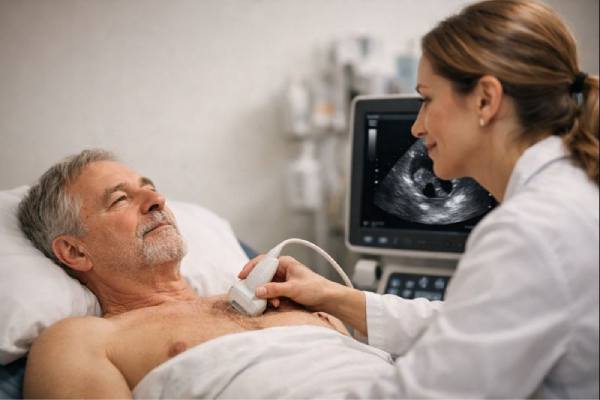
- Transthoracic echocardiography (TTE): performed on the chest wall; convenient and quick.
- Transesophageal echocardiography (TEE): the probe is in the esophagus; gives sharper views of the left atrium and left atrial appendage and is often used when decisions depend on excluding a clot before cardioversion.
To improve detection, clinicians may use ultrasound-enhancing agents (contrast for echo) when the heart borders are hard to see.
Cardiac CT and cardiac MRI
Other imaging can clarify uncertain findings or improve sensitivity in specific settings:
- Cardiac CT: can be helpful when TEE is not feasible; delayed-phase imaging can better distinguish clot from slow flow.
- Cardiac MRI (CMR): often excellent for characterizing tissue and can help differentiate thrombus from tumor in complex cases.
What doctors assess beyond “present or absent”
Imaging reports often describe features that influence urgency and treatment:
- Size and shape
- Mobility (a highly mobile clot may embolize more easily)
- Attachment (mural/laminated clots lie along the wall; pedunculated clots may sway)
- Associated findings (chamber size, ejection fraction, valve disease, device leads)
Lab tests and clinical evaluation
Blood tests do not “diagnose” a heart clot directly, but they help guide the next steps:
- Baseline blood counts and kidney/liver function (important for anticoagulant choice)
- Tests for triggers when appropriate (for example, clotting disorders in select patients, or cancer evaluation if clinically indicated)
- Work-up for infection if a vegetation is possible (fever, positive blood cultures, valve findings)
When uncertainty remains, clinicians often use a two-modality strategy (for example, TEE plus CT or MRI) to reduce the chance of mistaking tumor or infection for thrombus.
Treatment options and what to expect
Treatment aims to (1) prevent embolization, (2) dissolve or stabilize the clot, and (3) fix the condition that allowed the clot to form. The plan is individualized because the best approach depends on location, embolic risk, bleeding risk, and the underlying cause.
Anticoagulation: the cornerstone for most patients
Anticoagulants (“blood thinners”) reduce the blood’s ability to clot so the body can gradually break down the thrombus.
Common choices include:
- Direct oral anticoagulants (DOACs): often used for atrial fibrillation; sometimes used for left ventricular thrombus depending on patient factors and clinician judgment.
- Warfarin: still used in certain situations (for example, some valve conditions or special clotting disorders), with dose adjustments guided by INR blood tests.
- Heparin-based therapy: sometimes used initially in hospital for high-risk scenarios or when rapid anticoagulation is needed.
Typical expectations:
- Improvement is assessed over weeks to a few months, not days.
- Follow-up imaging is usually planned to confirm resolution or stable organization.
When procedures are needed
In select cases, anticoagulation alone may not be enough:
- Large, mobile right-heart clots (“thrombus in transit”) may require urgent decisions because the risk of pulmonary embolism can be high.
- Surgical or catheter-based removal may be considered if the clot is causing obstruction, repeatedly embolizes despite therapy, or is not a clot after further imaging.
- Delaying cardioversion: if a left atrial appendage clot is present, rhythm procedures are often postponed until the clot resolves.
Treat the driver, not only the clot
Long-term protection depends on correcting the underlying cause:
- Optimize treatment for heart failure (medications, devices when indicated).
- Address atrial fibrillation strategy (rate control, rhythm control, ablation when appropriate).
- Manage post–heart attack remodeling and ensure guideline-directed therapy.
- Remove or revise catheters/leads if they contribute and if clinically feasible.
Balancing clot risk and bleeding risk
Anticoagulation reduces embolic events but increases bleeding risk. Clinicians reduce harm by:
- Choosing the right drug and dose for kidney function and age
- Reviewing drug interactions (including over-the-counter NSAIDs)
- Planning follow-up and clear instructions for missed doses
- Reassessing the need for additional antiplatelet agents
For many patients, the safest plan is the one that is simple, monitored, and consistent.
Living with risk, prevention, and when to seek care
After an intracardiac thrombus is found, daily management focuses on reducing recurrence, avoiding bleeding complications, and knowing when symptoms require urgent care.
Medication habits that matter
If you are prescribed an anticoagulant:
- Take it at the same time every day.
- Don’t “double up” unless your clinician tells you exactly how to handle a missed dose.
- Avoid starting supplements or pain medicines without checking interactions first. As a general rule, NSAIDs (like ibuprofen or naproxen) can raise bleeding risk when combined with anticoagulants.
- Keep lab checks and dose adjustments on schedule if you take warfarin.
Follow-up imaging and appointments
Many care plans include repeat imaging to confirm resolution or stability. A common pattern is reassessment within 6–12 weeks, but timing varies by clot location and risk level. Ask your clinician:
- What imaging is planned (TTE, TEE, CT, or MRI)?
- What outcome changes the treatment duration?
- What symptoms should trigger immediate evaluation?
Risk reduction you can control
Lifestyle changes do not replace anticoagulation when it is indicated, but they reduce overall vascular risk:
- Blood pressure control: consistent home readings and medication adherence.
- Diabetes management: stable glucose lowers vascular inflammation over time.
- Smoking cessation: one of the strongest ways to reduce clot and vessel disease risk.
- Movement and mobility: avoid long periods of sitting; stand and walk every 1–2 hours on long travel days.
- Weight and sleep: treating sleep apnea and improving fitness can reduce atrial fibrillation burden.
When to seek urgent or emergency care
Seek emergency help immediately for:
- Stroke warning signs (face/arm/speech changes, sudden vision loss)
- Sudden shortness of breath, chest pain with breathing, fainting
- Sudden painful, cold, pale limb
Call your clinician promptly for:
- Black stools, vomiting blood, or unusual bruising while on anticoagulants
- New palpitations, worsening shortness of breath, rapid weight gain from fluid
- Persistent dizziness or near-fainting
A helpful mindset: the best outcome comes from treating the clot as a medical event with a clear plan—medication, monitoring, and a strategy for the underlying condition.
References
- Management of Patients at Risk for and With Left Ventricular Thrombus: A Scientific Statement From the American Heart Association – PubMed 2022 (Guideline)
- 2023 ACC/AHA/ACCP/HRS Guideline for the Diagnosis and Management of Atrial Fibrillation: A Report of the American College of Cardiology/American Heart Association Joint Committee on Clinical Practice Guidelines – PMC 2023 (Guideline)
- Direct oral anticoagulants or warfarin in left ventricular thrombus: an updated systematic review and meta-analysis of randomized trials – PubMed 2025 (Systematic Review)
- Cardiac CT vs Echocardiography for Intracardiac Thrombus Detection in Ischemic Stroke: A Systematic Review and Meta-Analysis of 43 Studies – PubMed 2024 (Systematic Review)
Disclaimer
This article is for educational purposes only and does not replace medical advice, diagnosis, or treatment. An intracardiac thrombus can be life-threatening, and decisions about imaging, anticoagulation, procedures, and medication interactions must be individualized by a licensed clinician who knows your history. If you have symptoms of stroke (sudden face droop, arm weakness, or speech trouble), pulmonary embolism (sudden shortness of breath or chest pain), fainting, or severe bleeding, seek emergency care immediately.
If you found this article helpful, please share it on Facebook, X (formerly Twitter), or any platform you prefer—and follow us on social media. Your support by sharing helps our team continue producing clear, reliable health content.