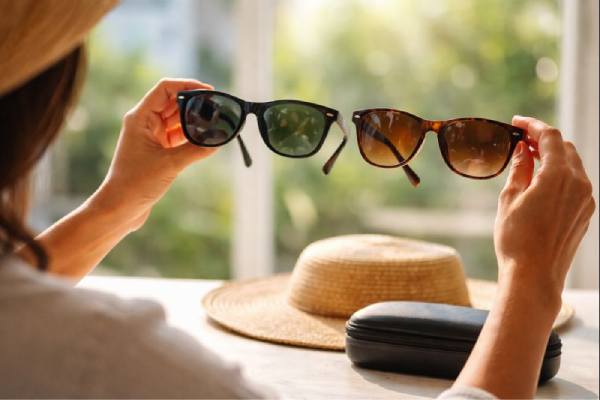
Most people buy sunglasses for comfort, but the most important feature is invisible: ultraviolet (UV) protection. UV exposure can irritate the surface of the eye in the short term and, over years, contribute to problems such as cataracts, growths on the eye surface, and skin cancers on the eyelids. Labels like “UV400” and “100% UV” sound reassuring, yet they are easy to misunderstand—and some sunglasses block plenty of visible light while letting UV pass through. That combination can be worse than no sunglasses because darker lenses make your pupils open wider.
This article explains what UV ratings actually mean, why lens color is not the same as UV filtering, and how to choose sunglasses that provide real protection while still meeting your needs for clarity, glare control, and comfort.
Essential Insights
- UV400 protection targets wavelengths up to 400 nm, covering UVA and UVB that matter most for long-term eye health.
- Lens darkness and color affect comfort and contrast, but they do not guarantee UV blocking.
- Very dark lenses without verified UV protection can increase UV exposure by enlarging your pupils.
- For driving, avoid extremely dark category 4 lenses and never use tinted sunglasses at night.
- Buy from reputable sellers and look for clear labeling plus a fit that limits side and top light leak.
Table of Contents
- What UV400 means and what it does not
- UVA and UVB: why eyes need broad UV blocking
- Lens color and darkness: what they change
- Labels, standards, and how to spot real claims
- Polarization, mirrors, and coatings vs UV protection
- Frame coverage, kids, and prescription options
- A practical buying checklist and common myths
What UV400 means and what it does not
“UV400” is one of the most common phrases on sunglass tags, and it can be genuinely useful—when it is accurate. The “400” refers to 400 nanometers (nm), the upper end of the ultraviolet spectrum. UV radiation sits just beyond visible violet light. When a lens is described as blocking UV up to 400 nm, it is intended to cover UVA and UVB, which are the UV bands most relevant to everyday sun exposure.
That said, UV400 is not a single universal government label. It is a shorthand term used in marketing and on product stickers. The protective value depends on whether the lens truly blocks UV across that range and whether the claim is backed by proper testing and labeling.
A second confusion is the phrase “100% UV protection.” Some consumers assume this always means “up to 400 nm,” but not every system uses the same cutoff. You may see older or vague wording such as “UV absorbing,” “UV protection,” or “blocks harmful rays,” which can be meaningless without a defined range. When the range is not stated, you cannot know whether the lens blocks only UVB, or UVA to a partial cutoff, or truly covers up to 400 nm.
Also important: UV protection is not the same as glare protection. UV is invisible. A lens can block UV extremely well and still be relatively light in visible tint. Conversely, a very dark fashion lens can block visible light while letting UV through.
If you want a simple mental model, think of a sunglass lens as having two separate “dials”:
- UV filtering: the invisible safety dial (UVA and UVB blocking)
- Visible light transmission: the comfort dial (how bright the world looks)
A good driving or outdoor sunglass manages both. A dangerous one reduces visible light without reliable UV filtering.
Finally, remember that UV protection is not limited to beaches. UV exposure increases with altitude and reflective surfaces like snow and water, and UV can still be meaningful on hazy or partly cloudy days. Your eyes do not need to feel “sunburned” for UV to be present.
UVA and UVB: why eyes need broad UV blocking
UV radiation is commonly divided into UVA and UVB for practical health guidance. UVB carries more energy per photon, but UVA is far more abundant in everyday sunlight and penetrates deeper into tissues. For eye protection, the message is not “pick one.” It is block both.
Your eye has multiple vulnerable areas:
- Cornea and conjunctiva (surface tissues): UV can cause short-term inflammation. A classic example is photokeratitis, a painful “sunburn” of the cornea that can happen after intense reflection from snow, water, or sand.
- Lens: Over time, UV exposure can contribute to changes in lens proteins and is associated with cataract development.
- Eyelid skin: The lids are thin and frequently exposed; skin cancers can develop on or around the eyelids.
- Retina: Most UV is filtered before it reaches the retina in adults, but the eye’s filtering changes across the lifespan. Children’s eyes can allow more UV and high-energy light to pass through, which is one reason consistent protection early in life matters.
Risk is not just about “sunny days.” Several factors raise the UV load your eyes receive:
- Sun angle and time of day: mid-day sun tends to be strongest.
- Altitude: UV intensity increases as the atmosphere thins.
- Reflective environments: fresh snow, water, light sand, and pale concrete can reflect UV upward into the eye.
- Cloud and haze: clouds do not guarantee low UV; you can still accumulate significant exposure.
Broad UV blocking is valuable even if you do not feel glare. Glare is a visibility and comfort issue; UV is a tissue-damage issue. Many people who do outdoor sports or spend hours driving in bright conditions focus on squint relief and forget that the eyes can be silently accumulating UV exposure.
Two groups deserve special attention:
- Children and teens: early habits can shape lifetime exposure. Smaller faces also mean more “side leak” around frames, so fit and coverage matter as much as the lens label.
- People with higher light sensitivity: those with dry eye, post-surgery sensitivity, migraines triggered by brightness, or inflammatory eyelid conditions may be tempted to choose very dark lenses. Darkness can help comfort, but UV protection and safe visibility still have to come first.
A practical takeaway: If your sunglasses claim UV protection but do not clearly indicate UVA and UVB coverage or a defined cutoff, treat the claim as incomplete until you confirm it through reputable labeling or professional testing.
Lens color and darkness: what they change
Lens color is often discussed as if it equals protection. It does not. Tint changes how you perceive the world, not whether UV is blocked. A clear lens can block UV very well, and a dark lens can fail at UV filtering. Understanding what color and darkness actually do helps you choose lenses that feel good while keeping your eyes safe.
Darkness: comfort and glare control, not automatic safety
Darkness is about how much visible light the lens lets through. Darker lenses reduce brightness and can reduce squinting, which is why they feel soothing in intense sun. However, darkness can also create a trap: your pupils open wider behind a dark lens. If UV is not properly blocked, more UV can enter the eye than it would without sunglasses.
This is why “cheap dark sunglasses” have a bad reputation. The problem is not price by itself. The problem is unverified UV filtering paired with strong tint.
Lens color: contrast and color balance
Tint color shifts which wavelengths of visible light reach your eyes. That affects contrast and how natural colors look.
- Gray: reduces brightness while preserving color accuracy. It is a dependable choice for general outdoor use and driving.
- Brown or copper: can enhance perceived contrast and depth, especially in variable light. Many people find it helps with haze.
- Green: often feels like a balance between gray and brown, with comfortable brightness reduction and fairly natural colors.
- Yellow or amber: can increase perceived contrast in some conditions, but it reduces overall light and can distort color. It is not a universal “visibility upgrade,” especially when light is already limited.
Color choice is about function. If you drive, you want lenses that keep traffic signals, brake lights, and road markings easy to interpret. Strong fashion tints can make that less reliable.
Driving safety: very dark lenses are not better
Driving includes rapid transitions—shade, tunnels, overpasses, and sudden weather changes. Extremely dark lenses reduce your ability to see into shadows, which can cost you time when scanning for hazards. In standards-based filter systems, the darkest category is generally not considered suitable for driving.
UV protection can be built into many materials
Modern lens materials and coatings can block UV even when the visible tint is light. That is why you should treat “color” and “UV rating” as separate decisions:
- Choose verified UV protection first.
- Choose tint and darkness based on comfort and the conditions you spend the most time in.
If you love a certain tint for style, that is fine—just do not let style substitute for verification. A beautiful lens that blocks visible light but not UV is a false sense of security.
Labels, standards, and how to spot real claims
Shopping for sunglasses often feels like decoding a mix of marketing language and tiny stickers. The good news is that you can filter most of the noise by focusing on a few high-signal indicators.
High-value label wording
Look for clear statements such as:
- “UV400”
- “99–100% UVA and UVB protection”
- “Blocks UVA and UVB” with an explicit range or standard reference
Be cautious with vague language like “UV protection,” “UV absorbing,” or “protects against harmful rays” if it does not specify UVA and UVB coverage.
Standards and road-use warnings
In many regions, sunglasses are designed to meet recognized standards for UV filtering, optical quality, and luminous transmission categories. Standards are not just bureaucracy; they exist because sunglasses can cause safety problems if they distort vision, block too much light, or interfere with signal recognition.
If a pair is not suitable for driving, it should be clearly indicated. Extremely dark lenses may be intended for high-glare environments such as glaciers or desert conditions, but those same lenses can be unsafe on roads where visibility into shade matters.
A practical driver’s check:
- If the lens is so dark that you hesitate in shade or you find yourself removing it under trees or approaching tunnels, it is not the right lens for typical road use.
Counterfeits and “too-good-to-be-true” listings
The biggest real-world risk is not that UV400 is “fake” as a concept, but that a product’s claim may be inaccurate. This is more likely when:
- the product is unbranded or sold considerately below typical pricing
- the listing uses many claims but few specifics
- there is no clear return policy or trustworthy seller information
A strong approach is to buy from reputable sellers and treat UV claims as a safety feature that should be easy to verify.
Professional verification: the underrated option
Many optical shops can measure lens transmission with a photometer or similar device. This can be especially useful if you:
- already own sunglasses with unclear labeling
- buy sunglasses online and want confidence
- have children’s sunglasses and want assurance that protection is real
- wear prescription sunglasses and want to confirm performance
Why “expensive” is not a test
Price and brand can correlate with quality, but they are not proof. Some inexpensive sunglasses meet strong safety requirements, and some expensive fashion lenses prioritize style over practical performance. The goal is to verify what matters: UV blocking plus optical clarity plus a lens darkness that fits your real environment.
If you treat a sunglass label the way you would treat a nutrition label—specific numbers and clear claims—you will make better decisions and avoid the most common pitfalls.
Polarization, mirrors, and coatings vs UV protection
Many features marketed as “protective” are actually about comfort and glare, not UV safety. Understanding the differences helps you avoid paying for the wrong upgrade.
Polarized lenses: glare control, not guaranteed UV protection
Polarization is designed to reduce harsh reflections from flat surfaces such as water, wet pavement, and glossy car hoods. It can improve comfort and can make the scene feel clearer by reducing reflected “white-out” glare. That is valuable, especially for driving and water environments.
But polarization is not the same as UV filtering. A polarized lens may have excellent UV protection, or it may not. Treat polarization as an add-on for reflected glare and still require verified UVA and UVB blocking.
Also note a practical driving trade-off: polarized lenses can reduce visibility of some screens or create odd patterns in laminated glass. If your vehicle uses a head-up display or certain LCD panels, test polarization in your own car before committing.
Mirror coatings: brightness reduction, not UV proof
A mirror finish reflects some incoming visible light away from the lens, which can reduce brightness. It can help in very bright conditions, but it is not a substitute for UV blocking. Some mirror-coated lenses block UV well; others simply look reflective.
Anti-reflective performance: especially helpful from behind
Glare can bounce off the back surface of a lens into your eyes, especially when the sun is behind you or entering from the side. This can create distracting ghost reflections. A well-designed backside treatment can improve comfort, particularly in late-day sun or when light enters around the frame.
Blue-light claims and UV claims are not the same
Some lenses are marketed as blocking “high-energy” visible light. That is a separate discussion from UVA and UVB protection. If a lens focuses on “blue light” but does not clearly specify UVA and UVB blocking, it is not answering the main outdoor safety question.
Wraparound design and side coverage often matter more than a fancy coating
Even a perfect lens can underperform if UV enters from the sides or above. Sunlight reflects off surfaces and arrives at the eye from multiple angles. A slightly larger lens with better coverage can reduce total exposure more reliably than a small lens with premium coatings.
A good strategy is to prioritize features in this order:
- Verified UV protection to 400 nm or explicit UVA and UVB blocking
- Optical clarity and safe visible transmission for your use (especially driving)
- Coverage and fit that reduce light leak
- Polarization and coatings for comfort in your specific environment
That sequence keeps you from buying “expensive comfort” while missing basic protection.
Frame coverage, kids, and prescription options
Real-world UV protection is not just a lab number. It is how much UV reaches your eye during normal wear. That depends heavily on frame design, fit, and what you actually do outdoors.
Coverage: the missing half of UV protection
UV enters from angles you do not expect, especially from reflections. A lens can block UV perfectly straight-on, yet still allow meaningful exposure if sunlight streams in from the sides, above the brow, or below the cheek line.
Helpful design features include:
- larger lens height that covers the full eye opening
- a frame that sits close enough to reduce gaps
- mild wraparound shape or wide temples for side protection
- a comfortable bridge that prevents slipping down your nose
If you wear sunglasses low on your nose for style, you are reducing protective coverage. For health protection, “coverage you actually use” beats “coverage on paper.”
Children: prioritize fit, durability, and habits
Children’s eyes and skin are more vulnerable to cumulative UV exposure, and kids often spend more time outdoors during peak sun seasons. Practical issues matter:
- small faces need properly sized frames, otherwise side leak is extreme
- durability matters because scratched lenses reduce clarity and may increase discomfort
- children may refuse sunglasses that pinch or slide
If sunglasses do not stay on, a wide-brim hat becomes a meaningful backup. The best protection is the protection a child will tolerate consistently.
Prescription wearers: do not settle for “close enough”
If you need vision correction, non-prescription sunglasses can reduce safety because blur and glare interact. Consider:
- prescription sunglasses with verified UV protection
- a dedicated driving pair with a safe darkness level
- lens materials and coatings that maintain clarity and reduce reflections
If you wear contact lenses that claim UV blocking, remember that contacts do not cover the entire eye and do not protect eyelid skin. Sunglasses still provide important coverage.
Outdoor work and long driving days
If you spend hours outside or drive for work, small improvements compound:
- better coverage reduces side exposure over long durations
- stable fit reduces the temptation to remove glasses frequently
- consistent comfort reduces squinting and eye fatigue
In other words, a protective lens paired with a leaky, poorly fitting frame is like sunscreen applied in streaks. To protect eyes in real life, lens quality and frame coverage have to work together.
A practical buying checklist and common myths
If you want a clear path from confusion to confidence, use a short checklist and keep a few myths out of your decision-making.
A buying checklist you can use in minutes
- Confirm the label clearly states UV400 or 99–100% UVA and UVB protection.
- Choose a lens darkness that fits your environment, especially if you drive through shade, tunnels, or variable weather.
- Pick a tint that supports your needs: gray for natural colors, brown for contrast, and be cautious with strong fashion tints.
- Consider polarization if reflected glare is a major issue, but verify UV protection separately.
- Choose a frame that limits side and top light leak and stays stable during movement.
- Buy from a reputable seller with clear product details and a return policy.
- If you are unsure, have the lenses measured at an optical shop.
Myths that cause the most mistakes
- Myth: Darker lenses always protect more.
Darkness reduces visible light. UV protection depends on the filter, not the tint. A dark lens without verified UV blocking can be worse than no sunglasses. - Myth: Expensive sunglasses always have better UV protection.
Some budget sunglasses meet strong UV requirements. Some fashion sunglasses prioritize aesthetics. Verify the claim instead of assuming. - Myth: UV only matters in summer or at the beach.
UV can be high on cool days, in hazy conditions, and at altitude. Reflection from snow and water can raise exposure dramatically. - Myth: You can reliably “see” good UV protection.
You cannot. UV is invisible. Comfort is not proof of safety. - Myth: Sunglasses are fine for night driving if they reduce headlight glare.
Tinted lenses reduce the light you need at night. If night glare is a problem, address windshield cleanliness, vision correction, and eye surface comfort instead.
When to replace sunglasses
Sunglasses do not have a universal expiration date, but consider replacement if:
- lenses are heavily scratched or visibly distorted
- coatings are peeling or creating glare artifacts
- the frame fit has loosened and coverage gaps have increased
- you cannot verify UV protection and the glasses are from an unknown source
A well-chosen pair of sunglasses should feel like quiet support: comfortable, clear, and protective without forcing you to adapt your behavior. If you keep “working around” your sunglasses—removing them constantly, squinting anyway, or feeling less confident in shade—that is a sign to choose a pair that better matches your real life.
References
- Ultraviolet radiation 2022 (Fact Sheet)
- Protecting your eyes from the sun’s UV light | National Eye Institute 2022 (Government Health Guidance)
- ISO 12312-1:2022 – Eye and face protection — Sunglasses and related eyewear — Part 1: Sunglasses for general use 2022 (Standard)
- Are sunglasses appropriate for driving? Investigation and prototype for public testing 2021 (Open Access Study)
Disclaimer
This article is for educational purposes and does not replace personalized medical advice from an optometrist, ophthalmologist, or other qualified clinician. UV protection guidance is general and may not account for individual conditions, medications that increase light sensitivity, recent eye surgery, or occupational risks. If you have new or worsening light sensitivity, eye pain, sudden vision changes, or difficulty driving safely due to glare, seek professional evaluation promptly.
If you found this article helpful, please consider sharing it on Facebook, X (formerly Twitter), or any platform you prefer.