Eye pressure testing is a quick measurement that helps clinicians estimate the pressure inside your eye, called intraocular pressure (IOP). It matters because pressure is the most treatable risk factor for glaucoma, a condition that can slowly damage the optic nerve without obvious symptoms early on. But the test is also widely misunderstood: a “normal” number does not automatically mean your eyes are safe, and a “high” number does not automatically mean you have glaucoma. The most useful way to think about IOP is as one piece of a bigger puzzle that includes your optic nerve appearance, visual field testing, and—often—your corneal thickness and structure. Understanding how the test is performed and what influences the reading can help you interpret results calmly, ask sharper questions, and follow the right next steps when your numbers change.
Essential Insights
- Eye pressure testing helps estimate glaucoma risk and track whether treatment is lowering pressure effectively.
- One reading is a snapshot; patterns over time and related tests often matter more than a single number.
- Corneal thickness, recent eye surgery, and squeezing your eyelids can shift results and occasionally mislead.
- If you get a surprisingly high result, repeat measurement and a full eye exam are often needed before conclusions.
- Keep a simple log of IOP values, time of day, and any medication changes to make follow-up decisions clearer.
Table of Contents
- Why eye pressure is measured
- How tonometry measures pressure
- What to expect and how to prepare
- Normal ranges and why they vary
- When eye pressure is high
- When eye pressure is low
- Turning results into a plan
Why eye pressure is measured
Intraocular pressure is created by a constant cycle: fluid (aqueous humor) is produced inside the eye, flows through the pupil into the front chamber, and drains through tiny pathways at the angle where the iris and cornea meet. If production and drainage fall out of balance, pressure can rise. Eye pressure testing is designed to estimate that pressure in millimeters of mercury (mmHg), similar to blood pressure units.
The biggest reason IOP is measured is glaucoma care—screening, diagnosis support, and monitoring. Elevated IOP increases the risk that the optic nerve will be damaged over time, and lowering IOP is the main proven strategy to slow or prevent vision loss in many forms of glaucoma. That said, pressure is a risk factor, not a verdict. Some people live for decades with mildly elevated IOP and never develop nerve damage (often labeled ocular hypertension). Others develop glaucoma even with IOP readings in the statistically “normal” range (often called normal-tension glaucoma). This is why clinicians rarely diagnose or rule out glaucoma based on pressure alone.
IOP testing also plays a role in other situations:
- Medication effects: Steroid eye drops, injections, and even some systemic steroids can raise IOP in susceptible people.
- After eye surgery: Pressure can rise or fall after procedures like cataract surgery, LASIK/PRK, or glaucoma surgery, and early detection of abnormal pressure can prevent complications.
- Eye injury and inflammation: Trauma can disrupt the drainage angle, and uveitis can alter fluid dynamics, causing pressure spikes or drops.
- Acute symptoms: Very high pressure can accompany urgent conditions, where rapid evaluation matters.
A helpful mindset is this: IOP is a modifiable “load” on the eye, but the eye’s tolerance differs from person to person. Your optic nerve health, corneal properties, blood flow factors, and age all influence what level of pressure is safe for you.
How tonometry measures pressure
“Tonometry” is the family of tests that estimate IOP. The different tools do not measure pressure the same way, which explains why results can differ by a few mmHg between devices—or even between operators.
Goldmann applanation tonometry
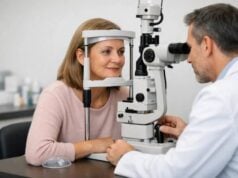
Goldmann applanation tonometry (often done at a slit lamp) is widely treated as the clinical reference standard. After numbing drops are placed, a small probe gently touches the cornea. The device measures the force needed to flatten a specific area of the cornea, and that force is converted into an IOP estimate. Goldmann readings tend to be most reliable when the test is performed carefully and the cornea is healthy, but the measurement can still be influenced by corneal thickness and biomechanics.
Non-contact “air-puff” tonometry
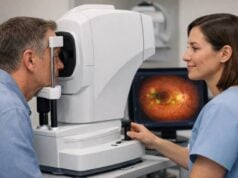
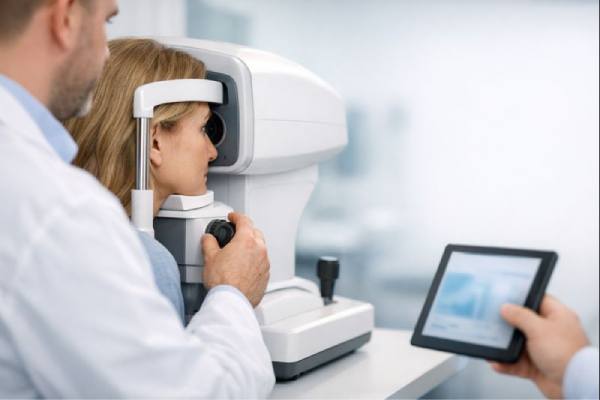
Non-contact tonometers use a brief puff of air to flatten the cornea without touching it. These are common in screening settings because they are fast and do not require anesthetic drops. The trade-off is that readings can be more variable, and some people blink or tense up, which can skew the number. When an air-puff test suggests elevated IOP, clinicians often confirm it with a contact method.
Handheld devices
Handheld tonometers are useful for children, older adults who cannot position at a slit lamp, bedside exams, and community screening.
- Rebound tonometry (for example, iCare): A tiny probe briefly contacts the cornea and rebounds; the rebound characteristics are used to estimate IOP. Many people find it more comfortable than expected, and it is convenient, but readings may differ from Goldmann depending on the pressure range and corneal properties.
- Tono-Pen (indentation/applanation hybrid): A handheld tip contacts the cornea after anesthetic drops. It can be practical in irregular corneas, but technique and repeated measurements matter for accuracy.
Dynamic contour and other specialized methods
Some devices aim to reduce cornea-related error by contour matching rather than flattening the cornea. These can be helpful in select cases (for example, post-refractive surgery or unusual corneas), but availability varies and results are still interpreted in clinical context.
The most important practical point: if your IOP seems inconsistent across visits, it may reflect real biological fluctuation, device differences, or measurement conditions. Clinicians often standardize the method used for follow-up so that trends are meaningful.
What to expect and how to prepare
Most people are surprised by how quick eye pressure testing is. The experience depends on the device used, but preparation and technique can meaningfully affect the number—especially if you are anxious, holding your breath, or squeezing your eyelids.
What the test feels like
- Goldmann or other contact methods: You’ll usually receive numbing drops. You may feel mild pressure or a light touch, but it should not be painful. Some clinics also use a dye to help visualize the measurement.
- Air-puff testing: You’ll feel a quick puff of air and may blink reflexively. The startle response is common, and clinics often repeat the test if the blink disrupts the measurement.
- Handheld rebound tonometry: Often feels like a gentle tap. It’s typically brief, and the device takes multiple readings automatically.
Steps you can take to improve accuracy
These tips are simple but can prevent falsely high readings:
- Breathe normally. Holding your breath or bearing down can temporarily raise pressure readings.
- Relax your face and shoulders. Tension can lead to eyelid squeezing, which can artificially elevate IOP.
- Keep both eyes open if asked. Some people squeeze the tested eye shut when the other eye closes.
- Look at the target. Eye movement during measurement can reduce reliability and prompt repeats.
- Tell the clinician if you are uncomfortable. A small adjustment in positioning often solves the problem.
What to mention before the test
Share factors that can change interpretation:
- Recent eye surgery or injury
- Current steroid use (drops, inhalers, injections, or pills)
- Known corneal conditions (keratoconus, scarring) or history of LASIK/PRK
- Contact lens wear (some clinics may ask you to remove lenses before certain measurements)
- Dry eye symptoms that make holding the eye open difficult
Why repeated readings are common
IOP can vary minute-to-minute, and every device has measurement “noise.” For that reason, clinicians often repeat the test, average multiple readings, or confirm an unexpectedly high value with a different method. If your pressure is borderline, you may also be tested at different times of day to look for meaningful peaks.
Normal ranges and why they vary
Many people are told that “normal eye pressure” is roughly 10 to 21 mmHg, but that range is a statistical reference—not a guarantee of safety. A better question than “Is my IOP normal?” is “Is my IOP safe for my optic nerve, given my risk factors and exam findings?”
Why the same number can mean different things
Two people can have the same IOP and very different risk profiles. Clinicians consider:
- Optic nerve appearance: Cupping, rim thinning, and asymmetry can suggest damage even when IOP is not high.
- Visual field testing: Functional loss may show up before symptoms.
- Retinal nerve fiber and ganglion cell layers (imaging): Structural thinning can help detect early disease and confirm progression.
- Family history, age, and ancestry: These influence baseline risk.
- Corneal thickness and biomechanics: A thicker or stiffer cornea can lead to higher measured IOP even if the true pressure is lower, and a thinner cornea can do the opposite.
Time of day and natural fluctuation
IOP is not a fixed value. Many people have a daily pattern, and some have clinically important peaks outside office hours. Even within a single appointment, stress, blinking, and measurement technique can change the reading. That is why clinicians may:
- Repeat measurements at the same visit
- Check IOP at different times across visits
- Focus on trends rather than a single data point
Why “correction formulas” are used cautiously
You may see online calculators that “correct” IOP based on central corneal thickness. In practice, many clinicians avoid treating these corrected numbers as exact, because corneal thickness is only one part of how the cornea affects measurement. Instead, corneal data is used to interpret the likelihood of over- or underestimation and to guide the level of concern.
Interpreting borderline results
Borderline readings (for example, low 20s) often trigger a careful confirmation rather than immediate treatment. A clinician may repeat the IOP, check corneal thickness, look for optic nerve changes, and evaluate the angle anatomy. If everything else is stable, the plan may be watchful monitoring with a clear schedule—because the goal is not to “chase a number,” but to prevent damage.
When eye pressure is high
A high IOP reading is a signal to take the next step—not a reason to panic. The meaning depends on how high the number is, whether it persists, and whether there are signs of optic nerve stress or symptoms suggesting an urgent cause.
Common reasons for elevated readings
Persistent elevation can occur with:
- Ocular hypertension: Elevated IOP without detectable optic nerve damage or visual field loss (yet).
- Primary open-angle glaucoma: The drainage system becomes less efficient over time, and pressure contributes to progressive optic nerve damage.
- Steroid response: Some people experience significant pressure increases with steroid drops, injections, creams used near the eye, or systemic steroids.
- Pigment dispersion or pseudoexfoliation: Material can clog drainage pathways and raise IOP.
- Angle-closure mechanisms: The drainage angle narrows or closes, sometimes intermittently.
When high pressure is urgent
Very high IOP—especially with symptoms—needs prompt evaluation. Seek urgent care if high pressure is associated with:
- Severe eye pain or headache
- Nausea or vomiting
- Sudden blurred vision or halos around lights
- A red eye with a mid-dilated pupil
- Rapid vision change after surgery or injury
These features can appear in acute angle closure or other serious conditions where time matters.
What typically happens after a high result
Clinicians often follow a structured approach:
- Confirm the measurement. Repeat IOP and consider a different device or examiner technique.
- Assess the cornea and angle. Corneal issues can affect readings; angle assessment helps identify closure risk.
- Check the optic nerve and retinal layers. Photos or imaging establish a baseline.
- Measure function. Visual field testing evaluates whether pressure is already affecting vision.
- Set a target and plan. If treatment is needed, the goal is usually a personalized “target pressure” that reduces risk of progression, not simply achieving an arbitrary “normal.”
Why a single spike may not mean glaucoma
Temporary elevations can occur due to stress, squeezing, inflammation, medication changes, or measurement factors. That is why clinicians rely on repeat readings, patterns, and evidence of optic nerve vulnerability. If you are told you have “high eye pressure,” ask whether it was confirmed, what method was used, and what other findings support concern.
When eye pressure is low
Low IOP is discussed less often than high IOP, but it can be clinically important—especially after surgery or eye injury. “Low” is not always dangerous, yet pressure that is too low for the eye’s structure can cause vision problems.
What counts as low
There is no single cutoff that applies to everyone, but persistently very low readings (often around 5 mmHg or lower) raise concern for hypotony, particularly when accompanied by symptoms or abnormal exam findings. Mildly low readings may be acceptable in some treated glaucoma patients if the eye remains structurally stable and vision is unaffected.
Common causes of low IOP
Low pressure can result from:
- Post-surgical overfiltration: After glaucoma surgery, the eye may drain too efficiently.
- Wound leak: After surgery or trauma, fluid may escape through a small leak.
- Inflammation: Reduced fluid production can occur with uveitis.
- Ciliary body problems: Trauma or certain conditions can reduce aqueous production.
- Retinal or choroidal issues: Fluid shifts and internal anatomy changes can accompany low pressure.
Symptoms and potential complications
Some people feel nothing. Others may notice:
- Blurred or fluctuating vision
- Distortion (straight lines look bent)
- A sensation of ocular “softness” (not a reliable sign, but sometimes reported)
- Discomfort after surgery
If hypotony is significant, the eye can develop changes that affect vision, such as macular folds or corneal swelling. The risk depends on how low the pressure is, how long it lasts, and whether the retina and optic nerve are being affected.
What evaluation and management may include
Because low IOP is often tied to a specific cause, management is typically targeted:
- Checking for wound leaks or bleb-related issues after glaucoma surgery
- Looking for signs of inflammation and treating it appropriately
- Imaging the back of the eye if visual distortion is present
- Adjusting medications that suppress fluid production if they are contributing
If you’ve had recent surgery or eye trauma and are told your pressure is low, it’s reasonable to ask: Is the eye structurally stable? Is there a leak? Are there signs of retinal change? What symptoms should trigger urgent contact?
Turning results into a plan
Eye pressure testing is most powerful when it drives a clear plan: what you’re watching for, what changes would matter, and how the next decision will be made. This is true whether you’re being screened, monitored for ocular hypertension, or treated for glaucoma.
Focus on trend, context, and consistency
A practical way to make IOP results meaningful is to standardize comparisons:
- Use the same device when possible. Switching between air-puff, handheld, and Goldmann methods can create “apples to oranges” changes.
- Note the time of day. If readings vary, timing may explain part of the pattern.
- Record medication details. Include start dates, dose changes, missed doses, and side effects.
A simple tracking format many people can maintain:
- Date and time
- Right eye IOP and left eye IOP
- Device type (if known)
- Current eye drops and dosing schedule
- Any unusual factors (poor sleep, steroid use, recent illness, eye irritation)
Understanding target pressure
When glaucoma is diagnosed—or when ocular hypertension is considered high-risk—clinicians often choose a “target IOP,” meaning a pressure range expected to reduce the chance of progression. This target is individualized based on:
- Stage of optic nerve damage
- Rate of change over time
- Baseline IOP and known peaks
- Corneal and angle anatomy
- Other risk factors
Targets can change. If testing shows progression at a previously acceptable pressure, the target is usually lowered.
Home monitoring and special situations
Some patients benefit from IOP checks outside clinic hours, especially when progression is suspected despite “good” office readings. Home or repeated measurements can reveal peaks that guide treatment. Home monitoring is not necessary for most people, and device choice and technique training matter, but it can be valuable in selected cases.
Special populations often need adapted strategies:
- Children: Handheld devices and experienced examiners are critical; readings may be influenced by movement or fear.
- Post-LASIK/PRK: Measured IOP can appear lower than true pressure; clinicians interpret results with extra caution.
- Irregular corneas or corneal disease: Alternative tonometry methods may be used, and the optic nerve and visual fields may carry more weight.
Questions that improve decision-making
If you want the most useful conversation after an IOP test, consider asking:
- Was the reading confirmed, and which method was used?
- How does my cornea affect interpretation of my number?
- Do my optic nerve and visual field results match the pressure reading?
- What change would make you adjust the plan—how many mmHg, or what trend?
- When should I return, and what symptoms should prompt urgent contact?
A pressure number is not the end of the story. It is the start of a more informed, individualized strategy to protect vision long-term.
References
- Glaucoma: diagnosis and management – NCBI Bookshelf 2022 (Guideline)
- A comparison of iCare and Goldmann applanation tonometry measurements during the COVID-19 pandemic: a retrospective study – PubMed 2024
- Outcomes of the Icare Rebound Tonometer versus the Gold Standard Tonometer in Measuring Intraocular Pressure among Mzuzu University Students, Malawi – PubMed 2023
- Agreement of Intraocular Pressure Measurement of Icare ic200 with Goldmann Applanation Tonometer in Adult Eyes with Normal Cornea – PubMed 2021
- The influence of corneal density and thickness on tonometry measurement with goldmann applanation, non-contact and iCare tonometry methods – PMC 2022
Disclaimer
This article is for general educational purposes and does not replace medical advice, diagnosis, or treatment from a qualified eye care professional. Eye pressure results must be interpreted alongside a full eye examination and, when appropriate, optic nerve evaluation, retinal imaging, and visual field testing. Seek urgent medical attention for sudden vision changes, severe eye pain, a red eye with nausea or vomiting, or symptoms after eye surgery or injury. If you have glaucoma, ocular hypertension, or use steroid medications, follow your clinician’s guidance for monitoring and medication use.
If you found this helpful, please consider sharing it on Facebook, X (formerly Twitter), or any platform you prefer.