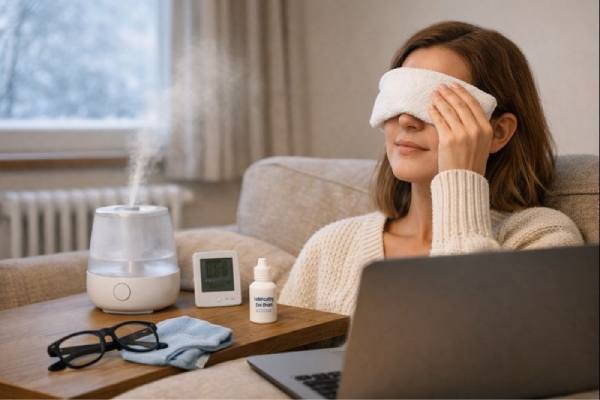
Winter can make dry eyes feel suddenly louder: burning on the commute, blur that comes and goes, and a “tired” eye sensation that builds through the day. The season changes your tear film in practical ways—cold wind increases evaporation, indoor heating dries the air, and people blink less when they hunch into scarves and screens. Even when your tear production is normal, the tear film can become less stable, leaving the cornea and conjunctiva more exposed and reactive. The upside is that winter dry eye is often highly responsive to environmental fixes. With a few targeted adjustments—humidity control, smarter airflow, better eyelid care, and the right type of lubricating drops—you can reduce irritation quickly and protect the ocular surface through the season without overcomplicating your routine.
Key Takeaways
- Keeping indoor humidity around 40–50% can reduce tear evaporation and improve comfort in heated rooms.
- Redirecting vents and avoiding direct airflow to the face often helps as much as adding more drops.
- Lid care (warm compresses and gentle hygiene) supports the oil layer that slows winter evaporation.
- Persistent pain, marked light sensitivity, discharge, or contact lens intolerance warrants prompt eye evaluation.
- A simple winter routine is midday preservative-free drops plus bedtime gel when mornings feel scratchy.
Table of Contents
- Why winter triggers dry eye flares
- How heating and low humidity break your tear film
- Set up your home to protect your eyes
- Outdoor wind, cold, and snow glare solutions
- Winter treatment plan: drops, gels, and lid care
- When winter dry eye needs medical care
Why winter triggers dry eye flares
Dry eye is not just “not enough tears.” It is often a stability problem: tears break up too quickly, leaving dry patches on the surface of the eye. Winter stacks the odds against tear stability because it changes both your environment and your behavior.
Cold air holds less moisture than warm air. When you move between outdoor cold and indoor heat, the relative humidity around your eyes can swing dramatically. That matters because the tear film is exposed and thin—measured in microns—so it responds quickly to changes in evaporation. Wind adds another layer: moving air across the eye accelerates tear evaporation, and in winter you are more likely to face wind directly (walking briskly, cycling, waiting on platforms, driving with vents on).
Indoors, heating systems can create “microclimates” that are harsher than the outdoor air. Forced-air heat and space heaters can lower humidity and push a steady airflow across your face for hours. That airflow matters even if your eyes feel fine for the first 30 minutes; dryness often builds slowly and becomes noticeable later in the day as the ocular surface gets irritated.
Winter routines can also change blink behavior. People spend more time indoors on screens, and concentrated screen work reduces blink frequency and increases partial blinks. Partial blinks do not fully refresh the tear film and do not express eyelid oils as effectively, which weakens the tear film’s outer oil layer. That oil layer is your “evaporation brake,” and when it is thin or patchy, dryness becomes more noticeable in low-humidity conditions.
Finally, winter increases exposure to irritants that can mimic or worsen dry eye: smoke from fireplaces, vehicle exhaust, and indoor allergens (especially when windows stay closed). The eye surface can become more inflamed, which makes it feel more sensitive to normal air and light. That is why winter dryness can feel sharper even if the eyes do not look dramatically red.
The practical point: winter dry eye often improves fastest when you reduce evaporation (humidity and airflow) and support the tear film’s oil layer (lid care), rather than relying only on more frequent drops.
How heating and low humidity break your tear film
Your tear film has three functional parts: a mucin layer that helps tears spread, a watery layer that provides volume and nutrients, and an oily layer that slows evaporation. Winter targets the last two—volume and evaporation—at the same time.
Low indoor humidity increases the evaporation rate from the eye surface. Think of it as pulling water off the tear film faster than your glands can replace it. When evaporation speeds up, salts and inflammatory signals concentrate on the surface, and the tear film becomes less smooth. That can cause fluctuating blur that clears after a blink, plus burning or stinging that worsens through the day.
Heating systems can make this worse in two ways:
- They dry the air as they warm it, lowering relative humidity unless moisture is added back.
- They create directed airflow. Even gentle airflow across the eyes can destabilize the tear film because the tear film is exposed between blinks.
Forced-air vents often produce the most noticeable symptoms because they combine both effects: warm, dry air plus a consistent stream. Space heaters and car vents can have a similar impact because the air is delivered close to the face. If you ever notice that one eye is worse than the other, airflow direction is a surprisingly common explanation.
Winter can also affect the eyelids. The meibomian glands in the eyelids produce oils that should be clear and flow easily. In colder conditions, oils can thicken, and if your glands are already partly blocked, the oil layer becomes more uneven. That makes evaporation worse precisely when humidity is lowest. Many people interpret this as “my drops are not working anymore,” but the real issue is that the tear film is evaporating faster than watery drops can compensate for.
A useful mental model is the “bucket and lid” model:
- The watery part is the bucket (tear volume).
- The oil layer is the lid (evaporation control).
In winter, the bucket can be drained faster, and the lid can be less effective. The most effective strategy is to improve the lid (eyelid oils and airflow control) while also keeping the bucket topped up (appropriate lubrication and hydration).
If you treat winter dry eye only as a volume problem, you may find yourself using drops frequently with short-lived relief. If you treat it as an evaporation problem as well, your routine becomes simpler and more reliable.
Set up your home to protect your eyes
Your home environment can either calm winter dry eye or keep it simmering. The goal is not a perfect “lab” environment—it is a stable, eye-friendly microclimate in the places you spend the most time.
Target a practical humidity range
Aiming for about 40–50% relative humidity is a useful starting point for many people. Below 30–35%, evaporation tends to feel noticeably worse. Much higher humidity may be uncomfortable and can aggravate condensation or indoor allergens in some homes. Use a simple hygrometer to measure reality; many people are surprised by how low humidity drops once heating runs regularly.
If you use a humidifier:
- Place it near where you spend time, but not so close that mist blows directly into your face.
- Clean it as recommended to reduce mineral dust and microbial growth.
- Consider using distilled water if mineral buildup is a problem.
Eliminate direct airflow to the face
Dry eye often improves more from airflow control than from buying new products. Practical steps:
- Redirect vents away from the bed and sofa.
- Avoid pointing space heaters toward your face.
- If you need air circulation, aim the fan across the room rather than at you.
At night, airflow is especially important because you blink less and your eyes are closed for hours. If you wake with irritation, check whether warm air is drifting toward your face overnight.
Improve air quality without over-drying the air
In winter, homes are often sealed. That can trap particulates and irritants. If you notice irritation that is worse indoors than outdoors, consider:
- Changing HVAC filters on schedule.
- Using exhaust fans during cooking and showers.
- Ventilating briefly once or twice per day (a short “air swap” can help without freezing the home).
Build a winter-friendly desk zone
If you work at home:
- Position the screen slightly below eye level to reduce eye opening and evaporation.
- Avoid sitting directly under a vent.
- Keep lubricating drops where you can use them proactively, not only once you are already uncomfortable.
The best home setup is one you can keep consistent. Small, stable improvements—humidity, airflow direction, and a clean air baseline—often make winter dry eye feel dramatically more manageable.
Outdoor wind, cold, and snow glare solutions
Outdoor winter dryness can feel unavoidable, but most of the discomfort comes from evaporation plus exposure. You can reduce both without turning winter into a medical project.
Use wraparound protection in wind
Wind is an evaporation accelerator. If your eyes sting on walks, commutes, or winter sports, eyewear that blocks side airflow can make a bigger difference than drops alone. Wraparound sunglasses or sports glasses create a calmer air pocket around the eyes. For people with significant sensitivity, moisture-chamber eyewear can be helpful because it reduces airflow and holds humidity near the surface.
Manage snow glare and light sensitivity
Snow reflects a large amount of light. When the ocular surface is dry or inflamed, light sensitivity often increases. Protective lenses (especially when outdoors for long periods) can reduce squinting, which lowers fatigue and helps maintain more normal blinking. If you notice headaches or a “tight” feeling around the eyes in bright winter conditions, glare control may reduce strain on top of dryness relief.
Plan your lubrication around exposure windows
Winter symptoms often spike at predictable times: right before leaving home, during the commute, and after arriving in a heated building. A practical approach is to use preservative-free lubricating drops 10–15 minutes before outdoor exposure, rather than waiting until your eyes feel dry. This creates a smoother tear layer before wind and cold challenge it.
If you wear contact lenses outdoors in winter:
- Be alert to dryness that becomes painful or causes fluctuating blur.
- Consider carrying glasses for long outdoor exposure.
- If cold wind reliably triggers discomfort, switching to glasses for outdoor segments can reduce irritation significantly.
Car vents and public transit airflow
Many people focus on outdoor wind and miss the indoor wind: car vents. If your eyes burn while driving, angle vents toward the torso rather than the face and avoid high fan settings aimed upward. On public transit, position yourself away from direct overhead vents when possible.
Winter exposure is often short but intense. If you reduce direct airflow and glare, and time lubrication strategically, you can prevent the “first spark” of irritation that makes the rest of the day feel uncomfortable.
Winter treatment plan: drops, gels, and lid care
A good winter plan is simple, consistent, and matched to the kind of dryness you have. Most winter flares are evaporation-heavy, so the best plan usually includes both tear support and eyelid support.
Pick the right lubricant for the time of day
Watery drops can help quickly, but they may not last long in low humidity. Consider this progression:
- Mild, occasional dryness: preservative-free artificial tears as needed.
- Daily winter discomfort: preservative-free tears used proactively (for example, mid-morning and mid-afternoon).
- Evening irritation or fast tear breakup: thicker gel drops after work, when slight blur is less disruptive.
- Morning scratchiness: bedtime gel or ointment to protect the surface overnight.
If you find yourself using drops frequently with short-lived relief, that is a signal to focus more on humidity, airflow, and eyelid oils.
Support the oil layer with eyelid care
The meibomian glands are critical in winter because their oils slow evaporation. A realistic routine is:
- Warm compress for 5–10 minutes (comfortably warm, not hot).
- Gentle lid massage toward the lash line.
- Lid hygiene if you have crusting, flaky lashes, or lid margin redness.
Do this daily for 2–4 weeks during winter flares, then maintain a few times per week if symptoms improve. Consistency matters more than intensity.
Reduce “hidden” winter irritants
If you use facial creams, retinoids, or fragranced products, keep them away from the eyelid margins. These products can migrate and irritate the surface, especially overnight. If you notice irritation mainly at the lash line, eyelid inflammation may be playing a larger role than you think.
Special situations: CPAP and nighttime dryness
If you use CPAP and wake with dry eyes, check for air leaks blowing toward the eyes. Even a small leak can dry the surface for hours. Mask fit adjustments and airflow direction changes often help, and some people benefit from moisture-seal eyewear or a supportive sleep mask.
A winter plan works best when it is layered: environment first (humidity and airflow), then lubrication timed to exposure, then eyelid care for longer-term tear film stability.
When winter dry eye needs medical care
Many winter symptoms can be managed at home, but there is a clear line where evaluation is the safer and more effective move. The main reasons to see a clinician are persistent inflammation, corneal surface damage, and dry eye subtypes that need prescription therapy or targeted procedures.
Seek prompt care for red flags
Do not wait weeks if you have:
- Moderate to severe eye pain
- Marked light sensitivity
- A very red eye with discharge
- Sudden, persistent vision changes
- Eye injury or chemical exposure
- Any concerning symptoms while wearing contact lenses
These can indicate infection, inflammation, or corneal surface problems that should be treated urgently.
Book a routine evaluation if winter symptoms are persistent
Consider an exam if:
- Symptoms occur most days for more than 4 weeks despite consistent humidity and lubrication
- One eye is consistently worse (possible airflow, eyelid closure, or surface issues)
- You wake with a “scratch” sensation repeatedly
- You have rosacea, autoimmune disease, thyroid disease, or a history of refractive surgery
- You need drops more than four times per day on most days
What clinicians typically check
A focused dry eye evaluation usually looks at:
- Eyelid margins and meibomian gland function (blockage and oil quality)
- Blink completeness and eyelid closure
- Tear film stability (how quickly tears break up)
- Surface staining patterns that show where dryness is damaging tissue
- Tear volume when low tear production is suspected
This matters because winter flares are not always purely environmental. Some people have underlying meibomian gland dysfunction or inflammatory dry eye that becomes obvious only when humidity drops. In those cases, prescription anti-inflammatory drops, short monitored steroid courses, in-office eyelid therapies, or tear-conservation approaches may be appropriate.
How to make your appointment more productive
Before you go, note:
- When symptoms are worst (morning, midday, evening)
- Whether vents, heaters, or car airflow worsen symptoms
- What drops you use and how often
- Whether you have styes, lid crusting, or facial rosacea symptoms
Winter dry eye is often fixable, but repeated flares are a signal to define your dry eye type and protect the ocular surface proactively rather than reacting all season.
References
- Dry Eye Syndrome Preferred Practice Pattern® – PubMed 2024 (Guideline)
- TFOS DEWS III: Management and Therapy – PubMed 2025 (Review)
- The Impact of Home Interventions on Dry Eye Disease (DED) Symptoms and Signs in United States Veterans – PubMed 2025 (Prospective Study)
- Influence of Environmental Factors with Clinical Signs and Symptoms in the Management of Dry Eye Disease – PMC 2024 (Clinical Trial)
- Frontiers | The environment and dry eye—manifestations, mechanisms, and more 2023 (Review)
Disclaimer
This article is for general educational purposes and does not replace professional medical advice, diagnosis, or treatment. Dry eye symptoms can overlap with infections, inflammatory eye disease, medication side effects, and corneal surface disorders that require an in-person exam. Seek urgent care for significant eye pain, sudden or persistent vision changes, marked light sensitivity, eye trauma, a very red eye with discharge, or any concerning symptoms if you wear contact lenses. If you have chronic health conditions or use prescription medications, consult an eye care professional before starting new eye products or changing your routine.
If you found this guide helpful, please consider sharing it on Facebook, X (formerly Twitter), or any platform you prefer. Your support through sharing helps our team continue producing clear, practical health content.