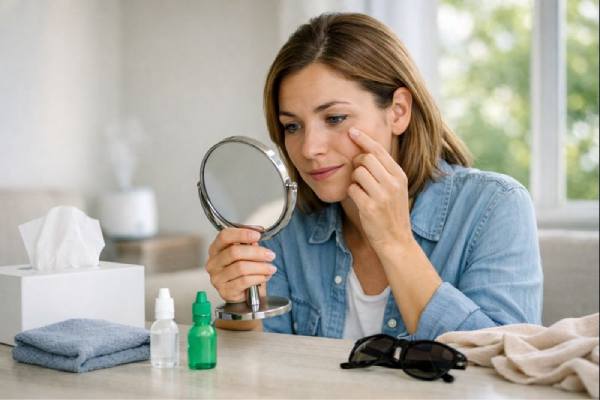
Dry eye and eye allergies can feel nearly identical at first: redness, watering, grittiness, and that persistent urge to rub. But the “why” behind the discomfort matters, because the best fix for one problem can worsen the other. Dry eye disease is often a tear film issue—too little tear volume, poor tear quality, or rapid evaporation—while allergic conjunctivitis is an immune reaction to triggers like pollen, dust mites, or pet dander. Many people have a blend of both, especially during allergy season or in dry indoor air.
This guide walks you through practical ways to separate dry eye from allergies using symptom patterns, timing, and simple self-checks. You will also learn what clinicians test for, how treatments differ, and how to build a plan that calms inflammation without drying the eyes further.
Core Points
- Track whether itching or burning is the dominant symptom, and note how quickly it flares after exposure to triggers.
- Use preservative-free lubricating drops as a low-risk first step, especially if symptoms occur most days.
- Treat allergy symptoms with targeted eye drops and avoidance strategies before relying on oral antihistamines that can worsen dryness.
- Seek urgent care for eye pain, sudden vision changes, one-sided swelling, or light sensitivity—these are not typical “just allergies.”
- If symptoms persist beyond 2–3 weeks despite basic care, ask for a structured dry eye and allergy evaluation so both contributors are treated.
Table of Contents
- Dry eye and allergies: what feels similar
- Timing and triggers that point to one cause
- Simple self-checks to narrow it down
- Tests eye doctors use and what they mean
- A practical dry eye treatment plan
- Treating eye allergies without making dry eye worse
Dry eye and allergies: what feels similar
Dry eye disease and allergic conjunctivitis overlap because they irritate the same surface tissues: the tear film, eyelids, and conjunctiva (the clear membrane covering the white of the eye). When that surface is inflamed, nerves become more reactive, and the tear film becomes less stable. The result is a shared cluster of symptoms that can mislead even attentive people.
Symptoms both conditions can cause
- Redness (especially after a long day or outdoor exposure)
- Watering or “tearing” (yes, dry eyes can water—more on that later)
- Gritty or sandy sensation
- Fluctuating vision that improves temporarily with blinking
- Eyelid heaviness or fatigue
- Sensitivity to wind, fans, or smoke
Where they start to diverge is the quality of the discomfort.
Dry eye tends to feel like:
- Burning, stinging, or “hot” eyes
- Scratchiness that worsens with screen time or reading
- A sensation of dryness that is oddly paired with occasional watering
- Blurry vision that comes and goes, often late in the day
- Discomfort that is worse in air-conditioned rooms, heated spaces, airplanes, or after contact lens wear
Allergies tend to feel like:
- Itching as the headline symptom (often hard to ignore)
- Puffiness of the eyelids, especially in the morning
- A watery, runny feeling, sometimes with stringy mucus
- Symptoms that flare quickly after exposure (pets, pollen, dusting)
- Frequent rubbing, which temporarily relieves itching but can worsen inflammation
A useful mental shortcut: itch is the signature of allergy, while burning and fluctuating vision are classic for dry eye. But reality is often mixed. Allergy inflammation can destabilize the tear film and trigger dryness. Dry eye can also make eyes feel “reactive,” so minor allergens or irritants feel bigger than they are.
Finally, consider the lids. Many “dry eye” cases are driven by meibomian gland dysfunction, where the oil layer of tears is insufficient or poor quality. That oil layer slows evaporation. If it is compromised, the eye dries out faster—even if tear volume is normal.
Timing and triggers that point to one cause
If symptoms feel similar, timing is often the clearer signal. Dry eye and allergies behave differently across the day, across seasons, and across environments.
Clues that lean toward allergies
- Seasonal pattern: symptoms spike during spring and fall, or whenever local pollen counts rise.
- Rapid onset after exposure: itching and watering start within minutes to an hour after being outdoors, near pets, or in dusty spaces.
- Both eyes affected similarly: allergies commonly involve both eyes, although one can feel worse if you rub it more.
- Coexisting allergy signs: sneezing, nasal congestion, throat itch, or eczema often travel with eye allergy.
Clues that lean toward dry eye
- End-of-day worsening: symptoms build through the afternoon and are worst in the evening.
- Screen-time link: discomfort increases after 30–90 minutes of focused work, gaming, or scrolling.
- Indoor amplification: heating, air-conditioning, fans, and low humidity reliably make symptoms worse.
- Contact lens sensitivity: lenses become intolerable earlier than usual, or feel “stuck” to the eye.
The environment can create a blended picture
A common scenario is: mild baseline dry eye + seasonal allergies. During allergy season, allergic inflammation makes the tear film less stable, and the person suddenly feels “dry all the time,” even though the initial driver was allergy. Another scenario: someone starts oral allergy medicine and their eyes feel drier within days because some systemic antihistamines can reduce tear and mucus secretion.
A quick trigger map
- Pollen, pets, dust mites, mold → more consistent with allergy
- Wind, fans, smoke, long screen sessions → more consistent with dry eye
- New face products, eyelash glue, fragranced creams → can cause irritant or contact reactions that mimic allergy and dry eye
- New eye drops “for redness” → can cause rebound redness and surface irritation, complicating both conditions
If you are unsure, keep a simple 7-day log:
- Morning / midday / evening symptom severity (0–10)
- What you were doing (screens, outdoors, cleaning, driving)
- Any medicines taken
- Drops used and whether they helped within 10–20 minutes
Patterns often emerge quickly—especially the “itch spikes after exposure” pattern that points toward allergy.
Simple self-checks to narrow it down
You cannot diagnose yourself with certainty at home, but you can gather better signals than “my eyes are red.” The goal is to reduce guessing and choose safer first steps.
Step 1: Identify the dominant sensation
Ask yourself: If I could remove only one symptom, which would it be?
- If the answer is itching, allergy moves up the list.
- If the answer is burning, stinging, or fluctuating vision, dry eye becomes more likely.
- If it is both, plan on treating both contributors.
Step 2: Look for discharge type
- Clear, watery tearing can occur in both.
- Stringy, mucus-like discharge is more common in allergy (especially if you notice “ropes” of mucus).
- Thick yellow or green discharge, eyelids stuck shut, or significant one-sided swelling suggests infection and needs medical advice.
Step 3: Try a low-risk “lubrication test”
Use preservative-free artificial tears (single-use vials or clearly labeled preservative-free bottles).
- Put 1 drop in each eye.
- Reassess in 10–15 minutes.
- If you feel noticeably calmer, less gritty, and vision steadies briefly, that supports a dry eye component.
- If itching still dominates with minimal change, allergy may be leading.
This is not a perfect test—lubrication can soothe allergy temporarily by rinsing allergens—but it helps reveal whether tear film instability is a major driver.
Step 4: Cold compress vs warm compress response
- Cold compress (5–10 minutes): often reduces itching and swelling more effectively, pointing toward allergy.
- Warm compress (8–12 minutes): often improves lid comfort and reduces evaporative dry eye symptoms over time, pointing toward meibomian gland involvement.
Step 5: Watch your blink behavior on screens
During focused tasks, blink rate commonly drops and blinks become incomplete (the upper lid does not fully meet the lower lid). If symptoms reliably surge with screens, that favors dry eye—even if allergies also exist.
Red flags that should override self-testing
Seek prompt medical assessment if you have:
- Moderate to severe eye pain
- Light sensitivity (photophobia)
- Sudden vision loss or persistent blurred vision in one eye
- A new droopy eyelid, unequal pupils, or double vision
- Marked swelling around one eye, fever, or severe tenderness
These features are not typical for straightforward dry eye or routine allergy.
Tests eye doctors use and what they mean
When symptoms persist, the most helpful visit is one that evaluates both the ocular surface and allergy contributors. Many people have been told “it is dry eye” without a structured exam, or “it is allergies” without checking tear stability. A good workup reduces trial-and-error.
Dry eye evaluation: what is being measured
Clinicians typically look for three things: tear stability, surface damage, and lid oil function.
- Tear breakup time: A dye is placed in the eye and the clinician measures how quickly the tear film breaks apart after a blink. Faster breakup suggests tear instability and evaporative dry eye.
- Ocular surface staining: Dyes highlight areas of surface irritation or damage. Staining patterns can suggest dryness, exposure, contact lens-related stress, or inflammation.
- Schirmer test: Paper strips measure tear production over a set time. This helps identify low tear volume (aqueous-deficient dry eye).
- Meibomian gland assessment: The clinician evaluates the eyelid margins, gland openings, and the quality of expressed oils. Thick, toothpaste-like oil points to meibomian gland dysfunction.
- Inflammation markers and osmolarity tests: Some practices use point-of-care tests that estimate tear saltiness or inflammatory markers. These can be helpful for guiding therapy, especially when symptoms and signs do not match.
Allergy evaluation: what confirms allergic conjunctivitis
Allergy is often diagnosed clinically, but several exam findings support it.
- Itchy eyes with conjunctival swelling (chemosis): swelling of the conjunctiva is a common clue.
- Papillae under the upper lid: the clinician may evert (flip) the upper eyelid to look for a “cobblestone” reaction typical of ocular allergy.
- Lid dermatitis or atopic features: eczema-like changes around the eyes can support allergic disease.
- History patterns: predictable flares with known exposures can be highly diagnostic.
Sometimes referral to an allergist is recommended when:
- Symptoms are severe and recurrent
- Nasal and respiratory allergies are poorly controlled
- You may benefit from allergen testing or immunotherapy
Why the overlap matters clinically
Allergic inflammation can worsen tear film instability. Meanwhile, dry eye can amplify the sensation of allergy and make drops sting. Clinicians often aim to calm the ocular surface first (improving tear film and reducing irritation), then fine-tune allergy treatment to avoid drying side effects.
If you have tried multiple over-the-counter products with little progress, a structured exam is the fastest path out of the loop.
A practical dry eye treatment plan
Dry eye treatment works best as a stepwise plan: improve the tear film, protect the surface, and address underlying inflammation or gland dysfunction. You do not need to do everything at once, but consistency matters.
Step 1: Get the basics right
- Use preservative-free artificial tears if you need drops more than 4 times daily. Preservatives can irritate the surface with frequent use.
- Aim for routine, not rescue: for chronic symptoms, start with 2–4 times daily for 2 weeks, then adjust based on response.
- Avoid “redness relief” vasoconstrictor drops as a routine. They may reduce redness temporarily but can increase irritation and rebound redness over time.
Step 2: Support the eyelid oil layer
If symptoms worsen with wind, fans, or screens, evaporative dry eye is likely.
- Warm compresses: apply a comfortably warm (not hot) compress for 8–12 minutes, then gently massage the lid margins. Do this once daily for at least 2–3 weeks before judging the effect.
- Lid hygiene: if you have crusting, oiliness, or irritation along the lashes, use a gentle lid cleanser or wipes. Over-scrubbing can backfire, so keep pressure light.
Step 3: Modify the environment and behaviors that drive evaporation
- Screen strategy: every 20 minutes, look 20 feet away for 20 seconds, and do 5 slow, complete blinks. The blink part is the underrated piece.
- Fan and vent control: keep car vents and desk fans from blowing directly at your face.
- Humidity: if indoor air is dry, consider adding moisture to the room and reducing direct airflow overnight.
Step 4: Escalate thoughtfully if symptoms persist
Depending on exam findings, clinicians may recommend:
- Prescription anti-inflammatory drops aimed at reducing ocular surface inflammation that perpetuates dry eye.
- Short courses of supervised steroid drops for flares (not a long-term do-it-yourself solution).
- Punctal plugs to reduce tear drainage in selected cases.
- In-office procedures that target meibomian gland dysfunction, when gland blockage is a major driver.
A practical reality check
Dry eye rarely resolves overnight. Many people improve in stages:
- fewer “bad days,”
- less end-of-day burning,
- more stable vision,
- less dependency on frequent drops.
If you also have allergies, it is common to need a combined approach. Treating lids and tear stability often makes allergy drops sting less and work better.
Treating eye allergies without making dry eye worse
Eye allergy care has two goals: reduce exposure to triggers and calm the immune response on the ocular surface. The challenge is doing that without drying the eyes further or irritating an already fragile tear film.
Step 1: Reduce allergen load with simple habits
- Do not rub your eyes. Rubbing releases inflammatory chemicals from mast cells and can prolong symptoms.
- Rinse and reset: after outdoor exposure, wash hands and face, and consider a quick shower to remove pollen from hair and brows.
- Cold compresses (5–10 minutes) can reduce itching and lid swelling safely.
- Manage the bedroom: keeping windows closed during high pollen periods and washing bedding regularly can help if dust mites or pollen are triggers.
Step 2: Choose the right type of eye drop
For many people, the best first-line option is a topical antihistamine and mast cell stabilizer combination (often called “dual-action” drops). These target itching quickly and reduce future flares when used consistently.
Helpful selection principles when dryness is also present:
- Prefer preservative-free versions when possible, especially if you need frequent dosing.
- Avoid overusing decongestant “get the red out” drops, which can worsen irritation and rebound redness.
- If drops sting, it may be because the surface is inflamed or dry. Lubricating first (waiting a few minutes) can make allergy drops more tolerable.
Step 3: Be cautious with oral antihistamines
Oral antihistamines can be useful for multi-system allergy (eyes plus nose), but some people notice increased dryness. If your eyes worsen after starting an oral allergy pill:
- Consider discussing alternative options with a clinician.
- Prioritize targeted eye drops and nasal therapies that control allergy without as much systemic drying.
Step 4: When allergy is severe or chronic
In more stubborn cases, clinicians may add:
- Short, supervised courses of steroid eye drops for significant inflammation (requires monitoring for pressure changes and other risks).
- Immunomodulating therapies for severe allergic eye disease (typically specialist-managed).
- Allergen immunotherapy (allergy shots or other approaches) when symptoms are persistent and clearly triggered.
How to treat both conditions together
A practical combined routine often looks like this:
- Morning: lubricating drop (preservative-free)
- Morning: allergy drop if needed (dual-action)
- Midday: lubricating drop, especially with screens
- Evening: warm compress if meibomian gland dysfunction is present
- During flares: cold compress and increased lubricant use
The key is to avoid creating a cycle where allergy treatment dries the eye, dryness increases irritation, and irritation feels like more allergy. When both are present, improving the tear film usually reduces overall reactivity and makes allergy control easier.
References
- Dry Eye Syndrome Preferred Practice Pattern® – PubMed 2024 (Guideline)
- TFOS Lifestyle Report: Impact of environmental conditions on the ocular surface – PubMed 2023 (Consensus Report)
- Prevalence of Comorbidity between Dry Eye and Allergic Conjunctivitis: A Systematic Review and Meta-Analysis – PubMed 2022 (Systematic Review and Meta-Analysis)
- Allergic Conjunctivitis Management: Update on Ophthalmic Solutions – PMC 2024 (Review)
- Allergic Conjunctivitis: Review of Current Types, Treatments, and Trends – PMC 2024 (Review)
Disclaimer
This article is for general educational purposes and does not replace individualized medical advice, diagnosis, or treatment. Eye symptoms can overlap across conditions, and some causes of redness, pain, or vision changes require urgent evaluation. If you have significant eye pain, light sensitivity, sudden vision loss, worsening swelling, or symptoms mainly in one eye, seek prompt care from an eye care professional or emergency service. If you are pregnant, immunocompromised, have glaucoma, or use prescription eye medications, ask a clinician before starting new eye drops—especially steroid or “redness relief” products.
If you found this guide helpful, please consider sharing it on Facebook, X (formerly Twitter), or any platform you prefer. Your support through sharing helps our team continue producing high-quality, practical health content.