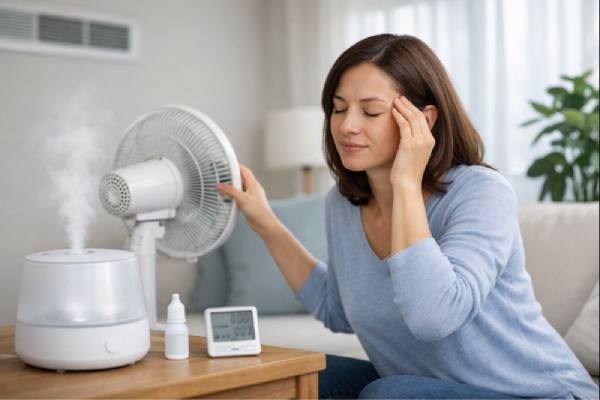
Dry indoor air can make your eyes feel gritty, watery, and tired—often without any obvious “eye problem” at first. The reason is simple: your tears are not just moisture, they are a thin optical coating that must stay smooth and stable. When heated or air-conditioned air lowers humidity and increases airflow across your face, tears evaporate faster, the surface of the eye becomes less protected, and irritation builds. The good news is that many people can noticeably reduce symptoms with practical indoor changes: improving humidity where you spend the most time, redirecting vents and fans, and supporting the tear film with better screen habits and targeted eye care. Still, dry air can also uncover underlying dry eye disease, allergies, or eyelid inflammation—conditions that benefit from a more structured plan. This guide explains what is happening, what actually works, and how to create an indoor setup that feels comfortable and supports clear vision.
Essential Insights
- Keeping indoor humidity in a moderate range can reduce tear evaporation and lessen burning and gritty sensations.
- Redirecting fans and vents away from the face often improves symptoms within days, especially during sleep and screen work.
- Humidifiers can help, but only when used safely with regular cleaning to prevent microbial and mineral issues.
- Persistent irritation, light sensitivity, or fluctuating blur may signal dry eye disease that needs an eye exam and targeted treatment.
- A practical starting plan is to aim for 40%–50% relative humidity where you work and sleep, then reassess symptoms after two weeks.
Table of Contents
- Why dry air irritates your eyes
- What humidity is best indoors
- Do humidifiers help and how to use them
- Fans, vents, and airflow fixes
- Daily habits that protect the tear film
- When home fixes are not enough
Why dry air irritates your eyes
“Dry air” is not just uncomfortable for your skin and throat—it changes the physics of your tear film. Your tears are a layered structure that includes water, oils (from the eyelid’s meibomian glands), and mucus-like components that help tears spread evenly. When that balance is stable, the eye surface stays protected, comfortable, and optically smooth. When the balance breaks, you can feel symptoms even if your eyes look only mildly red.
The main problem indoors is evaporation. Lower humidity increases the gradient that pulls moisture from the eye surface into the air. Air movement makes it worse by constantly replacing the air right in front of your eyes with drier air—like a small, invisible “wind” that speeds evaporation.
Common indoor triggers include:
- Winter heating: Warming cold outdoor air usually drops indoor relative humidity unless moisture is added back.
- Air conditioning: Cooling can also reduce humidity, and AC airflow often hits the face directly.
- Fans and vents: A ceiling fan, desk fan, or car vents can dry the tear film quickly, especially if aimed at your eyes.
- Screens and concentration: When people focus on screens, blink rate often decreases and incomplete blinks become more common, leaving the tear film uneven.
- Sleeping environment: Overnight dryness matters. Many people sleep with a fan, vent, or open-mouth breathing, which can leave eyes irritated on waking.
A frustrating feature of dry-eye-type irritation is that watery eyes can still be “dry.” Reflex tearing can occur when the surface gets irritated, but those tears may not have the oil layer needed to stay on the eye, so they run out and still feel uncomfortable.
If you are wondering whether this is “normal,” a useful rule is: brief irritation after a dry commute is common; irritation that recurs most days, affects vision clarity, or makes you reach for drops constantly suggests the tear film is not keeping up with your environment. The goal of the rest of this guide is to reduce the evaporation load and make your tear film more resilient—without overcomplicating your routine.
What humidity is best indoors
Humidity is one of the few indoor factors you can measure and adjust, and it often has an outsized effect on eye comfort. The key is moderation. Too little moisture dries the tear film; too much increases the risk of mold and dust mites, which can trigger allergies and indirectly worsen eye irritation.
For many people, a practical target range is:
- 40%–50% relative humidity (RH): often a comfortable zone for eyes, skin, and breathing
- Below ~30% RH: many people notice more dryness, especially with screens or contact lenses
- Above ~60% RH: increased risk of indoor dampness problems (mold growth and mite proliferation)
Because RH changes with temperature, a room can feel “dry” even if it is warm, and it can feel “damp” in a cooler space. That is why a small digital hygrometer can be useful: it makes an invisible factor visible.
How to measure humidity in a way that helps your eyes
- Measure where your eyes are: A reading across the room can be misleading. If you sit near a vent or window, the microclimate at your desk may be drier than the average.
- Check morning and evening: RH often drops overnight with heating and rises with cooking or showers.
- Track patterns for a week: Instead of chasing a single “perfect” number, look for consistent lows during the hours you feel worst.
Why “comfortable humidity” still may not solve symptoms
Humidity is only one part of the evaporation equation. Airflow, blinking, and tear quality matter just as much. For example, 45% RH may not feel comfortable if a desk fan is aimed at your face, or if you are spending six hours in a focused screen posture with reduced blinking.
It also helps to know that irritation can be cumulative. You may tolerate a dry room for an hour, but by late afternoon your tear film has been stressed repeatedly—then the same airflow feels suddenly intolerable. That is why small adjustments early in the day (like redirecting a vent or taking blink breaks) can prevent the evening “crash.”
If you do nothing else, start by identifying whether your main problem is low humidity, high airflow, or both. Once you know which lever matters most, your fixes become simpler, cheaper, and more effective.
Do humidifiers help and how to use them
Humidifiers can help with dry-air eye irritation, but they work best when you treat them like a health tool—not just a comfort gadget. The main benefit is straightforward: raising local humidity slows tear evaporation. Some people notice improvement within days, especially in winter heating season or in heavily air-conditioned rooms.
Which humidifier type makes sense
- Evaporative (wick) humidifiers: Often a good balance for many homes because they naturally limit over-humidification. They require wick changes and regular cleaning, but they tend to release fewer mineral “white dust” particles when used properly.
- Ultrasonic humidifiers: Quiet and efficient, but they can aerosolize minerals from tap water, leaving white dust on surfaces. This is not ideal for air quality. If you use ultrasonic, distilled or demineralized water is usually the safer choice for the room.
- Warm-mist (steam) humidifiers: Can be effective and reduce microbes by heating water, but they use more energy and carry burn risk—especially around children and pets.
Desktop humidifiers can be helpful for the “microclimate” around your workstation, but they should not blow mist directly into your face. The goal is to raise humidity in your breathing and eye zone, not to coat your eyelashes with droplets.
How to use a humidifier safely for eye comfort
- Aim for a range, not maximum output: Try to keep the room around 40%–50% RH, and avoid pushing past 55%–60%.
- Use the right water: Distilled water helps reduce mineral aerosol and residue.
- Clean on a schedule you can keep: Rinse and dry the tank regularly and follow manufacturer instructions for disinfection. A neglected humidifier can become a source of airborne microbes or irritants.
- Place it intelligently: Put it a few feet away from walls and electronics, and avoid directing mist toward bedding or windows where condensation can form.
- Watch for condensation: If you see moisture collecting on windows or cool surfaces, humidity is likely too high.
When a humidifier is the wrong first step
A humidifier may not be the best solution if your symptoms come mostly from direct airflow (fan or vent), allergies, or eyelid inflammation. In those cases, people sometimes humidify the room and still feel irritated—because the problem is not only dryness, it is also unstable tears, inflammation, or ongoing exposure to irritants.
A good approach is a two-week trial: set humidity targets, track symptoms at the same time each day, and combine humidification with airflow control. If symptoms barely change, you still learned something valuable: your next best lever is likely tear quality, eyelid care, or allergy management rather than room moisture alone.
Fans, vents, and airflow fixes
Airflow is often the hidden driver of “my eyes feel dry no matter what I do.” Many people focus on humidity and ignore the fact that a gentle stream of air across the eyes can overwhelm even a healthy tear film. The fix is frequently simple: stop the air from hitting your face, especially during long, still activities like working, reading, or sleeping.
Workstation and living space adjustments
- Redirect vents away from your face: If a ceiling vent points toward your desk or couch, use the vent louvers to direct air upward or toward the center of the room.
- Move the fan, not the air: Instead of aiming a desk fan at your face, aim it across the room for circulation or toward a wall so the airflow diffuses.
- Use a “buffer zone” for screens: Place the monitor slightly below eye level so your eyelids cover more of the eye surface while you work. This reduces exposed surface area and evaporation.
- Avoid sitting directly under a ceiling fan: Even low-speed fans can dry eyes over hours. If you need the fan, shift seating position so the airflow is not in your direct path.
Bedroom and sleep-related fixes
Morning irritation is a strong clue that the overnight environment is contributing. Helpful changes include:
- Turn fans away from the bed or reduce speed at night.
- Keep vents from blowing toward your pillow.
- Consider eyelid closure and airflow issues: Some people sleep with incomplete eyelid closure or with air leaking upward from a CPAP mask. If you wake with very dry, irritated eyes, mention this pattern to an eye clinician.
- Think about mouth breathing: It dries the airway and often correlates with a drier bedroom experience overall. Addressing nasal congestion can help indirectly.
Car and commute strategies
Car vents are notorious for causing eye dryness:
- Aim vents toward the windshield or chest, not the face.
- Use recirculation thoughtfully if outside air is very cold and dry.
- Keep sunglasses for bright winter days; squinting and reduced blinking can worsen dryness.
Indoor air quality and particles
Dryness often overlaps with irritation from airborne particles: dust, smoke, cleaning sprays, or fragrance. Even when humidity is improved, airborne irritants can keep eyes inflamed. A few practical steps:
- Vacuum and dust regularly, especially around vents.
- Avoid spraying cleaners near your face; apply to a cloth first.
- If you are sensitive to smoke or strong fragrance, minimize exposure where you spend the most time.
Airflow control is often the fastest win because it reduces evaporation immediately. Many people are surprised by how much better their eyes feel after a simple vent adjustment—sometimes more than from any eye drop.
Daily habits that protect the tear film
Indoor fixes work best when your tear film is supported from the “inside” as well. Think of this as increasing your buffer against dryness: better blinking, better eyelid function, and fewer triggers that destabilize tears.
Screen habits that matter more than you think
When focusing on screens, people tend to blink less and blink incompletely. That leaves the tear film patchy and increases evaporation. Try:
- Blink resets: Every 20 minutes, do 5 slow blinks where your upper and lower lids fully meet.
- Micro-breaks: Look across the room for 20 seconds to reduce visual strain and encourage natural blinking.
- Lower the monitor slightly: A downward gaze position reduces exposed eye surface.
Contact lens considerations in dry air
Contact lenses can feel significantly worse in dry, windy, or heated environments. If you wear lenses:
- Consider reducing wear time during heating season.
- Do not “push through” burning or blurry lenses—those are signs the surface is drying.
- Discuss whether a different lens material, replacement schedule, or wearing plan could be better for your tear film.
- Avoid sleeping in lenses unless specifically prescribed for that use.
Eye drops and lubrication, used wisely
Lubricating drops can help, but strategy matters:
- Choose preservative-free options if you need drops more than a few times per day.
- Use drops before the long exposure (for example, before a screen session or a flight), not only after symptoms peak.
- If you feel “worse” after certain drops, you may be reacting to preservatives or additives, or you may need a different formulation.
Eyelid and meibomian gland support
Many dry-eye symptoms come from an inadequate oil layer, which normally slows evaporation. Basic eyelid support can help:
- Warm compresses can be useful for some people, but they need to be comfortably warm (not hot) and used consistently.
- Gentle lid hygiene may reduce irritation from eyelid margin buildup.
Hydration, caffeine, and environment stacking
Hydration is not a cure by itself, but dehydration can make symptoms worse. Consider “stacking” risks: a dry office, heavy screen use, and too little water intake can combine into a predictable bad day. If you can reduce two of the three, symptoms often improve.
A practical mindset is to build a routine you can maintain: airflow control, humidity targets, blink habits, and targeted lubrication when needed. Consistency matters more than intensity.
When home fixes are not enough
If you improve your indoor setup and still struggle, it may be time to treat the problem as more than “dry air.” Persistent irritation can reflect dry eye disease, allergies, eyelid inflammation, medication effects, or less common eye surface problems. A structured evaluation can pinpoint what part of the tear system is failing and which treatments match your pattern.
Signs you should schedule an eye exam
Consider an evaluation if you have any of the following:
- Symptoms most days for more than 4–6 weeks
- Fluctuating blur that comes and goes with blinking
- Light sensitivity, burning, or a sandy sensation that does not improve with basic measures
- Increasing dependence on drops
- Contact lens intolerance that is new or worsening
- One eye consistently worse than the other
What clinicians typically check
A useful assessment often includes:
- Tear film stability and surface staining (to see if the surface is drying or inflamed)
- Eyelid margin and meibomian gland function (oil layer quality)
- Allergy signs (itching, seasonal pattern, eyelid swelling)
- Medication review (some medications worsen dryness)
- Evaluation for contributing factors like incomplete eyelid closure during sleep
Common treatment pathways beyond home changes
Depending on findings, a clinician may recommend:
- A more specific drop plan (different lubricants, anti-inflammatory drops, or allergy drops when appropriate)
- Targeted eyelid treatments for meibomian gland dysfunction
- Strategies to protect the eye surface overnight if morning dryness is prominent
- Adjustments for contact lens wearers (lens type, schedule, or temporary breaks)
When symptoms need urgent care
Dryness and irritation are common, but certain symptoms are not “just dry air.” Seek prompt care for:
- Significant eye pain
- Sudden vision loss or a sudden major change in vision clarity
- Marked redness with light sensitivity
- Chemical exposure to the eye
- A new contact-lens-related red, painful eye
The goal is not to medicalize every dry day. The goal is to recognize when your tear film is chronically stressed and needs more than environmental tweaks. If your quality of life or work comfort is affected, it is reasonable—and often very effective—to get a tailored plan.
References
- Dry Eye Syndrome Preferred Practice Pattern® 2024 (Guideline)
- TFOS Lifestyle Report: Impact of environmental conditions on the ocular surface 2023 (Systematic Review and Report)
- Safety and Efficacy of Photocatalytic Micro-Mist Desktop Humidifier for Dry Eye Caused by Digital Environment: A Randomized Controlled Trial 2024 (RCT)
- Interventions for Dry Eye An Overview of Systematic Reviews 2024 (Systematic Review Overview)
Disclaimer
This article is for educational purposes only and does not provide medical advice, diagnosis, or treatment. Dry air can worsen eye irritation and dry eye symptoms, but persistent or severe symptoms may reflect underlying conditions that require professional evaluation. Seek urgent care for severe eye pain, sudden vision loss, significant light sensitivity, chemical exposure, or a painful red eye—especially if you wear contact lenses. For ongoing irritation, fluctuating vision, or symptoms that interfere with daily life, schedule an exam with a qualified eye care professional for personalized guidance.
If you found this article useful, please consider sharing it on Facebook, X (formerly Twitter), or any platform you prefer. Your support helps our team continue producing high-quality, reader-focused health content.