Contact lenses can be remarkably safe and comfortable when daily habits are consistent: clean hands, clean lenses, fresh disinfecting solution, and a predictable replacement schedule. Problems start when small shortcuts become routine—topping off old solution, wearing lenses into the night, rinsing a case with tap water, or reusing a lens beyond its intended lifespan. Those choices do not just cause irritation; they can raise the risk of serious eye infections and corneal inflammation that may threaten vision.
The goal of good hygiene is not perfection. It is reducing the predictable, high-impact exposures that let germs, deposits, and chemicals build up on lenses and cases. When you understand which mistakes matter most, you can focus your effort where it pays off: safer cleaning, smarter storage, and simple “exit ramps” for days when you cannot follow your usual routine. This guide breaks down the most common errors and the practical fixes that protect both comfort and eye health.
Top Highlights
- A few habits prevent most problems: wash and fully dry hands, rub and rinse lenses as directed, and use fresh solution every time.
- Keeping lenses and cases away from water is one of the highest-impact ways to reduce infection risk.
- Reusing solution, stretching replacement schedules, and wearing lenses too long are common triggers for irritation and inflammation.
- Stop wearing lenses immediately for pain, light sensitivity, or reduced vision, and seek prompt evaluation.
- Replace your lens case at least every 3 months and reset your routine after travel, illness, or an “oops” day.
Table of Contents
- The hygiene mistakes that matter most
- Hand and eye area mistakes before you touch a lens
- Case and solution errors that build germs fast
- Wear and replacement mistakes that inflate risk
- Travel and gym habits that sabotage hygiene
- What to do after a hygiene slip
The hygiene mistakes that matter most
If you wear contact lenses long enough, you will eventually have an imperfect day: you fall asleep on the couch, you forget your case, or you rinse your hands quickly and tell yourself it is “close enough.” The problem is not the occasional slip. The problem is repeating the same shortcuts until they become your baseline.
A useful way to prioritize hygiene is to focus on mistakes that change one of three things:
- Germ exposure (introducing microbes from hands, water, or contaminated cases)
- Germ growth (creating a warm, wet, nutrient-rich environment in a case or on a lens)
- Corneal vulnerability (reducing oxygen, causing micro-abrasions, or irritating the eye surface so infections take hold more easily)
The highest-impact mistakes tend to be the ones that do all three at once.
Most common high-impact errors
- Water contact: showering, swimming, rinsing lenses or cases with tap water, or storing lenses in water “just for a minute.”
- Sleeping in lenses when they were not prescribed for overnight wear.
- Topping off old solution instead of emptying the case and refilling with fresh disinfecting solution.
- Using a dirty or old case that is rarely cleaned, rarely dried, or rarely replaced.
- Stretching replacement schedules, such as turning a two-week lens into a month or using a monthly lens for several months.
- Skipping handwashing or incomplete drying, then handling lenses and cases.
These behaviors are common because they often do not cause immediate pain. You may get away with them dozens of times—until you do not. When something finally goes wrong, it can feel sudden, but the risk has been accumulating.
Why “looks clean” is not the same as “safe”
A contact lens case can look spotless and still be contaminated. Germs thrive in microscopic film on damp plastic, and deposits from tears and solution residue can feed them. Similarly, rinsing with water can feel like a “freshening” step, but it introduces organisms and minerals that disinfecting solution is meant to control. Hygiene is less about visible dirt and more about breaking the conditions germs need to survive.
A simple rule to guide decisions
When you are uncertain, ask: Does this choice add water, reuse liquid, or extend time?
If the answer is yes, it usually increases risk. Safer choices remove water exposure, use fresh disinfecting solution, and keep wear and replacement schedules honest.
Hand and eye area mistakes before you touch a lens
Many contact lens problems start before the lens ever reaches your eye. Hands, towels, nails, and the “eye area” environment can introduce germs, fibers, and irritants that stick to a lens surface and stay there for hours.
Mistake: quick rinse instead of real handwashing
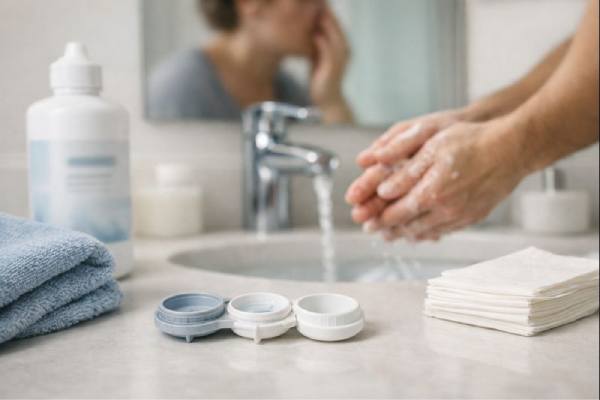
A fast splash of water is not the same as washing. Good hand hygiene is simple but specific:
- Use soap and water.
- Rub all surfaces of the hands and fingers, including under nails.
- Rinse thoroughly.
- Dry completely with a clean, lint-minimizing towel before touching lenses.
Drying matters because wet hands transfer more microbes, and water droplets can end up on the lens or in the case. If you tend to wash quickly, consider making handwashing a “two-step” habit: wash, then pause long enough to dry fully.
Mistake: handling lenses with long nails or rough fingertips
Long nails and sharp edges can nick the lens, scrape the cornea, or trap debris. A tiny scratch on the cornea may not be dramatic, but it can increase irritation and make the surface more vulnerable. If you wear long nails, compensate with extra care:
- Use the pad of the finger, not the nail tip.
- Slow down insert and removal.
- Stop if you feel a sharp sensation and re-check the lens for tears or debris.
Mistake: makeup and skincare contamination
Lotions, sunscreen, and makeup can coat lenses, destabilize the tear film, and cause burning or blurry vision. Common pitfalls include applying hand cream, then inserting lenses minutes later, or applying eyeliner to the inner lid margin where it mixes with tears.
Practical adjustments that help:
- Insert lenses before makeup and remove lenses before heavy makeup removal.
- Keep eyeliner off the inner lid margin if you are prone to clogged oil glands or dryness.
- Wash hands after applying skincare products, even if they are “non-greasy.”
Mistake: touching lenses around pets, dust, or aerosols
Hair spray, cleaning sprays, perfume, and dusty environments can deposit particles on a lens surface. If you have to handle lenses in a less-than-ideal environment, reduce damage by preparing first:
- Close windows, step away from fans, and avoid active spraying.
- Use a clean surface and keep the case capped when not in use.
- If you drop a lens, do not “rinse it off” with water. Use the recommended disinfecting solution and follow your care instructions.
Mistake: ignoring early eye irritation
If your eyes are already red, itchy, or gritty, inserting lenses can amplify inflammation and lead to more rubbing, which worsens the cycle. Consider lenses optional on “reactive eye” days. Wearing glasses for 24–48 hours can prevent a minor irritation from becoming a prolonged flare.
Case and solution errors that build germs fast
The lens case is one of the most underestimated risk factors in contact lens wear. A case is warm, damp, and repeatedly exposed to tears and microbes. If cleaning is inconsistent, a biofilm can form—an invisible layer where germs survive and multiply even in the presence of disinfecting solution.
Mistake: topping off old solution
“Topping off” means adding fresh solution to old solution in the case. This dilutes the disinfecting power and lets microbes persist. It also keeps old debris and deposits in contact with the lens.
A safer routine is consistent and non-negotiable:
- Empty the case completely every time.
- Rinse the case with disinfecting solution (not water).
- Wipe or rub the case wells if recommended by your provider or solution instructions.
- Refill with fresh solution only.
Mistake: skipping rub and rinse because the solution says “no rub”
Even when a product is marketed as “no rub,” many eyes do better when lenses are gently rubbed and rinsed with the recommended solution, because it removes deposits and reduces the material germs can cling to. If your instructions allow rubbing, it is often one of the easiest upgrades you can make.
A simple approach:
- Place the lens in the palm.
- Apply a few drops of solution.
- Rub gently for several seconds each side.
- Rinse thoroughly with solution.
- Store in fresh solution.
Mistake: “cleaning” the case with tap water
Water exposure is risky because water can carry organisms that are particularly dangerous for contact lens wearers. It can also leave mineral residue that encourages deposits and irritation. If you rinse your case with water, you may feel like you are cleaning it, but you may be seeding it.
Prefer cleaning steps that keep water out of the lens system:
- Use disinfecting solution for case rinsing if the product instructions allow.
- Let the case air-dry fully, face down on a clean tissue, with caps off.
- Replace the case regularly rather than trying to “rehabilitate” an old one.
Mistake: stretching case replacement
Many people replace the case only when it cracks or looks dirty. A better approach is time-based: replace the case at least every three months, and sooner if it looks scratched, cloudy, or slimy, or if you have had an eye irritation episode.
Mistake: mixing and matching solutions
Switching solutions frequently can increase irritation, especially if you have sensitive eyes or a history of allergy-like symptoms. It can also create confusion that leads to unsafe practices, such as using saline when disinfection is required.
If you have recurrent redness or burning:
- Consider whether the issue began after a solution change.
- Use the solution recommended for your lens type.
- Ask about a preservative profile that fits your eyes, or a peroxide-based system if appropriate.
Mistake: reusing solution during travel
Travel routines are where hygiene slips cluster: smaller hotel sinks, rushed mornings, and missing supplies. Do not compromise by reusing solution. If you are short on supplies, switch to glasses for the day instead of cutting corners with lens care.
Wear and replacement mistakes that inflate risk
Hygiene is not only about cleaning; it is also about time. The longer a lens is worn, and the longer it is kept past its intended replacement, the more deposits build and the more the cornea is exposed to hypoxia (low oxygen) and mechanical stress. Time-based mistakes often feel harmless because they are convenient—and because they can “work” for a while—until inflammation or infection forces a hard stop.
Mistake: wearing lenses longer than your eyes can tolerate
Even with perfect cleaning, wearing lenses for very long days can push the ocular surface into dryness and irritation. In some studies, wearing lenses beyond 12 hours has been associated with a meaningful increase in inflammatory complications. The takeaway is not that everyone must stop at a precise hour, but that long days should trigger more conservative habits:
- Use glasses for part of the day when possible.
- Avoid pushing wear time when you are sick, sleep-deprived, or in dry environments.
- Do not “extend” a long day by napping in lenses.
Mistake: sleeping in lenses not prescribed for overnight wear
Sleeping in lenses is one of the most consistent risk multipliers because it combines reduced oxygen, reduced tear exchange, and prolonged contact with any microbes present. Even a short nap can matter for sensitive eyes. If you find yourself falling asleep in lenses regularly, treat it as a system problem, not a willpower problem:
- Keep a lens case and glasses at your bedside.
- Set a nightly alarm labeled “lenses out.”
- Consider daily disposables if your routine makes you prone to dozing off.
Mistake: stretching replacement schedules
Replacement schedules exist because lens materials and surfaces change with wear. Deposits accumulate, microscopic surface damage increases, and comfort and safety decline.
Common examples of “schedule drift”:
- Two-week lenses worn for a month.
- Monthly lenses worn for two or three months.
- Daily disposables reused for multiple days.
If you are tempted to stretch replacement due to cost, the safest approach is to discuss alternatives with an eye care professional rather than improvising. Often, a different lens type or a different wear strategy can reduce total lens usage without unsafe reuse.
Mistake: wearing lenses while sick
When you are ill, your eyes may be drier, your immune system is busy, and your hygiene routines may be rushed. It is also easier to touch your face frequently. Many people do better taking a short “glasses-only” break during respiratory infections or significant allergy flare-ups.
Mistake: ignoring repeated late-day irritation
If your eyes reliably become red or uncomfortable late in the day, it is a sign your current system is not sustainable. Repeated inflammation increases deposits and makes future discomfort more likely. Instead of pushing through, use the pattern as data:
- Track when discomfort begins for one week.
- Note whether it worsens on screen-heavy days or in dry environments.
- Use that information to adjust wear time, lens type, or care system.
Travel and gym habits that sabotage hygiene
Most people know the basics of contact lens hygiene at home. The real trouble happens when routines change: travel, camping, long workdays, late nights out, and exercise. These scenarios increase the odds of water exposure, rushed handling, and “temporary” shortcuts that become habits.
Mistake: showering or swimming in lenses
Water exposure is a high-stakes error. Showering, swimming, hot tubs, and even rinsing your face can introduce organisms that are uncommon but serious in contact lens wearers. Studies have found that frequent showering in lenses is associated with a large increase in infection risk, including particularly severe infections.
Safer alternatives:
- Remove lenses before any water activity.
- Wear prescription goggles if you need vision correction in the water.
- If you must be in water unexpectedly, switch to daily disposables and discard immediately afterward, but remember that “better” does not mean “risk-free.”
Mistake: using bathroom sinks and public spaces for lens handling
Public sinks increase the chance of dropping a lens, touching contaminated surfaces, or rinsing with water. If you anticipate needing to remove lenses during the day, plan a controlled setup:
- Carry a small kit: backup glasses, a spare case, and your recommended solution.
- Use hand sanitizer only as a backup, and wait until hands are fully dry before touching lenses.
- Avoid placing lenses on towels or tissues in public restrooms.
Mistake: exercising in drying environments without a plan
Gyms often have fans, low humidity, and sweat that runs toward the eyes. Sweat itself is irritating, and wiping your face can dislodge a lens or introduce bacteria from gym equipment contact.
Practical strategies:
- Use a clean sweatband to reduce sweat migration.
- Avoid rubbing eyes during workouts.
- Consider daily disposables for gym-heavy days so you are not wearing a lens that is already deposited and dry from earlier hours.
Mistake: sleeping on planes or long rides in lenses
Air travel combines low humidity with dozing, both of which stress the eye surface. If you are likely to sleep, remove lenses before you do. If you cannot remove them safely mid-flight, consider wearing glasses for travel days.
Mistake: improvising when you run out of supplies
The most dangerous travel mistakes often start with good intentions: “I will just store them in saline,” or “I will reuse yesterday’s solution one time.” If you do not have the right supplies, the safest choice is simple: wear glasses until you do. Contact lenses are optional; corneal health is not.
A travel mindset that works is redundancy: one spare case, one small bottle of solution, one pair of backup glasses. That small kit prevents most “forced mistakes.”
What to do after a hygiene slip
Even careful lens wearers make mistakes. The key is responding in a way that reduces risk rather than hoping nothing happens. Think of it as a decision tree: remove the lens, reset the system, and watch for warning signs that require prompt care.
If the mistake involved water
Examples include showering in lenses, swimming in lenses, rinsing a lens with tap water, or putting lenses in after splashing water on your face.
Safer response:
- Remove the lenses as soon as you can.
- If lenses are reusable, clean and disinfect them according to your care instructions before wearing again, but consider discarding them if you cannot be confident about disinfection.
- If you wear daily disposables, discard them immediately.
- Switch to glasses for the rest of the day if your eyes feel irritated.
The goal is to reduce time of exposure and avoid trapping organisms under the lens.
If you slept or napped in lenses
Even short naps can leave eyes dry and more vulnerable. After an unplanned nap:
- Remove lenses if they feel stuck or if vision is hazy.
- Use a conservative approach the next day: shorter wear time, and consider glasses if eyes are still red.
- If you repeatedly fall asleep in lenses, treat it as a signal to change habits or lens type rather than repeating the cycle.
If you reused solution or skipped cleaning steps
If you realize you topped off solution or stored lenses in old liquid:
- Discard the old solution.
- Clean the case properly and let it dry.
- Re-disinfect lenses in fresh solution for the full recommended time before wearing.
- Consider replacing the case if this happens often or if the case is older.
When to stop lenses and seek care promptly
Remove lenses and seek prompt evaluation if you develop:
- moderate to severe pain
- notable light sensitivity
- reduced or foggy vision that does not clear with blinking
- worsening redness, especially in one eye
- a white spot, haze, or “scratch” sensation that persists
- thick discharge or eyelids sticking together
These are not “wait and see” symptoms for contact lens wearers.
How to restart safely after irritation
If your eyes became mildly irritated but improved after you stopped lenses:
- Wait until redness, burning, and gritty sensations have clearly resolved.
- Restart with shorter wear times for several days.
- Replace lenses and case if they are near the end of their cycle or if you suspect contamination.
- If irritation returns quickly, do not keep restarting. That pattern suggests a fit issue, solution sensitivity, deposit problem, or an untreated ocular surface condition.
The best long-term approach is not fear; it is structure. A simple, repeatable hygiene routine protects your vision and makes contact lenses feel effortless again.
References
- Impact of contact lens hygiene risk factors on the prevalence of contact lens-related keratitis in Alexandria-Egypt – PMC 2024
- How Can We Better Inform Patients of the Importance of Contact Lens Compliance?: Current Perspectives – PMC 2024 (Review)
- Development of a text message intervention designed to promote safe contact lens wear – PMC 2025
- Preventing Eye Infections When Wearing Contacts | Healthy Contact Lens Wear and Care | CDC 2025 (Government Guidance)
Disclaimer
This article is for educational purposes and does not replace personalized medical advice, diagnosis, or treatment. Contact lenses are medical devices, and hygiene mistakes can increase the risk of corneal injury and eye infections that may threaten vision. Remove your contact lenses and seek prompt evaluation if you have significant pain, light sensitivity, reduced vision, rapidly worsening redness, or symptoms that are much worse in one eye. For recurring irritation or repeated hygiene slips, schedule an eye exam to review lens fit, replacement schedule, and the safest care system for your eyes.
If you found this article helpful, please consider sharing it on Facebook, X (formerly Twitter), or any platform you prefer. Your support helps our team continue producing high-quality, trustworthy health content.