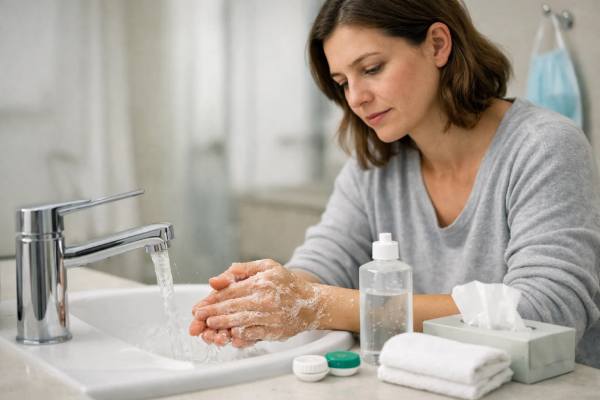
Wearing contact lenses during COVID-19 is not automatically unsafe, but it does change the risk calculation. Contacts require frequent hand-to-eye contact, and when you are sick your eyes are more likely to feel dry, irritated, or inflamed—conditions that make lenses less comfortable and can increase the chance of hygiene mistakes. For many people, the simplest and safest choice during active infection is to switch to glasses until they feel well again.
That said, some people rely on contact lenses for work, daily function, or specialized vision needs. If you choose to keep wearing them, the goal is not perfection—it is risk reduction: meticulous hand hygiene, strict replacement rules, and an early stop signal if your eyes become red, painful, or light-sensitive. This article offers a practical decision framework, step-by-step safety habits, and clear guidance on when an eye exam is worth prioritizing.
Quick Overview for Safer Lens Wear
- Switching to glasses during active illness can reduce hand-to-eye contact and simplify infection-control habits.
- If you keep wearing contacts, prioritize strict handwashing and never “stretch” wear time, cleaning steps, or replacement schedules.
- Stop lens wear immediately for new redness, pain, light sensitivity, discharge, or worsening blurry vision.
- Daily disposable lenses can reduce handling and storage steps compared with reusable lenses.
- Restart lenses only after symptoms resolve and you have replaced or disinfected lenses, cases, and any contaminated supplies.
Table of Contents
- How COVID-19 affects eyes and lens safety
- Should you wear contacts while you are sick
- Best practices to lower risk
- When to stop and get checked
- Special lens types and high-risk situations
- How to restart contacts after COVID-19
How COVID-19 affects eyes and lens safety
COVID-19 is primarily a respiratory illness, but the eyes can be part of the story in two ways: symptoms (irritation, redness, watery eyes) and behavior changes (more face-touching, more screen time, disrupted routines). Contact lens safety is less about the lens itself and more about what contact lenses require you to do repeatedly: touch your eyes.
Eye symptoms can make lenses less forgiving
During viral illness, the tear film often becomes unstable. Fever, dehydration, mouth breathing from congestion, and indoor heating can all increase evaporation and dryness. When your tear film is compromised, contact lenses can feel scratchy, shift more, and cause fluctuating blur. Dryness also encourages rubbing—exactly the habit you want to avoid during an infection.
Some people also develop conjunctivitis (pink eye) during COVID-19 or around the same time as other viral symptoms. Even mild conjunctival inflammation can make lenses uncomfortable and can trap debris under the lens, increasing irritation and the temptation to adjust the lens with your fingers.
Transmission risk is mostly about hands
Most everyday infection-control advice comes down to the same core principle: avoid touching your face with unwashed hands. Contact lens wear adds multiple “high-contact” moments per day—insert, remove, and sometimes reinsert or adjust. That does not prove contact lenses increase infection risk in all real-world settings, but it does mean lens wear depends on habits that can slip when you are exhausted, feverish, or medicated.
Glasses are not a shield, but they can help you touch less
Regular eyeglasses are not sealed eye protection, but they can act as a small behavioral barrier: they remind you not to rub your eyes and can reduce direct finger access. For people who are sick and tired, that simple friction can be helpful.
The key point: COVID-19 does not create a new set of contact lens rules—it amplifies the consequences of old ones. If your routine is already meticulous, you may be able to wear lenses safely. If your routine is “good enough on a normal day,” illness is when small shortcuts become bigger risks.
Should you wear contacts while you are sick
If you are actively sick with COVID-19, the safest default is glasses first. It is not a moral rule; it is a practical one. Glasses reduce hand-to-eye contact and simplify your day when you are already managing symptoms, isolation, and fatigue. Still, there are situations where someone may reasonably continue contact lens wear—especially if they have no good glasses option or rely on lenses for specific visual tasks.
A simple decision framework
Consider three questions:
- Can you reliably do strict hygiene today?
If you have chills, brain fog, nausea, or you are taking medications that make you drowsy, your technique is more likely to slip. That alone is a strong reason to switch to glasses. - Are your eyes quiet and comfortable?
If your eyes are red, watery, gritty, burning, or light-sensitive, lenses are less likely to fit well and more likely to trigger rubbing. Eye discomfort is a stop sign, not something to “push through.” - Do you have a low-handling option?
Daily disposables generally require fewer steps than reusable lenses. If you must wear contacts while ill, lower-handling options reduce opportunities for contamination.
When continuing lens wear may be reasonable
Continuing may be reasonable if all of the following are true:
- You have mild illness symptoms and feel capable of careful technique.
- Your eyes are not red or painful, and vision is stable.
- You will not sleep in lenses, stretch replacement time, or reuse solution.
- You have backup glasses available in case your eyes start to feel irritated.
If you rely on lenses for work that cannot be postponed, treat lens wear like a clinical routine: calm, clean, deliberate, and brief. Many people find it helpful to set up a “lens station” with soap, clean paper towels, and supplies so they are not improvising.
When glasses are the clear better choice
Switch to glasses if you have:
- fever and dehydration
- heavy congestion with mouth breathing
- new dry eye symptoms, gritty discomfort, or fluctuating blur
- any eye redness, discharge, or notable light sensitivity
- a history of contact-lens–related infections or inflammatory episodes
If you are unsure, choose glasses for a few days and reassess. Temporary inconvenience is a fair trade for lower risk while your body is already under stress.
Best practices to lower risk
If you decide to wear contact lenses during COVID-19, the goal is to reduce two risks at once: eye infection risk (keratitis, inflammation) and viral spread risk (hand-to-eye then hand-to-surfaces). The habits below are practical, not theoretical. They are designed for real life when you do not feel your best.
Handwashing that actually protects you
Do this every time you handle lenses:
- Wash hands with soap and water and scrub thoroughly.
- Rinse well and dry completely with a clean towel or disposable paper towel.
- Avoid “just sanitizer” as a routine substitute for lens handling unless you have no access to soap and water. If you must use sanitizer, wait until hands are fully dry and avoid touching the bottle tip to your hands.
Drying matters because wet hands can transfer microbes to lenses and because moisture can make lenses harder to handle cleanly.
Lens rules to follow without exceptions
- Do not sleep in lenses unless your prescriber has specifically told you that your lens type and eye health allow it—and even then, illness is the wrong time to take that risk.
- Do not “top off” solution. Discard old solution and use fresh disinfecting solution each time.
- Do not rinse lenses or cases with tap water, bottled water, or saliva.
- Do not wear lenses in the shower or bath.
- Replace the case on schedule (and sooner if you are sick and suspect contamination).
If you are using reusable lenses, rub-and-rinse cleaning is still important even when the solution label says “no rub.” Illness is not the time to skip mechanical cleaning.
Choose lower-handling options when possible
If daily disposables are available for your prescription and your clinician approves, they can reduce steps: no case, no bottle, no overnight storage. You still must wash hands, but you eliminate many contamination points.
If you wear reusable lenses and feel tempted to “make them last” because you are stuck at home, pause and switch to glasses. Stretching wear schedules is one of the most common ways mild irritation becomes a bigger problem.
Reduce eye-touching triggers
COVID-19 often increases the urge to rub your eyes because of dryness, fatigue, and screen time. These small strategies help:
- Use preservative-free lubricating drops before you feel desperate.
- Take short blink breaks during screen use.
- Keep tissues nearby for tearing so you do not wipe your eyes with your hands.
- Treat allergies if they are flaring, since itching is a rubbing trap.
If you want a single “must-do” list, treat it as a four-part routine: wash, dry, handle once, and stop early if discomfort starts. That mindset prevents most avoidable problems.
When to stop and get checked
One of the most important contact lens skills is not insertion—it is recognizing when your eye is signaling, “Stop.” During COVID-19, it is easy to blame symptoms on the virus and delay care. The safer approach is to separate normal discomfort from warning signs that can threaten vision.
Stop lens wear immediately if you notice
- new or increasing redness in one or both eyes
- moderate to severe pain (not just mild dryness)
- light sensitivity that makes you squint or avoid light
- worsening blurry vision that does not clear after blinking
- discharge, crusting, or eyelids stuck shut
- the sensation that something is stuck under the lid that does not improve after lens removal
When any of these appear, remove the lens and switch to glasses. Do not reinsert the same lens “to see if it feels better.”
When urgent care is appropriate
Seek urgent evaluation the same day if:
- pain is severe or rapidly worsening
- you cannot keep the eye open because of light sensitivity
- vision drops noticeably in one eye
- the cornea looks hazy or you see a white or gray spot on the colored part of the eye
- symptoms persist after lens removal and lubrication
These patterns can signal corneal inflammation or infection, which can progress quickly. Early treatment is the difference between a short course of care and a prolonged recovery.
Conjunctivitis versus keratitis: how they can feel
Conjunctivitis often causes redness and watering with mild to moderate irritation. Vision blur is usually from tearing and improves after blinking. Keratitis (corneal involvement) is more likely to cause sharp pain, pronounced light sensitivity, and a deeper sense of “something is wrong.” You do not need to diagnose yourself; you only need to notice that the symptom pattern is more intense than dryness.
A safer “return-to-lens” rule during illness
If you stop lenses because of symptoms, wait to restart until:
- redness is gone
- pain is gone
- light sensitivity is gone
- vision feels normal again in glasses
If symptoms are significant or one-sided, do not restart without professional guidance. A common mistake is restarting too soon because the eye feels “almost better,” then relapsing.
If you want to review how to reset safely after illness, see How to restart contacts after COVID-19 for a step-by-step approach.
Special lens types and high-risk situations
Not all contact lenses carry the same practical risks. The safest advice adapts to the lens type you use, your reason for wearing lenses, and the environment you are in while sick.
Daily disposables versus reusable lenses
Daily disposables can lower risk because they reduce:
- storage time
- case contamination
- solution errors
- the temptation to “stretch” use
Reusable lenses can be safe when cared for properly, but they demand consistency. If you are sick enough that basic routines feel hard, reusable lens hygiene is easier to get wrong.
Extended wear and overnight lenses
Even if you normally tolerate overnight wear, active illness is a poor time to do it. Sleep in lenses reduces oxygen to the cornea and increases the chance that mild irritation becomes inflammation. COVID-19 can also disrupt sleep patterns, which may lead to accidental naps in lenses—another reason glasses are often the smarter default.
Orthokeratology and specialty lenses
If you wear overnight orthokeratology lenses, your situation is different because skipping wear can affect daytime vision. Speak with your eye care professional about a short-term plan. In general, the same principles apply: illness increases the chance of handling mistakes, and eye irritation should be treated as a stop sign.
Scleral lenses and other medically necessary lenses may be part of ocular surface disease management. If your lenses are therapeutic, the decision may not be “wear or not,” but “how to wear safely.” In that case:
- prioritize the most sterile technique you can manage
- avoid shortcuts with cleaning and storage
- have a clear plan for what symptoms require urgent evaluation
High-exposure environments and healthcare settings
If you are working around other people while recovering or returning to work soon after infection, remember that contact lenses can increase the number of times you touch your eyes to adjust dryness or discomfort. If your eyes feel even slightly irritated, glasses may be the safer option for reducing face-touching behavior.
People with higher baseline eye risk
If you have any of the following, take a lower threshold approach to stopping lenses and seeking advice:
- prior corneal infection or ulcer
- chronic dry eye or blepharitis
- immune suppression
- diabetes with fluctuating vision
- recent eye surgery or injury
In these situations, “mild discomfort” is not something to tolerate. It is early information that can prevent a bigger problem.
How to restart contacts after COVID-19
Restarting contact lenses after COVID-19 is not just about feeling better. It is also about reducing the chance that you reintroduce contamination or restart while the ocular surface is still dry and fragile. A clean restart often prevents weeks of irritation.
When it is reasonable to restart
Most people can consider restarting when:
- fever and systemic symptoms have resolved
- you can comfortably avoid rubbing your eyes
- your eyes are white, comfortable, and not light-sensitive
- you can commit to full hygiene steps again
If your eyes felt dry during illness, give yourself an extra buffer day or two with lubrication and glasses. Comfort matters because discomfort drives lens adjustment and face-touching.
Replace or reset your supplies
Use a conservative approach:
- Discard any disposable lenses that were worn during illness.
- If you use a lens case, replace it rather than trying to “salvage” it.
- Replace opened solution bottles if you suspect poor hygiene occurred (for example, handling the bottle with unwashed hands).
- Wash and replace eye makeup and applicators if your eyes were red or watery, since makeup can carry bacteria and irritants back to the lids.
If you wore reusable lenses while sick and had any eye symptoms, consider starting with a fresh pair if you have one available, or discuss a reset plan with your clinician.
A gentle first week back
For the first few days, treat lens wear like a re-entry:
- start with shorter wear time than usual
- use preservative-free lubricating drops before lenses feel dry
- avoid long screen sessions without breaks
- do not “push through” late-day discomfort
If you notice end-of-day blur or burning, that is often a dryness signal. Reducing wear time early is not failure; it is how you prevent inflammation.
When to schedule an eye check
Consider an eye exam if:
- lenses feel noticeably less comfortable than before COVID-19
- you have persistent dryness, fluctuating vision, or gritty sensation for more than 1–2 weeks
- you had red eye, significant discharge, or pain during infection
- you are restarting after any episode that felt more than mild irritation
A quick evaluation can identify dry eye, lid inflammation, subtle corneal staining, or a fit issue that changed during illness. Addressing those early often restores comfort faster than repeated trial-and-error at home.
The best restart is calm, clean, and slightly conservative. Your eyes will usually reward that patience with better comfort and clearer vision.
References
- Preventing Eye Infections When Wearing Contacts | Healthy Contact Lens Wear and Care | CDC 2025 (Guideline)
- Ocular manifestations of COVID-19: A systematic review of current evidence 2024 (Systematic Review)
- Eyeglasses and risk of COVID-19 transmission—analysis of the Virus Watch Community Cohort study 2024 (Cohort Study)
- The impact of COVID-19 on soft contact lens wear in established European and US markets 2022 (Observational Study)
Disclaimer
This article is for general educational purposes and does not provide medical advice, diagnosis, or treatment. Contact lenses are medical devices, and improper wear or hygiene can cause serious eye complications, including infections that may threaten vision. If you have COVID-19 and develop new eye pain, significant redness, light sensitivity, discharge, or a noticeable drop in vision, remove your contact lenses and seek prompt evaluation from a qualified eye care professional. If symptoms are sudden or severe, seek urgent or emergency care.
If you found this guide useful, please consider sharing it on Facebook, X (formerly Twitter), or any platform you prefer.