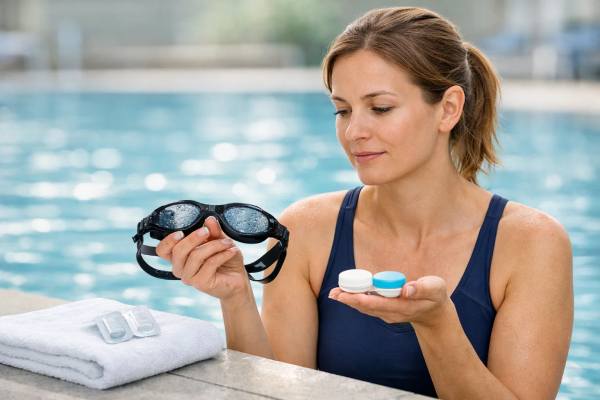
Contact lenses can make swimming feel effortless—no foggy prescription goggles, no glasses slipping, no squinting at the pool clock. The problem is that water is not sterile, and contact lenses are designed to sit directly on living tissue. When water meets a lens, it can trap microbes and irritants against the cornea, disrupt the tear film, and create tiny surface breaks that make infection easier to start. Most of the time nothing happens, which is exactly why the risk is easy to underestimate.
This article explains what can go wrong when you swim in contacts, which water settings are riskiest, and how big the infection concern really is. You will also learn safer ways to see in the pool or ocean, plus a practical “if it already happened” plan that lowers risk without panic. The goal is clear vision and healthy eyes.
Top Highlights
- Avoiding water exposure while wearing contacts is one of the simplest ways to reduce risk of serious corneal infections.
- Tight-fitting swim goggles and same-day lens disposal reduce risk compared with swimming bare-eyed in lenses, but they do not make it risk-free.
- Reusable lenses and poor post-swim handling increase contamination risk more than occasional, brief exposure.
- Pain, light sensitivity, worsening redness, or blurred vision after swimming requires prompt eye evaluation, especially for contact lens wearers.
- If you accidentally swim with lenses, remove them as soon as possible, discard daily disposables, and do not “rinse them off” with water.
Table of Contents
- Should you swim with contact lenses: the short answer
- What infections are linked to water and contact lenses
- Pool, ocean, lake, and hot tub: which is riskiest
- Do goggles make it safe and what about daily disposables
- If you accidentally swim in contacts: what to do next
- Safer ways to see while swimming without raising risk
Should you swim with contact lenses: the short answer
In most eye-care guidance, the safest answer is simple: do not swim with contact lenses in. That includes pools, lakes, oceans, hot tubs, and even showering. The reason is not that lenses magically “cause” infection. The reason is that lenses change the environment on your eye in ways that make microbes more likely to stick around long enough to do harm.
A helpful way to think about risk is to separate probability from consequence:
- The probability of a severe infection from one brief swim may be low.
- The consequence of certain infections can be high: prolonged treatment, corneal scarring, permanent vision changes, and in rare cases, surgery.
That combination is why many clinicians are strict about avoiding water exposure in lenses. It is also why “I have done it for years and I am fine” does not prove it is safe—it only proves the event has not happened yet.
Why water and lenses do not mix well:
- Water is not sterile. Even treated pool water can contain microbes. Natural water (lakes and rivers) carries additional organisms and debris.
- A lens can trap water and contaminants. Soft lenses, in particular, can hold a thin layer of fluid and particles against the cornea.
- The cornea is more vulnerable under a lens. Lenses can reduce oxygen at the surface and can cause micro-abrasions, especially if grit gets underneath.
- Disinfection is not perfect. Many lens care routines are good, but they are not designed to “undo” a water exposure event reliably.
If you occasionally must choose between unsafe vision and a controlled compromise, it is still better to understand the lowest-risk approach rather than pretend the choice does not exist. That is why later sections cover goggles, daily disposables, and “what to do if it already happened.” But as your baseline rule, treat swimming with contacts as an avoidable risk—especially if you have a history of dry eye, past infections, frequent red eyes, or you wear lenses longer than recommended.
What infections are linked to water and contact lenses
When people worry about swimming with contacts, they often picture “pink eye.” The more serious concern is keratitis, an infection or inflammation of the cornea. The cornea is the clear window at the front of the eye. Because it must stay transparent for vision, scarring is a bigger deal here than it would be on skin.
Here are the main infection categories tied to contact lens wear and water exposure:
Acanthamoeba keratitis
This is the infection most associated with water exposure. Acanthamoeba is a free-living organism found in many water sources. The infection is uncommon, but it is notoriously difficult to treat and can be intensely painful. It may require long treatment courses and can threaten vision. One reason it is dangerous is that early symptoms can resemble more routine irritation, and delays in treatment can worsen outcomes.
Bacterial keratitis
Bacteria are a more common cause of contact lens–related keratitis overall, and water exposure can raise risk by introducing organisms and by increasing lens contamination. Bacterial keratitis may progress quickly. Early, aggressive treatment often matters, which is why contact lens wearers are advised not to “wait it out” when symptoms are significant.
Fungal keratitis and mixed infections
Fungal infections are less common in many regions but can occur, particularly after exposure to contaminated water or trauma with plant material. Contact lenses can add a layer of risk by trapping organisms against the cornea.
Non-infectious but still disruptive problems
Not every post-swim issue is an infection, but these problems can still set you up for one:
- Chemical irritation: Chlorine and disinfectants can irritate the ocular surface, especially when a lens holds the chemical against the eye.
- Sterile infiltrates: Inflammatory spots can develop as the immune system reacts to contamination or lens deposits.
- Corneal abrasions: Sand, tiny debris, or a shifted lens can scratch the cornea. Any break in the surface makes infection more likely.
A key insight: infections are not only about “bad germs.” They are about the balance between germs, the eye’s surface defenses, and time. Water exposure increases germ contact, while the lens can reduce the eye’s ability to clear that exposure quickly. That is the combination you are trying to avoid.
Pool, ocean, lake, and hot tub: which is riskiest
People often ask which water is “safe enough.” The honest answer is that any water exposure is a risk with contact lenses, but the type of water changes the risk profile.
Hot tubs and spas
Hot tubs are often considered highest-risk behaviorally because people stay in them longer, water hits the face repeatedly, and the warm environment can support microbial growth if maintenance is imperfect. Heat also increases lens dehydration and irritation, which can increase rubbing and micro-injury.
Lakes and rivers
Natural freshwater tends to carry more organisms, sediment, and organic matter. Visibility is lower, so you are more likely to open your eyes wide under water and get a stronger exposure. In many safety discussions, freshwater exposure is treated as a major concern for serious keratitis risk.
Swimming pools
Pools are treated, but they are not sterile. Chlorine can reduce microbes, yet it does not eliminate them, and water quality varies across facilities and maintenance practices. Pools also contain sweat, sunscreen residues, and other irritants that can bind to a lens surface.
Ocean water
Saltwater can sting and can increase dryness and irritation. While it differs from freshwater in organisms and salinity, it is still not sterile. Sand and particulate exposure add abrasion risk, especially in surf conditions.
Showering and rinsing in tap water
Showering is often overlooked because it feels “clean,” but it is still water exposure. Water can run directly into the eyes, and lenses can be exposed for several minutes. Using tap water to rinse lenses, store lenses, or rinse a case is a separate and important risk factor because it can directly contaminate items that later sit on the cornea for hours.
A practical ranking, if you are trying to understand relative risk, is often:
- Lowest relative risk: brief surface splash with immediate lens removal
- Higher risk: pools and ocean with lenses in
- Higher still: lakes and rivers with lenses in
- Often highest: hot tubs and any situation with prolonged soaking or repeated face submersion
But remember: “lower relative risk” is not “safe.” The safest choice is still to keep lenses away from water.
Do goggles make it safe and what about daily disposables
Two common follow-up questions are: “What if I wear goggles?” and “What if I use daily disposables?” Both can reduce risk, but neither makes the situation risk-free.
Do swim goggles make swimming with contacts safe?
Tight-fitting swim goggles reduce direct water contact with the eyes. That is valuable, especially if you are doing lap swimming and keeping your head down. The limitation is that goggles can leak, shift, or be removed between sets, and people often touch their eyes and lenses with wet hands at the pool deck. Small leaks still count as exposure because the lens can hold that water against the cornea.
If someone is going to choose a compromise, goggles are part of the “least risky” version, but they are not a guarantee.
Are daily disposable lenses safer for swimming?
Daily disposables can be a risk-reduction tool because you can discard them immediately after exposure, eliminating the temptation to disinfect a potentially contaminated lens and wear it again. This matters because:
- Reusable lenses may carry contamination forward if cleaning is incomplete.
- A lens case can become a persistent contamination source.
- Water exposure plus repeated wear increases the number of opportunities for microbes to persist.
However, daily disposables still sit on the cornea during exposure. They do not protect the eye from microbes. They mainly reduce what happens after.
What about “waterproof” or “swim” contacts?
There is no contact lens category that makes water exposure medically safe. Marketing language can be confusing, but the biology remains: water can carry microbes, and lenses can trap them.
Which lens types add extra concern?
- Extended wear lenses: Wearing lenses overnight is already a known infection risk factor. Adding water exposure increases risk further.
- Orthokeratology: Overnight corneal reshaping lenses are worn during sleep. Water exposure around handling and cleaning is a major issue because the lens spends long hours on the eye.
- Scleral lenses: These vault the cornea and hold fluid underneath. They can be excellent for certain conditions, but water exposure and handling hygiene require extra care because of the fluid reservoir.
A realistic takeaway: if you absolutely must see clearly in the water, the best strategy is usually not “contacts and hope.” It is choosing a safer alternative (prescription goggles or swimming without correction) or, if you must compromise, using the most protective combination: tight goggles, minimal exposure time, clean hands, and immediate lens disposal.
If you accidentally swim in contacts: what to do next
Accidents happen: you forgot your lenses were in, goggles leaked, you got pushed into the pool, or you opened your eyes underwater without thinking. The goal now is to reduce risk calmly and avoid the common mistakes that raise it.
Step 1: Remove the lenses as soon as you can safely do it
- Wash and dry hands first if possible.
- If you cannot wash immediately, remove lenses at the earliest safe moment and avoid rubbing your eyes.
Step 2: Decide whether to discard or disinfect
- If you wear daily disposables: discard them. Do not try to “save” them.
- If you wear reusable soft lenses: do not put them back in right away. Many clinicians recommend discarding lenses after significant water exposure, especially if you were submerged, in a lake, or in a hot tub. If you choose not to discard, at minimum disinfect them properly before wearing again, and consider giving your eyes a rest in glasses for the remainder of the day.
- Never rinse lenses with water. Rinsing with water feels logical but directly increases contamination risk.
Step 3: Clean what matters most
If you use a case, treat it as a potential contamination reservoir:
- Empty old solution, let the case air-dry, and replace the case regularly.
- Use fresh solution each time. Avoid “topping off.”
Step 4: Watch for symptoms that warrant prompt care
After water exposure, seek eye evaluation promptly if you develop:
- Increasing pain (not just mild irritation)
- Light sensitivity that makes it hard to keep the eye open
- Worsening redness, especially in one eye
- Blurred vision that does not clear with blinking
- A feeling that something is stuck in the eye that persists
- Discharge, swelling, or rapidly worsening discomfort
A key point for contact lens wearers: do not self-treat with leftover antibiotic drops or random drops from a friend. Incorrect treatment can delay diagnosis and worsen outcomes. If symptoms are significant, the safest move is to stop lens wear and get evaluated.
What about preventive antibiotics?
Routine preventive antibiotics after an exposure are not a standard self-care step. They are sometimes used in specific clinical situations, but they should be guided by an eye clinician who can examine the cornea.
The most protective post-exposure action is straightforward: remove lenses, avoid re-wearing potentially contaminated lenses, do not rub, and take symptoms seriously.
Safer ways to see while swimming without raising risk
If you need vision correction in the water, you have more options than most people realize. The “right” choice depends on how strongly you need sharp vision, what kind of swimming you do, and whether you are willing to trade clarity for safety.
Prescription swim goggles
For many people, this is the simplest and safest solution. Prescription goggles avoid lens-on-eye exposure entirely. They are especially useful for lap swimming, water fitness classes, and regular pool training. If you have a complex prescription, you may need custom options, but many common prescriptions are supported.
Swimming without correction
If your prescription is mild to moderate, you may be able to swim without glasses or contacts and still stay safe in the lane. Many swimmers learn to navigate by pool markings, lane lines, and timers they can approach closely.
Daily disposables with tight goggles as a compromise
If you cannot function safely without correction and you choose to use contacts anyway, this is generally the least risky compromise pattern:
- Wear tight, well-fitting swim goggles throughout exposure.
- Keep swim sessions shorter when possible.
- Do not handle lenses with wet hands.
- Remove and discard lenses immediately after swimming.
- Switch to glasses afterward.
This approach reduces—but does not eliminate—risk because it minimizes exposure time and avoids re-wearing a potentially contaminated lens.
Do not use these “workarounds”
- Wearing contacts in water without goggles because “it is just for a minute”
- Wearing lenses in hot tubs
- Rinsing lenses or a case with water
- Storing lenses in water or saliva
- Sleeping in lenses after swimming, even if eyes feel fine
Who should be especially strict about avoiding water in lenses?
Be conservative if you:
- Have had a prior eye infection or corneal ulcer
- Have significant dry eye, allergy flares, or frequent red eyes
- Wear lenses longer than recommended or sleep in them
- Use orthokeratology or any complex lens modality
- Have reduced corneal sensation or a history of eye surgery
A final, practical mindset: treat contact lenses as a medical device, not a lifestyle accessory. If the water activity is important to you, invest in a vision strategy that fits your routine without putting your corneas on the line.
References
- Healthy Habits: Keeping Water Away from Contact Lenses | Healthy Contact Lens Wear and Care | CDC 2025 (Public Health Guidance)
- Bacterial Keratitis Preferred Practice Pattern® 2024 (Guideline)
- Acanthamoeba keratitis: from pathophysiology to prevention, a contemporary clinical perspective 2025 (Review)
- A Review of Contact Lens-Related Risk Factors and Complications 2022 (Review)
Disclaimer
This article is for educational purposes and does not replace personalized medical advice, diagnosis, or treatment. Contact lens wear and water exposure can increase the risk of serious corneal infections, and symptoms can worsen quickly. Seek urgent evaluation for significant eye pain, new light sensitivity, worsening redness, discharge, or blurred vision, especially after swimming, hot tub use, or any water exposure while wearing contacts. If you have recurrent symptoms, a history of eye infection, or questions about the safest vision option for water activities, consult an eye care professional for individualized guidance.
If you found this helpful, please consider sharing it on Facebook, X (formerly Twitter), or any platform you prefer. Your support through sharing helps our team continue producing quality health content.