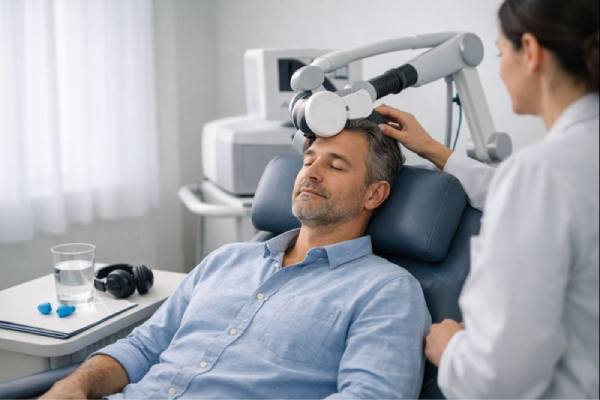
Transcranial magnetic stimulation (TMS) is a noninvasive treatment for depression that uses brief magnetic pulses to influence activity in brain networks linked to mood. For many people—especially those who have not responded well to medication—TMS offers a structured option that does not require anesthesia, does not cause systemic side effects like weight gain or sexual dysfunction, and allows you to return to daily life immediately after each session. The process is also more personalized than it first appears: clinicians measure your individual stimulation threshold, choose a protocol matched to your symptoms and history, and adjust comfort while keeping treatment within evidence-based parameters. This article explains what TMS is, why it can help depression, what a typical course looks like, realistic success rates, common and rare side effects, and how to plan next steps with your care team.
Top Highlights
- TMS can improve depressive symptoms by modulating front-to-back brain circuits involved in mood, motivation, and cognitive control.
- Many patients who have not improved with antidepressants still experience meaningful benefit, often within a few weeks of consistent sessions.
- Side effects are usually mild and localized (scalp discomfort or headache), but screening matters for rare risks like seizure and mood switching.
- A typical plan is 5 sessions per week for 4–6 weeks, with a taper or maintenance strategy discussed before the course ends.
Table of Contents
- What TMS is and who it helps
- How TMS changes depression circuits
- What treatment sessions are like
- Success rates and realistic expectations
- Side effects and safety considerations
- Choosing a clinic and planning next steps
What TMS is and who it helps
TMS is a brain stimulation therapy that delivers rapid magnetic pulses through a coil placed on the scalp. Those pulses induce small electrical currents in the outer brain surface (the cortex) without surgery and without causing a generalized seizure. For depression, TMS is most commonly delivered as repetitive TMS (rTMS) or a patterned form called theta burst stimulation (TBS). Both are outpatient treatments, typically done while you are awake in a clinic chair.
TMS is often considered when depression has been persistent, recurrent, or resistant to standard treatments. You will frequently hear the term treatment-resistant depression (TRD), which usually means depression that has not improved adequately after at least two well-conducted antidepressant trials. In practice, TMS may also be used when medications are not tolerated, when side effects are unacceptable, or when someone prefers a non-medication option and meets clinical criteria.
People who may be good candidates often include those who:
- have major depressive disorder (unipolar depression), with or without anxiety symptoms
- have tried psychotherapy and medications without sufficient benefit
- can attend frequent appointments for several weeks
- do not have contraindicated implanted metal or high seizure risk
TMS can be used alongside ongoing treatments. Many patients continue psychotherapy during a TMS course, and some continue medication if it is helping partially. The goal is not to replace everything at once, but to add a targeted intervention that may shift brain-state and make other supports work better.
Not every type of depression responds equally. Severe depression with psychotic features often requires a different urgency and may respond better to other interventions. Bipolar depression requires extra screening because any antidepressant-style treatment, including brain stimulation, can sometimes trigger hypomania or mania in vulnerable individuals. A careful intake should review personal and family history of bipolar disorder, past episodes of unusually elevated energy, and reduced need for sleep.
A helpful way to think about candidacy is “fit,” not “deserving.” TMS fits best when the diagnosis is clear, risk factors have been screened, and the practical schedule is feasible. If those pieces align, TMS can be a structured, evidence-based path forward rather than another trial-and-error medication loop.
How TMS changes depression circuits
Depression is not caused by a single “low chemical.” It involves networks—especially those that regulate emotion, reward, attention, and self-referential thinking. TMS aims to nudge these networks toward healthier patterns by repeatedly stimulating specific cortical targets and allowing downstream effects to ripple through connected brain regions.
For depression, a common target is the dorsolateral prefrontal cortex (DLPFC), a region involved in cognitive control, planning, and emotional regulation. In many depressed states, this control network can become underactive or poorly synchronized with limbic regions that generate intense emotional signals. When DLPFC influence is weaker, negative thoughts and emotional pain can feel louder, more convincing, and harder to disengage from. Stimulating the DLPFC can strengthen regulatory capacity and shift network balance.
Different protocols aim for different effects:
- High-frequency stimulation is often used to increase activity in a target region.
- Low-frequency stimulation is often used to decrease activity in a target region.
- Theta burst stimulation uses short bursts designed to efficiently promote neuroplastic changes with shorter session times.
The word neuroplasticity is important here, but it can be misunderstood. TMS is not “rewiring your personality.” It is more like helping the brain practice a different rhythm. Repeated stimulation can alter excitability, connectivity, and how strongly regions influence each other. Over weeks, these repeated nudges can create changes that outlast the session—especially when paired with stable sleep, routine, and therapeutic work that reinforces new habits.
Many patients notice changes that reflect circuit-level shifts rather than simple mood lift. Examples include:
- less rumination or a shorter “stickiness” of negative thoughts
- a slightly larger pause before reacting emotionally
- more ability to start tasks without a prolonged internal battle
- improved mental clarity or reduced cognitive slowing
These can appear before someone describes feeling “happy,” which is one reason progress tracking should include functioning, not only mood.
Mechanistically, TMS is also “state-dependent.” If someone arrives extremely sleep-deprived, actively intoxicated, or in severe crisis, the brain may be less receptive to learning-like changes. That does not mean TMS will not work, but it highlights why clinicians emphasize consistent attendance and stable routines during a course.
A final point that often calms fears: the magnetic field does not stay in the body. The stimulation is brief and localized. The therapeutic effect comes from the brain’s adaptive response to repeated sessions, not from any lingering energy or “charging” of the brain. That framing can reduce anxiety and help patients approach treatment with steadiness rather than apprehension.
What treatment sessions are like
Most people want the practical details: what happens in the room, how it feels, and how disruptive the schedule will be. A typical TMS course has three phases: an evaluation and mapping visit, an acute treatment phase, and a taper or maintenance plan.
During the initial visit, the team reviews your psychiatric and medical history, current medications, and any factors that affect safety. Then they usually determine your motor threshold. This is done by placing the coil over the part of the brain that controls hand movement and finding the lowest intensity that reliably causes a small thumb or finger twitch. That threshold helps individualize dosing because skull thickness and brain excitability vary by person. The team then uses a measurement method or neuronavigation (depending on the clinic) to position the coil over the depression target.
During daily treatment sessions, you sit in a chair and wear ear protection. The coil rests against the scalp, and you feel tapping sensations. The first few sessions are often the most noticeable because your scalp muscles are not used to the stimulation. After that, many people report that it becomes routine—uncomfortable at moments, but manageable.
Session length depends on protocol:
- Standard rTMS sessions may take roughly 20–40 minutes.
- Theta burst stimulation sessions can be much shorter, sometimes just a few minutes of active stimulation, though setup time still matters.
A common schedule is 5 sessions per week for 4–6 weeks, totaling around 20–30 sessions, with some protocols extending to 36 sessions or more. Many clinics then taper sessions over a couple of weeks (for example, reducing frequency gradually) to help consolidate gains and reduce the chance of abrupt symptom return.
What it feels like is usually described as:
- rhythmic tapping on the scalp
- brief facial muscle twitching near the forehead or eye
- pressure or tightness at the stimulation site
- a headache afterward in some patients, often responsive to standard pain relief measures
You can usually drive yourself home and return to work the same day. That said, the schedule can be a real burden. Daily appointments are a commitment, and some people feel fatigued simply from the time demand and the emotional effort of showing up while depressed. Planning transportation, work accommodations, and supportive routines ahead of time can make the course more sustainable.
Clinics often track symptoms weekly using standardized scales. This is not just bureaucracy. Depression improvement can be gradual, and measurement helps catch meaningful shifts that the day-to-day experience may miss. It also informs whether protocol adjustments are needed, such as changing intensity within safe ranges or considering an alternative target approach if response is limited.
Success rates and realistic expectations
“Does it work?” is the central question, and the best answer is both hopeful and specific. TMS is not a guarantee, but it has a solid evidence base for depression, particularly for people who have not responded to medication alone. Success is usually described in two clinical categories:
- Response: a substantial symptom reduction, often defined as about a 50 percent improvement on a depression scale.
- Remission: symptoms drop below a clinical threshold, meaning depression is minimal or absent by standardized measures.
Across studies and real-world practice, response and remission rates vary because patient populations differ. People seeking TMS often have longer, more complex depression histories and multiple prior treatments, which tends to lower response rates compared with first-line therapy trials. Even so, many clinics report meaningful improvements for a substantial portion of patients, including those with TRD.
Timing also matters. Some people feel early change in sleep, energy, or mental “pressure” within the first two weeks, while others improve later, closer to weeks four to six. It is common to have a slow first half and a more noticeable second half, which can be discouraging if you expect a quick shift. This is why consistency is emphasized: the benefit often depends on cumulative sessions.
Several factors can influence the likelihood of response:
- Degree of treatment resistance: more failed trials often predicts a lower chance of remission, though response can still occur.
- Co-occurring anxiety: anxiety symptoms do not rule out benefit, but they can complicate perception of progress.
- Sleep stability and substance use: heavy alcohol use, frequent cannabis use, or severe sleep disruption can blunt gains.
- Diagnostic fit: unipolar depression tends to be the clearest match; bipolar depression requires careful monitoring.
It also helps to define what “success” means to you. For some, success is full remission. For others, it is enough symptom reduction to return to work, reconnect socially, or engage in therapy more effectively. A realistic expectation is often a stepwise improvement: better sleep or reduced agitation first, then improved motivation and mood, then broader functioning gains.
Durability is another key concern. Many patients maintain improvements for months, and some for longer, especially when they continue psychotherapy, protect sleep, and address stressors that fuel relapse. Others benefit but later notice symptoms creeping back. In those cases, clinics may recommend maintenance sessions or a brief “booster” course based on symptom return patterns.
If you are considering TMS, a useful planning question is: “What is our plan if I respond, and what is our plan if I do not?” Knowing both paths in advance reduces pressure and supports clear decisions.
Side effects and safety considerations
TMS is generally well tolerated, but “noninvasive” does not mean “no side effects.” The most common effects are localized and temporary, and they tend to improve as the scalp adapts.
Common side effects include:
- scalp discomfort during stimulation
- mild to moderate headache after sessions
- facial muscle twitching or jaw tightness during pulses
- fatigue later in the day, especially early in the course
- lightheadedness or brief nausea in a smaller subset of patients
Clinics can often reduce discomfort by adjusting coil position slightly, ramping intensity gradually, adding brief breaks, and coaching relaxation of the jaw and forehead. Some people find that hydration, adequate sleep, and not arriving hungry meaningfully reduces post-session headaches.
Less common but important risks include:
- Seizure: This is rare, and clinics screen for factors that increase risk, such as a personal seizure history, certain neurological conditions, and substances or medications that lower seizure threshold. Following safety protocols and using evidence-based parameters keeps the risk low, but it is not zero.
- Hearing discomfort: The clicking noise can be loud. Ear protection is standard and important for safety.
- Mood switching: People with bipolar disorder or bipolar vulnerability can experience hypomania or mania, especially if depression lifts rapidly. This is one reason thorough diagnostic screening matters and why clinicians monitor sleep changes and activation symptoms during treatment.
Contraindications typically involve metal or implanted devices near the head. Examples can include certain aneurysm clips, implanted brain stimulators, or cochlear implants. Dental fillings are usually not a problem, but it is essential to disclose any implants, fragments, or medical devices. Safety screening should be specific, not casual.
Another safety topic is medication changes during a course. Some people assume they should stop antidepressants or sedatives during TMS. In reality, abrupt changes can destabilize mood and confound evaluation of whether TMS is helping. Any medication adjustment should be planned with your prescriber, with attention to withdrawal symptoms, sleep, and anxiety.
Finally, it helps to name a subtle limitation: TMS is a course-based treatment, not a single event. Side effects may accumulate as fatigue or headaches over a few weeks if daily scheduling is strenuous. Building recovery time into your day, reducing nonessential commitments when possible, and treating the course like a medical treatment block can reduce dropouts and improve tolerability.
Choosing a clinic and planning next steps
If you decide TMS is worth exploring, the quality of planning and delivery matters. Two clinics can both “offer TMS” yet deliver very different patient experiences, tracking quality, and protocol precision. The goal is not perfection; it is a clinic that follows evidence-based parameters, monitors outcomes carefully, and treats you as an informed partner.
Practical questions to ask a clinic include:
- Which protocols do you offer for depression (standard rTMS, theta burst stimulation, bilateral approaches, deep TMS)?
- How do you determine targeting and motor threshold, and how often do you re-check thresholds?
- How do you measure progress, and what happens if progress is limited by week three or four?
- Who is supervising treatment, and what is the process for managing side effects or mood changes quickly?
- What is your policy on missed sessions, and how do you handle unavoidable schedule disruptions?
It also helps to clarify how the clinic coordinates with your existing care. TMS works best when it is integrated into a broader treatment plan rather than acting as a standalone last resort. Ideally, your prescriber and therapist know the timeline, track symptom changes, and help you adjust life factors that affect durability.
If cost and coverage are concerns, ask early about authorization requirements and documentation. In many systems, insurers require evidence of prior medication trials and ongoing clinical monitoring. Even when coverage exists, scheduling logistics and travel time can be the real barrier. Some patients do best by arranging reduced work hours temporarily or planning appointments at consistent times to reduce daily decision fatigue.
You may also want a decision framework for comparing options. For severe, urgent, or psychotic depression, other interventions may be faster or more appropriate. For depression with strong anxiety sensitivity or medication intolerance, TMS may be appealing precisely because it is localized and does not add systemic burden. If you have responded to antidepressants in the past but relapse frequently, TMS can be considered as a way to deepen remission, with maintenance planning discussed up front.
Before starting, define your markers of progress. Pick three specific signs that would tell you the treatment is helping, such as:
- getting out of bed within 30 minutes of the alarm most days
- fewer hours lost to rumination in the afternoon
- returning to a basic routine (meals, showering, short walks)
- improved ability to concentrate for 20–30 minutes
These markers keep you grounded in lived outcomes rather than only chasing a particular number on a scale. TMS is most successful when it is treated as a structured partnership: the technology provides consistent stimulation, and you provide consistent attendance, honest feedback, and supportive routines that help the brain consolidate change.
References
- Clinical Practice Guidelines for the Therapeutic Use of Repetitive Transcranial Magnetic Stimulation in Neuropsychiatric Disorders – PMC 2023 (Guideline)
- Optimal parameter determination of repetitive transcranial magnetic stimulation for treating treatment-resistant depression: A network meta-analysis of randomized controlled trials – PMC 2022 (Network Meta-Analysis)
- The effect of repetitive transcranial magnetic stimulation on the Hamilton Depression Rating Scale-17 criterion in patients with major depressive disorder without psychotic features: a systematic review and meta-analysis of intervention studies – PubMed 2024 (Systematic Review and Meta-Analysis)
- Accelerated Theta-Burst Stimulation for Treatment-Resistant Depression: A Randomized Clinical Trial – PubMed 2025 (RCT)
Disclaimer
This article is for educational purposes and does not provide medical advice, diagnosis, or treatment. TMS suitability depends on your diagnosis, medical history, implanted devices, seizure risk factors, and mood history, including any bipolar symptoms. Do not start, stop, or change medications based on this article; discuss treatment options with a licensed clinician who can evaluate your situation and monitor safety. If you have suicidal thoughts, feel unable to stay safe, or experience severe mood changes such as mania, seek urgent help immediately through local emergency services or an emergency care provider.
If you found this article helpful, please share it on Facebook, X (formerly Twitter), or any platform you prefer so others can learn about depression treatment options with clarity and care.