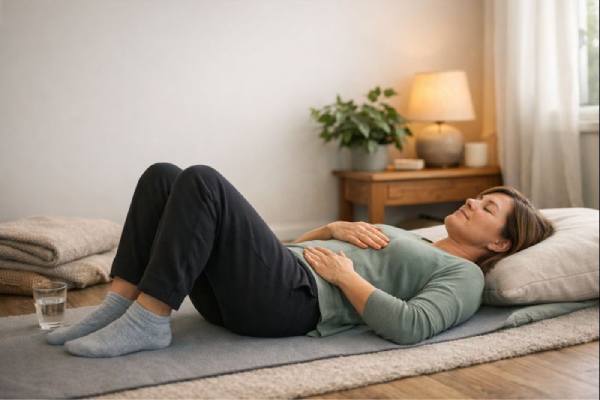
Anxiety is often described as worry, but many people experience it first as a body event: a tight chest, restless legs, shallow breathing, a knot in the stomach, or a sudden surge of heat and urgency. Somatic exercises work with those signals directly. Instead of trying to talk yourself out of anxiety, you practice shifting the state underneath it—your breathing rhythm, muscle tone, attention, and sense of safety in the present moment. Done consistently, these techniques can lower day-to-day tension, shorten the duration of anxious spikes, and help you recover faster after stress. They are also practical: you can use them at a desk, in bed, or in a parked car. This guide explains why somatic practices can be effective, how to use them safely, and which simple routines tend to be most helpful at home—especially when you want relief that feels real in your body, not just logical in your mind.
Quick Overview
- Short daily somatic routines can reduce baseline tension and make anxiety surges easier to ride out.
- Breath pacing, grounding, and muscle release work best when practiced regularly, not only in crisis moments.
- If you feel dizzy, panicky, or disconnected during an exercise, stop and switch to a gentler grounding option.
- The most useful routine is the one you can repeat: start with 5 to 10 minutes, 5 days per week, for at least 2 weeks.
- Pair one calming exercise with one “re-entry” step, such as standing up, sipping water, or walking for 60 seconds.
Table of Contents
- Why Somatic Exercises Help Anxiety
- Safety First and When to Get Support
- Breathing Practices You Can Use Anywhere
- Grounding and Orienting to Stop the Spiral
- Tension Release and Movement for Relief
- Build a Home Routine and Troubleshoot
Why Somatic Exercises Help Anxiety
Anxiety has a storyline—“What if this goes wrong?”—but it also has a physiology. Your nervous system shifts into protection mode, which can include faster breathing, increased heart rate, tightened muscles, narrowed attention, and a stronger urge to avoid. Somatic exercises aim at that protection mode directly. They do not argue with anxious thoughts; they help your body exit the alarm state so the thoughts lose urgency.
A helpful way to think about anxiety is as a loop:
- A stressor (or internal sensation) appears.
- The body activates: breathing becomes shallower, muscles brace, attention narrows.
- The mind interprets those sensations as danger (“Something is wrong”), which increases activation.
- The loop repeats until you escape, shut down, or exhaust yourself.
Somatic practices interrupt the loop in three main ways.
They retrain attention without forcing calm
When anxious, your attention gets sticky: it grabs threats and ignores neutral information. Somatic exercises widen attention again. Orienting to the room, feeling your feet, and noticing support under your body gives your brain new data: “I am here, and I am not in immediate danger.” This is not positive thinking. It is updating your nervous system with present-moment reality.
They shift breathing and muscle tone
Breathing and muscle tension are two of the fastest levers you can access. A longer exhale and slower pace can reduce the “revved” feeling. Releasing muscle bracing—especially jaw, shoulders, belly, and hands—can decrease the physical cues that keep anxiety high. Many people notice that thoughts soften after the body settles, not before.
They build a skill: faster recovery
The goal is not to never feel anxious. The goal is to recover sooner and with less fear. Practicing somatic exercises while you are only mildly stressed is like rehearsing an exit route. In intense moments, your brain will reach for what is familiar. Repetition is what makes these tools reliable.
Somatic exercises are simple, but they are not “small.” They work with core survival systems. Done with care and consistency, they can become a practical foundation for anxiety management at home.
Safety First and When to Get Support
Somatic exercises are generally low-risk, but “low-risk” is not the same as “risk-free.” Anxiety can be sensitive to internal sensations, and some practices can briefly intensify symptoms if they are too strong, too fast, or poorly matched to your needs. Safety comes from pacing, choice, and knowing when to switch strategies.
Use a simple safety rule: stay in the workable zone
A practical guideline is to keep the exercise in a range where you can still think, speak, and choose. If you notice any of the following, scale down:
- dizziness, tingling, or air hunger
- rising panic or a sense of losing control
- feeling unreal, far away, or “not in your body”
- nausea, sudden headache, or chest pain
If chest pain, fainting, severe shortness of breath, or neurological symptoms are new or unexplained, treat them as medical concerns first. Somatic tools should never replace medical evaluation when symptoms may be medical.
Choose the right intensity for your anxiety style
Different patterns respond to different entry points:
- If you run hot (panic, agitation, racing): prioritize slower breathing, longer exhale, and grounding through senses. Avoid strong breath holds or intense breathwork.
- If you shut down (numb, foggy, collapsed): gentle movement and orienting may work better than deep stillness. Try standing, looking around, and using light muscle activation before slow breathing.
- If you have trauma triggers: go slower than you think you need. The goal is safety and choice, not emotional intensity.
Set the room for success
Before you begin, make one small adjustment that signals safety:
- sit with your back supported, or stand with feet hip-width
- keep a glass of water nearby
- choose a time limit you can tolerate (start with 2 to 5 minutes)
- decide in advance what you will do afterward (stretch, walk, text a friend)
When to seek extra support
Home practices can help, but they are not enough for everyone. Consider professional support if you have:
- frequent panic attacks or avoidance that is shrinking your life
- insomnia that persists for weeks despite routine changes
- intense dissociation, self-harm urges, or substance use to cope
- trauma symptoms that worsen with body-focused attention
- anxiety plus severe depression or mood instability
Somatic exercises are tools, not a test. If one technique makes you feel worse, it does not mean you are doing it wrong. It usually means the dosage, timing, or type needs adjusting. Your job is to stay safe and keep the practice workable.
Breathing Practices You Can Use Anywhere
Breathing is one of the most direct ways to influence anxiety because it is both automatic and voluntary. You cannot always control your heartbeat, but you can shape your breath, and your nervous system often follows. The most reliable calming styles share two features: they slow the pace and they make the exhale a little longer than the inhale.
Practice 1: Extended exhale breathing
This is a strong first choice for most anxiety, including panic-prone anxiety.
- Sit or stand comfortably. Let your shoulders drop.
- Inhale gently through your nose for a count of 3 or 4.
- Exhale slowly through your nose or softly through pursed lips for a count of 5 or 6.
- Repeat for 8 to 12 cycles (about 2 to 3 minutes).
If counting feels stressful, switch to a simple ratio: inhale normally, then exhale slightly longer. Your goal is ease, not perfect timing.
Practice 2: Resonance breathing
Many people find a steady rhythm around 5 to 6 breaths per minute calming. It can also reduce the “jumpiness” that comes with irregular, shallow breathing.
- Inhale for 5 seconds.
- Exhale for 5 seconds.
- Continue for 5 minutes.
If 5 seconds feels too long, use 4 seconds in and 4 seconds out. If you feel lightheaded, shorten both sides and slow down gradually over time.
Practice 3: Rectangular breathing without breath holds
Some people like box breathing, but breath holds can feel uncomfortable for anxiety or panic. A gentler alternative is to trace a rectangle with your eyes and breathe along the sides.
- Pick a rectangle in the room (a door frame, window, or screen).
- Trace the short side while inhaling gently.
- Trace the long side while exhaling slowly.
- Keep the exhale longer than the inhale for 2 to 4 minutes.
This adds a visual anchor, which can reduce spiraling thoughts.
Common mistakes and quick fixes
- Mistake: breathing too deeply. Fix: breathe smaller, not bigger. Let the belly soften, but do not force a huge inhale.
- Mistake: trying to “win” against anxiety. Fix: aim for 10 percent calmer, not perfectly calm.
- Mistake: only using breathing during crises. Fix: practice once daily when you are relatively okay, so your body learns the pattern.
A good breathing practice should leave you feeling steadier, not drained or dizzy. If you feel worse, switch to grounding first, then return to breath later with a shorter duration.
Grounding and Orienting to Stop the Spiral
Grounding helps when anxiety pulls you into the future or into catastrophic interpretations of body sensations. It is not distraction in a shallow sense; it is a deliberate shift from internal threat monitoring to present-moment orientation. For many people, grounding works best as a bridge: it stabilizes you enough to then use breathing or muscle release effectively.
Practice 1: 5 4 3 2 1 senses
This technique uses your senses to widen attention and slow the loop.
- Name 5 things you can see.
- Name 4 things you can hear.
- Name 3 things you can feel (feet on floor, fabric on skin, chair support).
- Name 2 things you can smell.
- Name 1 thing you can taste.
If you are very anxious, simplify: pick one sense and do it thoroughly, such as noticing 10 visual details in the room.
Practice 2: The orienting sweep
This is especially useful when you feel unsafe for no clear reason.
- Turn your head slowly and look around the room.
- Let your eyes pause on neutral objects: a lamp, a plant, a bookshelf.
- Silently label them: “lamp,” “door,” “window.”
- Notice one point of support: your back against the chair, your feet on the floor.
The key is slow movement and genuine noticing. If you rush, your nervous system stays in “search mode.”
Practice 3: Pressure and contact grounding
Anxiety often comes with floating sensations—like you are not fully here. Pressure can help.
- Press your feet into the floor for 5 seconds, then release for 10. Repeat 5 times.
- Or place one hand on your chest and one on your belly, applying gentle pressure while you exhale slowly.
- Or hold a cool object and describe its texture and temperature in detail.
If touch is triggering for you, use external contact instead: hold a pillow, wrap in a blanket, or press hands into the wall.
When grounding does not work
Sometimes anxiety is powered by strong body activation, and grounding alone feels like trying to steer a car with no brakes. If your body still feels flooded after 2 to 3 minutes of grounding, add one regulating lever:
- two minutes of extended exhale breathing, or
- a brief tension release sequence (jaw, shoulders, hands), or
- a 60-second walk with slow head turns to orient.
Grounding is not meant to erase fear instantly. It is meant to restore choice: “I can stay here, and I can take one helpful step.” That is often the first real shift.
Tension Release and Movement for Relief
Anxiety commonly recruits the muscles: jaw clenching, raised shoulders, tight hips, curled toes, and gripping hands. That bracing sends a message back to the brain that danger is present. Movement and muscle release reverse the signal. The goal is not athletic exercise, but a controlled “downshift” in muscle tone and arousal.
Practice 1: Progressive muscle relaxation
This classic technique trains the difference between tension and release. It can be especially helpful for nighttime anxiety.
- Start with your hands: gently make fists for 5 seconds, then release for 15 seconds.
- Shrug shoulders toward ears for 5 seconds, then drop and release for 15 seconds.
- Tighten your thighs for 5 seconds, then release for 15 seconds.
- Press your feet into the floor for 5 seconds, then release for 15 seconds.
Move slowly. If you are prone to cramps, reduce the intensity of the “tense” phase. The release phase matters more than the squeeze.
Practice 2: The wall push and release
This is a grounding movement that can reduce restlessness and panic energy.
- Stand facing a wall, hands flat at shoulder height.
- Push gently into the wall for 8 seconds, feeling your arms and core engage.
- Exhale and step back slightly as you release.
- Repeat 5 times.
This can help your body complete a “mobilize” impulse in a safe, contained way.
Practice 3: Shake out and settle
Some people feel better after small, rhythmic shaking, especially when anxious energy is stuck in the limbs.
- Shake out your hands for 15 seconds.
- Shake out one leg at a time for 15 seconds each.
- Then stand still and notice the contrast: feel the floor, let your gaze soften, exhale slowly.
Keep it gentle. The goal is discharge and settling, not intensity.
Practice 4: Jaw and face reset
A surprising amount of anxiety lives in the face and throat.
- Let your tongue rest on the floor of your mouth.
- Unclench the teeth (lips can be closed, teeth slightly apart).
- Massage the jaw hinge lightly with fingertips for 20 seconds.
- Exhale as if fogging a mirror, softly, for 3 breaths.
If you feel safer starting small, do only the jaw reset. Tiny releases repeated daily often help more than dramatic efforts done once.
Movement-based somatic work is most effective when it ends with stillness. Give your nervous system a clear finish line: after the movement, pause for 20 seconds and notice, “What is different now?”
Build a Home Routine and Troubleshoot
The best somatic routine is the one you will actually repeat. A perfect 30-minute plan you avoid is less effective than a simple 6-minute plan you do most days. Think in terms of “stacks”—a short sequence that covers attention, breath, and muscle tone.
A reliable 10-minute somatic stack
Use this 5 days per week for 2 weeks, then adjust based on what helps.
- Orienting sweep (2 minutes): look around slowly, label neutral objects, feel your feet.
- Resonance or extended exhale breathing (3 minutes): pick the one that feels easiest.
- Mini progressive muscle relaxation (3 minutes): hands, shoulders, thighs, feet.
- Re-entry step (2 minutes): stand up, sip water, or walk slowly while looking around.
If 10 minutes feels like too much, cut it in half. Consistency matters more than duration at the start.
What to do during a spike or panic moment
When anxiety surges, your nervous system wants immediate safety. Use a short, structured plan:
- Step 1: Ground (60 seconds). Pick one anchor: feet press, cool object, or 5 visual details.
- Step 2: Exhale longer (90 seconds). Inhale 3, exhale 5, repeated.
- Step 3: Add contact (30 seconds). Hands on belly and chest, or hands on wall.
- Step 4: Decide one next action. Sit, step outside, text someone, or take a brief walk.
The goal is not to “stop panic” by force. The goal is to reduce escalation and return choice to your body.
If exercises make you feel worse
This is more common than people admit, and it is usually solvable.
- If breathing increases panic: breathe smaller and slower, skip breath holds, and start with grounding first.
- If body focus triggers dissociation: keep eyes open, orient to the room, and use movement-based grounding rather than stillness.
- If you feel emotionally flooded afterward: shorten the session and end with a calming finish (warm drink, shower, slow walk).
- If you cannot stick with it: reduce friction. Tie it to an existing habit, like after brushing teeth or before lunch.
How to know it is working
Look for practical markers:
- fewer “all day” anxious days
- faster recovery after stress
- less fear of body sensations
- improved sleep onset or fewer nighttime awakenings
- fewer avoidance behaviors
If you are practicing consistently for 3 to 4 weeks and nothing changes, consider adding support: skills-based therapy, a medical review, or a clinician familiar with anxiety and body-focused interventions. Somatic tools are powerful, but you do not have to do them alone.
References
- Breathing Practices for Stress and Anxiety Reduction: Conceptual Framework of Implementation Guidelines Based on a Systematic Review of the Published Literature – PMC 2023 (Systematic Review)
- Breathwork Interventions for Adults with Clinically Diagnosed Anxiety Disorders: A Scoping Review – PMC 2023 (Scoping Review)
- Efficacy of Progressive Muscle Relaxation in Adults for Stress, Anxiety, and Depression: A Systematic Review – PMC 2024 (Systematic Review)
- Yoga-based interventions may reduce anxiety symptoms in anxiety disorders and depression symptoms in depressive disorders: a systematic review with meta-analysis and meta-regression – PubMed 2023 (Systematic Review and Meta-Analysis)
- Panic attacks | Kent Community Health NHS Foundation Trust 2024 (Patient Information)
Disclaimer
This article is for educational purposes only and is not a substitute for individualized medical or mental health care. Somatic exercises can affect breathing, heart rate, and emotional arousal; stop any practice that causes significant dizziness, worsening panic, chest pain, fainting, or a sense of disconnection, and seek professional guidance as needed. If you have severe anxiety, frequent panic attacks, trauma symptoms that intensify with body-focused attention, thoughts of self-harm, or any urgent safety concerns, contact local emergency services or a qualified clinician promptly. Treatment decisions should be made with a licensed professional who can consider your symptoms, medical history, and medications.
If you found this guide helpful, please consider sharing it on Facebook, X (formerly Twitter), or any platform you prefer.