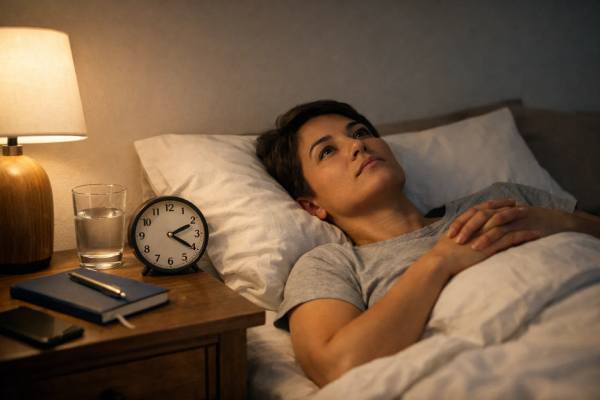
If you’ve ever watched the clock and felt your body tense as bedtime gets closer, you already understand sleep anxiety: the more you need sleep, the harder it becomes to let it happen. This is not “being dramatic.” It is a predictable brain-and-body pattern in which worry, pressure, and hyper-alertness crowd out the calm conditions that sleep requires. Sleep anxiety often starts after a few bad nights, a stressful season, travel, illness, or a schedule change. Then the bed itself becomes a cue for mental scanning—How long will it take? What if tomorrow is ruined?
The good news is that sleep anxiety is highly workable. With the right approach, you can reduce sleep effort, retrain the bed-brain connection, and rebuild trust in your ability to sleep—even if you still have occasional rough nights.
Core Points
- Reducing “sleep effort” often improves sleep more than adding new bedtime hacks.
- A consistent wake time tends to stabilize sleep drive and lowers nighttime clock-watching.
- If you’re awake in bed for long stretches, changing what the bed means to your brain is a key lever.
- Sleep anxiety is common, but persistent symptoms can signal insomnia disorder or another treatable sleep condition.
- Use a simple plan: protect mornings, simplify nights, and practice calm repetition for 2 weeks.
Table of Contents
- What sleep anxiety looks like
- How worry blocks sleep biology
- Common triggers and thought traps
- What to do during a bad night
- Two-week reset plan
- Treatment options and when to get help
What sleep anxiety looks like
Sleep anxiety is a pattern where worry about sleep becomes a major reason sleep doesn’t arrive. It can show up as a busy mind, physical tension, or a sense of dread as bedtime approaches. Some people feel “wired but tired,” while others fall asleep initially but wake and spiral into problem-solving. Often, the hardest part is not a single symptom—it’s the feeling of being trapped in a nightly performance test.
Common signs
You might recognize sleep anxiety if you regularly experience several of these:
- Pre-bed tension: a stomach drop, tight chest, clenched jaw, or restlessness when you think about going to bed.
- Clock and metric checking: checking the time repeatedly, calculating remaining hours, or relying on sleep trackers as a verdict.
- Safety behaviors: over-planning bedtime routines, repeatedly adjusting pillows, supplements, room temperature, or noise, hoping to “guarantee” sleep.
- Mental scanning: monitoring whether you feel sleepy, whether your heart rate is “too high,” or whether you’re “doing it right.”
- Next-day fear: intense worry about mistakes, mood, appearance, or productivity if sleep is imperfect.
Sleep anxiety vs insomnia vs generalized anxiety
These can overlap, but they are not identical:
- Sleep anxiety focuses on sleep itself (or the consequences of not sleeping).
- Insomnia disorder involves persistent difficulty falling asleep, staying asleep, or waking too early plus daytime impairment, typically occurring at least several nights per week for months. Sleep anxiety often fuels it.
- Generalized anxiety is broader worry across many areas; sleep may become a nighttime stage where worries get louder.
A key insight: sleep anxiety is often maintained by strategies that make sense in the moment (trying harder, monitoring more, controlling everything) but that accidentally train the brain to stay alert in bed.
How worry blocks sleep biology
Sleep is not a switch you flip on with effort; it’s a state that emerges when two forces align: sleep drive (built by time awake) and circadian timing (your internal clock). Sleep anxiety interferes by adding a third force—arousal—that can overpower both.
The arousal mismatch
Your brain treats worry as “unfinished business.” When your mind is forecasting threats—Tomorrow will be a disaster; I’ll never function—your body can respond as if action is required. That response may include a faster heart rate, lighter breathing, muscle tension, and a tendency toward vigilance. Even if you feel exhausted, this alertness makes it hard to drift into deeper sleep.
Conditioning: how the bed becomes a trigger
After enough nights of tossing and turning, the brain learns an association: bed = struggle. This is classical conditioning in everyday clothing. You walk into the bedroom and your mind revs up before you even touch the pillow, not because you’re broken, but because your brain is trying to predict and control what has become difficult.
Over time, certain “helpful” habits can reinforce the link:
- Staying in bed while wide awake for long stretches
- Using the bed as a problem-solving station
- Repeatedly checking time or sleep data
- Treating sleep as a nightly scorecard
Why trying harder often backfires
Sleep effort is like trying to force a sneeze: the harder you push, the more the body resists. When you chase sleep, you increase monitoring (“Am I asleep yet?”), which increases arousal, which delays sleep, which increases fear. The cycle feeds itself.
The goal is not perfect calm. The goal is to stop treating wakefulness as an emergency and to retrain your brain to experience bed as a low-stakes place where sleep tends to happen again.
Common triggers and thought traps
Sleep anxiety rarely appears “out of nowhere.” It usually begins with a real trigger—then grows through interpretation and repetition. Identifying your personal pattern helps you choose strategies that actually fit.
Common triggers
Many people can trace sleep anxiety back to one or more of these:
- A stressful period: workload spikes, caregiving, relationship strain, exams, or major life decisions
- A disrupted rhythm: travel, jet lag, shift work, a new baby, or irregular wake times on weekends
- A health scare: palpitations, reflux, pain flares, menopause symptoms, or a new medication
- A few “bad nights” that got labeled as dangerous: the fear becomes bigger than the sleep loss
- Tracking overload: chasing ideal sleep stats and feeling worse when the numbers disappoint
Thought traps that amplify pressure
Sleep anxiety often rides on predictable thinking patterns:
- Catastrophizing: “If I don’t sleep 8 hours, tomorrow is ruined.”
- All-or-nothing rules: “I must fall asleep by 11:00.”
- Fortune telling: “I can already tell tonight will be terrible.”
- Selective attention: noticing every micro-awakening and ignoring the parts you slept.
- Control myths: believing the right routine can guarantee sleep.
A practical reframe: sleep is responsive, not obedient. You can influence it, but you cannot command it.
Behavioral traps that look responsible
Some habits feel sensible but keep the cycle alive:
- Napping long or late to “catch up,” which can weaken sleep drive at night
- Sleeping in after a rough night, which can delay sleepiness the next night
- Going to bed early to “get more hours,” which can create long stretches awake in bed
- Using alcohol as sedation, which may increase awakenings later in the night
- Staying in bed to “rest,” which teaches the brain that bed is for wakeful waiting
None of these mean you’re doing anything wrong. They mean your brain is trying to solve a problem with tools that work short-term but backfire long-term.
What to do during a bad night
Sleep anxiety can feel urgent at 2:00 a.m., which is exactly why a pre-planned script helps. The goal is to reduce arousal and break the bed = struggle association—without turning the night into a project.
A simple “night protocol”
Use this in the same order each time:
- Stop clock-checking. If possible, turn the clock away and keep your phone out of reach. Time math fuels adrenaline.
- Do a quick body scan (not a performance test). Unclench your jaw, drop your shoulders, loosen your hands. You are sending a “no emergency” signal.
- If you feel stuck awake, get out of bed briefly. Choose a low-light, quiet activity that is boring and non-activating (simple reading, folding laundry, a calm puzzle). Return to bed when sleepy again.
- Keep the mood neutral. You’re not “fixing” the night—you’re practicing a new response to wakefulness.
A helpful guideline many people use: if you’ve been awake long enough that frustration is rising and sleep feels farther away, it’s time to reset out of bed. You do not need to time it perfectly.
Skills that reduce sleep effort
Pick one, not five. Consistency beats complexity.
- Worry parking: earlier in the evening (not in bed), write down the worries and one next step per item. In bed, remind yourself: I already scheduled this.
- Paradoxical intention: instead of trying to sleep, gently try to stay awake while resting. This can reduce performance pressure and soften the fear response.
- Paced breathing: slow, steady breathing for a few minutes can lower physiological arousal. Aim for smoothness, not a specific pattern.
- A “safe phrase” for spirals: short, repeatable, and non-negotiable—e.g., “Wakefulness is not danger,” or “My job is to rest, sleep will follow.”
What not to do at 2:00 a.m.
These commonly intensify sleep anxiety:
- Planning tomorrow in detail
- Debating whether you should take something “just in case”
- Reading alarming sleep content
- Negotiating with yourself (“If I fall asleep in 10 minutes…”)
- Chasing perfect comfort settings repeatedly
Bad nights happen. Your win condition is not instant sleep—it’s teaching your brain that wakefulness can be handled calmly and predictably.
Two-week reset plan
Sleep anxiety improves faster when you work from the outside in: stabilize the schedule, reduce sleep effort, and retrain the bed as a cue for sleep. Think of this as a short training block, not a permanent lifestyle.
Days 1–3: protect mornings
Your morning routine sets the tone for nighttime sleepiness.
- Keep a consistent wake time (including weekends) with a reasonable cushion. Consistency builds stronger sleep drive at night.
- Get bright light early (outdoor daylight if possible). Light anchors circadian timing and helps the brain recognize “day mode.”
- Move a little within the first few hours—walk, mobility work, or light exercise. It doesn’t need to be intense to help.
If you had a bad night, treat the day as “normal with adjustments,” not “ruined.” That mindset reduces the fear that fuels the next night.
Days 4–10: simplify nights and rebuild the bed cue
- Set a wind-down boundary: choose a consistent “screens and work end” point and keep it simple—dim lights, quieter tasks.
- Use the bed for sleep and intimacy only. If you regularly read, scroll, or problem-solve in bed, you’re training wakefulness there.
- Create a short pre-bed ritual (10–20 minutes). Examples: a warm shower, light stretching, calming music, or a few pages of an easy book outside bed.
If you lie down and feel your mind revving, treat it as a learned response, not a sign that you’re doomed. Your job is repetition.
Days 11–14: reduce time-in-bed “buffering”
Many people with sleep anxiety start going to bed earlier to compensate. That usually increases time awake in bed and strengthens the anxiety. Instead:
- Match bedtime to sleepiness, not to the ideal number of hours.
- Avoid “banking” time in bed unless you are truly sleepy.
- Track function, not perfection: note energy, mood, and focus in broad strokes rather than minute-by-minute sleep estimates.
If your sleep anxiety is intense or your insomnia is persistent, a structured insomnia program (often called CBT for insomnia) can guide these steps with more precision, including a temporary sleep window approach when appropriate.
Treatment options and when to get help
Sleep anxiety is treatable, and you do not need to “white-knuckle” it for months. The right help depends on what’s driving your wakefulness: habits, conditioned arousal, underlying insomnia disorder, a mental health condition, a medical issue, or a combination.
First-line treatment: CBT for insomnia
CBT for insomnia (often shortened to CBT-I) is widely considered a leading behavioral treatment for chronic insomnia and is also useful when sleep anxiety is prominent. It typically includes:
- Stimulus control: retraining the bed as a cue for sleep rather than wakefulness
- Sleep scheduling strategies: strengthening sleep drive and consistency
- Cognitive strategies: working with rigid beliefs and catastrophic predictions
- Skills for arousal reduction: relaxation, attention shifting, and response prevention (less checking and monitoring)
It can be delivered in-person, in groups, via telehealth, or through validated digital programs.
When medication is considered
Some people benefit from short-term medication support, especially during acute stress or severe insomnia. The key is to treat medication as a tool, not the core solution—because sleep anxiety is often maintained by learning and conditioning. Medication choices should be made with a clinician who understands your medical history, other medications, and safety risks (including daytime sedation).
Rule out common sleep and medical contributors
Seek evaluation sooner if you have signs of another sleep disorder or medical driver, such as:
- Loud snoring, witnessed breathing pauses, or waking up gasping
- Strong urge to move legs at night, creeping sensations, or frequent limb movements
- Nightmares, panic symptoms, trauma-related sleep disruption
- Significant reflux, pain, hot flashes, or medication side effects
Also consider mental health support if sleep anxiety sits inside broader anxiety, panic, OCD-like checking, or depression. Treating the wider pattern often helps sleep.
When to seek help urgently
Get prompt professional support if you have severe daytime sleepiness that makes driving unsafe, episodes of mania or hypomania, thoughts of self-harm, or you’re using alcohol or sedatives in risky ways to force sleep.
A final note: needing help is not a failure. Sleep anxiety is a learned cycle, and learned cycles can be unlearned—with the right plan.
References
- Behavioral and psychological treatments for chronic insomnia disorder in adults: an American Academy of Sleep Medicine clinical practice guideline – PMC 2021 (Guideline)
- The European Insomnia Guideline: An update on the diagnosis and treatment of insomnia 2023 – PubMed 2023 (Guideline)
- Digital cognitive behavioral therapy for insomnia on depression and anxiety: a systematic review and meta-analysis – PMC 2023 (Systematic Review and Meta-Analysis)
- Insomnia, anxiety and related disorders: a systematic review on clinical and therapeutic perspective with potential mechanisms underlying their complex link – PMC 2024 (Systematic Review)
Disclaimer
This article is for educational purposes only and is not a substitute for medical advice, diagnosis, or treatment. Sleep anxiety and insomnia can overlap with medical conditions and other sleep disorders that require individualized assessment. If your symptoms persist for weeks, impair daily functioning, involve unsafe sleepiness (especially while driving), or include breathing pauses during sleep, seek evaluation from a qualified clinician or sleep specialist. If you feel at risk of harming yourself or someone else, contact local emergency services immediately.
If you found this helpful, consider sharing it on Facebook, X (formerly Twitter), or any platform you prefer so others can learn practical, evidence-based ways to break the worry-and-wakefulness cycle.