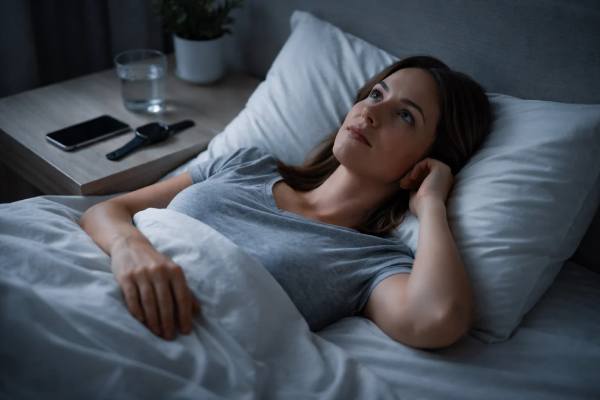
Sleep trackers promised something seductive: certainty. A clean score in the morning, a tidy graph at night, and the feeling that you can finally “solve” sleep. For many people, wearables do help spot patterns—like late caffeine, inconsistent bedtimes, or alcohol-related wake-ups. But for others, tracking turns into a nightly performance review. You start chasing perfect numbers, and sleep becomes a project instead of a biological rhythm.
Orthosomnia is the name sleep clinicians use when the pursuit of “optimal” sleep—often driven by wearable data—ironically worsens insomnia. It tends to show up in people who are conscientious, health-motivated, and prone to anxiety or perfectionism. The good news is that this pattern is very treatable. With a few targeted changes, you can keep the benefits of awareness without letting the data hijack your rest.
Core Points
- Reducing sleep-score checking can lower sleep effort, nighttime worry, and “performance” pressure that keeps the brain alert.
- Replacing rigid targets with flexible habits often improves sleep consistency and daytime energy within 2–4 weeks.
- Consumer sleep trackers can mislabel quiet wake as “sleep” and restless sleep as “awake,” so single-night scores are a weak basis for decisions.
- If insomnia lasts 3+ months, causes daytime impairment, or includes snoring and breathing pauses, a clinical evaluation matters more than tracker trends.
- A practical starting point is a 14-night “no-score” reset: hide sleep metrics, keep a steady wake time, and judge progress by how you function.
Table of Contents
- What orthosomnia means in real life
- How trackers estimate sleep and why they miss
- Why tracking can amplify anxiety and insomnia
- Signs sleep tracking is hurting your sleep
- A reset plan that protects sleep and sanity
- Evidence-based next steps and when to get help
What orthosomnia means in real life
Orthosomnia is not a formal psychiatric diagnosis. It is a clinically useful label for a recognizable pattern: sleep becomes worse because the person is trying too hard to make it perfect—often by relying on sleep-tracker feedback as the authority. The word is built from “ortho” (correct) and “somnia” (sleep), reflecting a belief that there is one correct way to sleep and that the tracker can verify whether you achieved it.
In daily life, orthosomnia often looks like this: you wake up and immediately check your sleep score. If it is low, you feel discouraged, irritable, or anxious—sometimes before you even notice how your body feels. You might compensate by spending extra time in bed, canceling plans, skipping exercise, or “protecting” sleep so intensely that your day shrinks. At night, you go to bed early “just in case,” monitor your watch during awakenings, or replay the last score in your head like a warning sign.
The most important feature is sleep effort—a shift from allowing sleep to happen to trying to force it. Sleep is a state that emerges when the brain senses safety and low demand. When you treat sleep like a test, the brain receives the opposite message: pay attention, stay vigilant, perform. Even if you are physically tired, that vigilance can keep your nervous system activated.
Orthosomnia can affect anyone, but it is especially common in people who are conscientious and health-focused, and in those with a history of anxiety, trauma, perfectionism, or previous insomnia. It can also appear after a stressful period (a new job, caregiving, illness, travel) when the desire for control is understandable but counterproductive.
The goal is not to demonize tracking. The goal is to restore a healthy hierarchy: your lived experience and clinical guidance matter more than a consumer score, and sleep quality is bigger than any single number.
How trackers estimate sleep and why they miss
Most consumer sleep trackers do not “measure sleep” directly. They infer it from signals that correlate with sleep, then use algorithms to guess what state you are in. Understanding that difference is often the first relief: the number is an estimate, not a verdict.
Common inputs include:
- Movement (accelerometer): Low movement often gets labeled as sleep; higher movement can look like wake. This is why quiet wakefulness—lying still while worrying—can be misclassified as sleep.
- Heart rate and heart-rate variability (PPG sensors): During many stages of sleep, heart rate trends lower and variability patterns change. But heart rate is also affected by stress, alcohol, illness, medications, temperature, and fitness.
- Breathing proxies: Some devices attempt to estimate respiration using subtle motion or pulse signals. These are indirect and can drift, especially in real-world conditions.
- Algorithms and “sleep scores”: Scores typically combine duration, estimated stages, awakenings, and sometimes “readiness” metrics. The weighting is proprietary and may change with software updates.
Because of these constraints, trackers can be better at estimating total sleep time than they are at distinguishing sleep stages or identifying brief awakenings. They also tend to perform differently across people. For example, someone who is naturally still may look “asleep” even while awake; someone who moves a lot in sleep may look “restless” or “awake.”
Night-to-night variability is another trap. Sleep is not designed to be identical every night. A single night can be lighter due to stress, late food, a warm bedroom, hormonal shifts, or just normal biology. When a tracker turns that variability into a “grade,” it can push you toward rigid rules that do not fit your life.
A subtle but common misinterpretation is assuming a tracker can diagnose problems. Consumer devices may hint at patterns, but they cannot reliably detect conditions like sleep apnea, restless legs syndrome, narcolepsy, or parasomnias on their own. Even when a device flags “awake time,” it may be reflecting normal sleep fragmentation that does not require treatment.
A practical mindset is to treat tracker data like a weather forecast: sometimes helpful, sometimes wrong, rarely worth panicking over. Use trends gently, and never let one night’s estimate define your expectations for the next night.
Why tracking can amplify anxiety and insomnia
Orthosomnia thrives on a feedback loop that looks logical on the surface: collect data, find the problem, fix the problem, sleep improves. But insomnia does not behave like a simple mechanical issue. Once sleep becomes associated with evaluation and threat, the brain learns to stay on guard.
A common loop goes like this:
- Trigger: You see a low score, a long “awake time,” or a graph that looks messy.
- Interpretation: “My sleep is broken.” “Tomorrow will be a disaster.” “I have to fix this tonight.”
- Body response: Stress hormones rise; the nervous system shifts toward alertness.
- Safety behaviors: You go to bed early, avoid evening plans, track more closely, search for hacks, or monitor symptoms.
- Short-term relief, long-term cost: You feel briefly reassured, but your brain learns that sleep requires constant management.
This loop is powered by cognitive arousal (worry, rumination, mental problem-solving) and sleep effort (trying to force sleep). The more you try to control sleep, the more you notice every sensation—heartbeats, breathing, temperature shifts, small awakenings—that most sleepers would ignore. Tracking can magnify this attention, because it trains you to treat the night as a data stream you must interpret.
There is also a self-worth component. If you are already hard on yourself, a score can become a moral judgment: “I failed at sleeping.” That framing is especially common in people who excel in other performance-based areas. Sleep looks like one more domain to master—until it pushes back.
Social dynamics can intensify it, too. Online communities sometimes normalize extreme routines, strict “sleep hygiene” rules, or competitive optimization. If your identity becomes “someone who does sleep right,” then any deviation feels threatening.
The paradox is that healthy sleep often returns when you practice permission and flexibility: you can have a rough night and still function, you can be tired and still cope, and you do not need perfect sleep to have a meaningful day. Letting go of the scoreboard is not resignation; it is a strategy that reduces the very arousal that keeps insomnia alive.
Signs sleep tracking is hurting your sleep
Not everyone who wears a tracker develops orthosomnia. The key question is whether tracking supports your well-being or starts to run it. The signs below are not about “liking data”—they are about a loss of flexibility, increased anxiety, and worsening sleep behaviors.
Mood and self-evaluation shifts
- You feel noticeably better or worse based on the score, even before you assess how you actually feel.
- A low score leads to catastrophizing (“I will not cope today”) or to excessive avoidance (canceling plans, calling in sick when you could manage).
- You doubt your own perception—“I felt okay, but the tracker says I slept badly, so I must be wrong.”
Nighttime behaviors that increase arousal
- You check the device during the night, especially after awakenings.
- You lie in bed “trying to sleep” longer than before, because you want the tracker to record more sleep.
- You go to bed earlier and earlier, hoping to “bank” sleep, but you end up awake and frustrated for longer periods.
Rigid rules and narrowing of life
- You avoid social events, exercise, travel, or intimacy primarily because they might lower your score.
- You feel compelled to follow strict routines even when they do not fit your schedule or values.
- You spend significant time reading about sleep metrics, comparing devices, or chasing new hacks.
Physiological and functional red flags
- Despite “good” tracker numbers, you still feel unrefreshed, anxious, or foggy—suggesting the score is not addressing the real issue.
- You develop a new fear of bedtime, frequent pre-sleep dread, or a sense that sleep is fragile and easily “ruined.”
- Insomnia persists for weeks to months and begins to affect concentration, mood stability, work performance, or relationships.
It can also help to watch for a subtle pattern: the tracker becomes the first and last thing you think about each day. That attention is not neutral. It teaches your brain that sleep is high-stakes, and high-stakes tasks trigger vigilance.
If you recognize several of these signs, you do not need to throw your device away in anger. You simply need a new relationship with it—one that puts your nervous system, not the algorithm, in charge.
A reset plan that protects sleep and sanity
A reset works best when it targets the mechanisms of orthosomnia: excessive attention, catastrophic interpretation, and sleep effort. The aim is not “perfect sleep.” The aim is lower pressure and steadier rhythms, which usually improves sleep as a side effect.
Step 1: Choose your tracking role
Pick one of these roles for the next month:
- Observer: You keep the device, but you do not look at sleep metrics daily.
- Minimalist: You track only bedtime and wake time, not stages or scores.
- Break: You stop sleep tracking entirely for a set window.
If you are stuck in a strong score-mood loop, the “Break” option is often the fastest reset.
Step 2: Run the 14-night no-score experiment
For two weeks:
- Hide sleep score notifications and remove sleep widgets from your home screen.
- Do not review sleep graphs in the morning.
- Track only one thing: a consistent wake time (within about 30–60 minutes daily).
At the end of two weeks, evaluate by daytime markers: energy stability, mood reactivity, concentration, and how often you dreaded bedtime.
Step 3: Replace “sleep goals” with “sleep conditions”
Instead of chasing a number, build conditions that make sleep more likely:
- A 30–60 minute wind-down routine that is quiet and predictable.
- A bedroom that is dark, cool, and reserved for sleep and intimacy.
- A “buffer” between work stress and bed (even a short shower, light reading, or stretching).
Step 4: Contain worry with a schedule
If your brain spins at night, give it an earlier appointment:
- Set a 10–15 minute worry window in the early evening.
- Write worries and one next action (even if the action is “decide tomorrow”).
- When worries show up in bed, remind yourself: “I handled this earlier.”
Step 5: Create a compassionate rule for rough nights
Use a simple script: “A rough night is uncomfortable, not dangerous.” Then choose one supportive action the next day—light movement, daylight exposure, hydration, and a normal meal schedule. Avoid “making up” sleep by spending long periods in bed, which often weakens sleep drive.
Step 6: Reintroduce data selectively, if you want it
If tracking is useful for you, try these boundaries:
- Review sleep metrics once per week, not daily.
- Focus on broad trends (bedtime consistency, wake time consistency), not stages.
- Treat the score as a “maybe,” not a diagnosis.
A good reset leaves you with one core skill: trusting your body’s signals again, even when the data is imperfect.
Evidence-based next steps and when to get help
If orthosomnia has blended into persistent insomnia, you deserve more than willpower. Insomnia responds best to structured approaches that reduce arousal and rebuild healthy sleep timing. The gold-standard behavioral treatment is cognitive behavioral therapy for insomnia (CBT-I), which targets the exact patterns orthosomnia strengthens.
Core CBT-I elements include:
- Stimulus control: Rebuild the bed as a cue for sleep (not wakefulness, scrolling, or worrying). This often means getting out of bed if you are wide awake and returning when sleepy.
- Sleep restriction or sleep compression: Temporarily limiting time in bed to consolidate sleep, then expanding it as sleep becomes more efficient. This is counterintuitive but often transformative when done correctly.
- Cognitive strategies: Challenging catastrophic predictions (“If I sleep 5 hours, I cannot function”) and reducing monitoring of sensations.
- Relaxation and downshifting skills: Breathing practices, progressive muscle relaxation, or mindfulness skills that reduce sleep effort.
- Smart sleep hygiene: Helpful as a support, but rarely enough on its own when insomnia is established.
If you prefer self-guided options, digital CBT-I programs can be effective for many people, especially when they include structured sleep scheduling and coaching-like feedback.
It is also important to know when tracking anxiety may be masking another sleep problem. Consider a clinical evaluation if you have:
- Loud snoring, choking or gasping, or witnessed breathing pauses
- Persistent morning headaches, dry mouth, or excessive daytime sleepiness
- Urge to move the legs at night or uncomfortable leg sensations
- Nighttime panic symptoms that feel medical, or new palpitations you have not evaluated
- Insomnia lasting 3 months or longer with clear daytime impairment
Finally, if sleep problems are paired with severe anxiety, depression, substance use, or thoughts of self-harm, treat that as a priority and seek professional support promptly. Sleep and mental health reinforce each other; improving one often helps the other, but you should not have to do it alone.
The most reassuring truth is also the most practical: when you reduce sleep effort and re-center your life around functioning—not scores—sleep usually follows.
References
- Orthosomnia: Are Some Patients Taking the Quantified Self Too Far? – PMC 2017 (Commentary)
- Evaluating consumer and clinical sleep technologies: an American Academy of Sleep Medicine update – PMC 2021 (Position Update)
- Behavioral and psychological treatments for chronic insomnia disorder in adults: an American Academy of Sleep Medicine clinical practice guideline – PMC 2021 (Guideline)
- Sleep effort and its measurement: A scoping review – PMC 2024 (Scoping Review)
- Systematic review and meta-analysis on fully automated digital cognitive behavioral therapy for insomnia – PMC 2025 (Systematic Review and Meta-Analysis)
Disclaimer
This article is for educational purposes only and is not a substitute for medical advice, diagnosis, or treatment. Sleep tracking data from consumer devices can be inaccurate and should not be used to self-diagnose sleep disorders or to delay professional care. If you have insomnia lasting three months or longer, significant daytime impairment, symptoms suggestive of sleep apnea or other sleep disorders, or urgent mental health concerns, seek evaluation from a qualified clinician.
If you found this helpful, consider sharing it on Facebook, X (formerly Twitter), or any platform you prefer so others can make more informed, less stressful choices about sleep tracking.