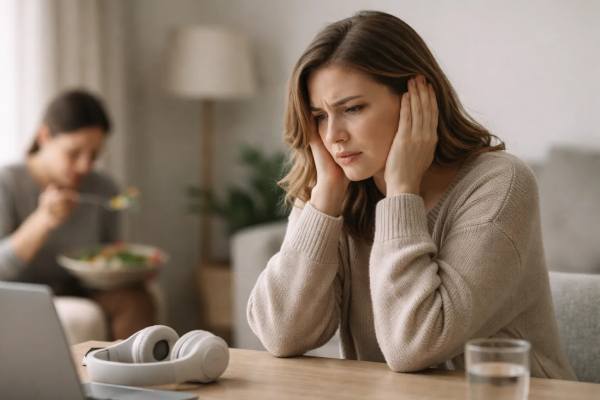
Misophonia is often misunderstood as being “too sensitive” or “easily annoyed.” In reality, it can feel like a sudden, involuntary alarm response to specific everyday sounds—especially those made by other people. The reaction is not about volume; it is about meaning, pattern, and the sense that your nervous system is being hijacked. For some, misophonia is a manageable irritation. For others, it can reshape daily life: meals become stressful, shared workspaces feel impossible, and relationships can suffer under the constant strain.
The good news is that misophonia is increasingly studied, and practical strategies can reduce distress and restore a sense of control. Understanding the condition—what it is, what it is not, and what helps—can be the first step toward calmer days and healthier boundaries.
Essential Insights
- Misophonia is a real, body-level stress response to specific trigger sounds and cues, not a preference or attitude problem.
- Tracking patterns (trigger, context, intensity, recovery time) often reveals clear levers you can change.
- Overusing earplugs can backfire for some people by increasing sound vigilance and sensitivity over time.
- Skills-based approaches (arousal reduction, attention training, and flexible coping) can meaningfully lower reactions.
- Start with a two-week trigger log and one small environmental change, then build a repeatable plan.
Table of Contents
- Misophonia in plain language
- Trigger sounds and misokinesia
- What is happening in the brain
- How misophonia differs from other conditions
- When to get professional help
- Treatment options and realistic goals
- Practical coping at home and work
Misophonia in plain language
Misophonia literally means “hatred of sound,” but the lived experience is more specific: certain sounds (and often the sight of the sound being made) trigger a fast, intense wave of distress. Many people describe anger, disgust, panic, or an urgent need to escape. The reaction can feel disproportionate to the situation, which is part of what makes misophonia so isolating—especially when others interpret it as rudeness.
A key feature is selectivity. The trigger is usually a narrow set of patterned, repetitive sounds such as chewing, lip smacking, sniffing, throat clearing, tapping, or keyboard clicks. Crucially, these sounds do not need to be loud. A quiet chew across a table can feel more unbearable than heavy traffic outside.
Misophonia also exists on a spectrum. In a large population survey, about one-third of people reported sensitivity to at least one misophonic sound, but only a smaller fraction reported symptoms that were moderate-to-severe, with severe-to-extreme symptoms being rare. That range matters: it helps explain why some people say, “That noise bothers me too,” while someone with misophonia may be fighting a full stress response.
Misophonia can start in late childhood or early adolescence, sometimes becoming more noticeable as social time increases—family meals, classrooms, shared bedrooms, open-plan offices. Stress and fatigue often amplify it. Many people can keep their reaction hidden in public, then feel drained afterward from the effort of self-control.
It is also important to know what misophonia is not. It is not simply disliking a sound, having a “short fuse,” or refusing to be flexible. Most people with misophonia want to be reasonable. They may even agree intellectually that the sound is harmless—while their body responds as if it is a threat.
Trigger sounds and misokinesia
Misophonia triggers tend to have three common ingredients: they are repetitive, human-made, and hard to ignore once noticed. Eating and breathing-related sounds are classic examples because they occur in close social settings and have a strong “presence” in the brain’s attention system. But triggers can be broader: pen clicking, foot jiggling, gum popping, spoon scraping, typing, swishing fabric, dog licking, or a neighbor’s bass line.
Many people also experience misokinesia—a strong emotional reaction to movement cues tied to sound or rhythm. Foot bouncing, jaw chewing, leg shaking, hair twirling, or finger tapping can be triggering even without much sound. This matters because it changes the coping plan: solving only the sound may not solve the problem if the visual cue still drives the reaction.
A practical way to understand triggers is to separate them into categories:
- Body sounds: chewing, swallowing, slurping, sniffing, breathing, throat clearing
- Rhythmic sounds: tapping, clicking, pen fidgeting, repetitive typing patterns
- Environmental micro-noises: wrappers, utensil scraping, gum cracking, fabric rustling
- Neighbor sounds: muffled TV, footsteps above, bass, door slams
- Movement cues: leg bouncing, jaw motion, repetitive gestures
Context can flip a sound from tolerable to unbearable. The same chewing may feel manageable from a stranger in a café but intolerable from a family member at dinner. That does not mean the family member is “the problem.” It often reflects how the brain assigns meaning: familiarity, lack of control, and the feeling of being trapped can magnify the threat signal.
Two “hidden” patterns show up again and again:
- Predictability and control: Reactions usually intensify when you cannot control the exposure (meetings, flights, classrooms).
- Recovery time: Some people calm down quickly once the sound stops; others stay activated for 20–60 minutes or more, which affects planning and relationships.
If you want one high-value next step, start a trigger log that includes: trigger type, location, who made it (if relevant), intensity from 0–10, body symptoms, thoughts (“I can’t stand this”), what you did, and how long it took to recover. Those details turn “I hate that sound” into a map you can work with.
What is happening in the brain
Misophonia is not fully explained by any single theory, but several lines of research point to a consistent theme: the brain flags certain cues as highly salient (important), and the body reacts before you have time to reason it away.
Think of it as a fast loop:
- Detection: A patterned sound or cue is detected quickly, often outside conscious choice.
- Tagging: The brain tags it as urgent or “wrong.”
- Arousal: The autonomic nervous system ramps up—heart rate, muscle tension, heat, agitation.
- Action urge: You feel driven to stop the sound, escape, or demand change.
- Aftermath: Shame, exhaustion, or rumination can follow, especially if conflict occurs.
Several mechanisms may contribute:
- A salience and threat bias: Certain brain networks prioritize the trigger, making it hard to “unhear.” This is why trying to ignore it often fails.
- Learned associations: Over time, the brain can connect a trigger with strong emotion and anticipatory stress. Eventually, even the possibility of the sound (a snack bag on a desk) can raise tension.
- Interoception and body awareness: Many people notice bodily cues first—tight chest, clenched jaw, skin crawling—before they label the emotion as anger or panic.
- Attention locking: Once attention clamps onto the trigger, it competes with everything else, which can make schoolwork, conversation, or meetings feel impossible.
A useful clinical insight is that misophonia often includes two layers: the raw nervous system response and the meaning you attach to it. The first layer is automatic (“my body is reacting”). The second layer can escalate distress (“they are doing this to me,” “I’m trapped,” “I’ll lose it”). Treatment often targets both: lowering baseline arousal and loosening the cognitive hooks that intensify the reaction.
Importantly, misophonia does not require “bad intent” from the other person. Yet it can feel personal because triggers often come from people close to you. That mismatch—your body reacting as if something is hostile when the other person is simply eating—creates relationship strain. Addressing misophonia well often involves a shared language: this is a nervous system event, not a character judgment.
Finally, many people find relief in recognizing that avoidance is a double-edged sword. Escaping can be necessary in the moment, but if it becomes the only strategy, the brain never learns that discomfort can rise and fall without emergency action. The goal is not forced exposure; it is flexible choice.
How misophonia differs from other conditions
Misophonia is commonly confused with other sound-related problems. Sorting this out matters because the best help depends on the best match.
Misophonia vs hyperacusis
Hyperacusis is primarily about loudness intolerance—sounds feel painfully loud or physically uncomfortable at volumes other people tolerate. Misophonia is typically about specific patterns and meanings, often at normal or low volume. Someone can have one, the other, or both. If loudness is the core issue, an audiology-focused evaluation is especially important.
Misophonia vs phonophobia
Phonophobia is fear of sound, often linked to migraine, anxiety, or trauma. The emotion is primarily fear and anticipation of harm (for example, “a loud noise will trigger pain”). Misophonia more often centers on anger, disgust, or a visceral “make it stop” reaction, though anxiety can be part of it.
Misophonia vs sensory processing differences
Autism and ADHD can involve sensory sensitivities, including sound. In those cases, sound overload may be broader (busy environments, layered noises) and tied to fatigue, attention load, or sensory regulation. Misophonia is usually narrower and more cue-specific. Again, overlap is common—many people have both misophonia and neurodivergent traits.
Misophonia vs obsessive-compulsive patterns
Some people describe a compulsive need to “neutralize” the trigger (stare at the source, mimic the sound, correct the person, or perform a mental ritual). That can resemble obsessive-compulsive patterns. The difference is not always clean, and comorbid anxiety or obsessive traits can intensify misophonia. A careful clinician focuses on which symptoms came first, what maintains the cycle, and what treatment target offers the biggest relief.
Misophonia vs irritation and stress
Anyone can be irritable when sleep-deprived, overstimulated, or stressed. Misophonia tends to be more consistent and specific, with a recognizable trigger profile and a rapid physiological surge. Many people can predict it: “Chewing sounds in a quiet room will set me off within seconds.”
A practical self-check is to ask: Is the reaction about volume, about fear of harm, or about a specific cue that feels intolerable even when I know it is safe? The answer guides what to try first: hearing evaluation, migraine management, anxiety treatment, sensory regulation work, or misophonia-focused therapy.
When to get professional help
Misophonia does not always require formal treatment. But it deserves professional support when it starts shrinking your life—when you avoid meals, isolate from family, dread school or work, or feel constantly on edge.
Consider seeking help if any of these are true:
- You routinely avoid common situations (shared meals, public transit, meetings) because triggers feel unmanageable.
- You feel ashamed of anger bursts, or you worry you might yell, throw something, or say something damaging.
- Your sleep is affected by anticipation or rumination about sound.
- Your relationships are being shaped around the condition in ways that feel unsustainable.
- You rely heavily on earplugs or noise-canceling all day just to function.
Also seek a medical evaluation if sound sensitivity appeared suddenly or alongside other symptoms such as ear pain, tinnitus changes, dizziness, or hearing changes. Misophonia can coexist with hearing or neurological conditions, and it is worth ruling out contributors that have specific treatments.
What a good evaluation often looks like:
- A clear history: onset, triggers, severity, coping habits, and how life is affected.
- Screening for overlap: anxiety, depression, trauma history, ADHD, autism traits, obsessive symptoms, migraine, tinnitus, hyperacusis.
- Hearing and sound tolerance check: especially if loudness intolerance or ear pain is part of the picture.
- A plan that fits your life: not just “avoid the sound,” but a stepped approach for home, work, and recovery.
Bring data to the appointment. A two-week trigger log is more useful than a general description. Include:
- Top 5 triggers and typical settings
- Intensity (0–10) and recovery time
- What helps in the moment
- What makes it worse (sleep loss, hunger, stress, alcohol, conflict)
- Your current use of ear protection and noise masking
Finally, know when the situation is urgent. If misophonia is tied to thoughts of self-harm, aggressive impulses you feel you cannot control, or severe panic, treat it as a safety issue and seek immediate support. You do not have to “prove” it is serious to deserve help.
Treatment options and realistic goals
Misophonia treatment is evolving, but there is enough evidence and clinical experience to support a realistic, hopeful message: many people improve, especially when the plan targets both body arousal and coping behaviors. The most helpful goal is rarely “I will never be triggered again.” A better goal is: faster recovery, fewer blowups, less avoidance, and more choice.
Skills-based psychotherapy
Cognitive behavioral therapy approaches are often used, typically focusing on:
- reducing arousal (breathing, muscle release, downshifting the stress response)
- shifting attention and reducing hyperfocus on cues
- updating interpretations that escalate distress (“I’m trapped,” “this is unbearable”)
- changing safety behaviors that keep the cycle alive (compulsive checking, rigid avoidance)
In a randomized trial of weekly group therapy over about three months, participants receiving CBT-based treatment showed meaningful symptom reduction compared with a waiting list, with a substantial minority showing clear clinical improvement. Benefits were reported to persist at follow-up, suggesting skills can generalize beyond the therapy room.
Sound strategies: use them strategically, not reflexively
Noise-canceling headphones, earplugs, and white noise can be lifesavers. They can also become a trap if used constantly. Some people notice that heavy, all-day sound blocking increases vigilance: the world feels sharper and more intrusive when protection is removed. A practical rule is to reserve stronger protection for high-trigger moments and use lighter options (soft background sound, moving seats, brief breaks) when possible.
Care for comorbid conditions
Treating anxiety, depression, ADHD, migraine, or insomnia can lower the overall “gain” on the nervous system. Medication is not a primary treatment for misophonia itself, but targeted treatment for overlapping conditions may reduce reactivity and improve coping capacity.
Family and relationship support
Because triggers often happen at home, a partner or family-based approach can be transformative. The aim is not to police the other person’s body forever. It is to:
- reduce shame and blame
- create predictable “sound rules” for high-risk moments (meals, bedtime)
- agree on respectful exit strategies
- build flexibility as symptoms improve
What to be cautious about
Be careful with any plan framed as “just endure it until it goes away.” Forced exposure without skills can increase distress and reinforce the threat response. If exposure is used, it should be gradual, paired with regulation skills, and guided by a clinician who understands misophonia.
A good treatment plan is individualized. It respects that misophonia is real, while still building your ability to stay present, recover faster, and protect relationships.
Practical coping at home and work
Daily life with misophonia improves fastest when you combine two things: environment design and behavior design. The goal is not perfection; it is reducing unnecessary triggers while building a stable response plan for the triggers you cannot control.
A simple home plan for shared meals
Meals are the most common flashpoint because they combine close distance, repetitive sounds, and social expectations. Try a layered approach:
- Add soft background sound (fan, gentle music, ambient noise) before eating starts.
- Choose seating strategically (distance and angle matter; visual cues can be as triggering as sound).
- Agree on a “quiet exit” signal that allows you to step away without a fight.
- Use a short recovery routine after triggers (two minutes of slow breathing, jaw unclenching, cold water on wrists, brief walk).
Work and school accommodations that feel normal
You do not need a dramatic disclosure to make changes. Start with neutral adjustments:
- Sit near steady, non-trigger sound sources (a consistent HVAC hum can be easier than random tapping).
- Use one earbud with low-level background sound rather than full isolation when possible.
- Request seating that reduces visual triggers (behind you rather than across from you).
- For meetings, choose a spot near the door so leaving briefly is easy and discreet.
Boundary language that protects relationships
Misophonia often improves when you remove moral judgment from the conversation. Scripts that help:
- “My nervous system reacts strongly to certain sounds. I’m going to step out for two minutes and come back.”
- “This is not about you doing anything wrong. I’m working on it, and I also need a few practical supports.”
- “When I’m triggered, I may look tense. If I leave the room, it’s a regulation strategy, not anger at you.”
A two-minute “in the moment” protocol
When you cannot escape immediately, give your brain a task that competes with the trigger:
- Drop your shoulders and unclench your jaw.
- Exhale slowly for longer than you inhale (even 4 in, 6 out).
- Label the experience: “Trigger. My body is activated. It will pass.”
- Choose one action: shift gaze, change posture, sip water, or refocus on a single work task for 30 seconds.
- If possible, take a short break before re-entering the situation.
Track progress by recovery time, not heroics
The most meaningful metric is often how quickly you return to baseline. If recovery drops from 45 minutes to 15, your life expands—even if triggers still happen.
Misophonia management is not about becoming numb. It is about building a predictable system so your day is not shaped by surprise alarms.
References
- Consensus Definition of Misophonia: A Delphi Study 2022 (Consensus Statement)
- A systematic review of treatments for misophonia 2023 (Systematic Review)
- Cognitive behavioral therapy for misophonia: A randomized clinical trial 2021 (RCT)
- The neurobiology of misophonia and implications for novel, neuroscience-driven interventions 2022 (Review)
- The prevalence of misophonia in a representative population-based survey in Germany 2024 (Epidemiology Study)
Disclaimer
This article is for educational purposes and does not provide medical diagnosis or personalized treatment advice. Misophonia symptoms can overlap with hearing, neurological, sleep, and mental health conditions, and a qualified clinician can help assess contributing factors and options. If you feel at risk of harming yourself or others, or you are experiencing severe distress, seek urgent support through local emergency services or a crisis resource in your area.
If you found this guide helpful, please consider sharing it on Facebook, X (formerly Twitter), or any platform you prefer so others can access practical, stigma-free information about misophonia.