
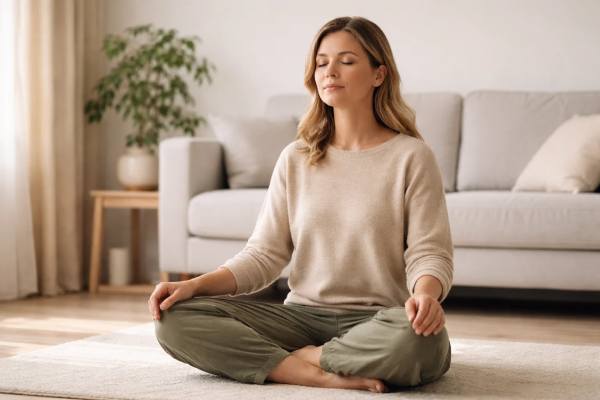
Meditation is often described as “calming,” but its most useful benefit for beginners is simpler: it trains attention. When you practice returning to a chosen point of focus—your breath, body sensations, or sounds—you build skills that translate into daily life: noticing stress earlier, responding with less reactivity, and sustaining focus for longer stretches. You do not need a blank mind, a special posture, or long sessions to start. In fact, the early wins usually come from short, consistent practice and a friendly, realistic approach to distraction. This guide explains what meditation is (and is not), how to choose a starting style, and several straightforward practices you can do in five to ten minutes. You will also learn how to troubleshoot common obstacles, stay safe, and turn meditation into a sustainable habit.
Key Insights for Getting Started
- Short daily sessions can improve stress tolerance and make it easier to refocus when the mind wanders.
- Beginners often benefit most from “returning” practice—gently coming back again and again—rather than trying to stay perfectly calm.
- Meditation can feel uncomfortable at times; adjust intensity and seek support if it reliably worsens anxiety, panic, or trauma symptoms.
- Start with 5 minutes once a day for 7 days, then add 1–2 minutes per week until you reach 10–15 minutes.
Table of Contents
- What meditation is and is not
- Picking your first practice
- Breath practice for stress relief
- Body scan and grounding skills
- Focus training for busy minds
- Building a habit and staying safe
What meditation is and is not
Meditation is best understood as practice—not a personality trait, a belief system, or a test of willpower. You are rehearsing two core skills: noticing where your attention is and choosing where to place it next. That is it. Calm can be a byproduct, but it is not the only goal. Many beginners quit because they expect immediate serenity and feel they are “bad at meditation” when thoughts keep appearing. Thoughts will appear. Planning, remembering, worrying, and daydreaming are normal brain functions. The practice is the return.
What you are training
Most beginner techniques involve a simple loop:
- Pick an anchor (breath, body sensations, sound, a word or phrase).
- Notice when attention drifts (it will).
- Label the drift lightly (for example, “thinking” or “planning”).
- Return to the anchor without scolding yourself.
This loop trains meta-awareness (recognizing what the mind is doing) and attention control (redirecting it). Over time, many people notice fewer impulsive reactions, more space before responding, and easier re-centering when stressed.
What meditation is not
- Not “emptying your mind.” Quiet moments happen, but forcing silence often backfires.
- Not a shortcut around emotions. Sometimes meditation reveals tension you usually outrun. That can be useful, but it should be approached gently.
- Not always relaxing in the moment. Early sessions can feel restless, sleepy, or surprisingly intense. The benefits often show up later—during a difficult conversation, a stressful commute, or a moment when you catch yourself spiraling sooner.
- Not one-size-fits-all. Breath focus helps many people, but others do better with movement, sound, or grounding through the senses.
A helpful mindset is to treat meditation like physical training. One workout rarely changes your fitness. Repeated, well-scaled practice does. Your job is not to “win” each session. Your job is to keep showing up with a level of challenge that is workable.
Picking your first practice
The “best” meditation for beginners is the one you can repeat. Choosing a style is less about ideology and more about matching your nervous system, your schedule, and your goals. Start with a method that feels doable on ordinary days, not just on your best days.
Choose based on your main goal
If stress is your priority:
- Breath awareness with a soft, natural pace
- Body scan or grounding (especially when you feel wired or overwhelmed)
- Loving-kindness style phrases if self-criticism is a major stress trigger
If focus is your priority:
- Counting breaths or short focus intervals
- Noting distractions and returning quickly
- Open monitoring (observing thoughts and sounds without following them) once you have basic stability
If you struggle with restlessness:
- Walking meditation or mindful movement
- Shorter sessions (2–5 minutes) repeated more than once per day
If you tend to feel sleepy:
- Eyes slightly open, upright posture
- Morning or midday practice
- A brighter anchor like sound awareness instead of breath
Set the difficulty correctly
Beginners often overshoot by doing long sessions with a harsh attitude. A better approach is “easy enough to repeat, challenging enough to learn.”
A practical starting plan:
- Pick one practice to repeat for 7 days.
- Set a tiny minimum (5 minutes, or even 2 minutes if needed).
- Keep a consistent cue (after brushing teeth, after coffee, at lunch break).
- Stop while it is still manageable. Ending a session thinking “I could do that again” is a powerful habit builder.
Create a simple setup
You do not need a perfect environment, but you do need fewer obstacles.
- Sit on a chair with feet flat, or on a cushion with hips slightly higher than knees.
- Choose a posture you can maintain without strain. “Stable and kind” is the goal.
- Decide in advance what you will do when distracted: label and return.
If you like guided practice, choose one voice and stick with it for a week. Variety is fine later, but early consistency helps your brain learn the routine.
Breath practice for stress relief
A simple breath practice is one of the most reliable starting points because the breath is always available. The goal is not to breathe “perfectly.” The goal is to use breathing sensations as a home base when stress pulls you away.
The five-minute basic practice
- Posture: Sit upright but not rigid. Let shoulders drop.
- Anchor: Choose one breath location—nostrils, chest, or belly.
- Notice: Feel one full inhale and one full exhale.
- When the mind wanders: Silently label “thinking” and return to the next breath.
- Finish: Before you stand, notice how your body feels and name one quality of the moment (for example, “tired,” “settled,” “busy,” “okay”).
If five minutes feels long, do two minutes. If it feels too easy, do seven minutes, but keep it repeatable.
What to do when stress spikes mid-session
Sometimes focusing on the breath increases anxiety, especially if you are already keyed up. If you notice tightness, air hunger, or panic-like sensations:
- Widen the anchor: include the feeling of your hands resting, or your feet on the floor.
- Soften effort: shift from “concentrating” to “resting attention.”
- Use a steady rhythm: gently lengthen the exhale without forcing it. For example, inhale naturally, then let the exhale be slightly slower.
- Open your eyes: orient to the room and name three neutral objects you see.
The main idea is to keep the practice within your “tolerance window.” Meditation should challenge you a little, but it should not regularly flood you.
A beginner-friendly way to measure progress
Progress is not “no thoughts.” A better metric is recovery time:
- How quickly do you notice you drifted?
- How gently can you return?
- Do you come back more times without giving up?
If you return 30 times in five minutes, that is not failure—that is 30 repetitions of the skill you came to train.
Body scan and grounding skills
When stress is high, the mind often races ahead, but the body tells the truth: jaw tension, shallow breathing, tight shoulders, a stomach knot, or restless legs. A body scan helps you reconnect with present-moment sensations and can reduce the urge to “solve” feelings with more thinking.
The quick body scan
Try this 8–10 minute version:
- Feet: Notice contact with the floor. Any warmth, pressure, tingling?
- Legs and hips: Scan slowly upward. If you find tension, see if it can soften by 5–10 percent.
- Belly and chest: Notice breathing movement without changing it.
- Hands and arms: Feel weight, temperature, or pulsing.
- Shoulders and face: Let the tongue rest, unclench the jaw, soften the eyes.
- Whole-body awareness: Hold the body as one field of sensation for 3–5 breaths.
If a body area feels blank, that is fine. “No sensation” is still information. If a spot feels uncomfortable, you can either soften attention (be curious, not intense) or move on and come back later.
Grounding when you feel overwhelmed
Grounding is meditation’s practical cousin. It is not about deep insight; it is about regaining stability.
Two options that work well in real life:
- Five-sense grounding: Notice 3 things you see, 2 things you hear, and 1 sensation you feel in the body. Repeat once.
- Contact points: Focus on three places where your body meets support (feet-floor, hips-chair, hands-thighs). Stay there for 10 slow breaths.
These are especially useful if you are stressed at work, stuck in traffic, or winding down before sleep. They also help people who find breath focus too activating.
How body scans support focus
Focus is not only a mental skill; it is also a physical one. If your shoulders are braced and your jaw is clenched, sustained attention costs more energy. Body scanning teaches you to recognize early tension and release small amounts before it escalates. Over weeks, many people notice fewer “stress carryover” moments—where irritation, pressure, or fatigue leaks into everything else.
Focus training for busy minds
If your main complaint is “I cannot concentrate,” meditation can help—but only if you train it in a way that matches how attention actually works. Attention naturally pulses. Even highly focused people drift. The skill is returning efficiently, without turning distraction into a self-criticism spiral.
Breath counting for focus
This practice gives your mind a simple task.
- Inhale and exhale naturally.
- Count “one” at the end of the first exhale, “two” at the end of the next, up to ten.
- If you lose track, restart at one without frustration.
Start with 5 minutes. If you want structure, do two rounds of 3 minutes with a short pause between. Counting can sharpen awareness of mind-wandering because you notice the moment you forget where you are.
Noting: a practical way to handle distractions
Noting is labeling what pulls you away, briefly and neutrally:
- “Planning”
- “Remembering”
- “Worrying”
- “Sound”
- “Itching”
Then return to your anchor. The label prevents you from being dragged into the story. It is like putting a sticky note on a mental event instead of stepping inside it.
A beginner tip: keep labels one or two words. If you label with full sentences (“I am worrying about my deadline and I should stop”), you are thinking again.
Open monitoring for mental clutter
Once breath focus feels familiar, you can try a more spacious style for 5–8 minutes:
- Sit and let sounds, thoughts, and sensations come and go.
- Do not chase any one thing.
- Your job is to notice “changing” rather than “content.”
This can be surprisingly helpful for people with busy minds because it reduces the urge to control each thought. Instead of fighting thinking, you practice seeing it as activity that rises and fades.
Using micro-practices for real-world focus
Beginners often get better results by adding short “focus resets” during the day:
- Before opening email: three slow breaths, feel feet on the floor.
- Before a meeting: 30 seconds of contact points.
- After a distraction: name it (“pulled”), then return to one task for 2 minutes.
These moments teach your brain that focus is something you can re-enter, not something you either have or do not have.
Building a habit and staying safe
Meditation becomes effective when it becomes ordinary. The goal is not heroic intensity; it is steady repetition with the right level of support. At the same time, “more” is not always better. A wise beginner plan includes both habit design and safety guardrails.
A simple four-week progression
This structure keeps effort realistic:
- Week 1: 5 minutes daily, same practice, same cue.
- Week 2: 6–7 minutes daily, or keep 5 minutes and add one 1-minute reset midday.
- Week 3: 8–10 minutes daily, introduce one new practice once (for example, one body scan day).
- Week 4: 10–15 minutes most days, choose a “default” practice and one backup (grounding) for hard days.
If you miss a day, avoid “catch-up” marathons. Return to the next session as normal. Consistency beats compensation.
Troubleshooting the most common problems
“I cannot stop thinking.”
Good. Now you are noticing thinking. That awareness is the skill. Make the return gentler and more frequent.
“I get bored.”
Boredom is often under-stimulation or avoidance. Shorten the session and add detail: feel the breath texture, the temperature of air, the movement in ribs.
“I fall asleep.”
Try earlier practice, eyes slightly open, or switch to walking meditation. Sleepiness can also be a sign of chronic fatigue—be kind to your body.
“I feel more anxious.”
Switch to grounding, shorten sessions, keep eyes open, and consider practicing with guidance. If anxiety reliably intensifies, stop and consult a clinician—especially if you have panic disorder or trauma history.
Safety considerations that matter
Meditation is generally safe, but it is not neutral for everyone. People with a history of trauma, dissociation, panic, mania, or psychosis should approach meditation carefully and may do best with professional support. Warning signs that you should scale back or seek help include:
- panic-like symptoms during or after practice that do not settle
- feeling unreal, detached, or “not in your body”
- intrusive memories that intensify with practice
- agitation that escalates over days
A safer approach in these cases often includes shorter sessions, eyes open, grounding through the senses, and a focus on stability over intense internal observation.
When done at the right dose, meditation is not about becoming someone else. It is about meeting your mind more skillfully—especially when life is demanding.
References
- Systematic review and individual participant data meta-analysis of randomized controlled trials assessing mindfulness-based programs for mental health promotion – PMC 2023 (Systematic Review)
- Mindfulness Enhances Cognitive Functioning: A Meta-Analysis of 111 Randomized Controlled Trials – PMC 2023 (Meta-Analysis)
- Defining and measuring meditation-related adverse effects in mindfulness-based programs – PMC 2021 (Safety and Harms Monitoring)
- The Effects of Mindfulness Meditation on Mechanisms of Attentional Control in Young and Older Adults: A Preregistered Eye Tracking Study – PMC 2025 (Study)
Disclaimer
This article is for educational purposes and does not provide medical advice, diagnosis, or treatment. Meditation and mindfulness practices may not be appropriate for everyone, especially individuals with a history of trauma, dissociation, panic attacks, mania, or psychosis. If you experience worsening anxiety, distressing symptoms, or functional impairment during or after meditation, stop the practice and seek guidance from a qualified healthcare professional. If you believe you may be in immediate danger or at risk of harming yourself or others, contact local emergency services right away.
If you found this guide helpful, please consider sharing it on Facebook, X (formerly Twitter), or any platform you prefer.





