
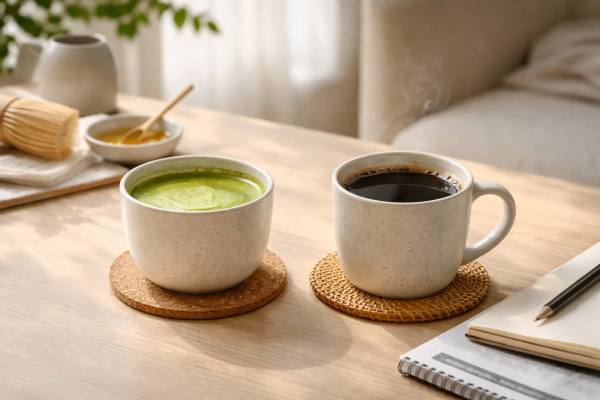
If coffee makes you feel productive but also slightly on edge, you are not imagining the trade-off. Caffeine can sharpen attention and lift energy, yet it can also amplify the physical sensations that anxiety feeds on—racing heart, restlessness, and a busy mind. Matcha is often marketed as a calmer alternative because it pairs caffeine with L-theanine, a tea amino acid linked to smoother, more stable focus. For some people, that combination feels like “clear energy” instead of jitters. For others, matcha still triggers anxiety, especially when the dose is larger or the timing is late.
This guide breaks down why these drinks feel so different in the body, how caffeine and L-theanine interact in the brain, and how to choose a routine that supports calm energy without sacrificing sleep or mood. The goal is not perfection—it is predictability and control.
Top Highlights
- Matcha can feel calmer than coffee because L-theanine may smooth caffeine’s “edge,” but the caffeine can still trigger anxiety in sensitive people.
- Coffee tends to produce a faster, higher peak of stimulation, which can be helpful for focus but more likely to provoke jitters or panic-like sensations.
- Caffeine timing often matters more than the beverage type; late-day caffeine can worsen sleep and raise next-day anxiety.
- If caffeine reliably causes panic symptoms, insomnia, or compulsive “top-ups,” reducing dose and seeking support may be safer than switching drinks.
- A practical starting point is 30–75 mg caffeine with food, finished 8–10 hours before bedtime, then adjusted based on your response.
Table of Contents
- How caffeine can amplify anxiety
- Matcha and coffee caffeine profiles
- L-theanine and calm energy
- Caffeine timing for anxious brains
- Why sensitivity varies so much
- A practical matcha vs coffee decision guide
- Safety, interactions, and when to get help
How caffeine can amplify anxiety
Caffeine does not create anxiety out of nowhere, but it can turn up the volume on anxiety’s most sensitive channels: body sensations, threat scanning, and restless thinking. It is helpful to separate two effects that often get blended together.
Caffeine increases arousal, and anxiety misreads arousal
Caffeine blocks adenosine, a signal that helps your brain feel sleepy and “settled.” When adenosine is blocked, you become more alert. That alertness often comes with physical changes—faster heartbeat, slightly higher blood pressure, and increased muscle tension. For an anxious brain, those signals can look like danger: Why is my heart racing? What if I lose control? This is especially common in panic-prone people who are highly tuned to internal sensations.
Caffeine can increase worry loops indirectly
Even when the body feels okay, caffeine can increase mental speed. If your default thinking style includes rumination (“going over it again”) or catastrophizing (“what if everything goes wrong”), extra cognitive fuel can mean extra loops. The result is not always a dramatic panic episode. It may show up as irritability, impatience, or a hard-to-describe sense of being “revved.”
Why dose matters more than most people think
Anxiety response to caffeine often has thresholds. Many people do fine with a small amount, then tip into jittery territory after a second drink or a strong dose. Another pattern is “stacking”: caffeine plus sleep debt plus stress plus a rushed morning. The drink becomes the visible trigger, but the background conditions are what made you vulnerable that day.
When caffeine helps anxiety
Some people experience the opposite: caffeine improves mood and reduces anxious hesitation because they feel more competent and less fatigued. That can be real, especially if low energy is driving avoidance. But the benefit tends to be most stable when:
- dose is moderate
- it is taken earlier in the day
- it is paired with sleep protection
In other words, caffeine can support functioning, but it is a blunt tool. The more anxious your nervous system already is, the more carefully you need to use it.
Matcha and coffee caffeine profiles
If matcha feels calmer than coffee, part of the explanation is chemistry—but part of it is simple: how much caffeine you are actually getting and how fast it hits.
Typical caffeine ranges are different, but not guaranteed
Coffee is usually the higher-caffeine option per serving, but preparation matters. A general comparison many people recognize in their bodies:
- Brewed coffee often lands in the “stronger push” category (commonly around 80–120 mg per typical mug, sometimes more).
- Espresso tends to be smaller volume but concentrated (often around 60–75 mg per shot, depending on extraction).
- Matcha often feels gentler at typical home doses (commonly 30–70 mg), but a cafe latte made with multiple scoops can approach coffee territory.
The key point is not the exact number—it is variability. Coffee is inconsistent across roast, brew method, and cup size. Matcha is inconsistent across grams of powder, grade, and serving style. If you want calmer energy, your first job is making your dose predictable.
Coffee often peaks faster
Many people drink coffee quickly and on an empty stomach, especially in the morning. That combination can produce a faster rise in stimulation. A rapid rise is more likely to create:
- jittery hands
- “too fast” thinking
- urgent feeling in the chest
- nausea or acid discomfort
Matcha is often consumed more slowly, sometimes with food, and its subjective effects are frequently described as smoother. That smoother experience may also be behavioral: the ritual is slower, the taste encourages sipping, and it is less associated with rushing.
Matcha has extra variables that can affect anxiety
A matcha latte can include sugar, flavored syrups, and large serving sizes. Sugar spikes can mimic anxiety symptoms (energy rush, then a crash), and crashes can trigger more caffeine. If someone says, “Matcha makes me anxious,” it is worth asking: was it matcha powder, or was it a sweetened, oversized drink consumed late?
Why this matters for anxious people
Anxiety responds poorly to surprises. If your caffeine dose swings widely, your nervous system cannot learn what is safe. Whether you choose matcha or coffee, calmer outcomes usually come from:
- smaller, consistent servings
- slower intake
- pairing with food
- avoiding the “second hit” that pushes you over your threshold
L-theanine and calm energy
L-theanine is a major reason matcha is associated with calm focus. It is not a sedative, and it is not a guarantee against anxiety, but it can change how caffeine feels for some people.
What “calm energy” likely means in the brain
Many people describe matcha as alert but not edgy. A useful way to picture this is that caffeine increases “go” signals, while L-theanine may increase “steady” signals—supporting attention without the same spike in tension. Subjectively, this can feel like:
- easier focus
- less irritability
- fewer jitter sensations
- smoother mood through the afternoon
Why matcha is not the same as an L-theanine supplement
A common misunderstanding is assuming matcha provides the same L-theanine dose used in supplement studies. Matcha can contain meaningful L-theanine, but the amount in a typical serving is often lower than the 200–400 mg daily doses frequently studied in supplemental form. That means:
- matcha may help subtly, not dramatically
- the caffeine effect may still dominate if your dose is high
- the “calm” effect may be most noticeable at lower caffeine levels
If you are very caffeine sensitive, L-theanine in matcha may smooth the experience but not eliminate physiological activation.
Why some people still feel anxious on matcha
There are several common reasons:
- The matcha dose is larger than assumed (multiple scoops, concentrated preparation).
- It is consumed late, so sleep is impacted, raising baseline anxiety the next day.
- The drink is sweetened, leading to energy spikes and crashes.
- The person has high interoceptive sensitivity (they feel small bodily changes intensely).
- Stress is high, and any stimulant becomes harder to tolerate.
How to use the L-theanine advantage correctly
If matcha helps you, it usually helps most when you treat it as a moderate stimulant with a smoothing companion, not as a caffeine-free calming drink. The most reliable pattern is:
- smaller serving
- earlier timing
- consistent routine
- attention to sleep
That is when people are most likely to get the “focused but steady” effect matcha is known for.
Caffeine timing for anxious brains
For anxiety, timing is often as important as the beverage choice. Many people focus on “matcha vs coffee” when the bigger driver is “caffeine at the wrong time.”
The sleep connection is the hidden pathway
Sleep loss increases threat sensitivity, reduces emotional control, and makes body sensations feel louder. Even a mild reduction in deep sleep can show up the next day as:
- higher irritability
- more worry
- lower resilience to stress
- stronger caffeine cravings
This creates a feedback loop: caffeine disrupts sleep, poor sleep increases anxiety, and anxiety increases caffeine reliance.
Know your cutoff window
Caffeine half-life varies widely. A conservative, anxiety-friendly starting rule is finishing caffeine 8–10 hours before bedtime. If you are very sensitive, you may need a 10–12 hour buffer. If you are less sensitive and your dose is small, you may tolerate a shorter window, but anxiety often improves when you protect nights aggressively for a few weeks.
Morning caffeine can also be mistimed
Some people drink coffee immediately upon waking, especially when they feel groggy. If you are prone to anxiety, consider experimenting with a delay of 60–90 minutes after waking. This can reduce the “wired immediately” feeling in some people and may keep your day smoother.
Use caffeine like a tool, not a drip feed
An anxious brain tends to do poorly with constant micro-dosing: a sip here, a sip there, all day long. It keeps your nervous system in a perpetual “almost on” state. A cleaner pattern is:
- one planned serving
- a consistent time
- no “top-ups” after your cutoff
Try the two-week timing experiment
If you want a practical test:
- Keep your caffeine dose consistent for 7 days and move it earlier by 60–120 minutes.
- Track sleep onset time, awakenings, and morning calmness.
- If anxiety improves, keep the timing and then decide whether you still need the same dose.
Many people discover that what they thought was “caffeine needed for energy” was partly “caffeine used to compensate for caffeine-related sleep disruption.”
Why sensitivity varies so much
Two people can drink the same matcha latte and have opposite outcomes. One feels focused and stable. The other feels shaky and tense. This is not just preference—it is biology, context, and learned patterns.
Genetics and metabolism
Some people metabolize caffeine quickly; others clear it slowly. Slow clearance means caffeine is still active late in the day, increasing sleep disruption and next-day anxiety. You do not need genetic testing to respond wisely. If you notice that afternoon caffeine affects your sleep, treat yourself as slower-clearing and adjust timing earlier.
Anxiety style matters
Different anxiety profiles react differently:
- Panic-prone: most sensitive to heart rate, chest sensations, and rapid peaks.
- Worry-dominant: more likely to experience cognitive overdrive and rumination.
- Perfectionism-driven: caffeine can increase urgency and self-criticism under stress.
This is why the same drink can be “productive” one day and “unbearable” on another day—the anxiety channel that is most active that week changes.
Hormones, medications, and life stage
Hormonal shifts can affect caffeine sensitivity and sleep. Some medications also change caffeine metabolism or amplify stimulation. Pregnancy deserves special caution because metabolism can slow and recommended caffeine limits are often lower.
Baseline stress and sleep debt
High stress raises baseline arousal, so caffeine has less room to help and more room to push you over the edge. Sleep debt does the same. One of the most reliable ways to make caffeine feel calmer is surprisingly simple: fix sleep for two weeks and reduce overall stress load where possible.
Hidden contributors that mimic anxiety
Sometimes “caffeine anxiety” is partly:
- low blood sugar from skipping breakfast
- dehydration
- reflux or stomach upset
- nicotine use
- energy drinks or pre-workout products stacked with coffee or matcha
If your goal is calm energy, it helps to treat the whole system. Matcha can be the gentler choice for some people, but it cannot outwork chronic sleep deprivation, inconsistent meals, and high stress.
A practical matcha vs coffee decision guide
Instead of asking “Which is better?” ask: “Which routine gives me energy without feeding anxiety?” Use this decision guide as a starting point and adjust based on your body.
If you get jitters or panic sensations
- Choose lower, smoother caffeine: matcha (small serving) or half-caf coffee.
- Avoid rapid peaks: drink slowly and with food.
- Prefer earlier timing: finish by late morning if possible.
- Consider decaf or caffeine-free on high-anxiety days.
A helpful rule: if caffeine causes chest tightness, shaking, or “impending doom,” treat that as a sign to reduce dose sharply rather than trying to “push through.”
If you mainly struggle with fatigue and brain fog
- Coffee can be effective if you tolerate it, but keep dose modest.
- Matcha may be better if you want steadier energy for sustained work.
- Pair caffeine with a short movement break and hydration to reduce reliance on higher doses.
If fatigue is chronic, do not assume caffeine is the answer. Persistent fatigue often reflects sleep problems, stress overload, depression, anemia, thyroid issues, or other medical factors worth evaluating.
If your main issue is sleep and next-day anxiety
Timing is the priority. Pick one:
- morning coffee only, no caffeine after a fixed cutoff
- morning matcha only, no caffeine after a fixed cutoff
- “caffeine-free weekdays” experiment for two weeks to reset sleep
If sleep is fragile, matcha can still disrupt it if consumed late. Calm taste does not mean calm circadian impact.
If you want the “best of both worlds”
Try a layered approach:
- coffee in the morning for a clear start (smaller cup)
- matcha earlier afternoon only if needed (smaller serving)
- no caffeine after your cutoff
The mistake to avoid is stacking: coffee plus matcha plus chocolate plus a late “just one more sip.” Anxiety responds better to clean, predictable inputs.
A simple starter plan
For two weeks:
- Choose one beverage most days.
- Keep dose consistent.
- Take it with food.
- Stop 8–10 hours before bedtime.
- Track anxiety level and sleep quality.
If your baseline anxiety drops, you have your answer: calm energy was less about the brand of caffeine and more about how you used it.
Safety, interactions, and when to get help
Matcha and coffee are widely used, but “natural” does not mean risk-free—especially when anxiety, sleep problems, and medication interactions are in the picture.
When to be cautious with caffeine
Consider lowering caffeine or choosing decaf if you have:
- chronic insomnia or frequent night waking
- panic attacks or severe physical anxiety symptoms
- uncontrolled reflux that disrupts sleep
- pregnancy or a need to limit caffeine for medical reasons
- a history of manic or hypomanic episodes, especially if sleep reduction is a trigger
Watch for behavioral red flags
Caffeine can quietly become a coping strategy that maintains anxiety:
- you cannot start the day without it, yet it increases worry
- you “chase calm” by alternating caffeine and sedatives (including alcohol)
- you repeatedly exceed your intended dose
- you rely on caffeine to compensate for consistently poor sleep
If these patterns show up, switching from coffee to matcha may not be enough. A more effective approach is addressing sleep, stress regulation, and anxiety skills directly.
When to seek professional support
Reach out to a clinician if:
- anxiety is impairing work, school, parenting, or relationships for two weeks or more
- you avoid daily activities because of panic or fear of symptoms
- sleep disruption persists even after moving caffeine earlier for 2–3 weeks
- you use alcohol, sedatives, or substances to counterbalance stimulation
- you experience thoughts of self-harm or suicide
A calm-energy mindset
The most helpful goal is not “never feel stimulated.” It is “feel energized without feeling unsafe.” For many people, matcha supports that goal better than coffee. For others, coffee in a small morning dose is fine, and the real fix is timing and sleep protection. The best choice is the one that makes your day more functional and your nights more restorative.
References
- Caffeine intake and anxiety: a meta-analysis – PMC 2024 (Meta-Analysis)
- Dose and timing effects of caffeine on subsequent sleep: a randomized clinical crossover trial – PMC 2024 (RCT)
- The effects of L-theanine supplementation on the outcomes of patients with mental disorders: a systematic review – PMC 2024 (Systematic Review)
- The therapeutic potential of matcha tea: A critical review on human and animal studies – PMC 2022 (Review)
Disclaimer
This article is for educational purposes and is not a substitute for medical advice, diagnosis, or treatment. Caffeine sensitivity varies widely, and both matcha and coffee can worsen anxiety or disrupt sleep depending on dose, timing, medications, pregnancy status, and underlying mental health or sleep conditions. If you have persistent anxiety, panic symptoms, significant sleep problems, or thoughts of self-harm or suicide, seek prompt help from a qualified healthcare professional or local emergency services.
If you found this article helpful, please consider sharing it on Facebook, X (formerly Twitter), or any platform you prefer.





