
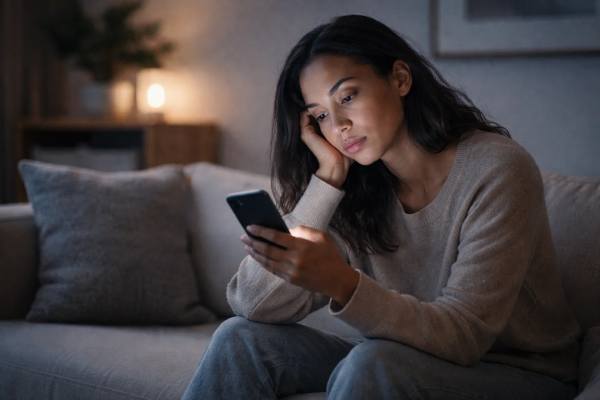
Social media is one of the most powerful mood-shaping tools most people use every day—often without noticing the mechanisms at work. It can help you feel connected, informed, and entertained in minutes. But the same design features that make it engaging can also amplify anxiety, intensify self-comparison, and quietly erode sleep quality. The effects are rarely “all good” or “all bad.” They depend on how you use social media, when you use it, and what your brain is trying to regulate in that moment—stress, boredom, loneliness, or uncertainty.
This article explains what’s happening under the hood: why feeds can feel irresistible, why notifications can raise baseline tension, how comparison loops reshape self-worth, and why nighttime scrolling can make sleep lighter and less restorative. You’ll also find a practical, realistic plan for healthier use.
Essential Insights
- Shifting from passive scrolling to intentional use often reduces anxiety and improves mood stability over time.
- Comparison pressure rises most when you browse while tired, stressed, or seeking reassurance.
- Nighttime social media tends to disrupt sleep through arousal and time displacement, not just screen light.
- If social media content triggers self-harm thoughts, eating concerns, or panic, prioritize support and tighter boundaries immediately.
- A 30–60 minute social media “buffer” before bed and after waking is a high-impact starting point for many people.
Table of Contents
- Why social media pulls attention
- How social media can raise anxiety
- Comparison and self-worth loops
- Sleep quality and nighttime scrolling
- Teens and higher-risk situations
- A practical plan for healthier use
Why social media pulls attention
Social media doesn’t just “show content.” It runs a continuous experiment on your attention. Each swipe provides a small uncertainty—What will I see next?—and the brain is highly sensitive to uncertainty. When a new post is surprising, funny, flattering, or emotionally charged, it stands out as “important,” even if it has no lasting value. Over time, your attention system starts to treat the feed like a slot machine: mostly ordinary outcomes with occasional strong rewards.
Variable rewards and dopamine timing
Dopamine is often misunderstood as a “pleasure chemical.” A more useful way to think of it is as a teaching and motivation signal: it helps the brain learn what predicts reward and what is worth pursuing. Social media packs many potential rewards into a short time—social approval, novelty, humor, outrage, belonging—delivered on an irregular schedule. That irregularity matters. Predictable rewards feel calmer. Unpredictable rewards keep the brain scanning and checking.
This is why “just five minutes” can stretch into forty. Your brain isn’t only consuming posts; it’s also chasing the next payoff.
Emotionally loaded content sticks
Strong emotion—especially threat, anger, or moral outrage—improves memory for what you just saw and increases the urge to keep going. Platforms don’t need to “decide” to harm you for this to happen. Algorithms often optimize for engagement, and intense emotions are reliable engagement drivers. The result can be a feed that feels urgent even when your day does not.
A key point: attention capture is not a personal failure. It’s the predictable outcome of (1) novelty, (2) social feedback, and (3) emotional intensity packaged into an endless stream. Once you understand the ingredients, you can change the recipe—by adjusting timing, notifications, and the type of engagement you choose.
How social media can raise anxiety
Anxiety thrives on uncertainty, social evaluation, and constant monitoring for risk—all of which social media can amplify. Many people notice a subtle shift after scrolling: shoulders tighter, thoughts faster, patience lower. That doesn’t always look like panic. Often it looks like restlessness, irritability, or a nagging sense that something is off.
Notifications train hypervigilance
Every alert is a cue: Something needs your attention now. Even when you ignore it, your nervous system registers the interruption. Over time, frequent cues can raise baseline arousal—like living next to a doorbell that rings randomly. This is especially true when notifications involve social evaluation (likes, replies, views) or ambiguous social signals (seen-but-not-responded).
A simple way to test this: notice how you feel in the minute after you check. If your mind immediately jumps to “What did I miss?” or “Do I need to reply?” that’s not just habit—it’s a conditioned anxiety loop.
Fear of missing out and unfinished conversations
Social platforms create a sense of endless social motion. Group chats continue without you. Trends shift quickly. News cycles refresh by the hour. The brain dislikes unfinished social threads, so even small uncertainties can feel pressing: Did I say the wrong thing? Are they ignoring me? The more you check to reduce uncertainty, the more you reinforce checking as the solution.
Meta-analytic findings in young people often show small-to-moderate relationships between problematic social media use and symptoms like anxiety and stress (roughly in the r≈0.30 range). That size is important: it suggests social media is rarely the only cause, but it can be a meaningful amplifier—especially when combined with poor sleep, high stress, or existing anxiety.
Doomscrolling as threat exposure
When your feed contains distressing headlines, arguments, or crisis content, your threat system can stay “on.” You may not feel scared; you may just feel tense. Consider setting specific windows for news or heavy topics, and avoiding them close to bedtime. Anxiety management is not avoidance—it’s choosing exposure on purpose rather than by algorithm.
Comparison and self-worth loops
Social comparison is normal; it helps us learn norms and find our place. Social media changes the inputs. Instead of comparing yourself to a small circle in realistic contexts, you compare yourself to curated highlight reels, filtered images, and people selected by algorithms for your attention. The comparison target is often unrealistic—and your brain reacts anyway.
Upward comparison and the “highlight reel” effect
A feed compresses other people’s best moments into a single stream: achievements, vacations, perfect lighting, confident poses, polished opinions. Even when you know it’s curated, repeated exposure can create a felt sense that your life is behind. This can show up as:
- Lower self-esteem after scrolling, even if you started neutral
- Reduced motivation (“Why try?”) or frantic overcompensation (“I need to catch up”)
- A harsher inner voice about appearance, productivity, or relationships
Research on online social comparison suggests robust links between frequent comparison and body image concerns, with correlations sometimes reaching moderate-to-large ranges in meta-analytic work. This matters because body dissatisfaction can spill into anxiety, social withdrawal, and sleep disruption—especially when the mind replays images and judgments at night.
Identity pressure and performance
Comparison isn’t only about looks. It also hits identity: Am I successful enough? Interesting enough? Mentally healthy enough? Posting can turn into self-monitoring—editing yourself to avoid criticism, scanning for reactions, and tying mood to feedback. This can lead to “performative coping,” where you feel pressure to present growth or happiness rather than actually experiencing it.
A protective shift is moving from performance to values:
- Post (or don’t) based on your goals, not on predicted approval
- Follow accounts that align with your values and genuine interests, not just aspiration
- Notice when “inspiration” turns into self-attack
If your feed reliably leaves you feeling smaller, more anxious, or more dissatisfied, the issue is not your willpower. It’s a mismatch between what your nervous system needs and what your feed supplies.
Sleep quality and nighttime scrolling
Sleep is where the brain files memories, resets emotional reactivity, and restores attention control. Social media can interfere with sleep in three main ways: time displacement, physiological arousal, and mental carryover.
Time displacement is the quiet disruptor
The simplest mechanism is also the most common: scrolling pushes bedtime later. The brain tends to underestimate time in immersive, fast-refresh environments. Losing 30–90 minutes a night may not feel dramatic in the moment, but it adds up quickly—especially if you need early wake times for work or school.
Over weeks, shorter sleep shifts the brain toward:
- More emotional reactivity (stronger response to stress)
- Reduced impulse control (harder to stop scrolling)
- More negative interpretation bias (a classic anxiety amplifier)
Arousal beats blue light most nights
Screen light can play a role, but social media often disrupts sleep because it is cognitively and emotionally activating. Arguments, dramatic stories, unexpected messages, or even exciting humor can increase alertness. The brain then treats bed as a place for stimulation rather than wind-down.
Signs nighttime social media is affecting sleep quality:
- You feel tired but “wired” once in bed
- You replay posts or conversations mentally
- You check again after lights-out “just in case”
- You fall asleep, but wake unrefreshed or more anxious
Meta-analytic evidence across electronic media use often shows small-to-moderate associations with poorer sleep outcomes (for example, correlations around r≈0.28–0.33 depending on how use is defined). “Problematic” use tends to have stronger links than simple time-based measures—suggesting compulsion, not just exposure, matters.
A better pre-sleep pattern
A practical starting target:
- Stop social media 30–60 minutes before bed
- Keep the phone out of arm’s reach (ideally out of the bedroom)
- Replace scrolling with a low-stimulation activity you can repeat nightly
The goal is not perfection. The goal is making sleep the default winner in the bedtime competition.
Teens and higher-risk situations
Social media affects everyone, but some brains and life contexts are more vulnerable. Adolescence is one of them. The teen brain is highly sensitive to social feedback, novelty, and peer status—exactly the signals social media concentrates. At the same time, teens often face early school start times, heavy workloads, and shifting identity—conditions that make sleep and self-worth more fragile.
Why teens can be more sensitive
For many teens, social media is not entertainment; it’s social infrastructure. That makes “just log off” unrealistic. A more useful frame is risk management:
- Reduce high-intensity exposure (late-night feeds, conflict-heavy spaces, appearance-focused content)
- Increase protective exposure (supportive communities, skill-building content, real friendships)
- Add guardrails (notification limits, device-free sleep routines, shared family norms)
When problematic use develops, the pattern can look like an addiction-style loop: craving, loss of control, escalating use, and continued use despite harm. This is when sleep, grades, mood, and real-world relationships often begin to shift.
Other higher-risk moments
People of any age can be more affected when they are:
- Sleep-deprived or working irregular hours
- Grieving, lonely, or socially isolated
- Living with anxiety, depression, OCD, or trauma symptoms
- Recovering from an eating disorder or struggling with body image
- Experiencing harassment, cyberbullying, or identity-based targeting
In these situations, content can hit harder and boundaries become more difficult. The right response is not self-blame—it’s increasing support and structure. That can include a trusted adult for teens, a clinician for persistent symptoms, or a deliberate “reset” period where you simplify your feed and reduce exposure to triggering content.
If social media use is linked to self-harm thoughts, suicidal thoughts, or escalating panic, treat that as a serious signal to seek professional help promptly and to tighten digital boundaries immediately.
A practical plan for healthier use
Healthy social media use is less about quitting and more about design—designing your environment so your brain isn’t forced to fight uphill all day. A useful framework is the “three Ts”: time, timing, and type.
Time: set a limit that matches your goals
Instead of aiming for a vague “less,” pick a number you can test:
- Start with a 20–30% reduction from your current average for two weeks
- If you don’t know your average, track for 3 days, then set a target
- Use app timers as guardrails, not moral judgments
If you repeatedly blow past limits, that’s a sign to change the environment (notifications, access, bedtime rules), not simply to “try harder.”
Timing: protect two high-impact windows
These two windows often deliver the biggest mental health return:
- After waking: delay social media for 30 minutes to reduce immediate stress reactivity and prevent instant comparison
- Before bed: stop social media 30–60 minutes before sleep to improve wind-down and reduce rumination
If you do nothing else, protecting these windows can meaningfully improve anxiety and sleep quality.
Type: shift from passive to intentional
Passive scrolling is most associated with comparison and mood dips. Try a menu approach:
- Intentional connection: message a friend, comment with care, join a supportive group
- Intentional learning: save one useful post, then leave
- Avoid when vulnerable: late night, after conflict, when you feel lonely or self-critical
A practical “feed cleanup” can help quickly:
- Unfollow or mute accounts that reliably trigger comparison or agitation
- Reduce exposure to appearance-focused, outrage-heavy, or conflict-driven content
- Add accounts that support sleep hygiene, skill-building, humor that relaxes you, or real-world hobbies
Finally, create a stopping cue you can repeat: “One more scroll” rarely ends. A stronger cue is behavioral: stand up, plug your phone in across the room, or switch to a non-feed activity.
You don’t need perfect discipline. You need a system that respects how attention, anxiety, and sleep actually work.
References
- Social media use, mental health and sleep: A systematic review with meta-analyses – PubMed 2024 (Systematic Review and Meta-Analysis)
- Problematic Social Media Use in Adolescents and Young Adults: Systematic Review and Meta-analysis – PubMed 2022 (Systematic Review and Meta-Analysis)
- Electronic Media Use and Sleep Quality: Updated Systematic Review and Meta-Analysis – PMC 2024 (Systematic Review and Meta-Analysis)
- The association between social comparison in social media, body image concerns and eating disorder symptoms: A systematic review and meta-analysis – PubMed 2025 (Systematic Review and Meta-Analysis)
- Social Media and Youth Mental Health: The U.S. Surgeon General’s Advisory [Internet] – PubMed 2023 (Guideline and Advisory)
Disclaimer
This article is for educational purposes only and does not provide medical advice, diagnosis, or treatment. Social media effects vary widely by age, health history, sleep patterns, and the type of content and engagement. If you are experiencing persistent anxiety, depression, sleep problems, disordered eating symptoms, or thoughts of self-harm, consider reaching out to a licensed clinician or a trusted health professional promptly. In urgent situations or if you feel at immediate risk, contact local emergency services right away.
If you found this article useful, consider sharing it on Facebook, X (formerly Twitter), or any platform you prefer so others can benefit.





