Dark showering is exactly what it sounds like: taking an evening shower in very low light, then stepping straight into a calmer, dimmer night. People who love it describe two changes that matter for sleep: their minds feel less “switched on,” and their bodies feel ready to cool down. The idea is not mystical—it’s practical. Bright light in the late evening can signal wakefulness, while a warm shower can encourage the body’s natural temperature drop that supports drowsiness. Combine those two levers—lower light and strategic warmth—and you get a routine that can feel like a clean break between day mode and sleep mode.
Dark showering is also adjustable. You can do it with a nightlight, an amber bulb, or even a dim hallway lamp, and it can take five minutes or fifteen. This guide explains why it may work, how to do it safely, and how to find the best version for your schedule and sleep style.
Quick Overview for Better Sleep
- Low light in the last hour of the day can make it easier to feel sleepy at a consistent bedtime.
- A warm shower timed before bed may shorten the time it takes to fall asleep by supporting post-shower cooling.
- The routine can reduce “revenge bedtime procrastination” by creating a clear, calming endpoint to the day.
- Very dim lighting increases slip and fall risk, so safety setup matters as much as the ritual itself.
- Start with a 5–10 minute warm shower about 60–90 minutes before bed, using only enough light to move safely.
Table of Contents
- What dark showering actually means
- Light, melatonin, and sleep pressure
- Warm water, cooling, and sleep onset
- Why low light calms the nervous system
- A step-by-step dark shower routine
- Common mistakes and quick fixes
- Who should skip or modify it
What dark showering actually means
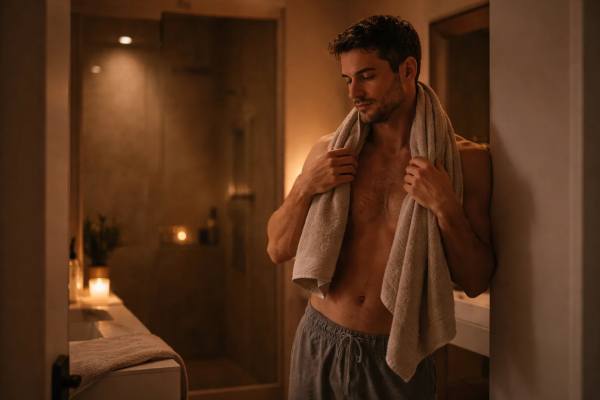
Dark showering is not “showering in total darkness.” It’s showering under low, warm-toned light—enough to be safe, but dim enough that your brain reads it as evening. In practice, it looks like one of these setups:
- A nightlight in the bathroom (or in the hallway with the bathroom door cracked)
- A dim, warm bedside lamp left on in the next room
- A bathroom fixture set to its lowest setting, ideally warm/amber rather than bright white
The point is to avoid the common pattern that breaks sleepiness: walking into a brightly lit bathroom, turning on overhead white lights, and suddenly feeling alert and “back online.” Dark showering tries to keep your night environment consistent so the shower feels like a wind-down, not a reset.
It also helps to define what dark showering is not:
- It is not a substitute for treating chronic insomnia, sleep apnea, or restless legs.
- It is not a promise that you will fall asleep instantly.
- It is not effective if you use it as a reason to stay up later.
Think of it as a bridge—a short ritual that transitions you from stimulation and decision-making to quieter sensory input and simpler actions.
A useful way to test whether your lighting is “dark enough” is the reading check. If you can comfortably read small text in the bathroom, the light is probably brighter than needed for a wind-down routine. If you can navigate safely and see water on the floor, but reading feels slightly inconvenient, you’re closer to the sweet spot.
Finally, dark showering works best when it is paired with the rest of a low-light night: softer lighting afterward, minimal screens, and a bedroom that feels like a different zone than your workday. The shower is the anchor—what you do after it determines whether the effect lasts.
Light, melatonin, and sleep pressure
If dark showering helps, it usually helps through light timing, not through the shower itself. Your brain uses evening light as a strong cue for whether it should maintain alertness or allow sleepiness to rise.
Two processes matter here:
- Circadian timing: your internal clock supports sleep at night and wakefulness during the day.
- Sleep pressure: the longer you’re awake, the more your body builds a need for sleep.
Bright light late in the evening can interfere with circadian timing by telling the brain that it’s still “day.” It can also make you feel temporarily energized even when sleep pressure is high, which sets up a frustrating pattern: tired body, alert mind.
Dark showering reduces this “mixed signal” problem. When you keep the bathroom dim, you avoid a late-night light spike that can:
- Push your natural sleepy window later
- Make it harder to feel drowsy at your planned bedtime
- Increase the temptation to do “one more thing” after the shower
A key nuance is that it’s not only screens that matter. Overhead bathroom lights and mirror lighting can be surprisingly intense, especially in small rooms with reflective surfaces. This is why dark showering can feel different from simply “not using your phone.”
If you want the routine to be consistent, focus on contrast: brighter mornings and dimmer evenings. People often try to fix sleep with dim evenings alone, but their days are spent indoors under relatively low light. Stronger daytime light exposure helps your system know when it is truly day, which makes the dim evening signal clearer. In other words, dark showering tends to work better when your day includes at least some outdoor daylight or a bright indoor morning routine.
A practical approach is to treat the last 60–120 minutes before bed as a lighting taper:
- Start lowering lights after dinner
- Keep the bathroom low-lit during the shower
- Stay dim afterward so the signal does not reverse
If you do all of this but still feel wide awake, the issue may be timing (too early), stimulation (work, conflict, intense media), or an underlying sleep disorder. Dark showering is most effective when the main barrier is “my brain gets reactivated at night,” not when sleep is disrupted by breathing problems, pain, or severe anxiety.
Warm water, cooling, and sleep onset
The “shower” part of dark showering matters because sleep is closely tied to body temperature regulation. In the evening, your system naturally shifts toward a lower core body temperature. That gentle cooling is one reason you feel sleepier at night.
A warm shower can support this process in a slightly counterintuitive way: by warming the skin and encouraging blood flow toward the body surface, it can make it easier to release heat afterward. Many people experience this as a calm heaviness or pleasant drowsiness that arrives after they towel off.
Timing is the difference between “cozy and sleepy” and “too energized.” A shower taken immediately before bed can feel stimulating for some people, especially if it is very hot, long, or paired with bright lighting. A shower taken earlier—often around 60 to 90 minutes before sleep—gives the body time to transition from warming to cooling.
If you want to apply this without turning your night into a science project, focus on three variables:
- Water temperature: warm, not scalding. A practical range is roughly 37–40°C (98–104°F)—comfortably warm without leaving you flushed.
- Duration: short and repeatable tends to work better than long and intense. Many people do well with 5–10 minutes.
- After-shower environment: the cooling phase is easier in a slightly cooler bedroom with breathable sleepwear and minimal bright light.
If you like a stronger effect, try a “warm then slightly cooler” finish:
- Shower warm for 5–8 minutes
- Turn the temperature down slightly for the last 30–60 seconds
- Step into a dim, calm room and avoid bright lights
This is not about forcing discomfort. It is about avoiding the post-shower “heat buzz” that can happen when you exit a hot shower into a warm, bright environment.
Also note that skincare and hair routines can unintentionally undo the benefit. If your shower is followed by 20 minutes of bright mirror lighting, blow-drying on high heat, and scrolling, the temperature and light signals are working against you. Dark showering works best when the shower is the main event—not the start of a new activity block.
Why low light calms the nervous system
People often describe dark showering as “quieting the mind.” That experience is not only about melatonin or temperature—it’s also about sensory load and nervous system state.
Bright light increases visual detail and draws attention outward. Dim light reduces visual input and makes the environment simpler. For many brains, that lower input can make it easier to shift from problem-solving to recovery. In a practical sense, dark showering can reduce three common bedtime triggers:
- Decision fatigue: In low light, you do fewer “micro-decisions” (fix this, clean that, respond to this message).
- Self-evaluation loops: Bright bathroom lighting and mirrors can pull people into appearance-focused thinking at the exact time they need to downshift.
- Task chaining: The brighter the space, the more likely you are to add tasks after the shower—laundry, tidying, emails, “just checking something.”
There is also a conditioning element. When you repeat the same sequence—dim light, warm water, simple steps—your brain begins to predict what comes next. Over time, the routine can become a cue: shower equals wind-down, wind-down equals sleep.
If you want to strengthen that cue, keep the dark shower consistent and slightly “special,” without making it complicated. Small anchors help:
- Use the same gentle scent (unscented if you’re sensitive)
- Keep the sound environment steady (quiet, or the same low-volume audio)
- Use the same towel or robe as a signal that “day is done”
Be cautious with strong stimulation disguised as relaxation. Cold plunges, very hot water, intense exfoliation, and energizing music can shift you toward alertness. Dark showering is most useful when it feels like lowering the volume on your day.
One more subtle point: dark showering can reduce late-night rumination by giving your brain an “off-ramp.” Many people finish work and go straight into open-ended phone time, which keeps cognitive arousal high. A short, dim, embodied routine interrupts that loop. You’re not trying to think your way to sleep—you’re giving your nervous system a different kind of input.
A step-by-step dark shower routine
The best dark shower routine is the one you can repeat without effort. Aim for simple, safe, and consistent. Here is a reliable starting version you can adapt.
Set up the environment
- Choose one low-light source you can trust (nightlight, dim lamp, or the lowest bathroom setting).
- Remove obvious hazards: pick up towels from the floor, clear clutter, and keep a bathmat in place.
- Set the room temperature so you do not overheat after the shower.
Pick a timing window
Start with 60–90 minutes before your target bedtime. If you go to bed at 11:00 p.m., shower around 9:30–10:00 p.m. This timing often supports the warm-then-cool sequence that helps drowsiness.
Shower in a “wind-down style”
- Step in and keep the water warm but not scorching.
- Stay in for 5–10 minutes. Longer is not automatically better.
- Keep the pace slow: wash, rinse, and finish without adding extra tasks.
- If you enjoy it, end with 30–60 seconds of slightly cooler water.
Exit into a dim landing zone
What you do after the shower determines whether the benefit holds:
- Dry off in dim light.
- Put on comfortable sleep clothes that breathe.
- Avoid turning on bright bathroom lights “just for a second.”
- If you need skincare, do it with the same low light and a minimal routine.
Choose one short post-shower activity
Pick a single, low-stimulation action that lasts 10–20 minutes:
- Stretching or gentle mobility
- Reading on paper or an e-ink device
- Quiet prep for tomorrow (only if it lowers stress, not if it creates planning spirals)
If you want a quick test of whether the routine fits you, evaluate two outcomes over a week: (1) how often you feel sleepy at the time you want to sleep, and (2) whether you stop “adding tasks” after the shower. If both improve, dark showering is doing its job.
Common mistakes and quick fixes
Dark showering can fail for reasons that have nothing to do with your biology. Most issues come down to light spikes, overheating, or routine creep. These fixes keep the practice effective and realistic.
Mistake: the bathroom is still too bright
If you feel alert the moment you enter the bathroom, the lighting is likely intense. Quick fixes:
- Use only one light source instead of overhead plus mirror lights.
- Close the shower curtain before turning on any light so reflections are reduced.
- Swap “cool white” bulbs for warmer tones if possible.
Mistake: showering too close to bedtime
If you get out feeling energized or flushed, try moving the shower earlier:
- Shift from “right before bed” to 60–90 minutes before bed.
- Shorten the shower by 2–3 minutes.
- Reduce the temperature slightly.
Mistake: the shower turns into a second wind
Some people treat the shower as the start of a new block: cleaning, grooming, reorganizing, messaging. If your mind picks up speed afterward:
- Make the shower the final “productive” act of the night.
- Prepare what you need beforehand (pajamas, towel, toiletries) so you do not roam around afterward.
- Use a gentle timer so the shower stays short and contained.
Mistake: screens undo the entire signal
If you step out of a dim shower and immediately scroll bright content, your brain receives mixed cues. Try one of these:
- Put the phone to charge before the shower.
- If you must use a screen, keep brightness low and choose calm content.
- Use a short “buffer activity” (stretching, reading) before any screen time.
Mistake: you made it too extreme
Showering in near-total darkness is unsafe and unnecessary. A better goal is “dim enough to feel like evening, bright enough to avoid injury.” If you feel anxious, unsteady, or irritated, increase light slightly and prioritize calm over strictness.
Dark showering is not a contest. The routine works when it reduces friction and stimulation. If it creates stress, it needs to be simplified.
Who should skip or modify it
Dark showering is generally low-risk, but it is not ideal for everyone. The two main concerns are safety (visibility and falls) and physiological sensitivity (heat, blood pressure shifts, skin conditions, and anxiety responses).
Prioritize safety if you are fall-prone
If you are older, dizzy at night, unsteady on wet surfaces, or taking medications that affect balance, do not reduce light aggressively. Modify instead:
- Use a brighter nightlight aimed at the floor rather than overhead glare.
- Install non-slip mats and grab bars if needed.
- Keep the floor dry and uncluttered before you dim anything.
Modify if heat affects you strongly
Some people feel overstimulated or lightheaded with warm showers, especially late at night. Consider:
- Slightly cooler water and a shorter shower
- Showering earlier in the evening
- A warm foot soak instead of full-body heat if you prefer gentler warming
Be careful with reflux, eczema, and skin sensitivity
Hot water can worsen reflux for some people (especially if bending and pressure are involved) and can dry skin. If your skin flares after showers:
- Keep showers short
- Use warm, not hot, water
- Moisturize quickly afterward in dim light with a simple product routine
Consider your relationship with darkness
If low light increases anxiety, intrusive thoughts, or trauma-related symptoms, dark showering may feel uncomfortable. You can still use the concept without going dark:
- Use soft, warm lighting rather than dim lighting
- Add a stable sound cue (quiet music, fan noise)
- Keep the routine brief and predictable
Know when to seek clinical help
If you have persistent insomnia (difficulty falling or staying asleep most nights for months), loud snoring with daytime sleepiness, morning headaches, or significant mood symptoms, a routine change may not be enough. Dark showering can be supportive, but it should not delay evaluation for conditions that need targeted treatment.
Used wisely, dark showering is a gentle tool—not a requirement. If it improves your wind-down without new problems, it is a meaningful win.
References
- Before-bedtime passive body heating by warm shower or bath to improve sleep: A systematic review and meta-analysis 2019 (Systematic Review and Meta-Analysis)
- Recommendations for daytime, evening, and nighttime indoor light exposure to best support physiology, sleep, and wakefulness in healthy adults 2022 (Recommendations)
- Associations between light exposure and sleep timing and sleepiness while awake in a sample of UK adults in everyday life 2023 (Observational Study)
- Assessing the Feasibility and Efficacy of Pre-Sleep Dim Light Therapy for Adults with Insomnia: A Pilot Study 2024 (Pilot Study)
- The Impact of Dynamic Lighting on Sleep Timing and Duration for Hospitalised Patients 2025 (Intervention Study)
Disclaimer
This article is for educational purposes only and does not provide medical advice. Sleep difficulties can have many causes, including insomnia disorders, sleep apnea, restless legs, medication effects, mood conditions, and chronic pain. Dark showering and other sleep-hygiene routines may help some people, but they are not a substitute for diagnosis or treatment. Use extra caution with low light if you are at risk of falls or dizziness, and avoid excessively hot showers if you experience palpitations, lightheadedness, skin flares, or reflux. If sleep problems are persistent, severe, or accompanied by concerning symptoms, consult a licensed healthcare professional.
If this article helped you, please consider sharing it on Facebook, X (formerly Twitter), or any platform you prefer.