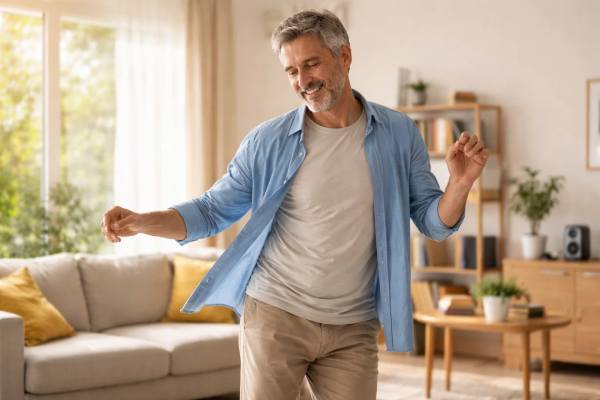
Dancing is more than “getting your steps in.” It is a rare form of exercise that asks your brain and body to solve problems together: timing, balance, spatial awareness, memory for sequences, and quick recovery when you miss a beat. That combination makes dance especially interesting for brain health, because it blends aerobic work (which supports blood flow and energy systems) with skill learning (which drives new connections) and social and musical cues (which shape mood and motivation). You do not need talent, a partner, or a studio to benefit. What matters is choosing a style you enjoy and building a routine that is safe, progressive, and realistic for your life. This guide explains what “brain benefits” from dance can look like, who tends to notice them most, and how to turn a fun activity into a consistent habit.
Essential Insights
- Dance can support mood and stress resilience by pairing movement with music, attention shifts, and (often) social connection.
- Learning and repeating step patterns can train coordination, attention, and working memory, especially when you keep adding small challenges.
- Improvements are not guaranteed, and effects vary by age, baseline fitness, sleep, and health conditions.
- Start with 20–30 minutes, 2–3 times per week, and increase either time or complexity (not both) every 1–2 weeks.
Table of Contents
- Why dance challenges the brain
- Mood and stress effects you can feel
- Memory and thinking benefits by age
- Coordination and balance that protect independence
- How to build a brain-smart dance plan
- Safety, technique, and when to get help
Why dance challenges the brain
If you want an activity that “lights up” mental systems, dance is a strong candidate because it demands real-time integration. Walking is largely automatic once learned. Dancing, especially when you learn new patterns, keeps you in a sweet spot where you are skilled enough to continue but challenged enough to adapt.
It is a three-layer task
Most dance sessions involve three layers happening at once:
- Rhythm and timing: matching your movements to a beat or musical phrase.
- Spatial mapping: tracking where your body is in space, where the floor boundaries are, and how you turn or travel without losing orientation.
- Sequencing and error correction: remembering “what comes next,” noticing mistakes, and adjusting quickly without stopping.
That last piece—error correction—matters. Each time you correct a missed step, you practice attention shifting, inhibition (“do not do the old step”), and working memory (“hold the next pattern in mind”). Over time, those small corrections can add up to a meaningful training effect.
Coordination is a brain workout in disguise
Coordination is not just muscle control. It includes predicting timing, distributing weight, and stabilizing the trunk while limbs move in different directions. Many dances also add “cross-body” patterns (right hand to left side, turns, diagonals). Cross-body work tends to be mentally demanding, because it challenges automatic movement habits and forces you to plan.
A practical way to think about this is the coordination tax: the mental effort you pay to execute a pattern smoothly. Early on, your coordination tax is high, and that is why dance can feel tiring even at a moderate heart rate. With practice, that tax drops—unless you keep introducing new patterns. That is why “learning” and “brain health” often travel together.
Why novelty matters
If you repeat the exact same routine forever, your brain will eventually run it on autopilot. The goal is not constant chaos; it is small novelty. A new eight-count, a new direction, a slightly faster song, or a different style can be enough to re-engage attention and learning. If you want dance for brain health, you are not only moving—you are building a habit of skill acquisition.
Mood and stress effects you can feel
Many people notice mood changes from dancing before they notice cognitive changes. That makes sense: dance combines physical activity (which can shift stress hormones and inflammation markers over time) with music, attention, and often social connection—three powerful mood inputs.
How dance can change your emotional state
Mood benefits from dance usually come from a few overlapping mechanisms:
- Physiological downshift after exertion: moderate movement can help “use up” stress arousal and support deeper calm afterward.
- Attentional absorption: focusing on timing and steps leaves less room for rumination. You cannot fully rehearse worries while counting beats and navigating turns.
- Music as a regulator: tempo, melody, and familiarity can reliably shift energy and emotion.
- Social safety cues (when present): synchronizing with others, even casually, can support feelings of belonging and reduce perceived threat.
You do not need a dance class to get mood benefits, but certain setups make them more likely: a playlist you genuinely like, an environment where you feel safe, and a routine that ends before you are depleted.
Dance and stress: the “recovery window”
A useful concept is the recovery window: the 30–120 minutes after a session when your body returns toward baseline. If you dance at an appropriate intensity, many people feel clearer, calmer, or more optimistic during that window. If you routinely push too hard, you may get the opposite—irritability, poor sleep, or a wired feeling.
To stay on the helpful side of that line, aim for a moderate intensity most days: you can talk in short sentences but singing would be difficult. Then, add short bursts of higher energy only when you are sleeping well, eating enough, and recovering normally.
Dance as an anti-isolation habit
Mood is not only chemistry; it is also context. Dance can be a low-barrier way to add structure to a week and create “social micro-moments,” even if that is just exchanging a smile in a class or sharing a routine with a friend online. If anxiety makes gyms or crowded spaces hard, dancing at home can be a gentle bridge—private, controllable, and still emotionally engaging.
Memory and thinking benefits by age
When people talk about “dance and brain health,” they often mean memory, attention, and executive function (planning, flexibility, and self-control). The research base is strongest in older adults, but the logic of skill learning and aerobic support applies across ages.
What improvements tend to look like
Cognitive changes from dance are usually subtle and functional rather than dramatic. People may report:
- remembering sequences more easily after practice
- better focus during complex tasks
- faster “mental switching” between steps (and sometimes between daily tasks)
- improved confidence in navigating busy environments
These outcomes depend on two ingredients: consistent practice and progressive challenge. A slow, repetitive dance that never changes may still help mood and fitness, but it is less likely to stimulate learning-dependent cognitive changes.
Older adults and mild cognitive concerns
In older adults, especially those who are deconditioned or socially isolated, dance may offer a “three-in-one” intervention: aerobic movement, balance training, and cognitive engagement. Some studies in older adults with mild cognitive impairment have found improvements in global cognitive scores or specific skills like verbal fluency and executive function after structured dance programs. Importantly, these programs are usually time-limited (for example, 8–12 weeks) and supervised or well-structured, which supports adherence and safety.
If you are supporting an older adult, the most realistic benefit may be improved daily functioning: more stable walking, better confidence, and easier participation in social activities. Those outcomes matter because they protect independence and reduce the spiral of inactivity that can worsen cognition over time.
Younger adults: fatigue, focus, and learning
In younger and midlife adults, the most noticeable “brain” outcomes may involve mental energy and stress-related cognitive fog. When sleep is poor or stress is high, attention and working memory often suffer first. Dance can help by improving sleep quality over time, reducing stress load, and providing a mentally engaging break from screens. For students or knowledge workers, a short session that includes learning a new combination can be a useful reset: it forces the brain into a different mode than verbal or analytical work.
A helpful rule: if your dance routine includes moments where you have to think, adapt, and recover from mistakes, you are more likely to get cognitive carryover than if you only “follow along” passively.
Coordination and balance that protect independence
Coordination and balance are brain-driven skills. They rely on sensory processing (vision, inner ear balance signals, and proprioception), motor planning, and rapid corrections. Dance trains these systems in ways that many standard workouts do not.
Why dance is different from many workouts
Traditional cardio often repeats a narrow movement pattern: cycling, jogging, elliptical. Dance asks you to:
- change direction frequently
- shift weight from foot to foot
- turn, pivot, and travel across space
- coordinate arms and legs with timing demands
- respond to external cues (music, an instructor, a partner)
These ingredients resemble real-life movement demands: stepping off a curb, turning quickly, moving around obstacles, or carrying something while walking. That is why dance is often discussed alongside “dual-task” and functional training.
Falls risk and confidence
In older adults, falls are not only a physical issue; they can become a fear-based behavior change. After a fall or a near-fall, people often move less, which weakens muscles and reduces balance, raising risk further. Dance can interrupt that cycle by building confidence and providing repeated practice in controlled instability (small shifts, turns, and varied footwork).
It is important to keep expectations grounded. Some reviews conclude that evidence for dance reducing falls is uncertain or low certainty, especially when falls are measured as the primary outcome. Still, many programs show improvements in balance tests, mobility, and perceived stability. In practical terms, that can mean fewer “close calls,” less stiffness when turning, and more willingness to move.
Coordination as “cognitive reserve” training
A useful way to frame coordination is that it is a form of brain maintenance. When you practice precise timing and sequencing, you keep neural systems active that support planning, attention, and response inhibition. For brain health, the target is not perfection; it is engagement. Even small stumbles can be beneficial if they are safe, because they require the brain to update and correct.
If balance is a concern, choose a style that allows hand support at first (near a counter or sturdy chair), reduce turns, and emphasize controlled weight shifts. Progression should feel like growing capability, not constant risk.
How to build a brain-smart dance plan
A “brain-smart” dance plan balances three variables: frequency, intensity, and complexity. The most common mistake is trying to increase all three at once. Instead, progress like a coach would: one lever at a time.
Choose a style that fits your goal
Different dance formats emphasize different benefits:
- Follow-along cardio dance: great for consistency and mood; moderate cognitive load unless you learn and repeat combinations.
- Partner dances (swing, salsa, tango): higher social and coordination demand; strong attention switching.
- Choreography-based styles (hip-hop, jazz, K-pop): excellent for memory and sequencing; can be intense.
- Low-impact options (line dance, folk dance, beginner ballroom): often joint-friendly and structured.
If you are mostly interested in brain benefits, pick a style that includes both repetition (to consolidate skills) and periodic novelty (to keep learning active).
A simple 4-week progression
Use this structure if you want measurable, realistic progress:
- Week 1: 2 sessions of 20–25 minutes at easy-to-moderate intensity. Repeat the same short routine each session.
- Week 2: 3 sessions of 20–30 minutes. Add one new step pattern but keep intensity similar.
- Week 3: 3 sessions of 25–35 minutes. Add a second new pattern or a gentle increase in tempo.
- Week 4: 3 sessions of 30–40 minutes. Keep two “practice” sessions and make one session a “learn” session with new choreography.
After week 4, keep the same rhythm: mostly practice, some novelty. A good ratio is two-thirds familiar, one-third new.
How hard should it feel?
For general brain and mood support, moderate intensity is a strong default. Use the talk test:
- Easy: you can sing.
- Moderate: you can talk in short sentences.
- Hard: you can only speak a few words at a time.
Most sessions can live in moderate. If you want a fitness boost, add short hard segments (20–60 seconds) once or twice per week, but only if recovery and sleep remain solid.
Finally, build cues for consistency: same days, same time, and a “start ritual” (shoes on, playlist ready). The brain likes predictable beginnings.
Safety, technique, and when to get help
Dance is generally safe when scaled to your current fitness, but it includes turning, impact, and quick changes of direction—common triggers for strains or dizziness. A few guardrails protect both safety and consistency.
Set up your environment
- Clear the floor of rugs, cords, and clutter.
- Use supportive shoes if you are turning often; avoid sticky soles that catch during pivots.
- Keep water nearby, and consider a fan if you overheat easily.
- If balance is a concern, dance near a stable surface you can touch lightly.
Technique basics that prevent injuries
You do not need perfect form, but these cues help:
- Soft knees: avoid locking the knees on landings.
- Quiet feet: aim for controlled steps rather than stomping.
- Turn with control: pivot on the ball of the foot and reduce speed before adding full turns.
- Posture stack: head over ribs over pelvis; avoid leaning back during fast steps.
Warm up for 3–5 minutes with gentle marching, shoulder rolls, and easy side steps. Cool down for 2–3 minutes with slower music and breathing that gradually steadies.
Know when to pause or modify
Stop and seek medical advice if you have chest pain, fainting, new severe shortness of breath, or neurological symptoms (new weakness, facial droop, sudden confusion). Modify and consider professional guidance if you have:
- frequent dizziness with turns
- uncontrolled blood pressure
- severe joint pain or unstable ankles
- recent concussion or balance disorder
- advanced osteoporosis with high fall risk
If you are managing a condition like Parkinson’s disease, vestibular disorders, or significant cognitive impairment, structured classes designed for your needs can be safer and more effective than improvising at home.
The most important safety principle is this: the best program is the one you can repeat. Choose a level that leaves you feeling capable the next day, not punished.
References
- The Effectiveness of Dance Interventions on Psychological and Cognitive Health Outcomes Compared with Other Forms of Physical Activity: A Systematic Review with Meta-analysis 2024 (Systematic Review with Meta-analysis)
- The effectiveness of dance movement interventions for older adults with mild cognitive impairment, Alzheimer’s disease, and dementia: A systematic scoping review and meta-analysis 2023 (Systematic Review and Meta-analysis)
- Effect of Dancing Interventions on Depression and Anxiety Symptoms in Older Adults: A Systematic Review and Meta-Analysis 2024 (Systematic Review and Meta-Analysis)
- Effectiveness of dance interventions for falls prevention in older adults: systematic review and meta-analysis 2024 (Systematic Review and Meta-analysis)
- Effects of Dance-Based Aerobic Training on Frailty and Cognitive Function in Older Adults with Mild Cognitive Impairment: A Randomized Controlled Trial 2025 (RCT)
Disclaimer
This article is for educational purposes only and does not provide medical advice, diagnosis, or treatment. Dancing can be an appropriate form of physical activity for many people, but individual risks vary based on medical history, medications, balance issues, and joint or heart conditions. If you have a chronic condition, recent injury, or symptoms such as chest pain, fainting, severe shortness of breath, or sudden neurological changes, seek urgent medical care. For personalized guidance—especially if you are older, have a history of falls, or are managing a neurological condition—talk with a qualified clinician or physical therapist before starting or significantly increasing activity.
If you found this helpful, please consider sharing it on Facebook, X (formerly Twitter), or any platform you prefer.