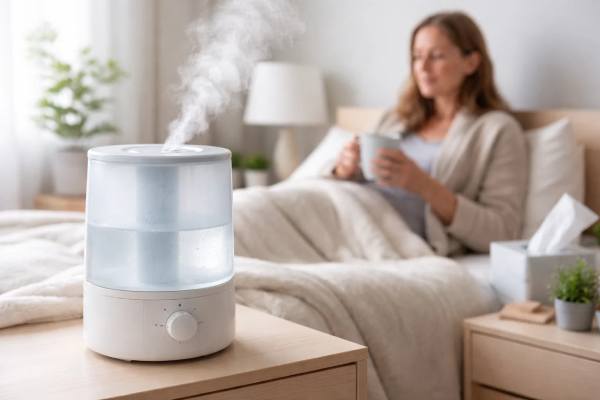
A humidifier can be a quiet ally when a cough won’t settle or congestion makes sleep feel impossible—especially in winter, when indoor air often turns dry. Adding moisture can soothe irritated nasal passages, loosen thick mucus, and reduce the scratchy throat sensation that triggers repeated coughing. But humidifiers are not “set and forget” devices. Too much humidity can invite mold and dust mites, and poor cleaning can turn a helpful tool into a source of odors and airborne microbes. The goal is a narrow comfort zone: enough moisture to support your airways, not so much that your home becomes damp.
This guide walks you through the practical decisions that matter most: the humidity range to aim for, which humidifier style fits your room and your household, where to place it for safer airflow, and a realistic cleaning routine that prevents slime and funky smells.
Essential Insights
- Keeping indoor humidity in a moderate range can ease dryness-related cough and help congestion drain more comfortably.
- Over-humidifying can worsen allergies and asthma by encouraging mold and dust mites.
- Daily water changes and frequent cleaning are the difference between “soothing mist” and “germ diffuser.”
- Distilled or previously boiled and cooled water can reduce mineral buildup and “white dust.”
- Aim for a measured humidity target (not guesswork) and adjust if you see condensation on windows or walls.
Table of Contents
- When a humidifier helps and when it does not
- Best humidity settings for bedrooms and nurseries
- Cool mist vs warm mist and ultrasonic vs evaporative
- Where to place a humidifier for safer airflow
- Water choices and additives to avoid
- Cleaning schedule that prevents mold and smells
- Troubleshooting and when to stop using it
When a humidifier helps and when it does not
A humidifier helps most when dry indoor air is part of the problem. Dry air can irritate the lining of your nose and throat, making you feel raw, tight, and “tickly.” That irritation can trigger cough reflexes even after the worst of a cold has passed. Moisture can also help thin mucus so it moves more easily—meaning less postnasal drip pooling in the throat and less coughing that starts the moment you lie down.
Common situations where humidification is worth trying include:
- Winter heating that leaves you waking up with a dry mouth, dry throat, or crusty nasal passages
- Congestion with thick mucus that feels “stuck,” especially overnight
- Mild nosebleeds or nasal dryness that make blowing your nose painful
- Hoarseness from mouth-breathing while congested
A humidifier is less helpful when your cough is driven by something moisture cannot fix, such as:
- Uncontrolled asthma, where you need a targeted asthma plan rather than more humidity
- Reflux-related cough, often worse after meals or when lying flat
- Medication side effects (certain blood pressure medicines can cause chronic cough)
- Bacterial sinus infection signs (worsening symptoms after initial improvement, severe facial pain, high fever)
Also, humidifiers are not a reliable way to “kill germs in the air.” A comfortable humidity range may support airway defenses, but it does not replace ventilation, staying home when ill, masking in close contact, or hand hygiene.
Consider humidification a comfort strategy, not a cure. If you have shortness of breath, chest pain, bluish lips, wheezing that is new or severe, signs of dehydration, or a cough lasting more than a few weeks, it’s safer to seek medical guidance than to keep adjusting a device.
Best humidity settings for bedrooms and nurseries
The most useful “setting” is not the mist dial—it’s the measured indoor humidity. Many people overshoot because humidity feels good at first, but excess moisture builds quietly over hours.
A practical target range for most homes is 30% to 50% relative humidity, with many people feeling best around 40% to 50% when sick. That range is high enough to reduce dryness but low enough to limit mold-friendly conditions. If your home is already damp, aim lower.
How to set it up like a grown-up (without turning your room tropical):
- Use a hygrometer. They are inexpensive and remove guesswork. Place it across the room from the humidifier, not directly in the mist plume.
- Start at 40%. Run the humidifier for 30–60 minutes, then check. Adjust gradually.
- Watch for condensation. Foggy windows, damp walls, “sweaty” corners, or musty smells mean you’re too high or you need better airflow. Lower the setting and run it for shorter intervals.
- Match the room temperature. Cooler rooms condense moisture faster. If the bedroom is chilly, you may need a lower humidity target to avoid wet surfaces.
- Use night-only strategies when needed. If your main goal is sleep, run it for the first few hours of the night or use an auto mode that maintains a set humidity.
For nurseries and kids’ rooms, the same humidity principles apply, but safety matters more:
- Avoid over-humidifying. Babies and young children are more sensitive to mold and dust-mite exposure.
- Keep the device out of reach and place cords where they cannot be pulled.
- Prefer cool mist to reduce burn risk (more on that below).
A helpful rule: if you can’t keep humidity in range without wet windows or dampness, humidify less and focus more on hydration, saline, showers/steam in the bathroom, and positioning for sleep comfort.
Cool mist vs warm mist and ultrasonic vs evaporative
Humidifiers come in a few main styles, and the best choice depends on who’s in the home, how much you hate cleaning, and whether your water is hard.
Cool mist vs warm mist
- Cool mist is generally safer for households with children because it avoids hot water and steam near curious hands. It can also feel more comfortable in warmer rooms.
- Warm mist (steam) can feel soothing, but it carries a burn risk if tipped or touched. Warm mist also uses more energy and may raise room temperature slightly.
Ultrasonic/impeller vs evaporative (wick/filter)
- Ultrasonic/impeller units are often quieter and produce a visible mist. The trade-off is that they can disperse minerals from tap water into the air, sometimes leaving “white dust” on surfaces. If you choose this type, water choice becomes more important.
- Evaporative units use a wick or filter and blow air through it. They tend to release fewer minerals into the air and often handle tap water better, but the wick/filter requires regular replacement and can develop odors if neglected.
If you’re deciding specifically for cough and congestion, comfort features matter:
- Built-in humidistat (automatic humidity control) reduces the risk of accidentally driving humidity too high.
- Easy-to-clean tank design matters more than extra modes. Narrow-neck tanks are harder to scrub and more likely to develop buildup.
- Noise profile matters for sleep. A quiet device is only helpful if you can tolerate it for hours.
A balanced pick for many households is an evaporative unit with a humidistat. If you prefer ultrasonic for quietness, plan on using lower-mineral water and staying strict about cleaning. No matter the type, remember: the “best humidifier” is the one you can maintain consistently.
Where to place a humidifier for safer airflow
Placement affects both effectiveness and safety. The goal is even moisture—not a wet zone around the device.
A simple placement checklist
- Put it on a stable, water-resistant surface (a small tray helps protect wood).
- Keep it a few feet from the bed, so you’re not breathing concentrated mist all night.
- Aim the output away from walls, curtains, and upholstered furniture to avoid damp patches.
- Keep it away from electronics and power strips.
- Keep it out of reach of children and pets, with cords secured.
Think in “mist paths,” not just room size. If the mist is visibly landing on the nightstand or bedding, it’s too close. That local dampness can promote mold growth in fabrics and create a musty smell even if the room’s overall humidity reads fine.
Airflow matters. If the room is sealed tight, humidity climbs fast and stale air lingers. You don’t need to sleep with windows wide open in winter, but small adjustments help:
- Crack a door, if privacy allows.
- Use the home’s ventilation features (bathroom fan after showers, kitchen exhaust when cooking).
- If multiple people are sick in one home, prioritize airflow and filtration strategies alongside humidification rather than relying on humidity alone.
For congestion relief at night, you can also use positioning:
- Elevate the head of the bed slightly (or use an extra pillow if safe for you).
- Keep the humidifier running long enough to stabilize humidity, then let it cycle off if you have a humidistat.
If your room frequently shows window condensation, try moving the humidifier farther from the window, lowering the set point, and running it only during the driest part of the night.
Water choices and additives to avoid
What you put in the tank matters because the humidifier can send tiny particles into the air along with water.
Best water choices
- Distilled water is a strong default, especially for ultrasonic units and nurseries, because it has low mineral content and reduces scale buildup.
- Boiled, cooled water can be a practical alternative when distilled water is unavailable. The key is letting it cool fully before adding it to the tank.
- Low-mineral water in general helps reduce residue and makes cleaning easier.
Tap water is not automatically “unsafe,” but hard tap water makes more mineral deposits, and some humidifier designs disperse those minerals into the air more readily. Mineral buildup also creates rough surfaces where biofilm can cling.
Avoid these common mistakes
- Do not add essential oils unless your specific model is designed for it. Oils can damage plastics, clog components, and leave residues that are difficult to remove. In some people, scented aerosols can trigger headaches, nausea, or airway irritation.
- Do not add disinfectants to the tank while it’s running unless the manufacturer explicitly instructs it. Airborne chemical exposure is not the goal.
- Avoid “home remedies” in the reservoir (vinegar, salts, menthol, herbal extracts). These belong in cleaning routines or topical use when appropriate, not in mist you will inhale.
- Avoid letting water sit in the tank for long periods. Stagnant water encourages growth and odors.
If you like the feeling of menthol when congested, use approaches that don’t risk aerosolizing unknown concentrations—such as a menthol rub used as directed, or a warm shower and humidifying the bathroom temporarily. The humidifier’s job is simple: deliver clean moisture at a controlled level.
Cleaning schedule that prevents mold and smells
Cleaning is not optional. A humidifier is essentially a small water system, and water systems grow film and scale quickly. The best plan is a routine that is realistic enough to maintain during a busy week.
Daily habits (takes 2–3 minutes)
- Unplug the unit.
- Empty the tank and base completely.
- Wipe any wet surfaces dry if you can.
- Refill with fresh water before the next use.
- Leave the tank open to air-dry if you’re not refilling immediately.
Every 3 days (or at least twice weekly) cleaning
- Unplug and disassemble per the manual.
- Scrub the tank and base surfaces that touch water, especially corners and seams.
- Remove visible scale and slime—this step matters more than the cleaning product.
- Rinse thoroughly multiple times so nothing you used for cleaning becomes part of the mist.
Many manufacturers recommend specific products. If they do not, common approaches include:
- Descaling (removing mineral buildup) with a mild acid such as vinegar, followed by thorough rinsing.
- Disinfecting periodically (for example, when someone has been sick, when slime appears quickly, or after storage) with a recommended disinfectant or hydrogen peroxide solution, again followed by thorough rinsing.
Weekly maintenance
- Check for hidden buildup under gaskets, caps, and valves.
- Wash or replace any filters/wicks as directed. Filters that smell musty should be replaced, not “perfumed over.”
- Clean any fan intake screens if your model has them.
Seasonal storage
Before storing for weeks or months: clean thoroughly, rinse well, dry completely, and store with the tank open (or per manufacturer guidance). Storing a damp unit is a reliable way to “pre-grow” the next season’s odor.
If your humidifier develops a smell quickly after cleaning, that usually means biofilm is still present in a seam or component you’re missing—or the unit design is too hard to clean effectively.
Troubleshooting and when to stop using it
A humidifier should make breathing feel easier, not worse. If symptoms change in the wrong direction, treat that as a useful signal.
Problem: The room smells musty or “sour.”
Likely cause: biofilm, mold, or stagnant water. Action: stop using it, deep clean, replace filters/wicks, and ensure all parts dry fully. If odors persist, consider replacing the unit—some designs hide buildup where you can’t reach.
Problem: White dust on furniture.
Likely cause: minerals dispersed from water (common with ultrasonic units). Action: switch to distilled/low-mineral water, consider an evaporative model, and clean scale regularly.
Problem: Condensation on windows or walls.
Likely cause: humidity too high or poor airflow. Action: lower the set point, run it in shorter blocks, move it away from cold surfaces, and improve ventilation.
Problem: Cough or wheeze feels worse.
Possible causes: over-humidity (dust mites/mold), contaminated humidifier, or irritation from additives/scented products nearby. Action: stop humidifying for 24–48 hours and see if symptoms improve; clean thoroughly; keep humidity at the lower end of the range. If wheezing or breathing difficulty is significant, seek medical care.
Problem: Congestion is unchanged.
Humidification may not be the limiting factor. Action: pair it with other supportive steps—saline nasal spray or rinse (with safe water practices), warm showers, hydration, and sleeping slightly elevated.
When to pause humidifier use entirely
- You cannot keep humidity below the point where condensation appears.
- Someone in the home has severe mold allergy symptoms that flare with humidity.
- You cannot clean it reliably (or the design prevents adequate cleaning).
Finally, remember the bigger picture: humidity is one piece of respiratory comfort. If cough and congestion are severe, prolonged, or paired with high fever, chest pain, shortness of breath, confusion, or dehydration, the safest move is to get medical guidance rather than relying on a device adjustment.
References
- Use and Care of Home Humidifiers | US EPA 2025 (Guideline)
- Preventing Waterborne Germs at Home | Drinking Water | CDC 2024 (Guideline)
- Indoor air humidity revisited: Impact on acute symptoms, work productivity, and risk of influenza and COVID-19 infection – PubMed 2024 (Review)
- Estimating the impact of indoor relative humidity on SARS-CoV-2 airborne transmission risk using a new modification of the Wells-Riley model – PubMed 2021 (Modeling Study)
- How to Care for Your Child’s Cold – HealthyChildren.org 2023 (Clinical Guidance)
Disclaimer
This article is for general educational purposes and does not replace individualized medical advice, diagnosis, or treatment. Humidifiers can improve comfort during cough and congestion, but incorrect use can worsen indoor air quality and trigger allergy or asthma symptoms. If you or your child has trouble breathing, persistent high fever, chest pain, signs of dehydration, worsening symptoms after initial improvement, or any urgent concern, seek prompt care from a licensed clinician or emergency services.
If you found this guide useful, consider sharing it on Facebook, X (formerly Twitter), or any platform you prefer so others can use humidifiers more safely and effectively.