Bird flu headlines can make everyday food choices feel suddenly uncertain, even though most people’s true risk does not come from eating dinner. The practical question is not “Is H5N1 out there?” but “Which situations could realistically bring live virus to my eyes, nose, or mouth?” This article separates kitchen reality from rumor: why properly cooked poultry and eggs remain a low-risk choice, why pasteurized milk is fundamentally different from raw milk, and where risk can quietly rise—like cross-contamination on cutting boards or handling raw animal products with small breaks in routine. You will also learn how to shop and store confidently during outbreaks, what to do with backyard eggs if your flock is sick, and when an exposure is significant enough to call a clinician. The aim is calm, specific guidance you can use today.
Quick Overview for Safer Choices
- Proper cooking and basic kitchen hygiene sharply reduce risk from poultry and eggs, even during bird flu outbreaks.
- Pasteurized milk and products made from it are the safer default; raw milk carries avoidable infectious risk.
- The biggest preventable mistakes are undercooking and cross-contamination from raw juices to ready-to-eat foods.
- If you handle sick or dead birds, raw milk from unknown sources, or contaminated animal environments, your risk profile changes.
- Use one simple rule: cook thoroughly, separate raw from ready-to-eat, and choose pasteurized dairy.
Table of Contents
- Food risk versus contact risk
- Eggs: what’s risky and what isn’t
- Poultry: the 165-degree safety line
- Milk and dairy pasteurization facts
- Raw milk cheese and edge cases
- Shopping, storage, and kitchen hygiene
- When food exposure needs medical advice
Food risk versus contact risk
Most human H5N1 infections have been linked to close contact with infected animals or contaminated environments—not to eating properly prepared food. That distinction matters because it changes what you should pay attention to.
Foodborne risk is about whether live virus can survive in something you eat and then infect you through the digestive tract. For H5N1, the more realistic pathway is usually contact risk: virus gets into the eyes, nose, or mouth during handling. Think splashes, droplets, and contaminated hands. A kitchen scenario can create contact risk if raw juices reach your hands and then your face, or if you contaminate a surface and touch it later while eating.
What’s “actually risky” in everyday life
Risk rises when one or more of these conditions are true:
- You handle raw poultry, raw eggs, or raw milk and then touch your eyes, nose, or mouth before washing hands.
- You prepare raw poultry and then use the same cutting board or knife for salad, fruit, or bread without cleaning and sanitizing.
- You consume raw or undercooked animal products, especially raw milk or lightly cooked eggs, where heat has not done its job.
- You obtain products outside regulated channels (for example, raw milk sold informally, home-slaughtered poultry, or eggs from a visibly ill backyard flock).
What’s “not very risky” for most people
These are lower-risk choices when done normally:
- Eating thoroughly cooked poultry and egg dishes.
- Buying eggs, poultry, and pasteurized dairy from regulated retail sources and storing them correctly.
- Handling packaged foods without touching your face and washing hands before eating.
A useful mindset is “reduce live-virus opportunities.” Cooking reduces live virus. Pasteurization reduces live virus. Handwashing reduces live virus transfer. Separating raw from ready-to-eat prevents your salad from becoming an accidental “no-cook” landing zone for raw juices.
If you want one clear bottom line: the average person can keep risk very low by treating bird flu like an extra reason to follow the same food safety practices that already prevent salmonella, campylobacter, and other common hazards.
Eggs: what’s risky and what isn’t
Eggs are where anxiety often spikes, partly because “bird flu” sounds like it should be inside anything a bird produces. In practice, the meaningful risk for consumers is usually the same as it has always been: eating eggs raw or undercooked, or spreading raw egg onto foods that will not be cooked.
Safer egg choices during outbreaks
For most households, store-bought eggs remain a reasonable option. Commercial systems respond aggressively to outbreaks to prevent products from entering the food supply, and the simplest safety advantage for consumers is that cooking is highly effective. If you are shopping, prioritize basics that support good handling:
- Choose eggs from refrigerated cases; skip cracked or leaking shells.
- Refrigerate promptly at home and keep eggs cold until use.
- Avoid “counter storage” habits during outbreak periods unless you are confident the eggs have been handled safely end-to-end.
What’s actually risky with eggs
The riskiest egg behaviors are the ones where heat never gets a chance to work:
- Raw batter and dough tasting (cookie dough is the classic).
- Homemade drinks and sauces made with raw eggs (some versions of eggnog, protein drinks, Caesar dressing, mayonnaise, and foam toppings).
- Soft-scrambled or runny eggs when you are feeding young children, pregnant people, older adults, or anyone with a weakened immune system.
If you love runny yolks, the practical compromise is to reserve them for low-risk situations and people, and use thoroughly cooked egg preparations when anyone vulnerable will be eating.
Cooking targets that make sense
You do not need a lab-grade plan—just thorough cooking:
- Cook egg dishes until whites and yolks are firm, not glossy.
- For casseroles, breakfast bakes, and quiches, cook until the center is set and hot.
- When you are uncertain, using a food thermometer can help you confirm the dish is fully cooked.
Backyard eggs need a different standard
If eggs come from your own flock or a neighbor’s birds, your risk depends on flock health and hygiene. Avoid using eggs from birds that are visibly ill, dying, or found dead. If your flock has unexplained sudden deaths, stop consuming eggs until you have guidance from a veterinarian or local animal health authority. In that scenario, risk is less about the egg itself and more about handling contaminated surfaces, bedding, and droppings while collecting.
Egg safety becomes straightforward when you decide: cook thoroughly, keep cold, and do not treat raw egg as harmless.
Poultry: the 165-degree safety line
For poultry, the most confidence-building fact is also the simplest: thorough cooking is highly effective. The goal is not a perfect shopping strategy; it is making sure heat reaches the parts of the bird where germs could live.
Why 165°F matters
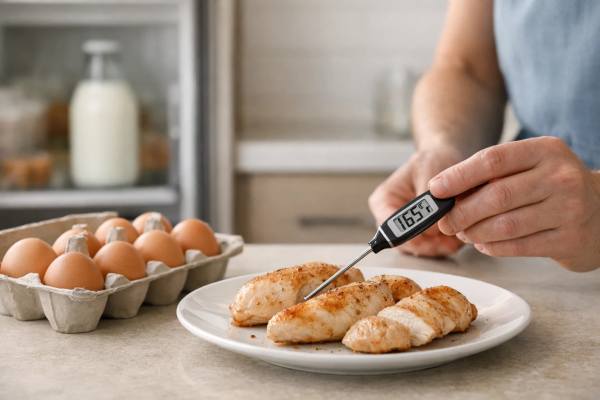
A clear internal temperature target gives you a safety line you can rely on. Cooking poultry to 165°F (74°C) is widely used because it kills common foodborne pathogens and is also sufficient to inactivate many viruses. That means the “bird flu question” does not require a new set of cooking rules—just consistent follow-through.
Where risk sneaks in
Most preventable kitchen risk is cross-contamination. Poultry juices can contaminate hands, counters, sink basins, sponges, and anything you rinse nearby. Common pitfalls include:
- Washing raw chicken in the sink (this spreads droplets onto nearby surfaces).
- Cutting raw poultry and then chopping salad on the same board.
- Touching the fridge handle, spice jars, or your phone with raw hands.
- Using a towel that has wiped raw juices and then drying clean hands or dishes with it.
If you do one thing differently during outbreaks, let it be this: treat your hands like they are “live” until you wash them after handling raw poultry.
Simple handling steps that work
Use a sequence that is hard to mess up:
- Set up a “raw zone” with one cutting board and one knife.
- Keep ready-to-eat foods (fruit, salad greens, bread) away from that area.
- Cook poultry fully; use a thermometer in the thickest part of meat and the center of ground poultry.
- Wash hands with soap and water after touching raw poultry or packaging.
- Clean and sanitize surfaces that contacted raw juices.
Leftovers and takeout
Takeout chicken and fully cooked deli poultry are generally low-risk choices when they are hot and handled normally. With leftovers, the key is time and temperature: refrigerate promptly, reheat thoroughly, and do not leave cooked poultry sitting out for long periods.
If you already have good poultry habits, you are already doing most of what matters for bird flu. The virus is not defeated by “special products.” It is defeated by temperature, separation, and clean hands.
Milk and dairy pasteurization facts
Milk is the area where guidance can sound most urgent, mainly because raw milk can contain live pathogens of many kinds, and because animal outbreaks can raise questions about what might be present before processing. The most practical way to reduce risk is also the most familiar: choose pasteurized dairy.
Pasteurized milk: what it changes
Pasteurization is a controlled heat process designed to inactivate harmful organisms. From a consumer perspective, the critical point is that pasteurization is not a minor label detail—it is a safety intervention. When milk is pasteurized and then handled and stored correctly, risk from live pathogens is far lower than in raw milk.
That difference becomes even more important during animal outbreaks because raw milk could be contaminated before it reaches the consumer. Pasteurization acts as a barrier that raw milk lacks.
Raw milk: why it is a different category
Raw milk is sometimes framed as “natural,” but from an infectious disease standpoint it is simply unprocessed. That means any pathogen present in the animal or introduced during collection can remain viable. Even outside of bird flu discussions, raw milk is linked to serious illness risks, especially for pregnant people, infants, young children, older adults, and those with weakened immune systems.
During H5N1-related concerns, raw milk creates two problems at once:
- It may contain infectious material if the animal is infected.
- It can be handled casually, increasing hand-to-face transfer risk in the kitchen.
What about boiling milk at home
Some people consider heating raw milk at home as a workaround. The practical caution is that home heating can be inconsistent unless you use a thermometer and a reliable process. From a risk management standpoint, buying pasteurized products is simpler, more consistent, and less error-prone. If you are already purchasing from a regulated retail source, pasteurized milk and pasteurized dairy products are the straightforward choice.
Which dairy products are generally lower risk
- Pasteurized milk, yogurt, ice cream, and most commercial dairy products.
- Hard cheeses and many aged cheeses made from pasteurized milk.
- Butter and products made from pasteurized cream.
The key consumer move is not chasing “special” dairy. It is choosing pasteurized and storing it cold. If you are not sure whether a product is made from pasteurized milk, treat that uncertainty as a reason to choose an alternative.
Raw milk cheese and edge cases
Food safety is usually simple until you hit edge cases: specialty cheeses, farm-gate products, informal sales, or social media claims that “aged” products are automatically safe. This is where clarity helps most.
Raw milk cheese is not the same as pasteurized cheese
Cheese made from raw milk can be safe when produced under strict controls, but it is not risk-free. Aging changes acidity, moisture, and microbial growth conditions, yet aging is not a guaranteed “kill step” for every pathogen in every scenario. Consumers often assume that “aged” equals sterile. It does not.
If you are deciding what to serve to a mixed group—kids, grandparents, pregnant friends—pasteurized cheese is the least complicated choice. It removes uncertainty without sacrificing most flavor options.
Soft cheeses, fresh cheeses, and homemade dairy
Fresh cheeses and soft cheeses can be higher-risk in general because they contain more moisture and are not cooked. If those products are made from raw milk, your margin for error shrinks further. The same logic applies to homemade ice cream, homemade yogurt, and any “farm milk” product that is not clearly pasteurized.
A good practical rule: if the product is cold, soft, and made from raw milk, it deserves extra caution.
Raw milk in pet diets affects human risk
Even if you do not drink raw milk, it can enter a household through pet diets or raw feeding trends. That matters because handling raw pet food or raw milk for animals can contaminate hands, counters, bowls, and sinks. The human risk here is not only what the pet eats—it is the kitchen contact that follows. If you live with someone who prepares raw pet diets, treat it like raw poultry: strict separation, careful cleanup, and no casual hand-to-face contact.
Live bird markets and home processing
Food risk and contact risk overlap most strongly when people purchase live birds for home slaughter or process game birds at home. Even if the final meat is cooked thoroughly, the handling phase can create splashes and contaminated surfaces. In those scenarios, eye protection, a well-fitting mask, and careful cleanup matter more than they do for a sealed supermarket package.
If your food choices include raw milk products, live birds, or home processing, the safest move is not panic. It is tightening the few steps that reduce contact risk: avoid raw consumption, cook thoroughly, and prevent contamination from spreading in the kitchen.
Shopping, storage, and kitchen hygiene
Outbreak seasons can make people overcorrect—skipping eggs entirely or discarding perfectly good food. A better approach is to shop and cook with systems that prevent mistakes.
Shopping decisions that reduce worry
- Prefer regulated retail channels for eggs, poultry, and dairy.
- Choose dairy labeled pasteurized, especially for milk, yogurt, and soft cheeses.
- Avoid products that are cracked, leaking, or sold without refrigeration when refrigeration is expected.
- If you are buying poultry in bulk, plan freezer space so you are not leaving raw meat in the fridge too long.
You do not need “disinfectant wipes in the grocery store” routines. Your kitchen habits matter more than the packaging surface.
Cold-chain basics that actually help
Proper storage reduces microbial growth and keeps handling predictable:
- Refrigerate eggs and dairy promptly.
- Keep raw poultry on a lower shelf to avoid drips onto ready-to-eat foods.
- Use a tray or container under raw poultry to catch leaks.
- Thaw poultry in the refrigerator, not on the counter.
A simple kitchen workflow
A workflow prevents cross-contamination more reliably than memory:
- Prep ready-to-eat foods first (salad, fruit, bread).
- Then handle raw poultry and eggs in a dedicated area.
- Cook thoroughly.
- Clean and sanitize the raw zone.
- Wash hands again before serving and eating.
If you do it in this order, you are far less likely to smear raw material onto foods that will not be cooked.
Cleaning that is effective and realistic
Cleaning has two steps: remove grime, then sanitize. Soap and water remove material. A sanitizer reduces microbes after surfaces are clean. You do not need extreme measures, but you do need consistency—especially with cutting boards, knives, sink rims, and sponges. Consider using paper towels for raw juice cleanup and laundering dish cloths frequently.
If you want a single “high-impact” habit: keep one cutting board only for raw poultry, and do not rinse it in a way that splashes. Wash it thoroughly and let it dry completely.
These routines reduce risk from bird flu concerns and also prevent the far more common problems that actually cause foodborne illness.
When food exposure needs medical advice
Most people with a cough after dinner do not need bird flu testing. The situations that justify medical advice usually involve meaningful exposure to potentially infected animals, raw milk from uncertain sources, or high-risk handling environments.
When to call a clinician
Seek advice promptly if you have both a credible exposure and compatible symptoms. Exposures that matter include:
- Handling sick or dead birds, cleaning coops, or processing birds in outbreak settings.
- Working in poultry or dairy environments where H5 infections have been identified in animals.
- Consuming or handling raw milk from a source where animal illness is suspected, especially if there was significant contact with the face or eyes.
Symptoms to take seriously after such exposures include fever, worsening cough, shortness of breath, unusual fatigue, and eye redness or irritation that is not easily explained.
When to seek urgent care immediately
Do not wait for testing or reassurance if you develop:
- Severe or worsening breathing difficulty
- Chest pain or pressure
- Confusion, fainting, seizures, or extreme drowsiness
- Bluish lips or face
- Rapid decline over hours to a day
These warning signs require evaluation regardless of which virus is responsible.
What to say when you call
A clear exposure story helps clinicians act faster:
- What you handled and where (raw milk, sick birds, home processing, workplace exposure)
- Whether there were splashes or dust exposure
- When the exposure happened and when symptoms began
- Whether anyone else in the household had similar exposure or symptoms
What home tests can and cannot do
Home tests for flu or COVID-19 can help with everyday decisions, but they are not designed to confirm H5N1. A negative home test does not reliably rule out concern after a high-risk exposure, especially early in illness. If your exposure story is strong, rely on clinical guidance rather than repeated home testing.
The most important takeaway is proportionality: most people can focus on cooking and hygiene. A smaller group—those with real animal exposure—should add timely medical advice to their plan.
References
- Food Safety and Bird Flu | Bird Flu | CDC 2024 (Guidance)
- Talking to Patients about Unpasteurized (Raw) Milk and Highly Pathogenic Avian Influenza | Bird Flu | CDC 2024 (Clinical Guidance)
- Investigation of Avian Influenza A (H5N1) Virus in Dairy Cattle | FDA 2025 (Public Health Update)
- Influenza: Avian 2024 (Guideline)
- Thermal inactivation spectrum of influenza A H5N1 virus in raw milk – PMC 2025 (Research Article)
Disclaimer
This article is for educational purposes only and does not provide medical advice, diagnosis, or treatment. Food safety guidance can change as outbreaks evolve. For personal health concerns—especially after contact with sick or dead animals, exposure in poultry or dairy work, or symptoms such as fever, eye irritation, or breathing difficulty—seek advice from a qualified clinician promptly. Call emergency services immediately for severe shortness of breath, chest pain, confusion, bluish lips or face, seizures, or rapid worsening.
If this article helped you, please consider sharing it on Facebook, X (formerly Twitter), or any platform you prefer.