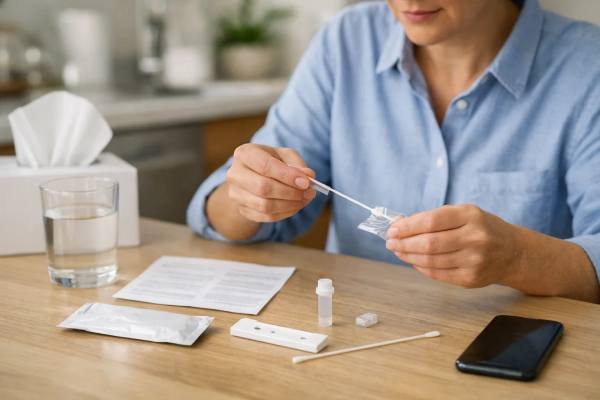
A sore throat can feel deceptively simple, yet the “right” next step is often nuanced. Most sore throats are viral and improve with time and supportive care, but strep throat is different: it’s a bacterial infection that can benefit from antibiotics when properly diagnosed. That difference is why at-home strep throat testing is getting more attention—people want faster clarity, fewer unnecessary clinic visits, and more confident decisions about work, school, and treatment.
Still, strep testing is not as forgiving as a typical nasal swab. Throat swabs can be technically tricky, results depend on timing and technique, and a negative rapid test does not always close the case—especially for children. The goal is not just a result, but a result you can act on safely. This guide explains what’s available, where accuracy can break down, and when a throat culture (or equivalent lab testing) is the smarter next move.
Essential Insights
- At-home strep tests can shorten the time to treatment when symptoms and exposure make strep likely.
- A positive rapid strep result is usually reliable, but it still needs a clinician to confirm the plan and prescribe antibiotics when appropriate.
- A negative rapid test can miss strep—backup culture (or lab-grade testing) is especially important for many children.
- The single biggest factor you control is swab technique: accurate throat sampling matters more than most people expect.
Table of Contents
- Which at-home strep tests exist
- What rapid strep tests detect
- Accuracy and false results
- How to swab and run the test
- What to do with results
- When a throat culture matters
Which at-home strep tests exist
“At-home strep test” can mean several different things, and the differences matter because they affect both accuracy and what you should do next.
1) Over-the-counter rapid strep tests labeled for home use
Some rapid strep tests are now cleared and labeled for over-the-counter use. These are designed for lay users and include consumer-facing instructions, safety steps, and the timing window for reading results. If you are shopping locally or online, the most reliable signal is the labeling: it should clearly state it is intended for over-the-counter use (not professional-only) and specify the sample type (typically a throat swab). If that wording is missing, you should assume the product may not be meant for self-testing.
2) Professional rapid strep kits sold online
Many “rapid strep kits” sold through marketplaces are designed for clinics operating under specific rules and quality systems. Even if the device itself is widely used in medical settings, distribution for direct-to-consumer at-home use may be restricted. The practical issue is not just legality—it’s that professional tests often assume training, controlled storage, and a consistent swab technique.
3) Telehealth-supervised home testing
Some services combine a video visit with guided self-swabbing. This can help with technique and ensures there’s a pathway to confirm results and prescribe treatment. It can be a good middle ground if you want to avoid an in-person clinic but still want clinician oversight.
4) Mail-in throat swab to a laboratory
Mail-in tests typically use lab methods (often molecular testing) after you collect a throat swab at home and ship it to a lab. Turnaround time is slower than a rapid test, but the analytic accuracy can be higher than many antigen tests, and you may get a formal lab report.
A realistic expectation: at-home tests are best at answering one narrow question—“Is group A strep likely present right now?” They do not evaluate dehydration, airway risk, peritonsillar abscess, mononucleosis, or other causes of severe throat pain. For those, the setting matters as much as the test.
What rapid strep tests detect
Most strep throat is caused by group A Streptococcus (GAS), also known as Streptococcus pyogenes. Rapid tests generally target GAS because it’s the strain most associated with classic strep throat and complications such as scarlet fever.
There are two main testing approaches you will encounter:
Rapid antigen tests (the classic “rapid strep”)
These tests look for strep antigens—small protein markers from the bacteria—in a throat swab sample. They can deliver results quickly (often within minutes). Their main strength is high specificity: when the test is positive, it is usually correct. Their main limitation is variable sensitivity: a negative result may occur even when strep is truly present, especially if swabbing misses the infected area or bacterial load is low early on.
Rapid molecular tests (NAAT-based options in clinical settings and some lab workflows)
Molecular tests look for genetic material from the bacteria. In many studies, rapid molecular methods are more sensitive than antigen tests, meaning they miss fewer true cases. The trade-off is that they often require a dedicated device or lab workflow, which is why you’re more likely to see them at pharmacies, urgent care, or clinics than as a simple strip-only home kit.
Throat culture (the reference standard)
A culture grows bacteria from the throat swab. It takes longer, but it remains a key “tie-breaker” because it can detect cases that rapid tests miss. Culture also helps in situations where you need high confidence, such as repeated negative rapid tests in a symptomatic child.
Important boundaries:
- Rapid strep tests are designed for throat swab specimens. A cheek swab, saliva sample, or tongue swab will reduce accuracy unless the test explicitly allows it.
- These tests are not designed to tell you whether a sore throat is viral, allergic, reflux-related, or due to mono. They only detect (or fail to detect) the targeted bacteria.
- Some people—especially children—can carry GAS in the throat without it causing the current illness. In carriers, a positive result may not always mean strep is the true cause of symptoms.
Accuracy and false results
Accuracy is not a single number you can safely apply to every household. It shifts with test type, swab technique, timing, and how “likely” strep is before you test.
Why positive results are usually more actionable
Rapid strep tests—especially antigen tests—tend to be highly specific. If the test is positive and the symptoms fit, clinicians often treat. This matters because appropriate antibiotics can shorten symptoms modestly, reduce contagiousness, and lower the chance of complications in confirmed cases.
Why negative results are trickier
A negative rapid test can be wrong for several reasons:
- Swab technique: If the swab never touches the tonsillar pillars or the back of the throat (or if it mostly touches tongue and cheeks), the sample may not contain enough bacteria to detect.
- Early illness: In the first day of symptoms, bacterial levels can be lower. A test done very early can miss evolving infection.
- Recent antibiotics: Even a dose or two can reduce detectable bacterial load and produce a false negative.
- Poor test handling: Reading too late, using the wrong number of drops, or mis-timing the result window can create errors.
Pretest probability changes what the same result means
A rapid test result is not interpreted in a vacuum. Two people can have the same negative test and different next steps because their risk is different.
Strep is more likely when you have several of the following together:
- Sudden sore throat with fever.
- Pain on swallowing.
- Swollen and tender nodes in the front of the neck.
- Tonsillar exudates (white patches) or palatal petechiae (tiny red dots on the palate).
- Known close contact with confirmed strep.
Strep is less likely when you have prominent viral features, such as:
- Cough, runny nose, hoarseness, conjunctivitis, or mouth ulcers.
False positives and the “carrier” issue
A positive test can occasionally reflect colonization rather than the cause of current symptoms. This is most relevant when viral symptoms dominate or when someone has frequent positive tests without a typical strep pattern. Carriers usually do not benefit from repeated antibiotic courses unless there are special circumstances a clinician will evaluate.
A practical takeaway: treat home testing as a decision aid, not a final verdict—especially when the result conflicts with the clinical picture.
How to swab and run the test
If you take only one skill seriously, make it the throat swab. Most accuracy problems at home start here.
Before you start
- Wash and dry hands thoroughly.
- Check the kit’s expiration date and storage requirements.
- Choose strong lighting and a clean, flat surface.
- If testing a child, recruit another adult if possible—one to hold the light and steady the head, one to swab.
It also helps to avoid eating, drinking, brushing teeth, using mouthwash, or chewing gum shortly before swabbing, since these can interfere with sampling or comfort. If you just ate, give it a little time so the throat is calmer and less likely to gag.
How to collect a better throat swab
- Have the person open wide and say “ahh” to lift the soft palate.
- Use the tongue depressor (if included) or a clean spoon to gently press the tongue down.
- Aim for the tonsils and the pillars around them, and the back wall of the throat.
- Firmly rub and rotate the swab across both sides.
- Avoid touching the tongue, teeth, or inside cheeks as much as possible. If the swab is contaminated, it’s better to use a new swab than to proceed with a poor sample.
If gagging is a problem, slow breathing through the nose can help. For children, short and decisive swabbing is usually more successful than prolonged “negotiation” once the mouth is open.
Running the test and reading it correctly
Follow your kit’s steps exactly, but these universal principles apply:
- Mix or extract the swab in the provided solution for the full recommended time.
- Apply the correct amount of processed sample to the test device. Too little can cause invalid results; too much can flood the strip.
- Set a timer immediately. Read the result only within the stated window. Reading too early or too late can create false interpretation.
- Confirm the control indicator appears; without it, the test is invalid and must be repeated.
When in doubt, take a clear photo at the correct read time. If you contact telehealth or a clinic, that photo can help communicate what you saw.
What to do with results
A home test result is most helpful when you already know what action it should trigger. Here is a practical, safety-first approach.
If your test is positive
- Contact a clinician promptly (primary care, urgent care, or telehealth). Antibiotics for strep require a prescription, and your clinician will confirm the plan, dose, allergies, and whether additional evaluation is needed.
- While waiting, focus on supportive care: fluids, warm salt-water gargles, throat lozenges (age-appropriate), and pain relievers as directed on labels.
- Consider the household: strep spreads through close contact. Avoid sharing cups, utensils, towels, and toothbrush storage space.
- If antibiotics are prescribed, ask when it is reasonable to return to school or work. A common benchmark is being fever-free and on antibiotics long enough to reduce contagiousness, but local policies vary.
If your test is negative
Next steps depend on symptoms, age, and risk:
- If viral symptoms are obvious (cough, runny nose, hoarseness, mouth ulcers), a negative strep test often supports home care. Monitor, hydrate, and reassess if symptoms worsen or persist.
- If strep still seems likely, do not assume the test ruled it out. This is where backup testing matters—especially for many children.
- If symptoms last longer than expected for a typical sore throat (for example, persistent or worsening pain after several days), or if you develop new symptoms (rash, ear pain, neck stiffness, or one-sided throat swelling), arrange an in-person evaluation.
Urgent and emergency warning signs
Do not rely on home testing if any of the following are present:
- Trouble breathing, drooling, or inability to swallow fluids.
- A muffled “hot potato” voice, severe one-sided throat pain, or jaw stiffness that makes opening the mouth difficult.
- Signs of dehydration (very little urine, dizziness, lethargy).
- High fever that does not respond to usual measures, or a rapidly worsening condition.
- A child who looks seriously ill or is difficult to awaken.
Home tests do not evaluate airway risk or deep-space infections. If these signs appear, seek urgent care.
When a throat culture matters
A throat culture is slower than a rapid test, but it can be the most responsible next step when the cost of missing strep is meaningful—particularly for children.
Situations where culture or lab testing is strongly worth it
- A child with symptoms consistent with strep and a negative rapid antigen test. Children have higher rates of strep than adults, and the clinical priority is avoiding missed infections that could lead to complications.
- High-suspicion illness with a negative home test. If fever, classic throat findings, tender neck nodes, and known exposure line up, confirm with culture or a high-sensitivity lab test.
- Repeated testing and confusing results. If someone tests positive repeatedly but has viral symptoms most times, a clinician may evaluate for a carrier state or an alternate diagnosis.
- Treatment failure or quick recurrence. If symptoms do not improve as expected after starting antibiotics, or return soon after finishing, culture can help clarify whether there is true persistent infection, reinfection, or something else entirely.
What to expect from a culture visit
A clinician will swab the throat similarly to a rapid test swab, but the sample is processed in a lab. Results can take longer, so clinicians often base the interim plan on severity, risk, and clinical appearance. In some settings, a molecular test may be used as an alternative to culture because it can provide high sensitivity faster.
A simple decision guide
Consider moving from home testing to culture or lab testing when any of these are true:
- The patient is a child with convincing strep symptoms and the rapid test is negative.
- The household has a confirmed strep case and symptoms are escalating.
- Symptoms are severe, unusual, or not following a typical course.
- You need high confidence before starting or withholding antibiotics.
Culture is not “extra” testing for the sake of it—it’s a targeted way to avoid both missed bacterial infections and unnecessary antibiotic use. When you’re uncertain, the best plan is often to confirm rather than guess.
References
- Clinical Guidance for Group A Streptococcal Pharyngitis | Group A Strep | CDC 2025 (Guideline). ([CDC][1])
- 510(k) Premarket Notification – FDA 2026 (Regulatory Summary). ([FDA Access Data][2])
- Diagnostic accuracy of rapid nucleic acid tests for group A streptococcal pharyngitis: systematic review and meta-analysis – PubMed 2021 (Systematic Review and Meta-Analysis). ([PubMed][3])
- Molecular Diagnostics for Group A Streptococcal Pharyngitis: Clinical and Economic Benefits in the Belgian Healthcare Context – PMC 2024 (Clinical Study and Review). ([PMC][4])
Disclaimer
This article is for general educational purposes and is not a substitute for personalized medical advice, diagnosis, or treatment. At-home test results can be affected by collection technique, timing, and the limits of the test itself. If you are concerned about severe symptoms, dehydration, breathing or swallowing difficulty, rapid worsening, or a child who appears very unwell, seek urgent medical care. For questions about antibiotics, allergies, pregnancy, immune conditions, or recurrent throat infections, consult a qualified clinician who can evaluate your specific situation.
If you found this guide useful, consider sharing it with friends or family on Facebook, X (formerly Twitter), or any platform you prefer.