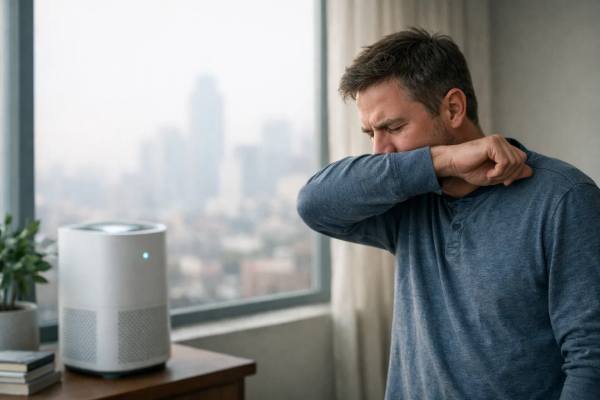
A cough is often blamed on a cold, but air quality can be the hidden driver—especially during wildfire smoke, high-traffic smog, dusty winds, or stale indoor air. Pollution-related cough tends to come from irritation and inflammation along the airways, not from an infection. That distinction matters because the best “treatment” is often environmental: reducing exposure, improving indoor filtration, and adjusting activity until the air clears.
Used wisely, tools like the Air Quality Index, well-fitted particulate respirators, and room filtration can reduce symptoms and lower the chance that a short-lived irritant cough turns into days of airway sensitivity. This article explains what pollutants do to the respiratory tract, how to tell a pollution-triggered cough from other common causes, and what practical steps help most—especially for children, older adults, and people with asthma or chronic lung conditions.
Key Insights
- Pollution-triggered cough often starts or worsens within hours of exposure and may improve noticeably after time indoors with clean air.
- Fine particles (PM2.5) and ozone are common outdoor triggers for throat irritation, cough, chest tightness, and wheezing.
- If you have asthma, chronic lung disease, or heart disease, treat “moderate” air days as potentially symptomatic and plan earlier exposure reduction.
- On poor-air days, reduce outdoor exertion and prioritize clean indoor air (closed windows, effective filtration, and a room purifier sized for the space).
Table of Contents
- How pollution triggers a cough
- Which air pollutants most commonly cause symptoms
- Pollution cough vs cold, allergy, and asthma
- Reading the AQI and what the numbers mean
- What to do on smoky or smoggy days
- Indoor air steps that matter most
- When a pollution-related cough needs urgent care
How pollution triggers a cough
Cough is a protective reflex: it clears mucus, particles, and irritants from the airway. Pollution can “turn up” that reflex in two main ways—direct irritation and inflammatory priming.
Direct irritation and nerve sensitivity
Many pollutants irritate the lining of the nose, throat, and bronchial tubes. That irritation activates sensory nerves that trigger coughing, throat clearing, and a burning or scratchy sensation. People often describe a pollution cough as “dry,” “tickly,” or “tight,” sometimes with a hoarse voice. Unlike a cold, the trigger can be immediate: stepping outdoors into smoke or heavy traffic fumes and feeling the cough begin within minutes to hours.
Inflammation and airway swelling
Fine particles and reactive gases can inflame the airway lining. Inflammation leads to:
- Swelling that narrows the small airways and increases resistance to airflow
- Increased mucus production that can cause a wet cough or frequent throat clearing
- Heightened airway reactivity, making the lungs more sensitive for days after the exposure ends
This is why one bad air day can linger. Even when the air improves, the airway may remain “touchy,” and minor triggers—cold air, exercise, perfume, or laughing—can reawaken the cough.
Why some people react more strongly
Symptoms depend on exposure dose and vulnerability. Higher risk groups include:
- People with asthma, chronic bronchitis, emphysema, or other chronic lung disease
- Children, whose lungs and immune systems are still developing and who breathe more air per body weight
- Older adults, who may have reduced respiratory reserve
- Anyone with recent respiratory infection, because the airway is already inflamed and reactive
A practical rule: if your cough predictably worsens with outdoor exposure and improves with cleaner indoor air, pollution may be a meaningful contributor—even if you also have allergies or a mild viral illness at the same time.
Which air pollutants most commonly cause symptoms
Not all “bad air” is the same. Different pollutants irritate different parts of the respiratory tract, and they peak under different conditions. Knowing the likely culprit helps you time your precautions.
Particle pollution: PM2.5 and PM10
Particulate matter is a mix of tiny solids and liquid droplets. The two labels you see most often refer to size:
- PM10: larger particles (like dust) that tend to affect the upper airways, causing throat irritation, congestion, and cough.
- PM2.5: fine particles that can penetrate deeper into the lungs, strongly linked with cough, wheeze, chest tightness, and exacerbations of asthma and chronic lung disease.
Wildfire smoke is heavily PM2.5-driven. So are many winter inversions and some urban pollution episodes. Indoors, PM can rise from cooking, burning candles or incense, fireplaces, and tobacco or vaping aerosols.
Ozone: the “sunlight smog” irritant
Ground-level ozone is not emitted directly; it forms when sunlight reacts with pollutants from vehicles, industry, and other sources. Ozone is a powerful airway irritant and is well known for causing:
- Dry cough and throat burning
- Chest tightness during exertion
- Shortness of breath that can feel out of proportion to the activity
Ozone often peaks later in the day, particularly on warm, sunny afternoons. People who exercise outdoors may notice symptoms more because faster breathing pulls more ozone deeper into the lungs.
Nitrogen dioxide, sulfur dioxide, and other irritants
Traffic-heavy areas can have higher nitrogen dioxide, which is associated with airway inflammation and can worsen asthma symptoms. Sulfur dioxide, more tied to certain industrial sources, can trigger bronchospasm in susceptible individuals. While you may not track these daily, they often rise alongside broader “bad air” conditions.
Indoor irritants: the overlooked half
Many cough flares blamed on outdoor air actually come from indoor sources layered on top:
- Cooking fumes and fine particles (especially high-heat frying)
- Scented products, cleaning sprays, and volatile chemicals
- Dampness and mold odors that reflect underlying moisture problems
- Poor ventilation that concentrates whatever is produced indoors
If you cough more at home than outside, the solution may be less about the city air and more about how your indoor environment is managed.
Pollution cough vs cold, allergy, and asthma
A pollution-triggered cough can look like other common conditions, and overlaps are frequent. The goal is not to self-diagnose perfectly—it is to spot patterns that guide safer decisions.
Clues that point toward pollution as a main driver
Pollution is more likely when:
- Symptoms begin during or soon after a known exposure (smoke, smog, dust, heavy traffic)
- The cough is worse outdoors and improves after several hours in cleaner indoor air
- You notice throat burning, eye irritation, or a “chemical” feeling in the air
- Multiple people in the same environment develop scratchy throat or cough at the same time
Some people also notice an “after-effect” pattern: the air improves, but cough persists for a few days due to airway sensitivity.
How it differs from a typical viral cold
Colds usually come with a cluster: sore throat that evolves, nasal congestion, fatigue, sometimes fever, and symptoms that last several days regardless of location. A pollution cough may have:
- Less systemic illness (no fever, no body aches)
- More immediate fluctuations based on where you are and what the air is like
- Prominent throat and chest irritation without the classic cold progression
That said, a cold can make you more sensitive to pollution. If you recently had a viral illness, “moderate” air days may suddenly feel much worse than they used to.
How it differs from allergies
Allergies commonly cause sneezing, itchy eyes, watery nasal drainage, and postnasal drip—often with a chronic, seasonal rhythm. Pollution can worsen allergy symptoms, but pollution-driven cough is more likely to include:
- Burning throat or chest tightness
- Symptoms that track with haze or smoke rather than pollen counts
- Less itch and more irritation
If you have both allergies and pollution exposure, your cough may be driven by a mix: postnasal drip plus airway irritation.
How it intersects with asthma
Asthma can present as cough, wheeze, and chest tightness—sometimes without obvious wheeze (“cough-variant asthma”). Pollution can:
- Trigger bronchospasm and airway swelling
- Increase rescue inhaler needs
- Prolong recovery after a flare
If you have asthma, a key red flag is a cough that comes with breathlessness, wheezing, or reduced ability to exercise normally—especially if it worsens at night or wakes you from sleep. In that case, pollution may be the trigger, but asthma management needs attention.
Reading the AQI and what the numbers mean
The Air Quality Index (AQI) is designed for quick decisions. It converts pollution measurements into a scale that runs from low concern to emergency-level conditions. Knowing what the categories mean helps you match precautions to your risk level.
The AQI categories in plain language
While details vary by pollutant, the common AQI bands are:
- 0 to 50 (Good): little to no risk for most people
- 51 to 100 (Moderate): generally acceptable, but unusually sensitive people may notice symptoms
- 101 to 150 (Unhealthy for Sensitive Groups): people with lung disease, children, older adults, and others at higher risk may have symptoms
- 151 to 200 (Unhealthy): symptoms become more common across the general public
- 201 to 300 (Very Unhealthy): health alert level; risk increases for everyone
- 301 and higher (Hazardous): emergency conditions; avoid exposure as much as possible
A subtle but important point: “sensitive groups” includes more people than many assume. If you have asthma, chronic bronchitis, emphysema, recurrent wheezing, or a history of pollution-triggered cough, you likely belong in that category.
Why your personal threshold may be lower
AQI is a population tool. Your symptoms depend on your airway sensitivity and recent history. You might notice cough at AQI 80 when others feel fine, especially if you:
- Recently recovered from a cold
- Have uncontrolled allergies or asthma
- Are exercising outdoors (higher breathing rates increase dose)
- Are exposed repeatedly over several days
If you consistently cough when air is “moderate,” use your body as feedback. It is reasonable to act earlier than the category name suggests.
Timing and location matter as much as the daily number
Air quality changes throughout the day:
- Ozone often peaks in the afternoon
- Traffic pollutants may be higher near roads and during rush hours
- Wildfire smoke can spike unpredictably with wind shifts
- Indoor air can be worse than outdoor air during cooking or poor ventilation
When you are deciding whether to run outdoors or open windows, the best approach is to treat AQI as a starting point, then layer in timing, local conditions, and symptoms.
What to do on smoky or smoggy days
When pollution is triggering cough, the most effective actions are exposure-reduction steps that lower the dose you inhale. Think in layers: change activity, change location, and change the air you breathe.
Outdoor behavior that reduces dose
If air quality is poor:
- Reduce intensity first. Replace vigorous outdoor exercise with light activity or indoor workouts. Heavy breathing increases pollutant dose.
- Shift timing. Choose times when the pollutant is typically lower (often morning for ozone; variable for smoke).
- Choose routes away from traffic. Even short distance from major roads can reduce exposure. Parks and side streets are usually better than roadside sidewalks.
- Shorten exposure windows. Several brief trips may be easier on the airway than a long outdoor stretch.
If you must be outside and particles are high (smoke, dust), a well-fitted particulate respirator can reduce inhaled particle dose. Comfort and fit matter: gaps around the nose or cheeks reduce effectiveness.
At-home strategies during a pollution episode
A simple “clean air routine” often helps more than complicated gadgets:
- Keep windows and doors closed when outdoor air is poor.
- Run air conditioning on recirculation if available and comfortable.
- Use a room air purifier in the room you occupy most (especially the bedroom).
- Avoid adding indoor pollutants: skip candles, incense, smoking, and high-heat frying when possible.
If your cough is already active, give your airway the lowest-irritant environment you can for 24 to 48 hours. Many people notice that once their exposure drops, cough becomes less frequent and less “tickly.”
When symptoms flare despite precautions
Pollution can trigger asthma-like symptoms even in people without a formal diagnosis. If you have a known respiratory condition, follow your clinician’s action plan. If you do not, treat persistent breathlessness, wheeze, or chest tightness as a reason to seek medical evaluation—especially if symptoms are new or worsening.
The goal is not to tough it out. Irritated airways can become more reactive with repeated exposures, and early exposure reduction can shorten the duration of symptoms.
Indoor air steps that matter most
Indoor air is where most people spend the majority of their time, and it is also where you have the most control. The best indoor steps combine filtration with source reduction and sensible ventilation.
Build one “clean air room”
If you are dealing with cough, aim to create a room—often a bedroom—where your airway can recover:
- Use a HEPA or high-efficiency particle purifier sized for the room.
- Keep the door mostly closed while it runs.
- Run it continuously at a speed you can tolerate, especially overnight.
This approach is particularly helpful during wildfire smoke or urban pollution episodes, when outdoor air may be poor for days.
Control indoor particle sources
Even on bad outdoor air days, indoor sources can be the main problem:
- Cooking: use the range hood if it vents outdoors; prefer lower-heat methods when possible during an episode.
- Cleaning: avoid aerosol sprays and heavily scented products if they trigger cough.
- Dust: vacuum with a well-filtered vacuum and consider damp dusting to reduce re-suspension.
- Smoking and vaping: avoid indoor exposure; these are potent cough triggers and can prolong airway irritation.
Use ventilation strategically
Ventilation is powerful when outdoor air is clean, and counterproductive when outdoor air is polluted. A practical strategy is:
- Ventilate with outdoor air when AQI is good and you need fresh air.
- Reduce outdoor air intake when AQI is high, focusing on filtration instead.
If your cough worsens every time you open windows, treat that as a clue: your indoor air may actually be cleaner than outdoor air at that moment.
Do not ignore humidity and dampness
Dampness can drive cough through mold and irritant byproducts, even when you do not see obvious growth. If you notice persistent musty odor, condensation, or recurring damp areas, focus on fixing moisture sources. Filtration can reduce some airborne particles, but moisture problems require direct remediation.
The most reliable indoor plan is not complicated: reduce indoor emissions, filter the air in key rooms, and adjust ventilation based on outdoor conditions.
When a pollution-related cough needs urgent care
Most pollution-triggered cough improves with exposure reduction, rest, and time. But cough can also signal serious respiratory distress, infection, or an asthma flare that needs prompt treatment.
Seek urgent care now for these warning signs
Get urgent evaluation if you have cough plus any of the following:
- Struggling to breathe, gasping, or using extra muscles to breathe
- Trouble speaking full sentences due to breathlessness
- Blue or gray lips or face, confusion, or extreme drowsiness
- Chest pain or pressure, especially if it is persistent or severe
- Rapidly worsening symptoms over hours, not days
These signs suggest a level of respiratory compromise that should not be managed at home.
Contact a clinician soon if symptoms are persistent or escalating
Consider medical evaluation if:
- Cough lasts more than 2 to 3 weeks, even if you suspect an irritant trigger
- You develop wheezing, frequent nighttime cough, or exercise limitation
- You cough up blood, have recurrent fevers, or feel progressively worse
- You need frequent rescue medication (if you have it) or symptoms do not match your usual pattern
A common scenario is a “two-hit” problem: a recent viral illness followed by pollution exposure that prolongs airway sensitivity. Another is previously unrecognized asthma that becomes obvious when air quality worsens.
Special considerations for children and older adults
Children may not describe symptoms clearly. Watch for fast breathing, belly breathing, reduced play, unusual fatigue, poor feeding, or persistent nighttime cough. Older adults may present with less dramatic complaints but can deteriorate quickly if underlying heart or lung disease is present.
If you are unsure, err on the side of evaluation—especially if symptoms interfere with sleep, normal activity, or breathing comfort. A cough that is “just irritation” should steadily improve as exposures drop. If it does not, it deserves a closer look.
References
- WHO global air quality guidelines: particulate matter (PM2.5 and PM10), ozone, nitrogen dioxide, sulfur dioxide and carbon monoxide 2021 (Guideline)
- Air Data Basic Information | US EPA 2025 (Guideline)
- Wildfire Smoke and Your Patients’ Health | US EPA 2026 (Guideline)
- Particulate matter air pollution: effects on the respiratory system – PMC 2025 (Review)
Disclaimer
This article is for general educational purposes and does not provide medical advice, diagnosis, or treatment. Air pollution can trigger cough and other respiratory symptoms, and it can also worsen asthma and chronic lung disease. If you have severe shortness of breath, chest pain, blue or gray lips or face, confusion, or rapidly worsening symptoms, seek urgent medical care immediately. For persistent cough, new wheezing, or symptoms that interfere with sleep or normal activity, consult a qualified healthcare professional for individualized guidance.
If this article helped you, consider sharing it on Facebook, X (formerly Twitter), or any platform you prefer.