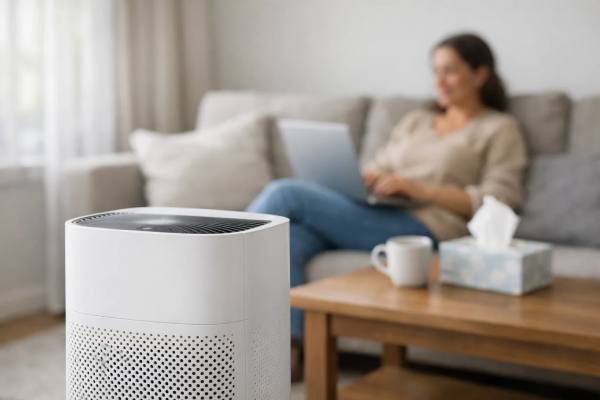
If you are sneezing through spring pollen or dragging yourself through a cold, an air purifier can feel like a simple, practical upgrade: plug it in, breathe easier, sleep better. Sometimes that happens. Often, the reality is more nuanced. Air purifiers are strongest at removing particles you would otherwise inhale—like pollen, pet dander, dust, and smoke. They are far less reliable for gases and odors unless the unit has enough activated carbon, and they do not “sterilize” a room in the way marketing sometimes implies.
Used well, a high-quality purifier can lower exposure in the spaces that matter most (especially bedrooms), which may reduce symptoms and improve comfort. Used poorly—wrong size, wrong placement, noisy settings you cannot tolerate, or features that create irritants—it can become expensive background noise. This guide helps you choose, size, place, and use a purifier with realistic expectations.
Core Points
- A properly sized HEPA purifier can meaningfully reduce airborne pollen, pet dander, and fine dust in the room where it runs.
- For colds, filtration can lower shared-room aerosol build-up, but it cannot replace distance, ventilation, and staying home when sick.
- Avoid devices that intentionally produce ozone or rely heavily on ionization, especially if anyone has asthma or sensitive lungs.
- Choose by clean air delivery rate and room volume, then run it consistently (often continuously) in the rooms where you sleep and spend time.
Table of Contents
- What air purifiers do and do not do
- Allergies and where filters help most
- Colds and what filtration can reduce
- Choosing a purifier for your room
- Whole-home filtration and ventilation upgrades
- Placement and run time and filter care
- Marketing claims and safety red flags
What air purifiers do and do not do
An air purifier is best understood as a particle-removal tool for a specific space. It pulls room air through a filter, captures particles, and returns cleaner air to the same room. If the purifier is appropriately sized and actually runs long enough, the concentration of airborne particles drops—often noticeably for people who react to pollen, pet dander, fine dust, and smoke.
What air purifiers reliably help
Most of the “wins” come from reducing particles you inhale:
- Pollen and outdoor allergens that drift in through doors, windows, and on clothing.
- Pet dander and allergen-carrying particles that remain airborne after pets move around.
- Fine dust and smoke particles, including those that can irritate the throat and trigger coughing.
- Some mold spores (the airborne portion), though filtration does not fix moisture problems.
A high-efficiency filter can also improve how the room feels: less throat scratchiness, fewer morning sneezes, and less “stuffy” irritation—especially when the purifier runs overnight in a closed bedroom.
What air purifiers do not reliably help
Purifiers have limits that matter for expectations:
- They do not remove what is not airborne. Dust mites in bedding, allergens in carpets, and dander embedded in upholstery still need cleaning, laundering, and source control.
- They do not remove all gases and odors unless the unit has a substantial amount of activated carbon and enough contact time. Thin carbon sheets help a little, but they are not a strong solution for many household gases.
- They do not prevent infection on their own. For colds, a purifier may reduce room-wide aerosol build-up, but it cannot eliminate close-range exposure when you are face-to-face with someone who is sick.
- They are room-limited. One purifier in a hallway rarely fixes air quality in closed bedrooms. Air has to cycle through the filter to benefit.
Think of purification as a “cleaner air faucet” running in the background. The benefits scale with (1) how much clean air the unit delivers, (2) how well the room air mixes, and (3) how continuously you run it. If you buy a powerful unit but run it on the lowest setting because it is loud, you may get less filtration than you expected. If you buy a quiet unit that is too small, it may never catch up.
Allergies and where filters help most
Allergies are not just about what is “in the air” in a general sense—they are about dose and timing. Many people breathe the highest proportion of their daily indoor air in two places: the bedroom and a main living area. A purifier is most helpful when it lowers exposure where your body is most reactive, especially during sleep.
Symptoms most likely to improve
Filtration tends to help when symptoms are driven by inhaled particles:
- Frequent sneezing or runny nose that flares indoors.
- Itchy, watery eyes that worsen after pets are in the room.
- Nighttime cough that correlates with dust, pollen season, or smoke exposure.
- Asthma that worsens with indoor particulate triggers (with medical guidance for treatment).
Results are often modest but meaningful: fewer awakenings, less morning congestion, less irritation. Do not expect an immediate “switch flip” unless your trigger is strongly airborne and the purifier is powerful for the room.
Where a purifier matters most
- The bedroom (first priority). Aim to keep this room a cleaner-air refuge. If your allergies disturb sleep, this is usually the best return on effort.
- The main daytime room (second priority). If you work from home or spend long stretches in one area, this is where sustained filtration can help.
- A child’s room (special case). Consistent overnight filtration can be helpful for children with allergic rhinitis or asthma triggers, but safety features and noise tolerance matter.
Pair filtration with high-impact allergen control
A purifier works best when paired with a few targeted steps that reduce the amount of allergen entering the air:
- Bedding control: wash sheets in hot water as tolerated for fabric, and dry thoroughly; use allergen-reducing covers if dust mites are a major trigger.
- Pet strategy: keep pets out of the bedroom if possible; if not, at least keep them off the bed and launder bedding more often.
- Vacuuming: use a vacuum with a sealed system and high-efficiency filtration; vacuuming can temporarily stir allergens, so running the purifier on high during and after cleaning helps.
- Humidity discipline: keep indoor humidity in a middle range (often roughly 30 to 50 percent) to discourage dust mites and mold growth; very high humidity increases risk of mold and mite proliferation.
A key nuance: a purifier is best at reducing what is already airborne. For dust mite allergy, the main reservoir is usually bedding and fabrics. For pet allergy, the trigger can be both reservoir-based and airborne. For seasonal pollen, a purifier can be especially helpful because pollen constantly enters from outdoors and becomes airborne again when you move around the house.
Colds and what filtration can reduce
Colds spread through a mix of routes: close-range droplets, short-range aerosols, and contaminated hands touching the nose or eyes. Filtration is most relevant to the shared-air portion—tiny particles that can linger and accumulate in a room, especially when ventilation is limited.
Where purifiers can help during a cold
A purifier is most useful when:
- A sick person is resting in a bedroom and you want to reduce lingering aerosols in that space.
- Multiple people share a living room, carpool-like indoor environment, or small office during peak respiratory season.
- Ventilation is limited (cold weather, poor outdoor air quality, or building constraints), and you want an additional layer that reduces particle concentration over time.
In these scenarios, a well-sized purifier can reduce the average concentration of airborne particles in the room. That can matter for risk over hours of shared air.
Where purifiers help less than people expect
Filtration is not a shield in the “near field,” meaning when you are close enough to share the same exhaled plume before it mixes into the room air:
- Sitting face-to-face on a couch, eating at a table, or talking at close range.
- Caring for a sick child at bedside.
- Crowded gatherings where people are shoulder-to-shoulder.
In those moments, what matters most is distance, time, and source control. A purifier is a background reducer, not a close-contact replacement for staying home when sick, spacing out, improving ventilation, and using masks when appropriate.
A practical way to use filtration during illness at home
If a cold is moving through a household, a simple “layered” plan often works better than relying on any single measure:
- Isolate the air when possible: have the sick person rest in one room with the door mostly closed.
- Add clean air to that room: run a properly sized purifier continuously, ideally at a setting that achieves meaningful air turnover.
- Ventilate strategically: short bursts of outdoor air (when conditions allow) can quickly dilute indoor air.
- Reduce close exposure: limit long, close conversations indoors; prioritize quick check-ins and practical caregiving.
- Keep surfaces and hands in the plan: hand hygiene and not sharing cups, utensils, and towels remain important.
A purifier is most likely to help when it is sized and used to meaningfully increase air turnover. If you run a small unit on low in a large open living area, the effect can be too small to matter. If you run a strong unit in a closed bedroom, the benefit can be more tangible—especially overnight when the same air is shared for many hours.
Choosing a purifier for your room
Choosing well is mostly about matching the machine’s particle-cleaning capacity to your room volume and your noise tolerance. Features matter less than fundamentals.
Start with filter type
For allergies and colds, prioritize:
- True HEPA or high-efficiency mechanical filtration for particles. This is the core technology for pollen, dander, dust, and fine particulate matter.
- A prefilter if you have pets or visible dust; it captures larger debris and helps the main filter last longer.
- Substantial activated carbon only if odors or smoke gases are a main issue; thin carbon layers have limited impact.
Avoid relying on vague terms like “HEPA-type” as your only criterion. Some products use the phrase loosely. Look for clear information about filtration class and replacement filters.
Use clean air delivery rate and room size
A practical sizing shortcut for an 8-foot ceiling is:
- Minimum clean air delivery rate (cubic feet per minute) ≈ 0.65 × room area (square feet).
Examples:
- 150 square feet: aim for at least ~100 cubic feet per minute.
- 300 square feet: aim for at least ~195 cubic feet per minute.
- 500 square feet: aim for at least ~325 cubic feet per minute.
If your ceilings are higher than 8 feet, or if the room is open to other rooms, you generally need a higher capacity unit or multiple units.
For a more precise approach, estimate air turnover:
- Air changes per hour ≈ (clean air delivery rate × 60) ÷ room volume.
- Room volume = area × ceiling height.
Many households do well aiming for roughly 4 to 6 air changes per hour in key rooms when focusing on particles and comfort. If your goal includes reducing shared-room aerosol build-up during respiratory season, higher turnover can be helpful if noise is tolerable.
Noise and real-world use matter
A purifier only helps when it runs. Ask yourself:
- Can I sleep with it on?
- Will I actually run it on a meaningful setting, or will I keep it on the lowest speed forever?
A common pattern is buying a powerful unit and then turning it down because it is disruptive. Sometimes it is better to buy a unit that is slightly oversized but still tolerable at medium speed, so you actually keep it running.
Consider total cost of ownership
Look beyond the purchase price:
- Replacement filter schedule and cost.
- Electricity use if you plan to run continuously.
- Ease of sourcing genuine replacement filters.
A purifier that is affordable to maintain is more likely to be used consistently—and consistency is what produces the sustained exposure reduction that helps symptoms.
Whole-home filtration and ventilation upgrades
Portable purifiers are excellent room tools, but many households get the best results from a two-part approach: portable filtration in the rooms that matter most, plus a sensible upgrade to whole-home airflow and filtration.
Upgrade central filtration when it fits your system
If your home has forced-air heating and cooling, the central filter runs whenever the fan runs. Improving central filtration can reduce circulating particles throughout the home, especially in open floor plans. Practical steps include:
- Use a higher-efficiency HVAC filter compatible with your system (many people consider filters around MERV 13 when systems can handle it).
- Replace filters on schedule; clogged filters reduce airflow and performance.
- Consider running the fan more often during peak allergy season or wildfire smoke events, balancing comfort, humidity, and energy costs.
Higher-efficiency filters can increase airflow resistance. If your system struggles, you may need professional guidance to avoid reducing airflow too much.
Ventilation is still the foundation
Ventilation replaces indoor air with outdoor air (or properly treated supply air), which is a different job than filtration. In practice, you often want both:
- Ventilation helps dilute indoor contaminants, including aerosols and certain gases.
- Filtration helps remove particles, especially when outdoor air is not ideal or when you need an extra layer.
A practical home approach:
- Use kitchen and bathroom exhaust fans as intended.
- When outdoor conditions are good, use brief, intentional window ventilation (cross-ventilation is especially effective).
- When outdoor air quality is poor, rely more on filtration and sealing drafts, and ventilate only as needed.
Humidity control supports both allergies and comfort
Humidity does not “clean” air, but it changes how indoor environments behave:
- Very high humidity can worsen mold risk and dust mite proliferation.
- Very low humidity can increase throat and nasal irritation for some people.
Aim for a balanced indoor humidity level that supports comfort without encouraging mold. If you use a humidifier, keep it clean and avoid over-humidifying—otherwise you can create the very conditions that increase allergens.
How portable and whole-home strategies fit together
- If allergies are the main issue: prioritize the bedroom purifier, then upgrade whole-home filtration if feasible.
- If colds are the main issue: prioritize ventilation strategies and a purifier in shared rooms during illness, plus bedroom purification for the sick person and caregivers.
The best plan is usually the one you can sustain: one well-sized purifier in the bedroom, one sensible central filter upgrade, and a few ventilation habits you can keep year-round.
Placement and run time and filter care
Even a great purifier underperforms if it is placed poorly or run inconsistently. The goal is simple: keep clean air moving through the breathing zone long enough to reduce average exposure.
Placement that improves performance
Use these practical rules:
- Give it breathing room: keep several inches of clearance around air inlets and outlets so airflow is not blocked by walls, furniture, or curtains.
- Keep doors in mind: a purifier mostly cleans the room it is in. If your goal is the bedroom, keep the bedroom door mostly closed while it runs.
- Put it where people are: for allergy relief during sleep, place it in the bedroom, not the hallway. For shared-air reduction, place it in the main room where people gather.
- Avoid creating a draft directly on your face if that irritates your eyes or sinuses; nearby is fine, but comfort matters.
Open-concept spaces are tricky. If air moves freely between kitchen, living, and dining areas, one unit may be insufficient. In that case, either choose a higher capacity unit or use two smaller units positioned to cover the main zones.
Run time and speed that deliver real results
For allergies, the most reliable strategy is continuous operation in the bedroom during the season that triggers symptoms. If that is not realistic, use:
- Higher speed for 30 to 60 minutes before bedtime.
- A tolerable overnight speed that you can sustain.
- Higher speed again after activities that stir particles, like vacuuming or changing bedding.
For colds in a household, consider:
- Continuous operation in the sick room with the door mostly closed.
- Higher speed during caregiving periods and for a period after people leave the room.
The exact schedule depends on your unit, room size, and noise tolerance. The best plan is the one you will actually follow.
Filter care that keeps performance from quietly collapsing
A purifier’s performance declines when filters clog. Build a simple routine:
- Check and clean or replace the prefilter regularly, especially with pets.
- Replace the main filter on the manufacturer’s schedule, sooner if you notice reduced airflow, increased noise, or persistent dust build-up.
- Do not “stretch” filter life far beyond recommendations if symptoms return; it is a common hidden cause of disappointment.
Also think about safety basics:
- Keep cords and units stable so they cannot be tipped by children or pets.
- Avoid placing a purifier where it can pull in lint, hair, or drapes directly into the intake.
Marketing claims and safety red flags
Some purifier features are oversold, and a few can be counterproductive—especially for people with asthma, chronic lung disease, or sensitive airways.
Red-flag technologies for sensitive lungs
Be cautious with devices that:
- Intentionally produce ozone. Ozone is a lung irritant. If a product frames ozone as a “fresh smell” or “air sterilizer,” that is a warning sign.
- Rely heavily on ionization or plasma without clear, credible emissions information. Some technologies can generate ozone or other reactive byproducts.
- Add fragrance or encourage scented “air cleaning.” Fragrance can trigger headaches, irritation, or asthma symptoms for some people.
If anyone in the home has asthma, it is generally safer to stick to straightforward mechanical filtration and avoid features that alter air chemistry.
Ultraviolet and other add-ons
Ultraviolet features are often misunderstood. Ultraviolet can inactivate microbes under the right conditions, but effectiveness depends on exposure time, airflow design, and maintenance. In many consumer devices, the real-world impact is uncertain. If you are buying for allergies and common colds, you usually get more value from:
- Strong mechanical filtration.
- Proper sizing.
- Consistent run time.
When a purifier is not enough
A purifier can reduce exposure, but it cannot diagnose or treat illness. Seek prompt medical evaluation if someone has:
- Shortness of breath, wheezing, chest tightness, or trouble speaking full sentences.
- Blue or gray lips or face, confusion, or signs of severe respiratory distress.
- Persistent high fever, dehydration, or worsening symptoms after initial improvement.
- Severe asthma flare symptoms or frequent need for rescue inhaler beyond the usual pattern.
For allergies, consider professional evaluation if symptoms persist despite good environmental control and appropriate treatment, or if you suspect asthma (recurrent cough, exercise intolerance, wheeze, nighttime symptoms).
A short list of trustworthy purchase criteria
When you want a simple filter-first decision:
- Pick mechanical filtration (HEPA or high-efficiency equivalent).
- Size by clean air delivery rate for your room volume.
- Choose a unit you can tolerate running for long stretches.
- Budget for replacement filters and run it consistently.
This approach is less exciting than bold marketing claims, but it is the path that most reliably improves indoor comfort and reduces exposure.
References
- Guide to Air Cleaners in the Home | US EPA 2025 (Guideline)
- Improving Air Cleanliness | Ventilation | CDC 2024 (Guideline)
- ASHRAE Position Document on Filtration and Air Cleaning 2024 (Position Statement)
- Effect of air filtration on house dust mite, cat and dog allergens and particulate matter in homes 2022 (Study)
- Efficacy of Portable Air Cleaners and Masking for Reducing Indoor Exposure to Simulated Exhaled SARS-CoV-2 Aerosols — United States, 2021 2021 (Study)
Disclaimer
This article is for general educational purposes and is not a substitute for medical advice, diagnosis, or treatment. Air purifiers can reduce airborne particle exposure in a room, but they cannot prevent all infections, eliminate all allergens, or replace appropriate medical care. If you or someone in your home has asthma, chronic lung disease, severe allergy symptoms, or breathing difficulty, seek guidance from a qualified clinician. Seek urgent care immediately for severe shortness of breath, chest pain, confusion, blue or gray lips or face, or any rapidly worsening symptoms.
If you found this article useful, consider sharing it on Facebook, X (formerly Twitter), or any platform you prefer so others can make informed decisions about cleaner indoor air.