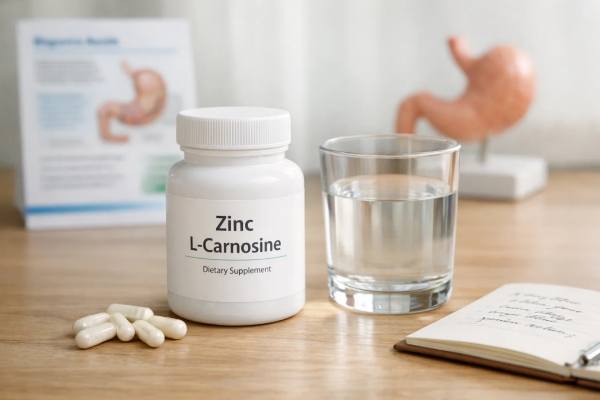
Gastritis can feel deceptively simple—burning, nausea, early fullness—yet it often has several overlapping drivers, from irritation after an NSAID to chronic inflammation linked to H. pylori. Zinc L-carnosine (also called zinc carnosine, and in some countries the medicine polaprezinc) is interesting because it is not an acid blocker. Instead, it is studied as a “mucosal support” compound: it tends to cling to irritated tissue and may help the stomach lining repair itself while calming oxidative stress and inflammation. For some people, that translates into fewer flare days and better tolerance of meals while the underlying cause is addressed. The key is using it with realistic expectations, correct timing, and an honest safety check—especially if you already take zinc, antibiotics, or medicines that interact with minerals.
Essential Insights
- Zinc L-carnosine is studied to support the stomach’s protective lining and may help symptom control while healing occurs.
- It is usually used as an add-on alongside the real “fix,” such as stopping an irritant or treating H. pylori.
- Long-term or high-dose use can contribute to copper deficiency risk, so duration and total zinc intake matter.
- A common trial approach is 75 mg twice daily for 4–8 weeks, taken away from competing minerals and certain medications.
Table of Contents
- What gastritis is and why it flares
- Zinc L-carnosine and polaprezinc explained
- What evidence suggests for gastritis
- Dosing and how to take it well
- Safety, interactions, and who should avoid it
- Building a complete plan and when to seek care
What gastritis is and why it flares
“Gastritis” means inflammation or irritation of the stomach lining. It can be acute (a short, sharp episode) or chronic (smoldering inflammation that comes and goes). People often describe it as burning or gnawing upper-abdominal discomfort, nausea, loss of appetite, early fullness, or a sour, unsettled feeling after meals. Some people mainly notice bloating and belching; others get pain that improves briefly with food and then returns.
The most common real-world drivers tend to fall into a few buckets:
- Infection-related inflammation: Helicobacter pylori is a major cause worldwide. When present, symptom relief often requires eradication therapy rather than supplements alone.
- Medication or chemical irritation: NSAIDs (like ibuprofen or naproxen) and aspirin can weaken protective defenses in the lining. Alcohol can also irritate and disrupt the barrier.
- Reflux and bile exposure: Not everyone with reflux has esophagitis; some have bile or acidic contents that irritate the stomach and upper gut.
- Autoimmune gastritis and nutrient issues: In some people, the immune system targets stomach cells, which can affect B12 and iron status over time.
- Stress, sleep disruption, and diet patterns: These are rarely the single cause, but they can magnify symptoms by changing acid exposure, motility, and sensitivity.
This matters because the best plan usually has two tracks:
- reduce the trigger (infection, NSAIDs, alcohol, certain foods, unmanaged reflux), and
- support healing while symptoms calm down.
Zinc L-carnosine fits into the second track. It is not a diagnosis tool, and it does not replace testing for H. pylori or evaluation for bleeding. Think of it as a potential “lining support” option—most useful when you also address the driver that keeps the lining irritated in the first place.
Zinc L-carnosine and polaprezinc explained
Zinc L-carnosine is a chelated complex of zinc and L-carnosine (a small dipeptide found in muscle and brain). In supplement form, it is often labeled zinc carnosine or zinc-L-carnosine. In some countries it is also available as a prescription or regulated medicine called polaprezinc.
What makes this compound different from “plain zinc” is how it behaves in the stomach:
It tends to localize where tissue is irritated
Research on this class of compound suggests it can adhere to injured mucosa more readily than to healthy tissue. That matters because it may deliver zinc and carnosine right where the stomach lining is trying to repair itself.
It supports repair rather than suppressing acid
Acid blockers reduce acidity; zinc L-carnosine is studied for its potential to:
- support mucus and barrier integrity,
- reduce oxidative stress in irritated tissue,
- modulate inflammatory signaling,
- support cellular repair processes involved in wound healing.
That is why you will sometimes see it discussed alongside “mucosal protectants.” It is not meant to work like an antacid, an alginate raft product, or a proton pump inhibitor.
It is often standardized by weight, not elemental zinc alone
Many products are dosed as 75 mg zinc L-carnosine per capsule. Because the zinc portion is a fraction of the total complex, the elemental zinc per capsule is typically in the mid-teens (often around 16–17 mg), though labels vary. This is important for safety: if you also take a multivitamin, immune “zinc” lozenges, or a standalone zinc product, your total daily zinc can climb faster than you realize.
The practical takeaway: zinc L-carnosine is best thought of as a targeted gastric lining support compound, not a general zinc supplement—and it should be used with attention to total zinc exposure.
What evidence suggests for gastritis
People usually look for zinc L-carnosine because they want fewer flare-ups, less burning, and better comfort with meals. The research landscape is encouraging in some areas, limited in others, and it helps to know where it is strongest.
Where the evidence is most relevant
- Mucosal healing and protection: Studies of polaprezinc and zinc carnosine often focus on healing of gastric or duodenal injury, protection from irritants, and improved quality of mucosal repair. Even if your diagnosis is “gastritis,” the core concept—supporting the barrier and healing irritated tissue—overlaps.
- Adjunct support with H. pylori therapy: Some trials evaluate zinc carnosine or polaprezinc added to eradication regimens. This can matter because ongoing infection keeps inflammation active. If H. pylori is driving symptoms, supplements alone rarely solve the problem.
- NSAID-associated injury patterns: Because NSAIDs can disrupt the lining, a compound studied for mucosal protection may be particularly relevant if your flares line up with anti-inflammatory use (including “just a few pills” during a headache week).
Where expectations should be modest
- Symptom relief can lag behind the cause: If you have ongoing triggers—daily NSAIDs, frequent alcohol, untreated reflux, or H. pylori—you may feel only partial improvement.
- Functional overlap can muddy the picture: Some people with “gastritis-like” symptoms actually have functional dyspepsia, reflux hypersensitivity, delayed gastric emptying, gallbladder issues, or medication side effects. In those cases, zinc L-carnosine may help the lining but not fully address the main driver.
What people often notice in real use
When it helps, improvements are typically described as:
- less burning after meals,
- fewer nausea episodes,
- better tolerance of previously irritating foods,
- calmer mornings and fewer “empty stomach” flares.
A reasonable trial is usually measured in weeks, not days. Many people try it for 4–8 weeks while also addressing triggers and, when appropriate, completing testing or treatment for H. pylori.
Dosing and how to take it well
Dosing works best when it is consistent, limited to a clear trial window, and coordinated with your other supplements and medications.
A common real-world dosing pattern
Many clinical and supplement protocols center on 75 mg twice daily (often written as 150 mg per day of zinc L-carnosine). Some research and clinical contexts use higher total daily amounts, but for most self-directed trials, starting with the common twice-daily approach is more cautious.
A practical way to structure a trial:
- Start: 75 mg once daily for 3–7 days (optional “test phase” if you are sensitive).
- Typical dose: 75 mg twice daily.
- Trial length: 4 weeks, then reassess. If improving, many people continue to 8 weeks.
- Stop or taper: If there is no meaningful improvement by 4–6 weeks, it is reasonable to reconsider the strategy rather than staying on indefinitely.
Timing tips that matter
- Take it away from competing minerals: Calcium, iron, magnesium, and high-dose zinc supplements can compete for absorption. If you take those, separate by about 2 hours when possible.
- Be careful with antibiotics and certain medications: Minerals can bind some antibiotics (notably tetracyclines and quinolones) and reduce absorption. If you are on these medicines, ask a clinician or pharmacist about spacing.
- With food or without food: Many people tolerate it best after a meal or with a small snack, especially if nausea is part of the picture. If you are using it specifically for nighttime symptoms, the second dose is often taken later in the day.
- Track what actually changes: Keep a simple log for 2 weeks: burning severity (0–10), nausea days per week, trigger meals, and sleep quality. This makes the “keep going or stop” decision much clearer.
Quality and label checks
Because products vary, look for:
- the mg per capsule of zinc L-carnosine (not just “zinc”),
- the elemental zinc amount if listed,
- third-party testing or good manufacturing practices statements,
- minimal extra irritants if you are sensitive (some people react to certain fillers).
The goal is a clean, repeatable trial—not a forever supplement.
Safety, interactions, and who should avoid it
Zinc L-carnosine is generally well tolerated for many people, but “safe” still depends on dose, duration, and your health context—especially because zinc is biologically active.
Common side effects
Most side effects, when they occur, are mild and gastrointestinal:
- nausea or stomach upset (often improved by taking with food),
- metallic taste,
- constipation or, less commonly, loose stools.
If symptoms worsen sharply after starting—more pain, vomiting, or new systemic symptoms—stop and reassess. “More is better” rarely holds true for mineral-based supplements.
The zinc and copper balance issue
Higher zinc intake can reduce copper absorption over time. For short trials (for example, 4–8 weeks) at typical doses, many people do fine. The risk rises with:
- long-term daily use without breaks,
- combining zinc L-carnosine with other zinc products,
- already-low copper intake or restrictive diets.
If you plan to use it longer than a short trial, it is reasonable to discuss copper status and monitoring with a clinician—especially if you develop unusual fatigue, low immunity, numbness, or anemia-like symptoms.
Medication and supplement interactions
Consider extra caution or professional guidance if you use:
- tetracycline or quinolone antibiotics (mineral binding can reduce antibiotic absorption),
- penicillamine (binding interactions are possible),
- high-dose iron or calcium (absorption competition),
- multiple supplements that already include zinc (total zinc climbs quickly).
Who should avoid or get medical guidance first
- Pregnancy and breastfeeding: Avoid self-prescribing high or prolonged zinc regimens without clinician input.
- Chronic kidney disease or significant liver disease: Mineral handling can change; get individualized advice.
- Known copper deficiency or unexplained anemia or neuropathy: Zinc can worsen copper deficiency if that is already present.
- Complex medication regimens: If timing is complicated, a pharmacist can help you avoid absorption conflicts.
A helpful safety habit is simple: add up total daily zinc from all sources before you start. If zinc L-carnosine is one piece of a larger supplement routine, it is easy to overshoot without realizing it.
Building a complete plan and when to seek care
Zinc L-carnosine tends to work best when it supports a clear, cause-focused plan. Gastritis is often reversible, but it rarely improves on supplement strategy alone if the driver stays in place.
Build a “two-layer” plan
Layer 1: Remove what keeps the lining irritated
- If you use NSAIDs or aspirin, ask whether you can pause, reduce, switch, or add protective strategies.
- If alcohol is part of your routine, a short 2–4 week break can be an honest test of how much it contributes.
- If reflux is frequent, focus on basics: earlier dinner, smaller late meals, and targeted reflux therapy when appropriate.
- If H. pylori is a possibility, testing matters. Treating it changes the trajectory far more than any supplement.
Layer 2: Support healing and symptom stability
- Zinc L-carnosine as a time-limited trial (often 4–8 weeks).
- A gentler meal pattern during flares: smaller portions, slower eating, and avoiding “stacking” irritants (spicy plus alcohol plus late meal).
- Hydration and sleep support, because symptom sensitivity rises when you are sleep-deprived.
Red flags that should not wait
Seek urgent care (or prompt medical evaluation) if you have:
- vomiting blood, black tarry stools, or signs of bleeding,
- severe, persistent pain (especially if it wakes you from sleep),
- dehydration, fainting, or inability to keep liquids down,
- unexplained weight loss, progressive trouble swallowing, or persistent vomiting,
- new symptoms after age 50–60, or a strong family history of upper gastrointestinal cancers,
- anemia, or symptoms that keep returning despite reasonable treatment.
When to move beyond self-care
If symptoms are present most days for more than 2–4 weeks, or if you need frequent acid suppression to function, it is worth getting a clear diagnosis. Testing for H. pylori, reviewing medications, and checking labs (iron, B12, and sometimes inflammatory markers) can turn a frustrating cycle into a plan with a timeline.
Zinc L-carnosine can be a useful tool—but it shines most when it supports healing while the root cause is identified and addressed.
References
- The role of Zinc L-Carnosine in the prevention and treatment of gastrointestinal mucosal disease in humans: a review. – ScienceDirect 2022 (Review)
- Zinc carnosine-based modified bismuth quadruple therapy vs standard triple therapy for Helicobacter pylori eradication: A randomized controlled study – PMC 2022 (RCT)
- Efficacy and Safety of Polaprezinc-Based Therapy versus the Standard Triple Therapy for Helicobacter pylori Eradication: A Systematic Review and Meta-Analysis of Randomized Controlled Trials – PMC 2022 (Systematic Review)
- Pharmacokinetics and Safety of Polaprezinc Granules Oral Administration in Healthy Chinese Volunteers Under Fasting and Fed Conditions – PMC 2025 (Safety)
- Recent advances on polaprezinc for medical use (Review) – PMC 2021 (Review)
Disclaimer
This article is for general educational purposes and does not provide medical advice, diagnosis, or treatment. Gastritis-like symptoms can overlap with ulcers, gallbladder disease, pancreatitis, infections, medication side effects, and other conditions that require specific care. If you are pregnant, breastfeeding, have kidney or liver disease, take prescription medications, or have red-flag symptoms (such as bleeding, persistent vomiting, severe pain, dehydration, or unexplained weight loss), seek prompt evaluation from a qualified clinician.
If you found this article helpful, consider sharing it on Facebook, X (formerly Twitter), or any platform you prefer so others can use it as a starting point for informed conversations with their healthcare team.