
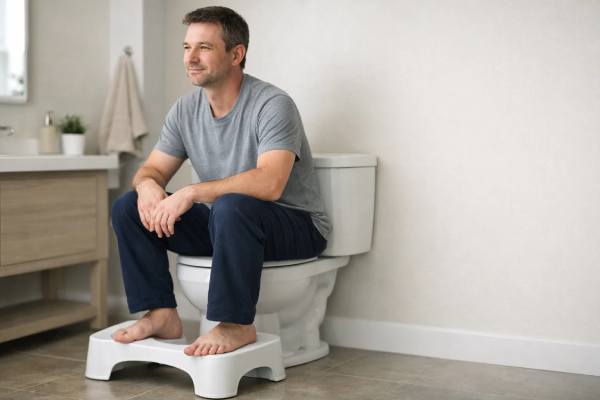
A toilet stool (often called a “Squatty Potty,” after the popular brand) is a simple tool: it lifts your feet while you sit, bringing your knees higher than your hips. That small change can make bowel movements feel smoother for some people, especially if you tend to strain, feel “stuck,” or leave the bathroom with a sense of incomplete emptying. The idea is not that your body suddenly becomes “better at digestion,” but that the mechanics of emptying may work more efficiently when your hips are more flexed and your pelvic floor can relax.
Still, it is not a cure-all. Constipation has multiple causes, and hemorrhoids have multiple triggers. A toilet stool can be a helpful add-on, but it cannot replace foundational habits like adequate fiber, fluids, and sensible bathroom timing—or medical evaluation when symptoms are persistent or concerning.
Essential Insights
- Elevating the feet can reduce straining and make emptying feel easier for some people, especially with mild outlet-type constipation.
- Less straining and less time on the toilet may support hemorrhoid symptom control, but it does not “treat” hemorrhoids on its own.
- Benefits vary widely because constipation is not one condition; posture helps mechanics, not every root cause.
- Avoid use if it worsens hip, knee, or balance problems, and do not delay care for rectal bleeding, severe pain, or sudden bowel changes.
- For a practical trial, use it consistently for 2–3 weeks and track time on the toilet, straining, and the feeling of complete emptying.
Table of Contents
- What a toilet stool changes
- How posture affects bowel emptying
- Does it help constipation
- Does it help hemorrhoids
- Who benefits and who should avoid
- How to use one well
- Choosing an alternative and setting expectations
What a toilet stool changes
A toilet stool is not a laxative, a probiotic, or a detox tool. It is a positioning aid. By lifting your feet, you increase hip flexion and tip your pelvis slightly, which can change how the rectum and anal canal line up during a bowel movement. Many people describe the difference as less “pushing” and more of a natural release.
It may help to understand the real-world goal: a bowel movement that is efficient, not forceful. Straining often shows up as one or more of these patterns:
- You hold your breath and push hard to start or finish.
- You spend a long time waiting for stool to move.
- You feel like you still have stool left after you are done.
- You routinely need multiple trips or repeated attempts.
A toilet stool aims to reduce the effort needed to get started and to finish, which can be especially appealing if you get pelvic pressure, anal discomfort, or a sense of “tightness” when trying to go.
It is also important to set expectations about what it cannot do. If constipation is driven mainly by slow movement of stool through the colon, dehydration, medication side effects, low fiber intake, or an untreated thyroid or neurologic issue, changing posture may not create a dramatic improvement. In those cases, better mechanics can still be helpful, but it is only one part of a bigger plan.
If you want an easy mental model, think of it like changing your posture when lifting a box: you can make the same task safer and less strained, but posture alone cannot make a heavy box weightless. The value is in reducing unnecessary strain and improving comfort, not guaranteeing a perfect bowel movement every time.
How posture affects bowel emptying
A bowel movement depends on coordination. The rectum fills, your nervous system recognizes fullness, the pelvic floor muscles adjust, and the anal sphincters relax at the right moment. When this sequence is smooth, emptying feels straightforward. When it is not, you may feel blocked, rushed, or unable to fully evacuate.
A key player is the pelvic floor, including a sling-like muscle that helps maintain continence by shaping the angle between the rectum and the anal canal. In everyday life, that is useful. During a bowel movement, you want the system to “open” rather than “hold.” Greater hip flexion can encourage a more favorable alignment and may make it easier for the pelvic floor to relax instead of reflexively tightening.
Another factor is pressure management. Many people instinctively bear down by holding their breath and pushing hard. That can increase pressure in the abdomen and the anal canal. A better pattern is often a controlled exhale—creating steady pressure without a forceful, prolonged strain. Positioning can help because when the hips are flexed and the torso is slightly forward, it may be easier to engage the abdominal wall and diaphragm in a more coordinated way.
This is also why a toilet stool sometimes helps people who have “outlet-type” constipation (difficulty evacuating) more than people who have “slow-transit” constipation (stool moves slowly through the colon). If your main challenge is the final step—getting stool out—mechanical changes can matter. If your main challenge is that stool is not arriving in the rectum often enough, the best fix usually focuses on stool consistency, routine, and underlying causes.
A useful takeaway: posture supports the “how” of emptying, not always the “when.” If you rarely feel an urge to go, or if stools are consistently hard and dry, a stool may not be enough on its own. But if you often feel the urge and still struggle to complete the bowel movement comfortably, optimizing posture is a reasonable place to start.
Does it help constipation
It can help constipation for some people, but the most accurate answer is: it depends on what “constipation” means in your body.
Constipation is not only “not going often.” It can include:
- Hard stools that are difficult to pass
- Straining even when stool is present
- A feeling of incomplete emptying
- Needing repeated attempts or extended time on the toilet
- A sense of blockage, tightness, or poor coordination
A toilet stool is most likely to help if your constipation involves straining and incomplete emptying, especially when you already feel the urge to go. In that scenario, stool may be ready to pass, but the mechanics are inefficient. Many people notice that raising the knees makes it easier to start the bowel movement and reduces the “final pushing” at the end.
It is less likely to help as a stand-alone tool if constipation is dominated by:
- Very infrequent urges
- Consistently small, hard, pellet-like stool
- Medication-related constipation (for example, certain pain medicines)
- Long-term slow-transit patterns
- Significant pelvic floor dysfunction that requires targeted therapy
That does not mean it is useless in those situations—only that it should be viewed as supportive, not central.
A practical way to test whether it helps is to run a short, structured trial:
- Use the stool for every bowel movement for 2–3 weeks.
- Set a time limit (for example, leave the toilet after about 5–7 minutes if nothing happens).
- Track a few simple markers: straining level (none, mild, moderate, severe), time spent sitting, and whether you felt fully emptied.
If the stool consistently reduces straining and time on the toilet, it is doing something meaningful. If nothing changes after a consistent trial, you can stop without much downside and shift your focus to stool consistency (fiber, fluids, osmotic agents when appropriate), routine (responding to urge, using the gastrocolic reflex after meals), and medical evaluation if constipation is persistent.
When to seek help sooner rather than later: constipation accompanied by rectal bleeding, unexplained weight loss, new anemia, severe abdominal pain, vomiting, a sudden major change in bowel habits, or symptoms that steadily worsen over weeks instead of improving.
Does it help hemorrhoids
A toilet stool may help with hemorrhoid symptoms indirectly, mainly by addressing two common aggravators: straining and prolonged sitting on the toilet.
Hemorrhoids are swollen vascular cushions in and around the anal canal. They are normal structures, but they can become symptomatic—itching, irritation, bleeding with bowel movements, or a feeling of fullness or swelling—when pressure and friction increase over time. For many people, flare-ups track closely with constipation, repeated straining, and long bathroom sessions.
If elevating your feet makes bowel movements quicker and less forceful, that can be helpful for symptom control. Fewer hard pushes may mean less pressure on sensitive tissue, and a shorter time parked on the toilet may reduce pooling and congestion in the area. In that sense, a toilet stool is best viewed as a pressure-reduction tool, not a hemorrhoid treatment.
It is also important to know what it cannot do. It will not:
- Remove existing hemorrhoids
- Treat a thrombosed external hemorrhoid (a sudden, very painful clot)
- Replace medical care for heavy bleeding, severe pain, or ongoing symptoms
- Fix diarrhea-related irritation (which can also worsen hemorrhoids)
For hemorrhoids, the fundamentals still matter:
- Keep stools soft and easy to pass (often through gradual fiber increases and adequate fluid intake).
- Avoid repeated straining, breath-holding, and “finishing pushes.”
- Limit time on the toilet; scrolling on a phone can quietly turn 3 minutes into 20.
- Use gentle hygiene (pat rather than scrub, avoid irritating wipes or fragrances if they sting).
- Consider warm water soaks for comfort during flares if they feel soothing.
A toilet stool fits into that plan because it targets the moment hemorrhoids often get irritated: the act of passing stool. If you notice less straining and less urgency to push hard, that is a meaningful improvement, even if symptoms do not disappear overnight.
If bleeding is frequent, pain is significant, or symptoms persist despite softer stools and reduced straining, an evaluation is worthwhile to confirm the diagnosis and discuss targeted options.
Who benefits and who should avoid
A toilet stool is most likely to benefit people who have mechanical difficulty emptying rather than people whose constipation is mainly about slow stool movement or poor stool consistency.
People who often find it helpful include:
- Those who strain despite feeling an urge to go
- People who frequently feel incompletely emptied
- Individuals who notice constipation worsens when routines change (travel, stress, schedule shifts) and want a low-effort support tool
- People managing hemorrhoid flares where reducing strain is a priority
- Some postpartum individuals, as long as sitting and hip flexion are comfortable and medically appropriate
It may also be useful as part of a broader plan for pelvic floor coordination, particularly when paired with breathing strategies and relaxation techniques. However, if pelvic floor dysfunction is significant (for example, severe outlet obstruction patterns), professional assessment and targeted therapy may be the main driver of improvement.
Who should be cautious or avoid it:
- Anyone with poor balance, frequent falls, or difficulty safely moving their feet into position
- People with significant hip, knee, or ankle pain that worsens when hips are flexed or feet are elevated
- Those with limited mobility who might struggle to reposition quickly
- Anyone recovering from surgery where hip flexion or straining patterns require specific instructions
- People with severe constipation symptoms suggesting obstruction (for example, inability to pass gas, severe bloating with vomiting, or intense progressive pain)
Safety and comfort matter more than “ideal posture.” A stool that wobbles, slides, or forces an uncomfortable joint angle can create new problems. Practical safety checks:
- Choose a stable design with a non-slip base.
- Keep the stool close enough that you are not reaching with your feet.
- Do not force extreme hip flexion; “knees a bit higher than hips” is a reasonable target.
- Stop if you feel sharp pain, numbness, or worsening pelvic pressure.
If you are unsure whether your symptoms are “routine constipation” or something that needs evaluation, err on the side of getting medical advice—especially with bleeding, significant pain, or a new change in bowel habits.
How to use one well
Using a toilet stool effectively is less about the brand and more about combining position, breathing, and timing.
Set your position
- Place both feet on the stool and let your knees rise above hip level.
- Scoot slightly forward on the seat so your torso can lean forward comfortably.
- Keep your feet supported and your thighs relaxed rather than tense.
A common mistake is perching rigidly and then straining harder because you expect instant results. The goal is to feel grounded and supported.
Use a low-strain breathing pattern
Instead of holding your breath and pushing hard, try this sequence:
- Inhale gently through the nose and let the belly expand slightly.
- Exhale slowly through pursed lips, as if fogging a mirror but gently.
- On the exhale, allow a mild “brace” in the abdomen—steady pressure, not a forceful shove.
If nothing happens within a few breaths, pause and reset. Straining for long stretches tends to backfire by tightening the pelvic floor and irritating hemorrhoids.
Time it with your body’s natural reflexes
Many people empty best after meals, when the colon is naturally more active. If you can, try sitting down when you actually feel an urge, or within 15–30 minutes after breakfast. Do not force long toilet sessions “just in case.”
Adopt a time limit
A practical boundary is about 5–7 minutes. If nothing happens, get up, move around, drink water, and try later. This habit alone often reduces hemorrhoid aggravation because long sitting sessions can increase pressure in the anal area.
Make it part of a complete constipation plan
If stools are hard, posture will only take you so far. Consider pairing the stool with:
- Gradual fiber increases (too fast can cause gas and bloating)
- Adequate fluid intake so fiber can do its job
- Regular movement, even short walks
- Reviewing medications with a clinician if constipation is a side effect
Used this way, a toilet stool becomes a simple “mechanics upgrade” rather than a stand-alone fix.
Choosing an alternative and setting expectations
If you are deciding whether to buy a dedicated toilet stool or improvise, it helps to focus on function: stable foot support that elevates the knees without stressing joints.
Common options
- Dedicated toilet stool: Often curved to fit around the base of the toilet, usually stable and easy to position.
- Simple step stool: Budget-friendly and widely available, but make sure it does not slide and that it fits your bathroom layout.
- Adjustable-height stool: Helpful if multiple people use the same bathroom and need different knee heights.
- Forward-lean “elbows on knees” approach: Some people get benefits from leaning forward with feet flat on the floor, especially if a stool is uncomfortable.
Whatever you choose, prioritize safety: non-slip base, easy cleaning, and a height that does not force pain in the hips or knees.
What success realistically looks like
For many people, success is modest but meaningful:
- Less straining
- Shorter time on the toilet
- Easier “start” to the bowel movement
- Better sense of complete emptying
- Fewer hemorrhoid flare triggers
It is not unusual for improvements to be inconsistent at first. Bowel habits are influenced by sleep, stress, travel, diet changes, hydration, and menstrual cycles. That is why a 2–3 week trial is more informative than a few isolated attempts.
When to move beyond posture
If you have tried a stool consistently and still struggle, consider other next steps rather than doubling down on pushing or spending more time on the toilet. Depending on your pattern, that might include:
- A structured constipation plan focused on stool softness and regularity
- Assessment for pelvic floor coordination issues
- Evaluation for hemorrhoids that need targeted treatment
- Screening for medical contributors when constipation is new, persistent, or worsening
A toilet stool can be a smart, low-risk addition. The best outcomes usually happen when it is paired with a broader approach that respects how complex bowel function really is.
References
- Sitting vs. squatting: a scoping review of toilet postures and associated health outcomes 2025 (Scoping Review)
- Using a footstool does not aid simulated defecation in undifferentiated constipation: A randomized trial 2023 (RCT)
- Symptoms of Hemorrhoids Diminished Significantly or Ceased Completely by Changing from the Sitting to the Squatting Defecation Position 2021 (Comparative Study)
- American Gastroenterological Association-American College of Gastroenterology Clinical Practice Guideline: Pharmacological Management of Chronic Idiopathic Constipation 2023 (Guideline)
- The American Society of Colon and Rectal Surgeons Clinical Practice Guidelines for the Management of Hemorrhoids 2024 (Guideline)
Disclaimer
This article is for educational purposes and does not provide medical advice, diagnosis, or treatment. Constipation and hemorrhoids can have many causes, and the right approach depends on your symptoms, medical history, and medications. Seek prompt medical care if you have significant rectal bleeding, severe or worsening pain, black or tarry stools, fever, unexplained weight loss, persistent vomiting, or a sudden change in bowel habits that does not improve. If you are pregnant, postpartum, recovering from surgery, or managing a chronic condition, ask a qualified clinician for guidance tailored to your situation.
If you found this article helpful, consider sharing it on Facebook, X (formerly Twitter), or any platform you prefer so others can benefit as well.





