
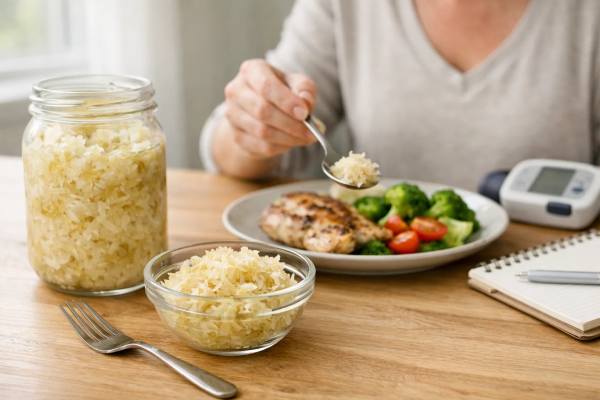
Sauerkraut is more than a tangy topping. When cabbage is fermented with salt, it becomes a living food that can carry lactic-acid bacteria, organic acids, and plant compounds your gut may respond to. For many people, a small daily serving supports digestion simply by adding variety: a little fiber, a little acidity, and (sometimes) a steady trickle of microbes that interact with the gut ecosystem. But “fermented” does not automatically mean “probiotic,” and not all jars contain live cultures. Sodium is the other practical concern—sauerkraut can be surprisingly salty, which matters if you manage blood pressure, kidney disease, or fluid retention.
This guide clarifies what sauerkraut can and cannot do for gut health, how to choose the right kind, and how to use portions that feel helpful rather than overwhelming.
Essential Insights
- Unpasteurized, refrigerated sauerkraut is most likely to contain live cultures, while shelf-stable options are often pasteurized.
- Small servings used consistently (as a condiment) are more tolerable than “gut-health” portions that double as a salt bomb.
- If you are sensitive to histamine or prone to bloating, start with tiny amounts and increase only if symptoms stay calm.
- High sodium is the main limitation; people with hypertension, kidney disease, and heart failure may need stricter portion control.
- A practical starting routine is 1 tablespoon with a meal daily for 1 week, then adjust up or down based on stool comfort and sodium intake.
Table of Contents
- What sauerkraut is and why fermentation changes it
- Probiotics and what live cultures really mean
- Gut health benefits you can realistically expect
- Portion size and how to introduce it gently
- High sodium concerns and who should limit it
- How to choose sauerkraut at the store
- Home fermentation and food safety basics
What sauerkraut is and why fermentation changes it
Sauerkraut is fermented cabbage, traditionally made with just two ingredients: cabbage and salt. That simplicity hides a lot of biology. Salt draws water out of cabbage, creating a brine. In that brine, naturally present lactic-acid bacteria begin converting sugars into lactic acid. As acidity rises, the environment becomes less friendly to spoilage organisms and more supportive of the microbes that thrive in fermented vegetables.
What fermentation does to the food
Fermentation changes cabbage in ways that matter for digestion and tolerance:
- Acidity increases. Lactic acid gives sauerkraut its sharp flavor and helps preserve it. For some people, this acidity can feel soothing (especially with heavy meals); for others, it can aggravate reflux.
- Texture softens. Fermentation partially breaks down plant cell walls, which can make cabbage easier to chew and digest than raw slaw.
- Flavor compounds develop. Fermentation creates complex aromas and tastes that can make small portions satisfying—useful when you want “a little bit” consistently.
- Microbial metabolites appear. Organic acids and other fermentation byproducts may influence the gut environment even when the microbes themselves do not colonize long-term.
Why sauerkraut is not just “pickled cabbage”
People often confuse fermented vegetables with vinegar pickles. Vinegar-pickled cabbage is preserved by added acid, not microbial fermentation. It may be tasty, but it typically does not deliver the same live-culture potential as lacto-fermented sauerkraut. This difference matters most if your goal is microbial exposure rather than just flavor.
The brine matters more than most people think
If the sauerkraut is truly unpasteurized, both the solids and the brine can contain live microbes. That is why “a forkful” and “a spoonful of juice” can feel different for some people: brine is concentrated in salt and acids and can hit the stomach more directly. If you are experimenting for gut comfort, start with the cabbage first and treat the brine like a strong condiment.
Sauerkraut is, at its core, a preserved vegetable. It can support gut health best when you treat it as part of a broader pattern: more plant variety, consistent fiber, and a routine your gut can predict.
Probiotics and what live cultures really mean
Sauerkraut is often marketed as a probiotic food, but it helps to separate three related ideas: fermented foods, live cultures, and probiotics.
Fermented does not automatically mean probiotic
A probiotic is typically defined by two things: the organism is alive at the time of consumption, and it has evidence of a health benefit at a specific dose (often strain-specific). Sauerkraut can contain live bacteria, but it rarely specifies strains or standardized doses on the label. That does not make it useless; it simply means it is more accurate to call many products “fermented” or “containing live cultures” rather than a probiotic supplement equivalent.
Pasteurization is the dividing line
The most important factor for live microbes is whether the product has been heat-treated:
- Unpasteurized, refrigerated “raw” sauerkraut is the most likely to contain live cultures.
- Shelf-stable, jarred sauerkraut is often pasteurized for safety and long storage. Pasteurization greatly reduces or eliminates live bacteria.
This is why two people can eat “sauerkraut” and have completely different experiences. One may be eating a living fermented food; the other may be eating a flavorful preserved vegetable with minimal live culture content.
Even without live microbes, sauerkraut still has “fermentation outputs”
If a product is pasteurized, it may still contain:
- Organic acids (which can influence taste and digestion)
- Plant compounds from cabbage that remain after fermentation
- A small amount of fiber (though portions are usually small)
So, pasteurized sauerkraut can still be a useful food. It just should not be counted on as a reliable source of live microbes.
Why “more bacteria” is not always better
With fermented foods, the question is not only how many microbes are present, but whether your gut tolerates them. People with very sensitive digestion may feel bloated with sudden increases in fermented foods, and people with histamine sensitivity may react to aged or fermented products even in small amounts. For them, the best sauerkraut plan is not “maximize live cultures.” It is “find a calm dose you can repeat.”
If you want a standardized probiotic effect for a specific symptom, a targeted probiotic supplement may be easier to evaluate. If you want food-based variety and gentle microbial exposure, sauerkraut can be a reasonable option—especially when chosen and portioned thoughtfully.
Gut health benefits you can realistically expect
Sauerkraut sits in a helpful middle ground: it is not a medical therapy, but it can be a practical tool for people trying to make their diet more gut-supportive without overcomplicating things.
What the best evidence suggests about fermented foods
Fermented foods as a category have been associated with changes in the gut environment and immune signaling in controlled settings. But the effects vary widely between individuals, and “fermented foods” include many different items with different microbes and different matrices (dairy, vegetables, grains). Sauerkraut is also unique because the serving size is usually modest. That means expectations should be scaled to the dose.
Benefits that are plausible and commonly reported
These are the outcomes people most often notice when sauerkraut fits them:
- Improved meal comfort when a small acidic condiment helps digestion feel “lighter,” especially with higher-protein meals
- More regular bowel patterns when sauerkraut is one part of a broader fiber and plant-variety routine
- Better tolerance of vegetables over time because a small fermented serving encourages consistent exposure and appetite for plant foods
- A “gateway habit” effect where one daily fermented food nudges overall food quality upward (more home meals, more whole foods, fewer ultra-processed snacks)
Some people also notice less bloating over weeks, but that is not guaranteed. Fermented foods can reduce bloating in one person and increase it in another, depending on baseline gut sensitivity and overall diet.
Where sauerkraut is less likely to help
Sauerkraut is not a shortcut for problems that usually require a different strategy:
- Severe constipation that is driven by pelvic floor dysfunction, medication effects, or very low fluid intake
- Active inflammatory bowel disease flares where fiber and acidity may be poorly tolerated
- Persistent diarrhea not clearly linked to diet changes
- Chronic reflux symptoms that worsen with acidic foods
It also is not the best “fiber food.” A tablespoon or two does not deliver enough fiber to replace legumes, whole grains, fruits, or vegetables.
A realistic way to think about outcomes
Sauerkraut tends to work best when you frame it as a small, consistent exposure:
- It may help your gut ecosystem “practice” dealing with fermented inputs.
- It can add flavor and acidity that makes whole foods easier to enjoy.
- It can support dietary variety, which is often the bigger driver of microbiome resilience than any single product.
If you treat sauerkraut as a daily habit that complements the rest of your diet, you are more likely to notice benefits. If you treat it as a stand-alone probiotic treatment, you are more likely to be disappointed.
Portion size and how to introduce it gently
The most common mistake with sauerkraut for gut health is starting with a “health portion” rather than a “tolerance portion.” For many people, the right starting dose is surprisingly small.
A simple portion ladder
Use this progression unless you already tolerate fermented foods well:
- Days 1–4: 1 teaspoon once daily with a meal
- Days 5–10: 1 tablespoon once daily with a meal
- Weeks 2–3: 2 tablespoons daily, or 1 tablespoon twice daily
- Week 4 and beyond: 2–4 tablespoons daily as desired and tolerated
Many people do well in the 1–2 tablespoon range long-term because it delivers flavor and (sometimes) live culture exposure without overwhelming sodium intake.
Best timing and pairing for comfort
Sauerkraut is usually easiest on the gut when you:
- Eat it with a meal, not on an empty stomach
- Pair it with simple carbs and protein (rice, potatoes, eggs, lean meats, tofu)
- Use it as a condiment, not a base vegetable
If you experience bloating, try reducing other fermentable foods at the same meal (large beans, huge raw salads, big servings of onions and garlic) so you can test sauerkraut without stacking fermentation triggers.
What to do if you get gas or loose stool
Treat symptoms as information rather than a sign you “cannot tolerate” sauerkraut forever:
- Gas and bloating: reduce to the last comfortable dose and hold for 7 days before trying again
- Loose stool: use smaller portions, avoid the brine, and take it with more solid food
- Cramping: stop for a week, then consider reintroducing at a teaspoon level only if symptoms settle
If symptoms are significant, do not keep escalating. Fermented foods should feel like a gentle addition, not an endurance test.
Special situations: histamine and sensitive guts
Fermented foods can be problematic for people with suspected histamine intolerance (flushing, headaches, hives, or rapid GI symptoms after fermented foods). If that is your pattern, sauerkraut may still be possible, but portions often need to stay very small, and some people do better avoiding it entirely.
If you have IBS, consider a cautious approach: use very small portions, avoid large servings of cabbage-based foods on the same day, and track symptoms across multiple exposures rather than judging from a single meal.
The goal is a repeatable dose that fits your body and your sodium budget. Consistency is the lever that matters most.
High sodium concerns and who should limit it
Sauerkraut’s biggest drawback is also part of how it is made: salt is essential for fermentation and safety. The result is a food that can deliver a meaningful amount of sodium in a small volume.
How salty is sauerkraut, practically
Sodium varies widely by brand and recipe, but many products land roughly in this range:
- About 200–450 mg sodium per 2 tablespoons
- About 400–900 mg sodium per 1/4 cup
That means a “generous bowl” can quietly become a large portion of a day’s sodium target. If you are already eating processed foods, sauces, deli meats, or salty snacks, sauerkraut can push totals higher than you realize.
Who should be especially cautious
Portion discipline matters most if you have:
- Hypertension or a strong family history of high blood pressure
- Chronic kidney disease (or you are advised to limit sodium or potassium)
- Heart failure, liver disease with fluid retention, or significant edema
- A medical plan that includes sodium restriction or diuretics
- Migraine patterns that are sensitive to sodium swings
Also be careful if you are using lower-sodium salt substitutes that contain potassium. Those products can be helpful for some people, but they are not appropriate for everyone, especially certain kidney conditions and medication regimens.
Ways to reduce sodium without abandoning sauerkraut
If you want the habit without the salt load:
- Use sauerkraut as a condiment: 1 tablespoon can still deliver flavor and routine.
- Drain rather than drink the brine: brine is concentrated in salt and acids.
- Pair with potassium-rich whole foods: foods like potatoes, beans, and fruits can support overall dietary balance, but follow your clinician’s advice if potassium is restricted for you.
- Avoid heating it if you want live cultures: heat may reduce live microbes, so add it after cooking rather than simmering it in a dish.
- Choose lower-sodium products when available: label comparisons can cut sodium dramatically.
Rinsing can remove some salt, but it also removes acids and some microbes. If you rinse, keep it brief and view it as a sodium-focused strategy rather than a probiotic-maximizing one.
A realistic “sodium-aware” target
If you are sodium-sensitive, a practical ceiling is often 1–2 tablespoons per day, especially on days when the rest of your diet is not intentionally low sodium. If you are not sodium-sensitive and your overall diet is low in processed foods, you may tolerate larger portions—but it still pays to check labels and keep the habit measured rather than mindless.
How to choose sauerkraut at the store
Choosing sauerkraut for gut health is less about the fanciest label and more about three basics: live cultures, ingredient quality, and sodium.
Step one: decide whether you want live cultures
If your goal includes microbial exposure, look for cues such as:
- Refrigerated placement (often a better sign than shelf-stable)
- “Raw” or “unpasteurized” wording
- “Contains live cultures” wording
If the jar is shelf-stable and marketed like a pantry staple, it may be pasteurized. Pasteurized sauerkraut can still be a useful food, but it is less likely to function as a live-culture source.
Step two: read the ingredient list like a minimalist
A simple ingredient list is often a good sign. Many traditional versions contain:
- Cabbage
- Salt
Some products include spices (caraway, garlic, juniper) or other vegetables. That is not inherently bad, but it can change tolerance. If you are sensitive, start with plain versions first, then branch out.
Avoid confusing “vinegar-pickled” cabbage with fermented sauerkraut if your goal is fermentation. Vinegar versions may list vinegar high on the ingredient list and may not be fermented in the traditional sense.
Step three: compare sodium by the serving size you will actually eat
Sodium labels can be misleading if the serving size is unrealistically small. Do the math in your head:
- If you plan to eat 1/4 cup, check sodium per 1/4 cup, not per tablespoon.
- If you plan to eat 1–2 tablespoons, choose a product that stays reasonable at that amount.
If you are using sauerkraut daily, sodium is not a detail—it is a core selection criterion.
Freshness and texture clues that matter
With unpasteurized products, fermentation continues slowly in the fridge. Flavor can become more sour over time. That is normal. However, you should avoid products that smell rotten, appear slimy, or show visible mold.
Also remember that “more sour” is not automatically “more probiotic.” Sourness mostly reflects acidity, not guaranteed microbe counts.
Comparable alternatives if sauerkraut does not fit you
If sodium, histamine sensitivity, or cabbage intolerance gets in the way, you can still pursue fermented-food benefits through other options, such as yogurt or kefir (if tolerated), or other fermented vegetables with lower sodium per typical serving. The goal is not loyalty to sauerkraut. The goal is a fermented-food routine that your body accepts.
Home fermentation and food safety basics
Making sauerkraut at home can lower cost and improve control over texture and sourness, but it does not automatically make it low sodium. Salt is still central to safe fermentation. The advantage of home fermentation is consistency and transparency: you know exactly what went in, and you can standardize your process.
A simple, reliable method
A common approach is to use salt as a percentage of cabbage weight:
- Weigh shredded cabbage.
- Add about 2 percent salt by weight (for example, 20 g salt per 1,000 g cabbage).
- Massage until brine forms, then pack tightly into a clean jar so cabbage stays submerged.
Submersion matters. Cabbage exposed to air is where mold is most likely to grow. Many people use a fermentation weight or a smaller jar filled with water to keep cabbage below the brine line.
Timing, temperature, and taste
Fermentation speed depends on temperature:
- Warmer rooms ferment faster and can taste sharper sooner.
- Cooler rooms ferment slower and may taste cleaner and less aggressive.
A practical window is 3–14 days, tasting periodically once fermentation is clearly active. When it tastes pleasantly sour and smells clean (tangy, not rotten), move it to refrigeration to slow the process.
What is normal and what is not
Normal signs:
- Bubbles, fizzing, and a pleasantly sour smell
- Cloudy brine (often normal)
- A white film on the surface that does not look fuzzy (often a harmless yeast layer)
Concerning signs where discarding is the safer choice:
- Fuzzy mold growth, especially if it spreads below the brine line
- Pink coloration or slimy texture
- A rotten, putrid smell rather than a clean sour scent
When in doubt, choose safety over salvage.
Who should be cautious with home-fermented foods
People who are severely immunocompromised, have complex medical conditions, or are advised to avoid higher-risk foods should discuss home-fermented foods with a clinician. While fermented vegetables are generally considered safe when properly made, individual risk tolerance varies, and medical context matters.
Home sauerkraut is best approached as a repeatable craft: clean tools, measured salt, full submersion, and patience. Done well, it gives you a consistent product you can portion accurately for both gut comfort and sodium control.
References
- The impact of regular sauerkraut consumption on the human gut microbiota: a crossover intervention trial 2025 (Crossover Trial). ([PMC][1])
- Gut Microbiota-Targeted Diets Modulate Human Immune Status 2021 (Randomized Trial). ([PMC][2])
- Fermented foods, their microbiome and its potential in boosting human health 2024 (Review). ([PMC][3])
- Sodium reduction 2025 (Fact Sheet). ([World Health Organization][4])
- Use of lower-sodium salt substitutes: WHO guideline 2025 (Guideline). ([World Health Organization][5])
Disclaimer
This article is for educational purposes and does not provide medical advice, diagnosis, or treatment. Fermented foods can affect people differently, and sauerkraut may worsen symptoms for some individuals, especially those with reflux, IBS flares, suspected histamine intolerance, or conditions requiring sodium restriction. If you have hypertension, chronic kidney disease, heart failure, liver disease with fluid retention, are taking prescription medications that affect fluid or electrolytes, or you develop concerning symptoms such as severe or persistent abdominal pain, vomiting, blood in stool, black stools, fever, unintended weight loss, or ongoing diarrhea or constipation, consult a licensed clinician before changing your diet.
If you found this guide helpful, please consider sharing it on Facebook, X (formerly Twitter), or any platform you prefer.





