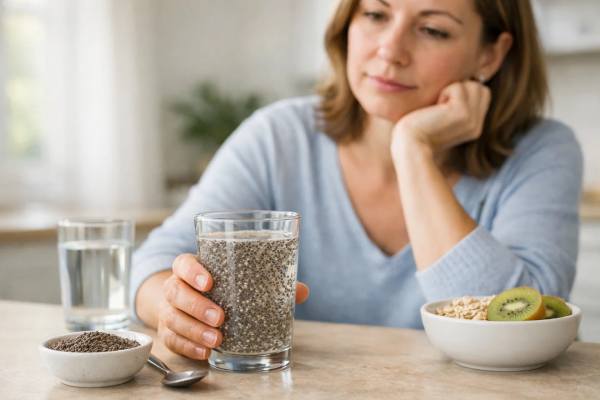
The “internal shower” drink—chia seeds mixed into water (often with lemon)—has become a popular at-home fix for constipation. The appeal is understandable: chia forms a gel when hydrated, and that gel can add bulk, soften stool, and make bowel movements easier for some people, especially when low fiber and low fluid intake are part of the problem. But chia seed water is not a detox, and it is not risk-free if used incorrectly. Dry chia can swell after swallowing, and a sudden jump in fiber without enough fluid can backfire with bloating or even worse constipation. The smartest approach is to treat chia water as a fiber tool—useful in the right person, prepared the right way, and replaced or combined with better-tested options when needed. This guide explains what the drink can and cannot do, how to use it safely, what side effects to watch for, and which alternatives are more predictable.
Essential Insights on Chia Seed Water
- Hydrated chia can soften stools and improve regularity when constipation is related to low fiber intake and mild dehydration.
- Benefits are usually gradual, showing up over several days as stool consistency changes rather than as an instant “clean out.”
- Dry chia or poorly hydrated chia can pose a choking or blockage risk, especially for people with swallowing or intestinal narrowing issues.
- Start with a small dose, soak until fully gelled, and pair it with extra water to reduce bloating and constipation rebound.
Table of Contents
- What the internal shower drink is
- How chia seed water may help constipation
- How to make and use it safely
- Side effects interactions and who should avoid
- Safer alternatives with stronger evidence
- When to seek care for constipation
What the internal shower drink is
The “internal shower” drink is usually a simple mix: chia seeds stirred into water (sometimes with lemon juice), left to thicken, then consumed as a gel-like beverage. The defining feature is chia’s mucilage—a soluble-fiber-rich coating that absorbs water and forms a slippery gel. That gel is why chia is often described as “sweeping” the gut, but the more accurate description is less dramatic and more useful: it changes stool texture and movement by holding water and adding bulk.
Constipation is not just “not going.” Many people meet constipation criteria even if they have bowel movements most days. Common patterns include:
- Hard, dry stools (often Bristol types 1–2)
- Straining, prolonged time on the toilet, or a feeling of incomplete emptying
- Fewer than three bowel movements per week
- A sense that stool “stalls” or requires tricks (suppositories, manual help)
Chia water may help most when constipation is driven by low fiber intake, low fluid intake, irregular meals, travel, or a sedentary period. It is less likely to solve constipation caused by:
- Pelvic floor coordination problems (difficulty relaxing the pelvic floor to evacuate)
- Medication side effects (opioids, certain antidepressants, iron supplements, some blood pressure medicines)
- Significant slow-transit constipation
- Structural issues (strictures, tumors, severe hemorrhoids causing avoidance, prolapse)
One more important clarification: this drink is widely marketed as a “detox.” Your liver and kidneys already handle detoxification continuously. If you feel “cleaner” after chia water, it is usually because your bowel movements are easier and your abdomen feels less heavy, not because toxins were pulled out of your blood.
Used well, chia seed water is simply a hydrated soluble fiber supplement in food form—helpful for some, not magic for everyone, and safest when treated like a fiber intervention rather than a challenge or cleanse.
How chia seed water may help constipation
Chia seed water can support constipation relief through a few predictable mechanisms that overlap with other fiber-based strategies.
1) It increases stool water and softness
Soluble fiber holds onto water. When there is enough fluid in the mix—and enough fluid in your day—stools tend to be softer, easier to pass, and less likely to “scratch” the anal canal (a common trigger for fissures and hemorrhoid pain).
2) It adds bulk and supports motility
Fiber increases stool volume. For many people, a larger, softer stool stimulates the colon to contract more effectively, improving the urge to go and reducing the “nothing happens” feeling.
3) It may reduce straining by improving lubrication
The gel texture can make stool feel less dry and less resistant, especially when constipation is mild to moderate. That can be meaningful if your main complaint is straining, not just frequency.
What to expect in real life
For most people, the benefit looks like better stool form first, then more consistent timing. It is common to notice:
- Less “rabbit pellet” stool over 2–4 days
- Easier passing and less straining within a week
- More predictable bowel habits over 2–4 weeks if used consistently
If someone expects an immediate purge, they often overdo the dose, get bloated, and decide it “didn’t work.” Fiber is usually a slow win.
Who tends to benefit most
- People eating well below typical fiber targets
- People who routinely under-hydrate
- People with hard stools and straining as the main issue
- People who are consistent (daily habits matter more than heroic single doses)
Who may feel worse
- People with significant bloating, abdominal pain, or IBS-type sensitivity to fiber
- People whose constipation is mainly pelvic floor dysfunction (they may produce stool but cannot evacuate efficiently)
- People with suspected narrowing of the digestive tract (where bulky fiber can worsen blockage risk)
A practical way to decide whether chia water is worth a trial is to ask: “Is my stool hard and dry most days?” If yes, a carefully dosed, well-hydrated fiber approach is reasonable. If not—especially if stools are already soft but hard to pass—other strategies (toileting mechanics, pelvic floor therapy, or different medications) may be more effective than adding more bulk.
How to make and use it safely
The safety and comfort of chia seed water depend less on the ingredient and more on hydration, dose, and pacing. The goal is a fully gelled mixture that goes down smoothly and does not steal fluid from your gut.
A safer basic recipe (single serving)
- Add 1 teaspoon chia seeds to 250–300 mL (about 1 cup) water.
- Stir well, wait 2 minutes, stir again (this prevents clumping).
- Let it sit at least 15–30 minutes until it thickens evenly.
- Drink it, then follow with an extra glass of water if you can tolerate it.
After 3–4 days, if you are comfortable and not bloated, you can increase to 1 tablespoon daily. Many people do well at 1 tablespoon per day; jumping to 2 tablespoons immediately is a common reason for gas and cramps.
Timing that tends to work
- Morning works well for some because it pairs with natural colon activity after waking and breakfast.
- Others prefer mid-day to avoid evening bloating or nighttime bathroom trips.
- Consistency matters more than the exact hour.
How long to trial it
- Give it 7–14 days before judging, unless side effects make you stop sooner.
- If nothing changes by two weeks—no stool softening, no reduced straining—chia water may not match your constipation pattern.
Medication spacing
Because gel-forming fiber can trap or delay absorption of some medicines and supplements, a conservative habit is to separate chia water from oral medications by at least 1–2 hours unless your clinician tells you otherwise. This matters especially for medicines where timing is critical.
Ways to make it easier to tolerate
- Start low and increase slowly (your gut bacteria need time to adapt).
- If you bloat, reduce the dose and keep it gelled and well diluted.
- Consider mixing gelled chia into food (yogurt, oatmeal, smoothie) rather than drinking it thick, especially if texture is a barrier.
- Keep your overall fluid intake steady; fiber works best when it has water available.
One rule that prevents most problems
Never swallow dry chia seeds “followed by water” as a shortcut. Hydrate first, then consume. If you ever feel the drink “sitting” in your throat, stop and do not force more down.
Side effects interactions and who should avoid
Chia seed water is generally well tolerated when fully hydrated and introduced gradually, but the side effects are real—and they usually come from doing “too much, too fast” or using chia in the wrong person.
Common side effects (usually dose-related)
- Bloating and visible abdominal distension
- Gas and cramping
- Looser stools or urgency if you overshoot your fiber tolerance
- A temporary feeling of fullness that can reduce appetite
These effects often improve when you reduce the dose, increase water, and give your gut 1–2 weeks to adapt.
The most important safety risk: swelling after swallowing
Chia can expand dramatically in liquid. If seeds are swallowed dry or only partially hydrated, they can swell after ingestion and create a choking hazard or blockage risk. This is especially important for people with:
- Difficulty swallowing (dysphagia), prior food impactions, or known esophageal strictures
- Conditions that narrow the intestinal lumen (for example, Crohn’s disease with strictures or prior obstruction history)
- Severe constipation with suspected impaction (a large fiber bolus can worsen symptoms)
If you have known narrowing or recurrent obstruction symptoms (worsening crampy pain, vomiting, inability to pass gas), avoid bulky fiber experiments and seek medical guidance.
Potential interactions and special situations
- Medications and supplements: gel-forming fiber can interfere with absorption for some people, so spacing from oral meds is prudent.
- Fluid restrictions: if you have heart failure, advanced kidney disease, or another condition requiring limited fluids, fiber drinks can be tricky; discuss dosing and fluid goals with your clinician.
- Blood sugar and blood pressure: high-fiber foods can modestly affect glucose and, in some cases, blood pressure. This is usually beneficial but can matter if you are prone to low blood pressure or tightly managed diabetes.
- Allergy: rare, but stop if you develop hives, swelling, wheezing, or persistent itching after ingestion.
Signs you should stop and get evaluated
- Trouble swallowing, drooling, or inability to swallow liquids
- Severe abdominal pain, vomiting, fever, or a rigid abdomen
- Blood in stool that is new or heavy
- Constipation that worsens sharply after starting fiber, especially with increasing pain
A safe bottom line: chia seed water is not a good fit for everyone. If your constipation is complicated, painful, or paired with alarm symptoms, it is better to use predictable treatments and get assessed than to escalate fiber on your own.
Safer alternatives with stronger evidence
If chia seed water helps a little but not enough—or if you want a more predictable plan—several constipation approaches have stronger clinical track records. The best alternative depends on whether your main problem is hard stool, slow movement, or difficulty evacuating.
Food-based options that often work well
- Prunes or prune juice: prunes combine fiber with naturally occurring sorbitol, which draws water into the bowel. A common starting point is 4–6 prunes daily (or a small glass of prune juice), adjusting to tolerance.
- Kiwifruit: many people notice improved stool frequency and comfort with 2 kiwifruits per day, often within 1–2 weeks.
- Psyllium husk: a gel-forming fiber with strong evidence. Start with 1 teaspoon daily, then gradually increase. Always take it with plenty of water and avoid it if you have swallowing problems or suspected narrowing.
- Ground flaxseed: typically 1 tablespoon daily, increased slowly, can improve stool softness and regularity for some.
Over-the-counter options with predictable dosing
- Polyethylene glycol (PEG): a widely used osmotic laxative that draws water into the stool. Many adults use a standard daily dose and adjust based on stool consistency. It often works within 1–3 days and is commonly used for longer periods under guidance.
- Magnesium oxide or magnesium hydroxide: can help by pulling water into the colon, but should be used cautiously in people with kidney disease and should not be treated as an unlimited daily habit.
- Stimulant laxatives (senna, bisacodyl): useful for short-term rescue when you are backed up, but not ideal as an everyday solution without clinician input.
When the issue is evacuation, not stool texture
If you produce stool but feel blocked, spend a long time on the toilet, or rely on unusual maneuvers, consider strategies that address mechanics:
- Toileting posture: feet elevated (small stool under feet), leaning forward, relaxed belly breathing.
- A predictable window: try 10 minutes after breakfast or coffee (a natural trigger for the colon).
- Pelvic floor evaluation: pelvic floor physical therapy and biofeedback can be transformative when dyssynergia is the driver.
A simple “choose-your-next-step” guide
- Hard, dry stool: prioritize hydration + gel-forming fiber (psyllium or cautious chia) or PEG.
- Infrequent urges and sluggish movement: consider PEG and lifestyle support; discuss prescription options if persistent.
- Soft stool but difficult to pass: consider pelvic floor assessment rather than adding more fiber.
Chia water can be one tool, but it should not crowd out better-tested, more controllable options when symptoms persist.
When to seek care for constipation
Most constipation is benign and responds to habit changes, fiber, and appropriate laxatives. The risk comes from assuming every pattern is “normal” and delaying evaluation when warning signs appear.
Seek prompt medical evaluation if you have
- New constipation after age 50, especially if it persists
- Blood in the stool, black stools, or unexplained anemia
- Unintentional weight loss, persistent fever, or night sweats
- Severe abdominal pain, vomiting, or inability to pass gas
- A sudden change in bowel habits that does not improve within 2–3 weeks
- A personal or strong family history of colorectal cancer, inflammatory bowel disease, or celiac disease
- Constipation during pregnancy that is severe or paired with pain, bleeding, or dehydration
Common contributors worth checking
Constipation often has more than one driver. A clinician may review:
- Medication list (opioids, iron, anticholinergics, calcium channel blockers, some antacids, some antidepressants)
- Thyroid status and metabolic issues
- Diet patterns (low fiber, irregular meals, low fluid intake)
- Activity level, sleep disruption, and stress
- Pelvic floor symptoms (incomplete emptying, straining, “stuck” sensation)
What evaluation can look like
Depending on your history, evaluation may involve:
- Basic blood work (anemia, thyroid function, electrolytes)
- Stool testing if there is concern for inflammation or bleeding
- Colonoscopy based on age, symptoms, family history, and screening status
- Specialized testing for chronic refractory constipation (transit studies, anorectal manometry) when pelvic floor dysfunction is suspected
A realistic home plan before your appointment
If you are stable and without red flags, a short structured trial can clarify what helps:
- Choose one main approach (for example, psyllium or PEG) and use it consistently for 2 weeks.
- Keep a simple log: stool frequency, stool form, straining, and abdominal pain (0–10).
- Avoid stacking multiple new remedies at once (it becomes impossible to tell what helped or harmed).
If constipation is frequent enough to affect your mood, appetite, sleep, or daily function, you deserve a plan that is reliable—not a rotating set of viral fixes. Chia seed water can be part of that plan, but it should sit inside a bigger strategy focused on safety, consistency, and the true cause of your symptoms.
References
- American Gastroenterological Association-American College of Gastroenterology Clinical Practice Guideline: Pharmacological Management of Chronic Idiopathic Constipation – PubMed 2023 (Guideline)
- The Effect of Fiber Supplementation on Chronic Constipation in Adults: An Updated Systematic Review and Meta-Analysis of Randomized Controlled Trials – PubMed 2022 (Systematic Review and Meta-Analysis)
- Consumption of 2 Green Kiwifruits Daily Improves Constipation and Abdominal Comfort-Results of an International Multicenter Randomized Controlled Trial – PubMed 2023 (RCT)
- Chia seeds (Salvia hispanica L.): A therapeutic weapon in metabolic disorders – PMC 2022 (Review)
- Watch It Grow: Esophageal Impaction With Chia Seeds – American College of Gastroenterology 2014 (Case-Based Safety Report)
Disclaimer
This article is for educational purposes and does not replace medical advice, diagnosis, or treatment. Constipation can sometimes signal a serious condition, especially when it is new, severe, persistent, or paired with bleeding, weight loss, fever, vomiting, or severe abdominal pain. If you have swallowing difficulty, known strictures, inflammatory bowel disease with narrowing, or a history of bowel obstruction, speak with a qualified clinician before using high-fiber drinks such as chia seed water. Always follow medical guidance for medication use, pregnancy-related symptoms, and chronic digestive concerns.
If this article was useful, please consider sharing it on Facebook, X (formerly Twitter), or any platform you prefer.