
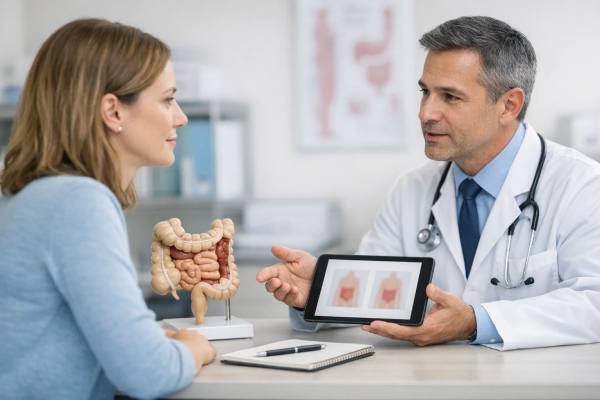
Inflammatory bowel disease (IBD) is a long-term immune-driven condition that inflames the digestive tract, often in waves of flares and calmer periods called remission. The two main types—Crohn’s disease and ulcerative colitis—can look similar at first (diarrhea, pain, fatigue), yet they behave differently inside the body. Those differences matter: they shape which tests you may need, what “good control” looks like, when surgery is helpful, and how to reduce complications over time. The goal today is not just fewer symptoms, but quieter inflammation—because ongoing inflammation can quietly drive anemia, weight loss, nutrient deficiencies, and bowel damage even when day-to-day symptoms seem manageable. This guide breaks down the most practical ways Crohn’s and ulcerative colitis differ, how diagnosis is confirmed, and how modern treatment strategies aim to protect your quality of life and your long-term gut health.
Core Points for Crohn’s and Ulcerative Colitis
- Knowing where inflammation occurs (small bowel vs colon) often predicts symptoms, treatment options, and surgery outcomes.
- Measuring inflammation with stool and blood markers can reveal “silent” disease activity even when symptoms feel mild.
- Steroids can calm a flare quickly but are not a safe long-term maintenance plan.
- A treat-to-target plan works best when you track symptoms plus objective markers on a shared timeline with your clinician.
Table of Contents
- Crohn’s disease and ulcerative colitis compared
- Symptoms patterns and red flags
- How IBD is diagnosed and staged
- Medication options and treatment strategy
- Surgery complications and cancer surveillance
- Nutrition lifestyle and daily management
Crohn’s disease and ulcerative colitis compared
Crohn’s disease and ulcerative colitis share the same “umbrella” diagnosis—IBD—but they differ in location, depth, and pattern of inflammation.
Ulcerative colitis (UC) affects the large intestine (colon) and always starts at the rectum, spreading upward in a continuous pattern. Inflammation is typically limited to the inner lining of the bowel. Because the rectum is involved, UC often causes urgency, blood and mucus, and a feeling of incomplete evacuation (tenesmus).
Crohn’s disease can involve any part of the digestive tract from mouth to anus, but commonly affects the end of the small intestine (terminal ileum) and the colon. Inflammation tends to be patchy (“skip lesions”) and can extend through the full thickness of the bowel wall. That deeper inflammation is why Crohn’s is more associated with narrowing (strictures), fistulas (abnormal tunnels between organs), and abscesses.
A simple way to compare:
| Feature | Crohn’s disease | Ulcerative colitis |
|---|---|---|
| Location | Anywhere in GI tract; often ileum and colon | Colon only; starts in rectum |
| Pattern | Patchy, skip areas | Continuous |
| Depth | Full thickness | Inner lining |
| Common complications | Strictures, fistulas, perianal disease | Severe bleeding, toxic megacolon |
| Surgery effect | Helps complications; disease can recur | Colectomy can remove colitis |
Extraintestinal symptoms can occur in both—joint pain, skin rashes, eye inflammation, or liver and bile duct conditions. Importantly, these issues may flare with gut inflammation (and sometimes have their own course), so a symptom outside the gut is not “unrelated” by default.
Two practical implications often surprise people:
- Symptom severity does not always match inflammation. Some people feel “okay” while inflammation smolders.
- The same medication class can behave differently depending on disease location (for example, therapies that work well for colonic inflammation may be less effective for extensive small-bowel disease, and vice versa).
The most helpful mindset is this: Crohn’s and UC are not simply “mild vs severe.” They are distinct patterns of immune inflammation, and the best plan is the one matched to your disease location, behavior, and risk factors.
Symptoms patterns and red flags
IBD symptoms cluster into bowel symptoms, whole-body symptoms, and complications. Paying attention to patterns (not just single bad days) can help you and your clinician separate a true flare from stress, diet-related irritation, medication side effects, or an infection.
Typical bowel patterns
Ulcerative colitis often features:
- Frequent loose stools with blood or mucus
- Urgency (rushing to the bathroom) and tenesmus
- Symptoms that can be worse in the morning and may wake you at night during active disease
Crohn’s disease commonly includes:
- Crampy abdominal pain, often on the lower right when the ileum is involved
- Diarrhea that may be watery and not always bloody (blood is still possible, especially with colonic disease)
- Weight loss, reduced appetite, and bloating
- In some cases, constipation-like symptoms or alternating patterns if strictures are forming
Whole-body symptoms can be as disabling as bowel symptoms:
- Fatigue that feels “bone deep,” especially with anemia or low iron
- Low-grade fevers, night sweats, and poor sleep
- Delayed growth or puberty in children and teens
Red flags that deserve urgent medical attention
Seek urgent care if you have:
- Severe abdominal pain with a rigid belly, high fever, or fainting
- Heavy rectal bleeding (soaking the toilet bowl repeatedly) or dizziness
- Signs of dehydration: minimal urination, racing heart, confusion
- Inability to pass stool or gas with worsening cramping and vomiting (possible obstruction)
- New severe pain around the anus, swelling, or fever (possible abscess)
A flare-tracking approach that is actually useful
Consider tracking, for 7–14 days, these simple markers:
- Stool frequency (number per day) and nighttime stools (yes or no)
- Visible blood (none, streaks, mixed in, mostly blood)
- Pain score (0–10) and where it is located
- Temperature (especially if you feel flu-like)
- Medication adherence (missed doses are more common than people realize)
Bring that record to appointments. It turns vague suffering into actionable information and helps your care team decide whether you need testing, a medication adjustment, or evaluation for infection (including common triggers like certain bacterial infections or C. difficile).
How IBD is diagnosed and staged
IBD is diagnosed by combining symptoms with objective evidence of inflammation and characteristic findings on endoscopy and biopsy. There is no single “IBD blood test” that confirms the diagnosis on its own.
Step 1: Confirm inflammation and rule out look-alikes
Common starting tests include:
- Bloodwork: complete blood count (anemia or high white blood cells), markers of inflammation (CRP and/or ESR), liver enzymes, and nutrient markers (iron studies, B12, folate, vitamin D)
- Stool testing: to check for infection and to measure inflammatory markers such as fecal calprotectin (often used to distinguish inflammatory disease from functional disorders like IBS)
Why this matters: treating the wrong problem can backfire. For example, worsening diarrhea might reflect infection, bile acid diarrhea, medication effects, or active IBD—and each has a different treatment.
Step 2: Direct visualization and biopsies
A colonoscopy with biopsies is the cornerstone test for suspected ulcerative colitis and for Crohn’s that involves the colon. Biopsies can show chronic inflammatory changes that help differentiate IBD from short-lived infectious colitis. The rectum-to-colon pattern also provides clues: UC typically appears continuous, while Crohn’s is often patchy.
If small bowel involvement is suspected, clinicians may add:
- MR enterography or CT enterography to visualize small bowel inflammation, narrowing, fistulas, or abscesses
- Capsule endoscopy in selected cases (often after ensuring there is no stricture that could trap the capsule)
Step 3: Classify severity and behavior
Staging is more than paperwork—it guides treatment intensity. Your clinician may describe:
- Extent (rectum only, left-sided, extensive colitis) in UC
- Location and behavior (inflammatory, stricturing, penetrating) in Crohn’s
- Perianal involvement (important for planning imaging, antibiotics, biologics, or surgery)
Monitoring goals: moving beyond symptoms
Modern care increasingly uses a “treat-to-target” approach. In practical terms, that means aiming for:
- Symptom control (fewer stools, less urgency, less pain)
- Objective improvement (normalizing CRP or calprotectin, healing seen on endoscopy or imaging)
- Steroid-free stability (because needing repeated steroid courses is a sign the plan needs upgrading)
A useful question to ask your clinician is: “What will we measure in 8–12 weeks to know this plan is working?” That timeline keeps care proactive instead of reactive.
Medication options and treatment strategy
IBD treatment has two jobs: calm a flare (induction) and prevent relapse (maintenance). The right plan depends on disease location, severity, complications, and your personal goals (work, school, pregnancy plans, travel, and risk tolerance).
Foundational therapies
- 5-aminosalicylates (5-ASA): often used for mild to moderate ulcerative colitis, especially when disease is limited to the colon; they are less effective for Crohn’s disease in many situations.
- Corticosteroids: effective for short-term flare control, but not safe for long-term maintenance. Repeated courses raise risks like bone loss, infection, sleep disruption, blood sugar changes, cataracts, and adrenal suppression.
- Immunomodulators: such as thiopurines (azathioprine or 6-mercaptopurine) and methotrexate, mainly used as maintenance options in selected cases and sometimes combined with biologics to improve durability.
Advanced therapies (biologics and small molecules)
These are commonly used for moderate to severe disease or high-risk patterns:
- Biologics (protein-based medicines): anti-TNF therapies, gut-selective anti-integrin therapy, and interleukin-targeting therapies
- Small molecules (oral options): JAK inhibitors and S1P modulators, among others
Rather than a single “best” medication, choices are often based on:
- Disease location: extensive small-bowel Crohn’s may be approached differently than limited colonic disease
- Complications: fistulas, strictures, and perianal disease often require earlier escalation
- Past exposure: what you have tried before and how well it worked
- Safety profile: infection risk, blood clot history, liver disease, heart disease, skin cancer history, and vaccination status
- Lifestyle fit: infusion center vs injection vs pill, and how quickly you need relief
Step-up vs early effective therapy
Some people do well with a traditional step-up approach (starting with simpler therapies and escalating only if needed). Others benefit from early use of highly effective therapy, especially when they have features linked to complications—deep ulcers, stricturing behavior, significant weight loss, severe anemia, or early need for steroids.
Practical safety steps that protect you
Before starting many immunosuppressive treatments, clinicians commonly:
- Screen for infections such as tuberculosis and hepatitis B
- Review vaccines and update them when appropriate
- Discuss pregnancy planning and medication safety in advance (many therapies can be used safely, but planning matters)
A helpful way to frame treatment is: “What is the lowest-risk plan that gives me the highest chance of durable, steroid-free remission?” That question keeps the focus on both safety and effectiveness.
Surgery complications and cancer surveillance
Surgery is not a “failure.” In IBD, it is sometimes the safest route to restore health, prevent emergencies, or remove areas that can no longer function normally.
How surgery differs in Crohn’s vs ulcerative colitis
- In ulcerative colitis, removing the colon and rectum can eliminate colitis. Some people choose restorative surgery that creates an internal pouch (often called an ileal pouch-anal anastomosis), allowing bowel movements through the anus rather than a permanent ostomy.
- In Crohn’s disease, surgery can remove strictures, drain abscesses, or resect severely diseased segments, but the disease can recur elsewhere in the digestive tract. Surgery is often part of long-term management rather than a cure.
Common reasons surgery becomes necessary
- Persistent symptoms and inflammation despite optimized medical therapy
- Strictures causing repeated obstructions
- Fistulas or abscesses that do not resolve with medication and drainage
- Severe complications such as toxic megacolon (more associated with UC)
- Precancerous changes (dysplasia) or cancer found on surveillance
Complications to watch and prevent
IBD can affect the whole body. Common longer-term complications include:
- Anemia (iron deficiency, chronic inflammation, or B12 deficiency in ileal Crohn’s)
- Bone loss (from inflammation, low vitamin D, and steroid exposure)
- Blood clots (risk increases during active inflammation and hospitalization)
- Nutrient deficiencies (B12, iron, folate, zinc, magnesium—depending on location and diarrhea severity)
- Extraintestinal manifestations involving joints, eyes, and skin
Cancer surveillance: why time matters
The risk of colorectal cancer is influenced by:
- How much of the colon is inflamed (extent)
- How long the disease has been present
- Ongoing inflammation over time
- Co-existing conditions such as primary sclerosing cholangitis
- Family history
Many people with long-standing colitis will be advised to have regular surveillance colonoscopies, often beginning around 8–10 years after diagnosis of more extensive colitis, with frequency tailored to risk. The details vary, but the principle is consistent: sustained inflammation is a risk signal, and surveillance is meant to catch precancerous changes early, when treatment is simpler and outcomes are better.
If you are unsure about your surveillance plan, ask: “What risk category am I in, and how often should I have a colonoscopy when my disease is controlled?” That shifts the conversation from fear to a clear schedule.
Nutrition lifestyle and daily management
Food does not “cause” IBD, but food choices can strongly affect symptoms, energy, and nutrition status. The most helpful approach is to separate inflammation control (medications and monitoring) from symptom shaping (diet strategies, stress, sleep, and habits). Both matter.
Nutrition during a flare vs remission
During an active flare—especially with narrowing or severe diarrhea—many people do better with:
- Softer, lower-fiber foods (sometimes called low-residue)
- Smaller, more frequent meals
- Extra fluids with electrolytes if stools are frequent
- Temporarily limiting high-fat, very spicy, or high-lactose foods if they worsen symptoms
During remission, the goal is often to broaden variety and rebuild nutrition:
- A Mediterranean-style pattern (vegetables, fruits, legumes as tolerated, whole grains, olive oil, fish, nuts) is a common starting point
- Fiber can be reintroduced gradually, paying attention to tolerance—especially important in Crohn’s with strictures
- Adequate protein supports healing and muscle maintenance, particularly after weight loss
Targeted nutrient checks that are worth discussing
Because deficiencies can be silent, clinicians often monitor:
- Iron and ferritin (fatigue and shortness of breath can be anemia, not “just stress”)
- Vitamin B12 (especially with ileal disease or prior ileal surgery)
- Vitamin D and calcium (bone protection, especially after steroid use)
If diarrhea is persistent even when inflammation is controlled, ask about non-inflammatory contributors such as bile acid diarrhea, lactose intolerance, or overlapping IBS-like sensitivity. These can be addressed without escalating immune therapy.
Lifestyle levers with real impact
- Smoking: stopping is one of the most meaningful actions for Crohn’s disease risk and complications.
- Sleep: poor sleep can amplify pain sensitivity and fatigue; aim for consistent wake and sleep times.
- Exercise: moderate activity supports mood, bone density, and cardiovascular health; a realistic target is about 150 minutes per week when you are stable, scaled to your current stamina.
- Stress management: stress does not cause IBD, but it can worsen symptoms and coping. Consider structured tools (therapy, mindfulness practice, breath training, or CBT skills) rather than relying on willpower alone.
A practical “flare toolkit”
Keep a written plan for:
- Which symptoms mean you should call your clinician within 24–48 hours (for example, rising stool frequency plus blood)
- Which symptoms mean urgent care (fever with severe pain, dehydration, obstruction signs)
- What you can do immediately: hydration plan, simplified meals, medication adherence check, and tracking stool frequency and blood
Daily management is not about perfection. It is about building a system that makes good weeks more common and bad weeks shorter, with fewer surprises.
References
- ECCO Guidelines on Therapeutics in Crohn’s Disease: Medical Treatment 2024 (Guideline)
- ACG Clinical Guideline Update: Ulcerative Colitis in Adults 2025 (Guideline)
- AGA Living Clinical Practice Guideline on Pharmacological Management of Moderate-to-Severe Ulcerative Colitis 2024 (Guideline)
- STRIDE-II: An Update on the Selecting Therapeutic Targets in Inflammatory Bowel Disease (STRIDE) Initiative of the International Organization for the Study of IBD (IOIBD): Determining Therapeutic Goals for Treat-to-Target strategies in IBD 2021 (Consensus Statement)
- ECCO Guidelines on Extraintestinal Manifestations in Inflammatory Bowel Disease 2024 (Guideline)
Disclaimer
This article is for educational purposes and is not a substitute for personalized medical advice, diagnosis, or treatment. Inflammatory bowel disease can be serious and may require urgent evaluation, especially with severe abdominal pain, high fever, dehydration, heavy bleeding, or signs of bowel obstruction. Always seek care from a qualified clinician for symptoms, medication decisions, pregnancy planning, and monitoring strategies, and do not stop or change prescribed treatments without professional guidance.
If you found this guide helpful, consider sharing it on Facebook, X (formerly Twitter), or any platform you prefer so others can access clear, practical information about Crohn’s disease and ulcerative colitis.





