A “better” bowel movement is not about perfection. It is about comfort, efficiency, and consistency—going without dread, pain, or long bathroom sessions. For many people, pooping becomes harder when modern routines fight basic gut biology: rushed mornings, irregular meals, dehydration, sitting all day, and ignoring the urge because life is busy. The good news is that small, targeted changes can often shift things quickly, especially when you combine timing (using your body’s natural reflexes), mechanics (how you sit and breathe), and daily habits (fiber, fluids, movement, and stress). This guide explains what “normal” looks like, how to build a reliable routine without forcing it, and how to recognize signs that you should get checked.
Essential Insights
- Using a consistent “post-meal” bathroom window can reduce straining and shorten toilet time over 1–2 weeks.
- A footstool and a relaxed exhale can make stools easier to pass without pushing hard.
- Gradually increasing fiber and fluids often improves stool softness and completeness within days to weeks.
- Ongoing rectal bleeding, severe pain, or unexplained weight loss should be evaluated promptly.
- Try a 5-minute sit 15–30 minutes after breakfast daily, then stand up if nothing happens.
Table of Contents
- What counts as a good poop
- Timing your bowel movements
- Position and breathing mechanics
- Daily habits that soften stool
- Troubleshooting common bathroom problems
- When home strategies are not enough
What counts as a good poop
A “good” bowel movement is one that happens with minimal effort and leaves you feeling empty enough to move on with your day. Frequency matters less than comfort and consistency. Some people go twice a day; others go every other day. A commonly cited “normal” range is anywhere from three times per day to three times per week, as long as the pattern is stable for you and not paired with red flags.
Signs your stool and pattern are in a healthy zone
- You do not have to strain hard. Mild effort is fine; breath-holding and forceful pushing are not.
- You finish in a reasonable time. Many clinicians suggest keeping toilet time to under about 5–10 minutes, partly to reduce hemorrhoid pressure and pelvic floor fatigue.
- Your stool has a “soft formed” shape. On the Bristol Stool Form Scale, this often resembles Type 3–4 (sausage-shaped with cracks, or smooth and soft).
- You feel mostly emptied. Occasional “not quite done” happens, but frequent incomplete emptying can signal constipation, pelvic floor coordination issues, or habits that interfere with the urge.
Why constipation can show up even if you poop daily
Constipation is not only “infrequent pooping.” It can mean hard stools, straining, feeling blocked, or needing unusual maneuvers to pass stool. A person can poop every day and still be constipated if stools are consistently hard, painful, or incomplete. That is why improving mechanics and stool softness often matters more than chasing a specific number.
When bowel changes deserve attention
Seek medical guidance sooner (not later) if you notice any of the following, especially if new for you:
- Blood mixed into stool, black stools, or persistent rectal bleeding
- Unintentional weight loss, fevers, or ongoing vomiting
- New constipation or diarrhea after age 50, or a strong family history of colon cancer
- Severe abdominal pain, a swollen belly with inability to pass gas, or symptoms that rapidly worsen
- Persistent anemia, fatigue, or a major change in bowel habits that lasts more than a few weeks
The rest of this guide assumes you are aiming to improve comfort and regularity without alarming symptoms. If your body is sending warning signs, the best “poop tip” is getting evaluated.
Timing your bowel movements
Your colon does not move stool along at a steady speed all day. It tends to be more active at certain times—especially after waking and after eating—because of natural reflexes that nudge the gut to contract. You cannot “will” these reflexes into existence, but you can learn to work with them.
Use the post-meal window instead of forcing random attempts
Many people do best with a planned bathroom opportunity 15–30 minutes after breakfast (or after the first substantial meal of your day). This timing uses the natural increase in gut motility that often follows eating. If mornings are impossible, try the same strategy after lunch or dinner.
A practical approach:
- Eat a consistent meal (even a small breakfast helps).
- Have a warm drink if you tolerate it (warmth can be calming and may support the routine).
- Sit on the toilet for up to 5 minutes with good posture and relaxed breathing.
- If nothing happens, stand up and move on—no extended “camping.”
The goal is to create opportunity, not pressure. With repetition, many people notice more predictable urges within 1–2 weeks.
Do not ignore the urge, but do not chase it either
Ignoring the urge repeatedly can backfire because the rectum stretches and becomes less sensitive over time. On the other hand, hovering over the toilet “just in case” can train anxiety and muscle tension. A balanced rule:
- If you feel a clear urge, go soon.
- If you do not feel an urge, do not force it. Use your planned post-meal sit and then leave.
Build a routine that supports the urge
Timing works best when the inputs are consistent:
- Meal timing: similar breakfast/lunch times day to day
- Hydration timing: a glass of water on waking and with meals
- Movement timing: even a 10-minute walk after meals can support gut rhythm
- Sleep timing: irregular sleep can disrupt gut timing (your gut has its own daily rhythm)
A note about “pooping at work” and travel
People often suppress urges away from home, then wonder why stools become hard. If you travel or commute, plan one supportive habit that travels with you—such as a consistent breakfast, a short walk, or setting aside a private bathroom window. The more your routine depends on a perfect environment, the more fragile it becomes.
Position and breathing mechanics
Pooping is partly about stool texture, and partly about coordination. The pelvic floor must relax while gentle abdominal pressure helps move stool out. Poor mechanics often look like clenching, breath-holding, and pushing down against a closed outlet.
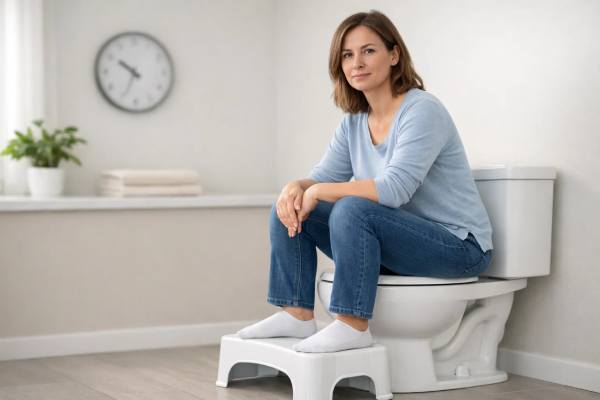
Set up a “squat-like” sitting position
You do not need a squat toilet to gain squat benefits. You can mimic a more open angle at the hips:
- Place your feet on a sturdy footstool (often 6–8 inches / 15–20 cm, adjusted to comfort).
- Let your knees rise above your hips.
- Lean forward slightly, with elbows resting on thighs.
- Keep your belly soft—avoid bracing as if lifting a heavy weight.
This posture can reduce the feeling of “stool stuck at the exit” and may lower straining for many people. If you have significant knee or hip pain, prioritize comfort and safety over the ideal angle.
Breathe out like you are fogging a mirror
A common mistake is holding your breath and bearing down hard (a Valsalva maneuver). That raises pressure in ways that can worsen hemorrhoids and pelvic floor tension. Instead, try this pattern:
- Inhale gently through the nose.
- Exhale slowly through pursed lips, as if fogging a mirror.
- On the exhale, let the belly expand outward slightly rather than pulling it in.
- Think “open and soften” at the anus, not “push and brace.”
If you want a mental cue: aim for a steady exhale plus relaxed outlet, not force.
Make the bathroom phone-free and time-limited
Scrolling encourages long sits, and long sits increase pressure on rectal veins. A simple boundary that helps many people:
- Leave the phone outside the bathroom.
- Set a quiet timer for 5–10 minutes if you tend to lose track.
- If nothing happens, stand, wash hands, and try again after the next meal or after a walk.
Recognize signs of pelvic floor “mis-timing”
If you consistently feel blocked, need to strain hard, or have to change positions repeatedly to finish, mechanics may be a major driver. Other clues include:
- A sense that stool is at the exit but cannot pass
- Very thin stools (not always, but sometimes)
- Frequent incomplete emptying
- Urinary hesitancy or pelvic tightness alongside constipation
In these cases, posture and breathing help, but many people also benefit from pelvic floor-focused evaluation and therapy.
Daily habits that soften stool
If timing is the “when” and mechanics are the “how,” daily habits are the “what” that makes stool easier to move. The most effective changes are usually the least dramatic: steady fluids, enough fiber, consistent movement, and fewer things that dry or slow the gut.
Fiber: increase gradually and aim for a steady baseline
Fiber helps stool hold water and adds bulk that stimulates the colon. The key word is gradually. Sudden big jumps can cause gas and cramps.
Ways to build fiber without a backlash:
- Add one fiber-focused food per day for 3–4 days, then add another.
- Consider soluble fiber sources if you bloat easily (for example, oats, chia, psyllium).
- Pair fiber with water; dry fiber can worsen hardness.
Practical food examples:
- Breakfast: oats, chia pudding, berries, ground flax
- Lunch: lentil soup, beans added to a salad, whole grains
- Dinner: roasted vegetables, a side of quinoa or brown rice
- Snacks: kiwifruit, prunes, pears, nuts (if tolerated)
Fluids: use timing, not just totals
Many people drink a lot “eventually,” but not at the times that support stool hydration. Try a simple pattern:
- A full glass of water on waking
- A glass with each meal
- Extra fluids around exercise and hot weather
If you limit fluids due to a medical condition (such as heart or kidney disease), follow your clinician’s plan rather than general hydration advice.
Movement: short walks count
Exercise supports gut motility, but it does not have to be intense. A reliable, low-friction habit is a 10–15 minute walk after meals, especially after breakfast or dinner. Movement also helps stress regulation, which can matter for gut function.
Sleep and stress: the hidden stool hardeners
Poor sleep and chronic stress can disrupt gut rhythm and increase pelvic floor tension. If constipation worsens during stressful periods, treat stress management as a bowel strategy, not an optional add-on:
- Keep sleep and wake times as consistent as possible
- Use a brief wind-down routine (dim lights, light stretching, slow breathing)
- If you clench your jaw or belly under stress, practice “soft belly” breathing during the day
Review common constipation triggers
Constipation is often a side effect. If stools changed after a new medication or supplement, that is a clue worth acting on. Common culprits include certain pain medicines, iron supplements, some allergy medicines, and some antidepressants. Never stop a prescribed medication on your own, but do discuss alternatives or supportive strategies with your clinician.
Troubleshooting common bathroom problems
Sometimes you are doing “the right things,” but the problem has a specific pattern. Matching the fix to the pattern can save weeks of frustration.
If stools are hard and pellet-like
This pattern often signals slow transit, dehydration, or not enough fiber (or fiber without fluids). Try:
- Add one stool-softening food daily for a week (kiwi, prunes, pears, oats, chia).
- Increase fluids earlier in the day.
- Use a consistent post-breakfast toilet sit.
- Avoid repeated forceful pushing; it tends to backfire.
If you feel incomplete emptying
Incomplete emptying can come from stool consistency, but it is also common with pelvic floor coordination issues.
- Re-check mechanics: footstool, forward lean, slow exhale.
- Try a brief “reset” rather than extended sitting: stand up, walk for 30–60 seconds, then sit again for another minute.
- Notice whether stress makes it worse; tension often shows up in the pelvic floor.
If you get urgency but only small output
This can happen with constipation as well as other conditions. Constipation can irritate the rectum and trigger frequent urges, even when stool is hard. Helpful steps include:
- Soften stool first (fluids, fiber, gentle osmotic options if appropriate).
- Avoid repeated “checking” trips that train anxiety and irritation.
- If urgency comes with mucus, bleeding, fever, or nighttime symptoms, get evaluated.
If hemorrhoids flare when you try to fix constipation
Hemorrhoids are often fueled by straining and long toilet time. Protect the area while you improve stool consistency:
- Keep toilet time short and phone-free.
- Use gentle hygiene (avoid aggressive wiping; consider rinsing with water).
- Prioritize softening strategies over “pushing through.”
If your routine collapses on weekends
Weekend sleep-ins and delayed meals can disrupt gut timing. If you want a weekend that feels better, keep one anchor habit stable—usually breakfast time or a morning walk—so your gut clock does not swing wildly.
If you only poop with coffee
Coffee can stimulate the gut for some people. That is not automatically a problem. The goal is to avoid becoming dependent on large amounts of caffeine or using it to override dehydration and low fiber. If coffee helps, pair it with a real breakfast and water rather than relying on coffee alone.
When home strategies are not enough
If you have tried timing, mechanics, and daily habit changes consistently for a few weeks and still struggle, it does not mean you failed. It often means the problem needs a more targeted approach—such as treating underlying constipation patterns, reviewing medications, or assessing pelvic floor function.
Consider a structured “two-week trial” before escalating
A clear trial helps you and your clinician see what is working.
For 14 days:
- Keep breakfast and a post-breakfast toilet sit consistent.
- Use a footstool and relaxed exhale every attempt.
- Increase fiber gradually (one change every few days).
- Walk after one meal daily.
- Track a few simple notes: stool form, straining level, and time spent on the toilet.
If there is no meaningful improvement, you have strong justification to discuss next steps.
Over-the-counter options: use the gentlest effective tool
Many people benefit from short-term or intermittent support while habits catch up. In general, “gentler” tools focus on softening stool rather than stimulating forceful contractions.
Common categories you might discuss with a clinician:
- Bulking fibers (help form and softness for many, but require fluids)
- Osmotic agents (draw water into stool; often used for hard stools)
- Stimulant laxatives (can be useful for intermittent rescue, but should be used thoughtfully)
If you are pregnant, have kidney disease, heart disease, inflammatory bowel disease, or take multiple medications, consult a clinician before starting new laxatives or supplements.
When testing and pelvic floor therapy make sense
If symptoms suggest pelvic floor mis-coordination—blocked feeling, significant straining, incomplete emptying—your clinician may consider tests that evaluate evacuation function. Pelvic floor biofeedback therapy can be highly effective for certain patterns, because it retrains coordination rather than just changing stool texture.
Red flags that should not wait
Get urgent medical care if you have:
- Severe abdominal pain with vomiting or inability to pass gas
- Large amounts of rectal bleeding, black stools, or dizziness
- Rapidly worsening constipation with abdominal swelling
- New neurological symptoms (weakness, numbness) alongside bowel changes
For less urgent but persistent problems—especially if you have tried habit strategies—schedule a visit to review medications, diet, thyroid status, iron levels, and whether further evaluation is appropriate. Better pooping is not only a lifestyle project; sometimes it is a medical one.
References
- American Gastroenterological Association-American College of Gastroenterology Clinical Practice Guideline: Pharmacological Management of Chronic Idiopathic Constipation – PubMed 2023 (Guideline)
- The American Society of Colon and Rectal Surgeons Clinical Practice Guidelines for the Evaluation and Management of Chronic Constipation – PubMed 2024 (Guideline)
- Evaluation and management of refractory constipation – American Gastroenterological Association 2026 (Clinical Practice Update)
- Dyssynergic Defecation: A Comprehensive Review on Diagnosis and Management – PMC 2023 (Review)
- Sitting vs. squatting: a scoping review of toilet postures and associated health outcomes – PMC 2025 (Scoping Review)
Disclaimer
This article is for educational purposes and does not replace personalized medical advice, diagnosis, or treatment. Bowel habits vary widely, and symptoms that seem “digestive” can sometimes signal conditions that need evaluation. If you are pregnant, have a chronic medical condition, take prescription medications, or have alarm symptoms such as persistent rectal bleeding, black stools, unexplained weight loss, fever, severe abdominal pain, or sudden changes in bowel habits, contact a qualified clinician promptly.
If you found this guide useful, consider sharing it on Facebook, X (formerly Twitter), or any platform you prefer so others can benefit from practical, evidence-informed bowel health strategies.