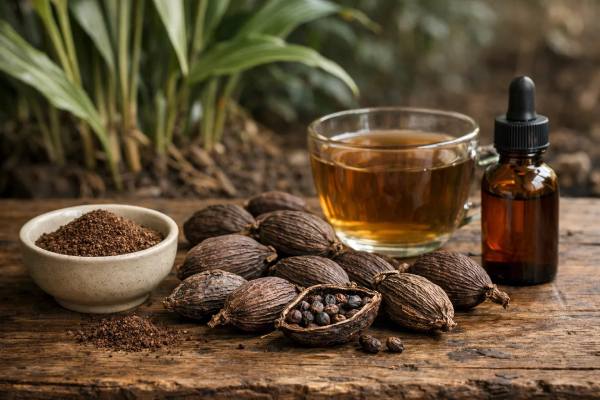
Black cardamom is a bold, smoky spice made from the dried seed pods of Amomum subulatum, a ginger-family plant traditionally cultivated in parts of the Eastern Himalayas. In the kitchen, it is valued for its deep aroma in curries, stews, and spice blends. In traditional wellness systems, it has also been used to support digestion, freshen breath, and ease seasonal respiratory discomfort.
Modern interest in black cardamom centers on its aromatic oils and polyphenols, which may help explain its antioxidant and soothing properties. The most realistic benefits are modest and practical: improving the flavor of lower-salt meals, encouraging digestive comfort after heavy foods, and providing a concentrated source of plant compounds that may support the body’s normal inflammatory balance. At the same time, “more” is not always better. Because black cardamom is often smoke-dried, quality matters, and concentrated supplements deserve extra caution—especially if you have reflux, take medications, or are pregnant.
Quick Overview
- May support digestive comfort after rich meals when used regularly in food or tea.
- Contains aromatic compounds with antioxidant and inflammation-modulating potential, but human evidence is limited.
- Typical supplemental range is about 0.5–1.5 g/day (powder or crushed pods) or 1–2 pods per cup as tea.
- Choose reputable, clean-smelling pods and avoid over-charring during cooking to limit unwanted smoke byproducts.
- Avoid medicinal dosing if pregnant or breastfeeding, and use extra caution with reflux, blood thinners, or diabetes medications.
Table of Contents
- What is black cardamom
- Key compounds and how they work
- What black cardamom may help with
- How to use black cardamom
- How much black cardamom per day
- Side effects and who should avoid it
- What the evidence says
What is black cardamom
Black cardamom (also called large cardamom) is the dried fruit (pod) of Amomum subulatum Roxb., a plant in the Zingiberaceae family. It is related to ginger and turmeric, but it is a different species from green cardamom (Elettaria cardamomum). The pods are larger, darker, and famously smoky because they are often cured over heat or wood smoke. That curing method gives the spice its signature “campfire” aroma, which can transform a pot of lentils, a braised meat dish, or a vegetable stew.
Inside each pod are small, sticky seeds. The seeds hold much of the aroma, while the papery husk contributes a softer, smoky note. In cooking, black cardamom is usually used whole (lightly crushed) so the flavor infuses slowly and the pods can be removed before serving. Ground black cardamom is also sold, but it loses fragrance more quickly, and it is easier to overuse.
From a wellness perspective, it helps to think of black cardamom as a “functional spice” rather than a stand-alone medicine. You get the most consistent value when it is part of a pattern: flavoring meals in a way that makes lighter cooking more satisfying, and using it in gentle preparations like tea after heavy foods.
How it is typically used
- Culinary infusion: whole pods in soups, stews, rice, legumes, and braises
- Spice blends: garam masala-style blends and savory rubs
- Tea or decoction: crushed pods steeped in hot water, sometimes with other spices
- Extracts and capsules: less traditional, more variable in strength and quality
How to choose good pods
- Look for pods that smell smoky but not musty or “chemical.”
- Pods should feel dry and intact, not soft or damp.
- Seeds should be aromatic when you crack the pod open.
Key compounds and how they work
Black cardamom’s “medicinal properties” are largely tied to its volatile oils (aromatic compounds) and a smaller contribution from polyphenols and other plant constituents. These compounds do not act like a single drug; they act more like a constellation—each in small amounts, potentially working together to influence digestion, microbial balance in the mouth, oxidative stress, and inflammatory signaling.
Aromatic oils that drive the signature effects
The dominant bioactive “signal” in black cardamom is its essential oil fraction. Research commonly identifies monoterpenes and terpene esters that are also found in other culinary aromatics. These compounds are often studied for:
- Antioxidant activity: helping neutralize reactive molecules created during stress and normal metabolism
- Anti-inflammatory signaling: influencing pathways involved in the body’s normal inflammatory response
- Digestive support: supporting bile flow and gut motility in preclinical models, and enhancing subjective comfort in traditional use
- Antimicrobial activity: especially relevant to oral freshness and food preservation effects
A practical way to interpret this is: black cardamom’s aroma is not just “smell”—it is chemistry. When you crush a pod and simmer it, those volatile compounds dissolve into the food and may contribute to the spice’s traditional uses for digestion and breath.
Polyphenols and supportive constituents
Beyond the volatile oils, black cardamom contains plant antioxidants such as phenolic acids and flavonoid-like compounds (the exact profile varies by origin and curing). These tend to be less “fragrant” but may matter for longer-term, low-grade oxidative stress. In real-life use, the dose is small, so it is best to view these as supportive, not dramatic.
Why curing and storage change potency
Because black cardamom is often smoke-cured, its chemistry can shift with:
- Drying temperature and duration
- Exposure to smoke
- Age and storage conditions (heat, light, oxygen)
That is why the same “amount” of black cardamom can taste—and potentially act—very differently from one brand to the next. If you are using it for wellness purposes, prioritize consistent sourcing and gentle cooking over high doses.
What black cardamom may help with
Black cardamom is not a cure-all, but it may offer a few realistic benefits that align with how people actually use it: in meals, after meals, and during seasonal discomfort. The most evidence-consistent way to think about it is “supportive and symptom-adjacent,” not “disease-treating.”
Digestive comfort and appetite support
Many traditional uses focus on digestion: heaviness after meals, gas, and sluggish appetite. The aroma itself can stimulate salivation and digestive secretions, and the warming, bitter-sweet profile can make simpler foods feel more satisfying. If you are already using warming spices like ginger’s active compounds, black cardamom often plays a similar supporting role—but with a smokier flavor that fits savory dishes.
Practical signs it may be helping:
- Less “heavy” feeling after rich meals
- Easier belching and reduced bloating discomfort
- Better tolerance of legumes when pods are simmered in the pot
Oral freshness and microbial balance
Chewing aromatic seeds is a long-standing practice in many cultures. Black cardamom’s volatile oils may help reduce odor-causing compounds in the mouth. It is not a substitute for dental hygiene, but as a food-based habit—especially after garlic-heavy meals—it can be useful.
Inflammatory balance and oxidative stress
Preclinical research suggests black cardamom extracts can influence markers related to oxidative stress and inflammatory mediators. In everyday terms, that does not guarantee pain relief or measurable changes in chronic conditions. What it does support is the idea that black cardamom belongs in an “anti-inflammatory kitchen pattern”: meals built around herbs, spices, legumes, vegetables, and adequate protein.
Respiratory comfort in seasonal use
Black cardamom is often described as warming and “clearing.” In practical home use, it is commonly combined with hot liquids and steam-adjacent foods (soups, broths, spiced teas). The aromatic oils may create a subjective sense of open breathing, similar to other strongly scented spices. This is best treated as comfort care, not treatment for asthma, infection, or persistent cough.
How to use black cardamom
Most people get the best results from black cardamom when they treat it as a technique, not a supplement. Its flavor is strong, and small choices—crushing, simmering, and timing—make a bigger difference than adding more.
Best culinary methods
1) Slow infusion (most forgiving)
- Lightly crush 1–2 pods to crack the shell.
- Add early to soups, stews, curries, braises, or lentils.
- Simmer at least 20–40 minutes.
- Remove pods before serving (like bay leaves).
This approach gives you depth without bitterness. It is also the easiest way to avoid overdoing the smoky note.
2) Blooming in fat (stronger, faster)
- Warm oil or ghee gently.
- Add a cracked pod for 30–60 seconds, then add onions, garlic, or spices.
- Continue cooking.
This intensifies aroma quickly. Use it when you want a pronounced smoky backbone.
3) Grinding (use sparingly)
Ground black cardamom is convenient, but it can dominate a dish. If you use it, start with a pinch and increase slowly.
Tea and after-meal use
For digestive comfort, a simple tea is often enough:
- Crush 1 pod (or use about 0.5–1 g of crushed seeds and husk).
- Steep in hot water 10–15 minutes.
- Strain and sip warm.
It pairs well with other kitchen spices, but keep blends simple so you can tell what works for you. If you want a savory direction, cumin is a classic partner—see cumin health benefits and uses for ideas on how it is traditionally combined in food-based routines.
Capsules, extracts, and essential oil
Supplements are harder to evaluate because “black cardamom extract” can mean many things: seed-only, whole pod, different solvents, and different concentrations. If you choose capsules, look for clear labeling and avoid mega-dose products.
Do not take black cardamom essential oil internally unless under professional guidance. Essential oils are highly concentrated and can irritate the gut and mucous membranes.
How much black cardamom per day
There is no universally accepted daily dose for black cardamom because most research is preclinical and culinary use varies widely. The safest and most practical approach is to scale your intake by form: whole pods in food first, then tea, and only then consider standardized supplements.
Food use ranges
For most adults, culinary amounts are appropriate for regular use:
- Whole pods in cooking: 1–3 pods per day, typically spread across meals
- Ground spice: about 1/8–1/2 teaspoon per day (start low because it is potent)
These amounts are not “therapeutic doses” in a clinical sense, but they are enough to provide consistent exposure to aromatic compounds while staying within normal dietary patterns.
Tea and gentle wellness dosing
If your goal is digestive comfort:
- Tea (infusion): 1 pod per cup, up to 2 cups per day
- Crushed pods or seeds: about 0.5–1 g per cup, steeped 10–15 minutes
If you notice heartburn, throat irritation, or nausea, reduce the strength or frequency.
Supplement ranges and timing
If you use capsules or extracts, keep expectations conservative and dosing cautious:
- Powder in capsules: roughly 0.5–1.5 g/day, divided once or twice daily
- Concentrated extracts: follow the product label and favor lower-dose products first
Timing depends on your goal:
- For digestion: with meals or after heavier meals
- For general culinary wellness: earlier in cooking and distributed through the week
How long to use it
As a spice, black cardamom can be used long-term. As a supplement, consider a “trial window”:
- Use a consistent dose for 2–4 weeks.
- Track one or two outcomes (for example, post-meal heaviness or bloating).
- If there is no noticeable benefit, it may not be the right tool for your goal.
If you are using it for a medical reason (blood sugar, blood pressure, inflammation), involve a clinician and do not replace prescribed care.
Side effects and who should avoid it
Black cardamom is generally well-tolerated in food amounts, but “natural” does not mean risk-free—especially when you concentrate it into powders, teas, or extracts. Side effects are usually dose-related and often show up as digestive irritation.
Common side effects
- Heartburn or reflux flare: the smoky, aromatic profile can aggravate sensitive stomachs
- Stomach upset or nausea: more likely with strong tea or high-dose capsules
- Dry mouth or throat irritation: sometimes from concentrated preparations
- Allergy: uncommon, but possible with any spice (itching, hives, mouth tingling)
If you experience persistent symptoms, stop and reintroduce later at a lower amount—or keep it strictly culinary.
Medication and condition cautions
Direct human data on interactions is limited, so caution is based on plausible mechanisms and preclinical findings:
- Blood thinners and antiplatelet drugs: use caution with concentrated extracts due to potential effects on inflammatory and platelet-related pathways.
- Diabetes medications: if using supplemental doses, monitor glucose more closely at first.
- Blood pressure medications: spice-level use is typically fine, but concentrated extracts warrant caution, especially if you already run low.
Who should avoid medicinal dosing
Avoid black cardamom supplements (and keep culinary use modest) if you are:
- Pregnant or breastfeeding: safety data for medicinal amounts is not strong enough
- Managing significant reflux, ulcers, or chronic gastritis: it may worsen symptoms
- Preparing for surgery: stop supplemental dosing in advance to reduce theoretical bleeding-risk concerns
- Giving it to young children as a supplement: use food amounts only, if at all
A note on smoke-drying and quality
Because black cardamom is often cured using smoke or high heat, it can be exposed to undesirable byproducts if processing is uncontrolled. You can reduce risk by:
- Buying from reputable brands with good turnover (fresher stock)
- Avoiding pods that smell acrid, burnt, or musty
- Not charring spices in the pan—gentle heat is enough
If you are using black cardamom daily for wellness, quality is as important as quantity.
What the evidence says
Black cardamom sits in a common herbal “evidence gap”: widespread traditional use and promising laboratory findings, but relatively few high-quality human trials. That does not make it useless—it simply changes what a responsible claim looks like.
What research supports most strongly
- Chemical plausibility: studies consistently identify aromatic compounds (especially oxygenated monoterpenes and terpene esters) that are known to show antioxidant and antimicrobial activity in laboratory models.
- Anti-inflammatory signals in preclinical work: animal and cell studies suggest extracts can reduce inflammatory mediators and oxidative stress markers under experimental conditions.
- Food-function value: as a culinary spice, black cardamom can help people build satisfying, lower-salt, higher-flavor meals—one of the most reliable “health benefits” spices offer in real life.
Where evidence is limited or indirect
- Metabolic outcomes (blood sugar, lipids): human studies on “cardamom” often involve green cardamom, mixed cardamom preparations, or small sample sizes. A few older human studies exist for Amomum subulatum, but they are not enough to establish dosing standards.
- Respiratory claims: the comfort effect is plausible due to aroma and traditional use, but clinical evidence for treating respiratory disease is not established.
- Cancer claims: lab studies may explore mechanisms, but that is not the same as proving prevention or treatment in humans.
How to interpret claims responsibly
If your goal is inflammation support, it may help to compare black cardamom’s role to better-studied botanicals. For example, boswellia research includes more direct human clinical attention for certain inflammatory conditions, whereas black cardamom is best positioned as a supportive spice and functional-food ingredient.
A grounded takeaway is this: black cardamom can be a smart addition to a health-forward kitchen and may provide modest digestive and antioxidant benefits, but it should not be marketed—or used—as a substitute for evidence-based medical treatment.
References
- Recent advances in the extraction, chemical composition, therapeutic potential, and delivery of cardamom phytochemicals 2022 (Review)
- Anti-Inflammatory Potential Exhibited by Amomum subulatum Fruits Mitigates Experimentally Induced Acute and Chronic Inflammation in Mice: Evaluation of Antioxidant Parameters, Pro-Inflammatory Mediators and HO-1 Pathway 2021 (Preclinical Study)
- Antioxidant-rich fraction of Amomum subulatum fruits mitigates experimental methotrexate-induced oxidative stress by regulating TNF-α, IL-1β, and IL-6 proinflammatory cytokines 2022 (Preclinical Study)
- Determination of Polycyclic Aromatic Hydrocarbons in Traditional Chinese Medicine Raw Material, Extracts, and Health Food Products 2022 (Food Safety and Analytical Study)
Disclaimer
This article is for educational purposes only and does not provide medical advice, diagnosis, or treatment. Herbs and spices can affect individuals differently, especially when used in concentrated forms. If you are pregnant or breastfeeding, have a medical condition (such as reflux, liver disease, or diabetes), or take medications (including blood thinners), consult a qualified healthcare professional before using black cardamom as a supplement or in high amounts. Seek urgent medical care for symptoms of a serious allergic reaction, significant breathing difficulty, chest pain, or signs of gastrointestinal bleeding.
If you found this guide helpful, consider sharing it on Facebook, X (formerly Twitter), or your favorite platform so others can use black cardamom more safely and effectively.