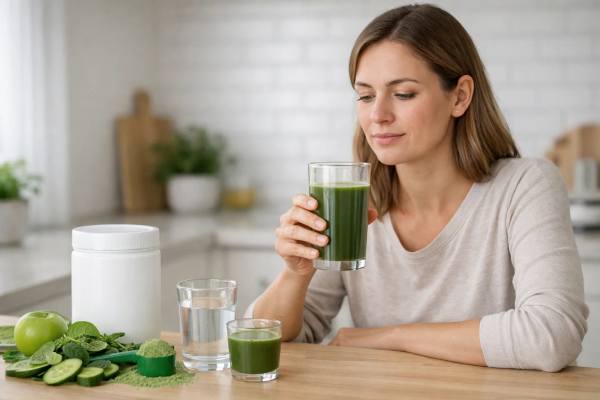
Greens powders promise a shortcut to the benefits of vegetables: concentrated plant nutrients, convenience, and an easy add-in for smoothies or water. For some people, they do exactly that—helping fill small nutrition gaps on busy days and nudging daily fiber and phytonutrient intake upward. For others, the first week comes with uncomfortable bloating, gas, cramping, or sudden changes in bowel habits. That reaction is not necessarily a sign the product is “bad” or that your gut is “weak.” It is often a predictable response to concentrated fibers, sugar alcohols, probiotics, algae ingredients, or large doses taken too quickly—especially in sensitive digestive systems. This article explains the most common reasons greens powders trigger bloating, how to read labels with a gut-first mindset, and how to choose and use a product in a way that is more likely to feel supportive than disruptive.
Essential Insights
- Bloating is most often triggered by fermentable fibers (like inulin and fructooligosaccharides), sugar alcohols, and rapid dose increases.
- A “gentler” greens powder usually has a shorter ingredient list, minimal added fibers, and no sugar alcohol sweeteners.
- People with IBS, frequent reflux, or a history of antibiotic-related diarrhea often need extra caution with multi-ingredient blends.
- Start with 1/4 serving daily for 3–4 days and increase gradually only if symptoms stay mild and short-lived.
- Choose products with third-party quality testing when possible, especially if algae ingredients are included.
Table of Contents
- What greens powders actually contain
- Why supergreens cause bloating
- Ingredients that commonly trigger gas
- Who should be extra cautious
- How to choose a gentler product
- How to use greens powder without bloating
What greens powders actually contain
“Greens powder” is a marketing umbrella, not a single type of product. Two tubs can look similar and behave very differently in your gut because the ingredient categories vary widely. Most formulas combine several of the following:
1) Dried vegetables and grasses
Common bases include spinach, kale, broccoli, wheatgrass, barley grass, alfalfa, parsley, and moringa. These are often dehydrated, sometimes “juice powders” (where fiber may be lower) and sometimes whole-leaf powders (where fiber may be higher). Drying concentrates flavor compounds and some nutrients, but it does not perfectly match the nutrition of fresh produce.
2) Fermentable fibers and “prebiotic” blends
Many products add chicory root fiber (inulin), fructooligosaccharides (FOS), resistant dextrin, acacia fiber, or “digestive fiber” blends. These are popular because they support regularity for some people and help a powder feel more “functional.” They are also one of the top reasons for gas and bloating.
3) Fruits, “antioxidant” extracts, and polyphenols
Berry powders, green tea, grape, pomegranate, turmeric, ginger, and assorted botanicals are common. These ingredients can be beneficial, but concentrated extracts sometimes irritate sensitive stomachs, especially when taken on an empty stomach.
4) Probiotics, enzymes, and “gut health” add-ons
Some blends include probiotic strains, digestive enzymes, peppermint, or “soothing” herbs. These can help certain people and bother others. In practice, the dose and the delivery format matter: a small amount in a mixed powder is not the same as a clinically targeted probiotic or enzyme product.
5) Algae and sea vegetables
Spirulina, chlorella, kelp, and other algae ingredients are common in “supergreens.” They add pigments and minerals, but they also bring quality-control questions, because algae can accumulate environmental contaminants depending on how it is grown and processed.
A useful way to think about greens powders is: base + boosters + tolerability modifiers. The base provides color and general plant content. Boosters add fibers, extracts, and microbes. Tolerability modifiers include sweeteners, flavors, and gums that change how your gut responds. If a powder makes you bloat, the issue is often in the boosters and modifiers—not the spinach itself.
Why supergreens cause bloating
Bloating is a sensation (pressure, fullness, tightness) that may or may not come with visible belly distension. Greens powders can trigger it through a few overlapping mechanisms. Knowing which pattern fits you helps you choose smarter and troubleshoot faster.
Mechanism 1: Fermentation happens quickly
Many greens powders contain fibers your small intestine cannot fully digest. Those fibers reach the colon, where gut microbes ferment them. Fermentation is not “bad”—it can produce beneficial short-chain fatty acids—but it also produces gas. If you introduce a fermentable fiber suddenly, gas production can outpace your ability to move it along comfortably.
Typical pattern: bloating and gas that builds 2–8 hours after the drink, often worse in the evening.
Mechanism 2: Dose mismatch
A full serving of a concentrated blend can be a big change, especially if you do not regularly eat high-fiber foods or if your gut is in a sensitive period (after travel, illness, antibiotics, or stress). Even if the ingredient list is “healthy,” the dose can be too abrupt.
Typical pattern: symptoms begin within the first 1–3 days, then improve if you reduce the serving size.
Mechanism 3: Sweeteners and thickeners pull water into the gut
Sugar alcohols and certain fibers can draw water into the intestines, leading to bloating, urgency, or loose stool. Gums and thickeners can also feel heavy for some people, especially when combined with a large volume of liquid.
Typical pattern: cramping, gurgling, and looser stool within hours.
Mechanism 4: Acid and concentrated botanicals irritate the upper gut
Some powders include citrus acids, strong flavors, green tea extracts, or adaptogenic herbs. In sensitive stomachs, this can cause nausea, reflux, or “upper belly” pressure that people often describe as bloating.
Typical pattern: discomfort within 15–60 minutes, especially on an empty stomach.
Mechanism 5: Your baseline gut sensitivity raises the threshold
People with IBS, reflux, pelvic floor dysfunction, constipation, or suspected small intestinal bacterial overgrowth often have a lower tolerance for sudden fermentable loads. That does not mean you must avoid greens powders forever; it means you need a more cautious selection and dosing strategy.
A simple self-check: if the discomfort feels like gas that moves and changes, it often points to fermentation or sweeteners. If it feels like pressure that sits high and burns, it may be reflux or irritation. If it is crampy and urgent, think sweeteners, magnesium, or an additive effect.
Ingredients that commonly trigger gas
If you want to predict whether a greens powder will bloat you, focus less on the front label and more on the ingredient list and the “extras.” The following ingredients are common triggers—not because they are inherently harmful, but because they are frequently fermentable, osmotically active, or irritating at the doses used in blends.
High-bloating-risk fibers and prebiotics
These often appear as “gut health,” “prebiotic,” or “fiber blend” ingredients:
- Chicory root fiber (inulin)
- Fructooligosaccharides (FOS) or oligofructose
- Jerusalem artichoke fiber
- “Prebiotic blend” with no specific amounts listed
- Large amounts of resistant dextrin or mixed soluble fibers (varies by person)
These fibers can be helpful for regularity and microbiome support, but they commonly cause gas when introduced quickly or when combined with other fermentable ingredients.
Sweeteners that can cause bloating
Look for sugar alcohols and certain “diet” sweeteners:
- Erythritol, xylitol, sorbitol, mannitol, maltitol
- “Sugar alcohol” listed without the specific type
- Large amounts of certain non-nutritive sweeteners can also bother some people, even without sugar alcohols
A frequent real-world scenario is a “low sugar” greens powder that is easy to drink but causes a swollen, gassy feeling later. The sweetener system is often the reason.
Gums and thickeners
Not everyone reacts to gums, but if you do, they can contribute to a heavy or bloated sensation:
- Xanthan gum, guar gum, gellan gum
- “Thickener” or “stabilizer” blends
Some people tolerate gums well in small amounts but react when multiple gums are combined.
Probiotics and enzyme blends
Probiotics are not automatically soothing. In sensitive guts, they can cause transient gas or changes in stool pattern, particularly when combined with fermentable fibers. Enzymes can help in specific contexts (like lactose digestion), but “digestive enzyme blends” vary widely and are not always targeted to your needs.
Algae ingredients and concentrated botanicals
Spirulina and chlorella are common in supergreens, and they can be fine for many people. But algae-based ingredients raise two practical concerns:
- Quality control can vary across supplement supply chains.
- Some individuals report nausea or GI upset with algae-heavy blends, especially at higher doses.
If you have bloating plus nausea or a “queasy” feeling, consider whether the product is algae-forward or heavy in strong extracts.
The simplest label strategy is to identify your likely trigger category: fermentable fiber, sweeteners, gums, probiotics, or algae/extract load. Then choose a product that minimizes that category first, rather than changing five things at once.
Who should be extra cautious
Greens powders are not a requirement for health, and certain people should approach them with extra care—or skip them unless a clinician agrees they fit. The concern is not only bloating; it is also interactions, ingredient complexity, and quality-control variability.
People with IBS or frequent functional bloating
Many greens powders stack multiple fermentable ingredients: prebiotic fibers, fruit powders, sweeteners, and gums. If your gut is already sensitive, that combination can amplify symptoms. A product that is “healthy” on paper can still be too fermentable for your current threshold.
People prone to reflux or sensitive stomach lining
If you often get heartburn, nausea, or upper abdominal burning, be cautious with powders that contain strong acids, concentrated green tea extracts, or large amounts of peppermint and botanicals. Taking a concentrated powder in water on an empty stomach is a common setup for discomfort.
People on blood thinners or with tight vitamin K management
Some greens powders contain meaningful amounts of vitamin K from dried leafy greens. Vitamin K intake consistency can matter for certain anticoagulants. If you take a blood thinner, do not “add greens powder” without checking whether it could affect your medication plan.
Kidney disease, recurrent kidney stones, or very high mineral sensitivity
Greens powders can contain potassium-rich ingredients and plant compounds that are not ideal for everyone with kidney concerns. Some blends also concentrate oxalate-rich greens. This does not mean all greens powders are unsafe, but it does mean you should be selective and discuss with your clinician if you have known kidney disease or a history of calcium oxalate stones.
Immune suppression and certain probiotics
Most people tolerate probiotics well, but if you are significantly immunocompromised, you should be cautious with products that include live microbes, especially when strain and dose information is vague.
Pregnancy and breastfeeding
A simple vegetable powder is different from a “supergreens plus herbs plus adaptogens” blend. During pregnancy and breastfeeding, ingredient complexity matters. Many herbal extracts and concentrated botanicals have limited safety data in these contexts.
History of food-triggered diarrhea after antibiotics
If you have had severe diarrhea after antibiotics or are currently taking antibiotics, be cautious with multi-ingredient powders. New fibers and sweeteners can worsen diarrhea, and certain infections need a different approach than “more probiotics and fiber.”
If any of these categories describe you, you do not have to give up on greens powders entirely. You may simply need a narrower, simpler product—or you may do better with food-based alternatives like blended vegetables, soups, or a small daily smoothie made from tolerated ingredients.
How to choose a gentler product
A “gentle” greens powder is usually not the most exciting one on the label. It is typically the one with fewer moving parts: fewer fermentable fibers, fewer sweeteners, and fewer concentrated extracts. Here is a practical way to choose without getting lost.
Step 1: Decide what you actually want it for
- If your goal is “more greens on busy days,” you do not need a microbiome-maximizing prebiotic blend.
- If your goal is regularity, you might benefit from added fiber—but you should choose it intentionally and dose it slowly.
Clear goals prevent accidental over-stimulation.
Step 2: Favor short ingredient lists and transparent amounts
Look for products that list recognizable ingredients and do not hide half the formula in “proprietary blends.” Transparency matters because bloating is often dose-dependent.
Step 3: Minimize common bloat triggers
For sensitive digestion, a safer starting point is often:
- no chicory root fiber (inulin) or FOS
- no sugar alcohols
- minimal gums and thickeners
- modest “extras” (few botanicals, not dozens)
If you still want prebiotics, choose a product with a clearly stated amount and plan to titrate slowly.
Step 4: Look for quality signals that reduce contamination risk
Greens powders are dietary supplements, and quality varies. Helpful signals include:
- third-party testing certifications or verified quality programs
- accessible batch testing information (some companies provide certificates of analysis)
- clear manufacturing and sourcing statements
This is especially important for algae-containing products, because algae can be vulnerable to contamination depending on growing conditions.
Step 5: Consider your “base tolerance” and choose the right format
If you bloat easily, you may do better with:
- a greens powder made mostly from dried vegetables and grasses, without added prebiotic fibers
- a single-ingredient powder (for example, wheatgrass or moringa) so you can test tolerance cleanly
- a product you can measure precisely, rather than “heaping scoop” instructions
Finally, remember the most gut-friendly option may be the smallest consistent habit: a half-serving of a simple powder that you tolerate is more useful than a maximal blend you cannot take twice in a row.
How to use greens powder without bloating
Even a well-chosen greens powder can cause symptoms if you introduce it too aggressively. The goal is to let your gut adapt gradually, while keeping the experiment clean enough to learn from.
Use a slow-start protocol
A practical ramp that works for many people:
- Days 1–3: 1/4 serving once daily
- Days 4–7: 1/2 serving once daily
- Week 2: full serving only if symptoms stayed mild and short-lived
If you notice bloating, drop back to the last well-tolerated dose and stay there for a week before trying to increase again.
Take it with food if you get upper-gut discomfort
If the powder causes nausea or reflux, try taking it:
- with breakfast or lunch rather than first thing in the morning
- mixed into a smoothie or yogurt alternative rather than plain water
- not close to bedtime
This often helps more than changing the product immediately.
Separate “fiber load” from “greens load”
If your greens powder contains prebiotic fibers, be mindful of other high-fiber foods on the same day. Stacking a fiber-heavy powder on top of beans, large salads, and high-fiber snacks can overshoot your current tolerance.
A gentler approach is to keep the rest of the day’s diet relatively steady while you test the powder.
Troubleshoot by symptom timing
- Symptoms within 30–60 minutes: consider acids, botanicals, caffeine-like extracts, or reflux sensitivity.
- Symptoms 2–8 hours later: consider fermentable fibers and gut fermentation.
- Urgency and loose stool: consider sugar alcohols, magnesium, or too-high dose.
Match the fix to the timing. Otherwise you can end up changing the wrong variable and staying stuck.
Know when to stop and get help
Stop the product and seek medical guidance if you develop:
- persistent diarrhea, fever, or dehydration
- blood in stool or black tarry stool
- severe abdominal pain
- symptoms that last more than 1–2 weeks despite dose reduction
- unintended weight loss or significant weakness
Food-first alternatives that are often easier to tolerate
If powders repeatedly cause symptoms, consider:
- a small daily smoothie with tolerated greens (start with a few leaves, not a large handful)
- blended vegetable soups
- lightly cooked greens, which many people tolerate better than raw
- a targeted supplement (like a single fiber or a specific probiotic) chosen for your exact issue, rather than an all-in-one blend
Greens powders can be useful, but your gut does not need to “power through.” A slow, measured approach is usually the difference between a supplement that feels supportive and one that becomes a recurring trigger.
References
- The Prebiotic Potential of Inulin-Type Fructans: A Systematic Review 2021 (Systematic Review)
- ACG Clinical Guideline: Management of Irritable Bowel Syndrome 2021 (Guideline)
- Current Good Manufacturing Practices (CGMPs) for Food and Dietary Supplements | FDA 2024 (Regulatory Guidance)
- Microbiota and Cyanotoxin Content of Retail Spirulina Supplements and Spirulina Supplemented Foods 2023 (Study)
- Microcystins and Cyanobacterial Contaminants in the French Small-Scale Productions of Spirulina (Limnospira sp.) 2023 (Study)
Disclaimer
This article is for educational purposes only and does not provide medical advice, diagnosis, or treatment. Greens powders are dietary supplements, and ingredient quality and tolerability vary widely across products and individuals. If you are pregnant, breastfeeding, immunocompromised, managing kidney disease, using blood thinners, or taking prescription medications, talk with a qualified clinician or pharmacist before starting a greens powder. Seek urgent medical care for severe abdominal pain, persistent vomiting, signs of dehydration, fever with diarrhea, blood in stool, black tarry stools, fainting, or rapid worsening of symptoms.
If you found this article useful, please consider sharing it on Facebook, X (formerly Twitter), or any platform you prefer.