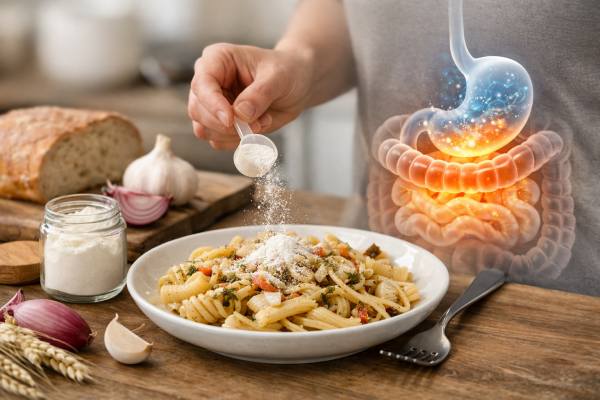
If garlic, onion, or wheat reliably leave you bloated and uncomfortable, you are not alone—and you are not imagining it. These foods are common triggers because they contain specific fermentable carbohydrates that can pull water into the gut and feed gas-producing fermentation. FODMAP enzyme powders are a newer, targeted tool designed to break down certain FODMAP carbohydrates before they reach the large intestine, ideally reducing post-meal gas, pressure, and urgency without forcing you into strict avoidance.
Used well, they can make restaurant meals, travel, and social eating feel less risky. Used poorly, they can be disappointing—because enzymes are narrow in what they can digest, sensitive to timing, and limited by portion size. This guide explains what these powders can realistically do, how they interact with garlic, onion, and wheat triggers, how to take them for the best chance of benefit, and when you should prioritize medical evaluation instead.
Quick Overview
- Enzyme powders can reduce symptoms when triggers are specific FODMAP carbohydrates, especially fructans from garlic, onion, and wheat.
- They are not a substitute for gluten avoidance in celiac disease or a treatment for wheat allergy.
- Timing matters: enzymes work best when taken with the first bites so they contact the food in the stomach.
- If symptoms persist despite correct use, the issue may be portion size, a different FODMAP type, or a non-FODMAP trigger.
- A structured “test meal” approach helps you learn which foods respond and which do not.
Table of Contents
- What FODMAP enzyme powders do
- Garlic and onion fructans and inulinase
- Wheat triggers: fructans, not gluten
- Timing and dosing for best effect
- Safety, side effects, and who should skip
- Using enzymes within a FODMAP plan
What FODMAP enzyme powders do
FODMAP enzyme powders are digestive enzyme blends designed to break down specific fermentable carbohydrates in food. The logic is simple: if a carbohydrate is poorly absorbed (or not digestible at all) in the small intestine, it arrives in the large intestine where it pulls in water and becomes fuel for fermentation. That combination can drive bloating, gas, pain, and altered bowel habits in sensitive people. Enzymes aim to “pre-digest” the trigger so less reaches the colon intact.
What they target and what they do not
Most products focus on one or more of these enzyme categories:
- Fructan-targeting enzymes (often described as inulinase or fructanase activity) for garlic, onion, wheat, rye, and some inulin-chicory additives
- Alpha-galactosidase for galacto-oligosaccharides (GOS) in beans, lentils, and some nuts
- Lactase for lactose in milk, soft cheeses, and ice cream
This matters because “FODMAP sensitivity” is not one thing. Two people can both say “wheat bothers me,” but one reacts to wheat fructans, another reacts to something unrelated to FODMAPs (such as wheat protein sensitivity, food additives, large portion size, or stress-related gut-brain responses). Enzymes only help when the problem is the carbohydrate the enzyme can actually break down.
Why powders can be more practical than capsules
Powders are meant to mix with food, which improves contact between enzyme and carbohydrate. Contact is not a small detail—it is the whole mechanism. If an enzyme does not physically reach the FODMAP in the meal early enough, it cannot do meaningful work before the food moves onward.
That said, powders are still limited by:
- Dose and portion size: a “normal” dose may not cover an unusually large serving of a trigger food.
- Meal complexity: many meals contain multiple FODMAP types and other triggers (fat, spice, alcohol, sugar alcohols).
- Individual absorption: breaking fructans into smaller sugars may help one person and still bother another.
A realistic expectation is not “symptom-proof eating.” It is symptom reduction in predictable situations, with learning built in.
Garlic and onion fructans and inulinase
Garlic and onion are among the most common FODMAP triggers because they are rich in fructans—chains of fructose that humans do not digest well. Since fructans resist digestion, they travel to the colon where they are rapidly fermented. For some people, that fermentation feels like a balloon inflating from the inside: pressure, audible gurgling, distension, and sometimes urgent stools.
What fructan-targeting enzymes are trying to do
Fructan-targeting enzymes (often labeled as inulinase or fructanase) are intended to chop long fructan chains into smaller sugars early in digestion. The goal is to reduce the amount of intact fructan that reaches the colon.
Two practical details shape success:
- Fructans are stable through cooking. Roasting garlic or caramelizing onions can change flavor and texture, but it does not reliably remove fructans. So “cooked is safe” is not a dependable rule.
- Fructans are not oil-soluble. This is why garlic-infused oil is often better tolerated than garlic itself: the flavor compounds move into oil, while fructans largely do not. If your trigger is garlic and onion, infused oils can be a low-effort strategy even before you try enzymes.
Why garlic and onion feel uniquely “strong”
People often report that a small amount of garlic or onion causes disproportionate symptoms. A few reasons this can happen:
- Garlic and onion are frequently hidden in sauces, broths, spice blends, and restaurant foods, which makes dose harder to estimate.
- They often appear alongside other triggers (wheat, dairy, alcohol, high fat), which can amplify symptoms.
- The gut can respond not only to gas volume, but also to gas distribution and sensitivity—some people feel a normal amount of gas more intensely.
When fructan enzymes may help most
Enzymes tend to fit best when your symptoms have these features:
- You tolerate many other foods well, but garlic and onion consistently trigger bloating or discomfort.
- Symptoms are mostly post-meal gas and distension, rather than systemic symptoms.
- You can identify high-fructan meals (pizza with garlic sauce, onion-heavy stir-fry, restaurant soups) as repeat offenders.
They tend to fit poorly when garlic and onion sensitivity is part of a broader pattern of frequent diarrhea, unexplained weight loss, or nighttime symptoms. In those cases, it is safer to evaluate for a wider range of gut conditions rather than trying to “out-enzyme” the problem.
Wheat triggers: fructans, not gluten
Wheat is complicated because it contains multiple components that can cause symptoms in different people. When someone says “wheat makes me bloated,” it can mean at least four different things:
- Wheat fructans (a FODMAP) causing fermentation-related symptoms
- Gluten-related immune disease (celiac disease)
- Wheat allergy (an allergic reaction that can be serious)
- Non-FODMAP triggers (portion size, additives, fat, stress, or gut sensitivity)
FODMAP enzyme powders are only relevant to the fructan piece.
Fructans in wheat and how symptoms show up
Wheat fructans are present in many foods people eat in large portions: bread, pasta, pizza crust, baked goods, and snack foods. If fructans are the issue, symptoms often feel like classic fermentation: bloating, gas, abdominal pressure, and sometimes looser stools—often within a few hours of eating.
A key nuance: wheat-based meals often stack triggers. A restaurant pasta dish can combine wheat fructans, garlic and onion in the sauce, high fat, and alcohol. If an enzyme only targets fructans but your symptoms are primarily driven by fat or alcohol, you may see little improvement.
Enzymes do not “detox” gluten
It is essential to say this clearly: fructan enzymes do not make gluten safe.
- If you have celiac disease, you must avoid gluten regardless of enzymes.
- If you have a wheat allergy, enzymes do not prevent allergic reactions.
- If you are using a gluten-free diet because it helps symptoms, fructans may be the real culprit—but you should not reintroduce wheat solely on the basis of an enzyme without a plan.
A useful way to think about it is: fructan enzymes are a tool for carbohydrate intolerance, not for immune or allergic disease.
A practical “wheat trigger” self-check
If you are trying to decide whether wheat fructans are likely your main issue, these patterns can help:
- You react to wheat and also to garlic and onion, which points toward fructans as a common thread.
- You tolerate some naturally gluten-free grains (rice, oats) but bloat with wheat-based meals.
- You react more to large portions (two slices of bread, big pasta bowl) than to small amounts.
If you suspect celiac disease (persistent diarrhea, anemia, unexplained weight loss, family history, or symptoms that improve strongly on gluten avoidance), do not start or deepen gluten restriction without medical guidance—testing can be affected by being off gluten.
Timing and dosing for best effect
With enzymes, “how” matters almost as much as “what.” Many people try an enzyme once, feel no change, and conclude it does not work—when the real issue is timing, contact, or an unrealistic serving size. A good trial looks more like an experiment than a gamble.
Timing rules that actually matter
Enzymes work best when they meet the food early:
- Take or apply the enzyme with the first bites, not after you finish eating.
- If the meal is long (multiple courses over an hour), consider splitting the dose so enzyme is present throughout.
- If you forgot and you are already done eating, taking it late is unlikely to help, because the food has already moved on.
Powder formulations are designed for contact. If the instructions say to sprinkle on food, follow that rather than swallowing it dry. Contact is especially important for garlic and onion triggers, which are often distributed through sauces and mixed dishes.
Heat, acidity, and mixing
Enzymes are proteins, and many lose activity with high heat. Practical rules:
- Do not cook the powder into boiling food unless the label explicitly says it is heat-stable.
- For soups or hot dishes, let the food cool slightly, then mix the powder in.
- Mix into the portion you are actually eating, not into a large pot you will store for later.
Stomach acidity varies between people and can influence how well an enzyme survives long enough to act. That is one reason results differ even with correct use.
How to test whether it is helping
Try a three-meal test approach:
- Meal A (control): a known trigger meal without enzyme.
- Meal B (enzyme): the same meal, similar portion, with enzyme used exactly as directed.
- Meal C (dose check): if Meal B helped somewhat, repeat with a modestly higher dose if allowed by the label, or with a smaller trigger portion.
Keep other variables steady (alcohol, carbonated drinks, stress, late-night eating) so you do not confuse the result.
Common reasons it “fails” even when you did everything right
- The meal contained a different FODMAP type (polyols, excess fructose) that your enzyme does not target.
- The portion was simply too large for the enzyme dose.
- Your symptoms are driven more by fat, spice, caffeine, or gut-brain sensitivity than by fermentation.
- You have overlapping issues such as constipation, which can amplify bloating regardless of FODMAP load.
A “failure” can still be useful data. It tells you what not to rely on and where to focus next.
Safety, side effects, and who should skip
Digestive enzyme powders are generally considered low-risk for most adults, but “low-risk” is not “risk-free,” and not everyone should experiment casually. Safety depends on your health history, the enzyme source, and what you are trying to manage.
Who should avoid self-experimenting
Use extra caution or seek clinician guidance first if you have:
- Celiac disease or suspected celiac disease and plan to use enzymes to “handle” wheat
- Wheat allergy or a history of allergic reactions to foods
- Unexplained weight loss, anemia, persistent diarrhea, blood in stool, or nighttime symptoms
- Inflammatory bowel disease, significant GI surgery history, or severe ongoing symptoms
In these situations, the priority is diagnosis and targeted care, not symptom-masking.
Possible side effects
Most side effects are mild and GI-related, such as:
- Temporary changes in gas pattern (sometimes less, occasionally different timing)
- Mild nausea if taken on an empty stomach
- Loose stools if the meal remains high in overall fermentable load
Less common but important considerations:
- Allergy or sensitivity to enzyme sources. Some enzymes are produced via microbial or fungal fermentation. If you have severe mold allergies or react to supplements frequently, start cautiously.
- Ingredient “extras.” Some products include sweeteners, fibers, or fillers that can themselves be fermentable. If you are sensitive, check the ingredient list carefully.
Pregnancy, breastfeeding, and children
Because enzyme powders are categorized as dietary supplements in many regions, pregnancy and pediatric use often have less robust safety data. If you are pregnant, breastfeeding, or considering use for a child, it is wiser to use food-based strategies first (portion adjustment, infused oils, structured reintroduction) and discuss supplements with a qualified clinician.
What enzymes cannot safely replace
Enzymes can be a convenience tool, but they are not a substitute for:
- Medical evaluation when symptoms are persistent or escalating
- Appropriate treatment for constipation, which often needs its own plan
- Dietary reintroduction and personalization, which builds long-term tolerance
- Evidence-based care for disorders of gut-brain interaction (including stress and sleep support)
A safe mindset is: enzymes can support a broader plan, but they should not become the plan.
Using enzymes within a FODMAP plan
The most satisfying way to use FODMAP enzyme powders is as a bridge between strict avoidance and normal life. If you rely on them as permission to eat unlimited trigger foods, you will usually hit a ceiling—because the gut has limits, and enzymes are dose-limited tools. If you use them strategically, they can reduce anxiety around eating and widen your diet without constant symptoms.
Pair enzymes with “portion intelligence”
For garlic, onion, and wheat triggers, portion size is often the difference between success and disappointment.
Practical examples:
- A small amount of wheat in a mixed meal may be manageable with an enzyme, while a large pasta bowl may not.
- A dish flavored with garlic (especially if you choose infused oil options) may respond better than a dish built on onion as the main ingredient.
Think of enzymes as shifting your threshold upward—not removing it.
Use them during reintroduction, not instead of it
If you are following a low FODMAP approach, the long-term goal is personalization: identifying which FODMAP types bother you and in what amounts, then liberalizing your diet as much as possible. Enzymes can help you test foods with less fear, but they should not replace the learning process.
A practical pattern:
- Reintroduce a food in a measured portion.
- If it triggers symptoms, repeat later with an enzyme under similar conditions.
- If the enzyme reduces symptoms, you have a workable “tool plus portion” strategy for real life.
- If it does not, you have clarity that your trigger may be a different FODMAP type or a non-FODMAP factor.
Plan for the situations that matter most
Most people do not need enzymes daily. They need them for:
- Restaurants where garlic and onion are hard to avoid
- Travel meals and airport food
- Social events where you cannot control ingredients
- “Favorite foods” you want occasionally without paying for it afterward
Targeting these situations keeps your approach sustainable and reduces supplement fatigue.
When to move beyond enzymes
If you are using enzymes correctly and still regularly struggling, consider a broader next step:
- Evaluate constipation or incomplete evacuation, which can amplify bloating.
- Review other FODMAP categories (polyols, excess fructose, lactose, GOS).
- Consider whether stress, sleep disruption, or eating speed is driving symptoms.
- If symptoms are persistent, severe, or changing, seek medical evaluation.
The best outcome is not perfect digestion. It is confidence—knowing which triggers are real for you, what tools help, and when to ask for a higher level of care.
References
- Safety and Tolerability of Microbial Inulinase Supplementation in Healthy Adults: A Randomized, Placebo-Controlled Trial – PMC 2024 (RCT)
- Microbial inulinase promotes fructan hydrolysis under simulated gastric conditions – PMC 2023 (Mechanistic Study)
- A randomized double-blind placebo-controlled crossover pilot study: Acute effects of the enzyme α-galactosidase on gastrointestinal symptoms in irritable bowel syndrome patients – PubMed 2021 (RCT)
- ACG Clinical Guideline: Management of Irritable Bowel Syndrome – PubMed 2021 (Guideline)
- Fructan, Rather Than Gluten, Induces Symptoms in Patients With Self-Reported Non-Celiac Gluten Sensitivity – PubMed 2018 (RCT)
Disclaimer
This article is for educational purposes and does not provide medical advice, diagnosis, or treatment. Digestive symptoms after garlic, onion, or wheat can reflect many causes, including FODMAP sensitivity, constipation, infections, celiac disease, wheat allergy, inflammatory bowel disease, or disorders of gut-brain interaction. Do not use enzyme supplements to justify gluten exposure if you have celiac disease, suspected celiac disease, or a wheat allergy. Seek prompt medical care for severe or persistent symptoms, unintentional weight loss, fever, dehydration, black stools, blood in stool, anemia, nighttime symptoms, or a new and unexplained change in bowel habits.
If you found this article useful, please consider sharing it on Facebook, X (formerly Twitter), or any platform you prefer.