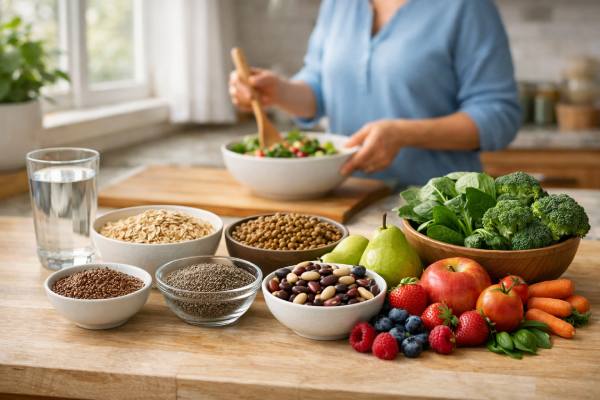
Constipation is often treated as a problem of “not enough laxatives,” but for many people it is first a problem of daily structure: too little fiber, too little fluid, and too little steady movement through the day. Fiber helps by increasing stool bulk, holding water in the stool, and supporting the intestinal patterns that make bowel movements feel easier and more complete. It can also reduce straining, which matters if you deal with hemorrhoids, fissures, or pelvic heaviness.
Still, fiber works best when it is added with strategy. The wrong type, the wrong dose, or a sudden jump can leave you feeling more bloated, crampy, and stuck. This article gives you an evidence-based way to choose fiber types, hit a realistic daily target, and build meals around high-fiber foods—without turning your gut into a daily experiment.
Key Insights
- A consistent fiber intake can improve stool softness, stool frequency, and straining over time, especially when your starting intake is low.
- Soluble, gel-forming fibers (not all “fiber” in general) tend to be the most reliable for constipation.
- Increasing fiber too quickly can worsen gas and discomfort, and adding fiber without enough fluid can backfire.
- A practical ramp is adding about 2–3 grams every few days while monitoring stool form and bloating.
- If constipation is new, severe, or paired with red-flag symptoms, do not rely on fiber alone to solve it.
Table of Contents
- Constipation and fiber basics
- How much fiber you need
- Choosing the right fiber types
- Best food sources and servings
- Increase fiber without more bloating
- When fiber is not enough
Constipation and fiber basics
Constipation is not only “not going often.” It is usually a mix of stool texture, stool volume, and how well your pelvic muscles coordinate. Many people meet the usual constipation definition through some combination of fewer bowel movements per week, hard or lumpy stools, straining, a sense of incomplete emptying, or a need to use manual maneuvers. The good news is that fiber can help several of these pieces at once—if you match the fiber strategy to your pattern.
Fiber is the part of plant foods that resists digestion in the small intestine. When it reaches the large intestine, it can do three important things:
- Hold water and soften stool (especially gel-forming fibers)
- Add bulk and shape, which can trigger a more effective “push” through the colon
- Feed beneficial gut microbes, creating short-chain fatty acids that influence motility and gut function
Constipation often appears when the “three movers” of stool fall out of balance:
- Stool water is too low (common with low fluid intake, sweating, or some medications).
- Stool bulk is too low (common with low plant-food intake, highly processed diets, or low appetite).
- Transit and coordination are off (common with sedentary routines, travel, stress, pelvic floor dysfunction, or certain medical conditions).
Fiber helps most when low stool bulk or low stool water is part of the problem. It can be less helpful, or even irritating, when constipation is driven mainly by pelvic floor dysfunction or very slow transit. That is why “just eat more fiber” sometimes fails: the advice is correct, but the details matter.
A practical way to think about fiber is as a tool you adjust, not a single goal you chase. The right dose makes stools softer and easier to pass. The wrong dose makes you feel swollen, gassy, or more backed up. Your job is not to maximize fiber overnight—it is to find your personal “sweet spot” and keep it steady.
How much fiber you need
If constipation is your focus, “How much fiber do I need?” has two answers: a general daily target for health, and a personal target that matches your symptoms and tolerance. Many adults fall well below the general target, and that gap alone can keep stools small, dry, and difficult to pass.
A useful starting target
A common guideline is about 14 grams of total fiber per 1,000 calories. For many adults, that translates to a daily range that looks like:
- About 25 grams per day for many adult women
- About 38 grams per day for many adult men
These are not strict “must hit” numbers, and you do not need to treat them like a pass-fail test. They are a practical way to estimate whether your current intake is likely to support regularity.
How to estimate your current intake in five minutes
You do not need an app to get a useful estimate. Try this quick audit:
- Look at a typical day and list your main plant items (fruit, vegetables, whole grains, beans, nuts, seeds).
- Add up fiber using labels for packaged foods and basic estimates for whole foods.
- If you consistently land under 15 grams, you are likely in the zone where increasing fiber can make a noticeable difference.
A second clue is stool size. If your bowel movements are small, pellet-like, or feel incomplete, you may not be generating enough stool bulk.
Constipation-specific aiming: a range, not a number
For constipation, many people do well when they reach the mid-20s to mid-30s grams per day, but symptom response matters more than the exact count. Your personal target is the highest intake that:
- Improves stool softness and ease of passage
- Does not create persistent bloating or cramping
- Is sustainable with your normal meals
If you are already near your target and still constipated, the issue may be fluid, movement, medication effects, pelvic floor coordination, or a need for a different approach entirely. Fiber is foundational, but it is not the only lever.
Two common mistakes
- Jumping from low fiber to very high fiber quickly (the gut often reacts with gas and discomfort).
- Adding fiber while fluid intake stays low (stool bulk increases, but stool water does not, and things can feel worse).
In the next sections, you will learn which fiber types are most reliable for constipation and how to raise intake without paying for it in bloating.
Choosing the right fiber types
All fiber is not the same, and constipation responds best to specific fiber properties. If you have ever tried “more whole grains” or “more salad” and felt worse, it may be because the fiber type did not match what your gut needed.
The three properties that matter most
When choosing fiber for constipation, focus on these features:
- Gel-forming (viscous) soluble fiber
This fiber mixes with water to form a soft gel. It tends to improve stool consistency and ease of passage because it holds onto water. A classic example is psyllium husk. - Insoluble, bulking fiber
This fiber stays more intact and adds structure and bulk. It can speed transit for some people, but in others—especially if stool is already hard or transit is slow—it can increase bulk without improving softness. - Fermentability (how much gut bacteria break it down)
Highly fermentable fibers can support the microbiome, but they also tend to produce more gas. For a constipation plan that avoids bloating, you often want some fermentable fiber, but not a sudden overload.
What tends to work best for constipation
Clinical trials most consistently support soluble, gel-forming fiber, especially when taken daily and given enough time. A practical rule is:
- If you want the most reliable “stool-softening and straining-reducing” option, start with gel-forming soluble fiber.
This is also why some people do better with oats, chia, and psyllium than with large doses of wheat bran or raw cruciferous salads.
Where people get tripped up
- Bran is not always gentle. Some forms of wheat bran are coarse and helpful, while very finely ground bran can sometimes harden stool for certain people.
- Inulin and similar prebiotic fibers can be gassy. They can help some people, but they are common triggers for bloating, especially when introduced quickly or at higher doses.
- A “high-fiber diet” can still be low in the right fibers. Many people eat lots of fiber from one lane (for example, rough insoluble fiber) without enough gel-forming fiber.
Food versus supplements
Food-based fiber comes with water, minerals, and phytonutrients, and it tends to spread fiber through the day. Supplements can be useful when you need a predictable dose, when appetite is low, or when you are trying to avoid trigger foods.
A balanced constipation plan often looks like this: build most fiber from food, then use a small daily dose of a gel-forming supplement if you need a steadier effect.
Best food sources and servings
The best fiber sources for constipation are the ones you will actually eat consistently. Instead of chasing “superfoods,” aim for a mix of soluble and insoluble fiber from a few dependable categories, then repeat them in simple rotations.
High-impact fiber categories
These are constipation-friendly staples, with approximate fiber amounts that help you build a day:
- Beans and lentils: about 6–9 grams per 1/2 cup cooked
- Berries (especially raspberries and blackberries): about 6–8 grams per cup
- Pears and apples (with skin if tolerated): about 4–6 grams per medium fruit
- Oats: about 4–5 grams per 1/2 cup dry oats (before cooking)
- Chia seeds: about 8–10 grams per 2 tablespoons
- Ground flaxseed: about 3–4 grams per 1 tablespoon
- Potatoes with skin: about 3–4 grams per medium potato
- Whole-grain bread: about 2–4 grams per slice (varies widely)
You do not need all of these daily. Pick two or three “anchors” you enjoy and tolerate, then add one or two smaller fiber boosts.
Constipation-friendly meal templates
Here are practical combinations that often work well:
- Breakfast: oats cooked soft plus chia or ground flax, topped with berries
- Lunch: grain bowl with a modest portion of beans, cooked vegetables, and olive oil
- Snack: pear or kiwi with a small handful of nuts
- Dinner: roasted potatoes or brown rice plus a serving of cooked greens and a protein
Cooked vegetables are often easier than raw vegetables when you are trying to increase fiber without bloating. Cooking softens plant cell walls, reduces chew burden, and can make meals feel less “gassy” while still delivering fiber.
Fiber additions that are small but powerful
If you struggle to add volume to meals, use “micro-adds”:
- 1 tablespoon ground flax in yogurt or oatmeal
- 2 tablespoons chia soaked into pudding or stirred into oats
- 1/2 cup beans blended into soup (smoother texture can feel gentler)
- A side of berries most days rather than occasional large servings
What about prunes and dried fruit?
Dried fruit can help constipation because it offers fiber and naturally occurring compounds that draw water into the bowel. The tradeoff is that dried fruit can be highly fermentable and may cause gas if you overdo it. A measured approach is better than a large serving: try a small portion daily for a week and adjust based on response.
The best plan is the one you can repeat. Regularity is built from steady inputs, not occasional extreme “fiber days.”
Increase fiber without more bloating
The most common reason people abandon fiber is not that it fails—it is that they add it too quickly. Your gut needs time to adapt to higher stool volume and to changes in fermentation. A slow ramp avoids the “bloating tax” and helps you identify which foods truly work for you.
A gentle ramp that protects comfort
If your current intake is low, aim to increase by about 2–3 grams every few days. That can be as simple as adding one small fiber item at a time, such as:
- Day 1–3: add 1 tablespoon ground flax to breakfast
- Day 4–6: add one fruit serving (pear, berries, or kiwi)
- Day 7–9: add 1/2 cup beans at lunch or dinner
- Day 10–12: add oats or a whole-grain swap
- Day 13–14: reassess stool softness, straining, and bloating
If stools get softer and easier, hold steady. If bloating rises, do not keep stacking fiber; pause and stabilize.
Use the stool-and-bloat feedback loop
A simple tracking method is:
- Stool texture: harder than ideal means you likely need more water-holding fiber or more fluid.
- Straining: persistent straining suggests you need softer stool, better timing, or pelvic floor coordination support.
- Bloating: rising bloating often means fermentable fiber increased too fast, meal size is too large, or constipation is still causing trapped gas.
A key insight: bloating sometimes improves after you address constipation consistently, because gas becomes easier to pass once stool moves regularly.
Hydration and fiber: how to pair them
Fiber works by interacting with water. Practical hydration does not require perfection, but it does require consistency. Helpful signs include lighter-colored urine, fewer hard stools, and less “dry” straining.
If you use a fiber supplement, always take it with a full glass of water and avoid taking it right before lying down. If you have swallowing issues or a history of intestinal narrowing, supplements should be discussed with a clinician.
Choose lower-gas preparation styles
To reduce gas while still increasing fiber:
- Prefer cooked vegetables over large raw salads during your ramp.
- Soak and rinse legumes, or start with smaller portions.
- Spread fiber across the day instead of concentrating it in one meal.
- Consider gentler fibers first (oats, chia, psyllium) before highly fermentable add-ons.
Where supplements fit
If food alone is not enough, a gel-forming supplement can provide a consistent base. A practical dosing approach is to start small and build slowly, aiming for the lowest dose that improves stool softness and ease. Many people do best with split doses taken with meals and plenty of water.
When fiber is not enough
Fiber is often the right first move, but it is not a universal solution. If constipation persists despite steady fiber, it usually means one of the other drivers is still active. Recognizing these situations early can save you months of frustration.
Signs you may need a different approach
Consider expanding beyond fiber if you notice:
- No meaningful improvement after 3–4 weeks of a stable, tolerable fiber increase
- Ongoing hard stools despite good fiber intake, suggesting fluid balance or medication effects
- A strong sense of blockage or incomplete evacuation even when stool is soft, suggesting pelvic floor coordination issues
- Constipation that began after starting a new medication or supplement
Medications and supplements that commonly contribute to constipation include certain pain medicines, iron, some antihistamines, some antidepressants, some blood pressure medicines, and calcium supplements. If timing matches, ask whether an alternative exists.
When slow transit or pelvic floor patterns dominate
If stool moves slowly through the colon, simply adding bulk can increase discomfort. If pelvic floor muscles do not relax correctly during a bowel movement, stool can be “held back” even when it is soft. In both cases, fiber is supportive but not sufficient on its own. Treatment may involve targeted bowel regimens, pelvic floor therapy, or evaluation for underlying conditions.
Red flags that should not be managed with diet alone
Seek medical evaluation promptly if constipation is new or worsening and you also have:
- Blood in stool or black stools
- Unintentional weight loss, anemia, fever, or persistent vomiting
- Severe or escalating abdominal pain
- A major change in bowel habits lasting weeks
- Symptoms that regularly wake you from sleep
These signs do not automatically mean something serious is happening, but they do mean you should not rely on a self-directed fiber plan as the only response.
A balanced view of next steps
If fiber helps but does not fully solve constipation, that is still a win. It often reduces straining and supports long-term gut health even when you also need additional tools. The most effective constipation plans are layered: steady fiber, adequate fluid, daily movement, a predictable bathroom routine, and targeted therapies when needed.
References
- American Gastroenterological Association-American College of Gastroenterology Clinical Practice Guideline: Pharmacological Management of Chronic Idiopathic Constipation – PMC 2023 (Guideline)
- The Effect of Fiber Supplementation on Chronic Constipation in Adults: An Updated Systematic Review and Meta-Analysis of Randomized Controlled Trials – PMC 2022 (Systematic Review and Meta-Analysis)
- Effects of Dietary Fiber Supplementation on Chronic Constipation in the Elderly: A Systematic Review and Meta-Analysis of Randomized Controlled Trials – PMC 2025 (Systematic Review and Meta-Analysis)
- The Role of Dietary Fiber in Health Promotion and Disease Prevention: A Practical Guide for Clinicians – StatPearls – NCBI Bookshelf 2025 (Review)
Disclaimer
This article is for educational purposes and does not provide medical advice, diagnosis, or treatment. Constipation can have many causes, including medication effects, pelvic floor dysfunction, endocrine or neurologic conditions, and gastrointestinal disease. If you have severe pain, vomiting, fever, blood in stool, black stools, unexplained weight loss, anemia, or a new and persistent change in bowel habits, seek medical care promptly. If you are pregnant, immunocompromised, have swallowing difficulties, or have a history of intestinal narrowing or bowel obstruction, consult a clinician before using fiber supplements or making major dietary changes.
If this guide was helpful, please consider sharing it on Facebook, X (formerly Twitter), or any platform you prefer.