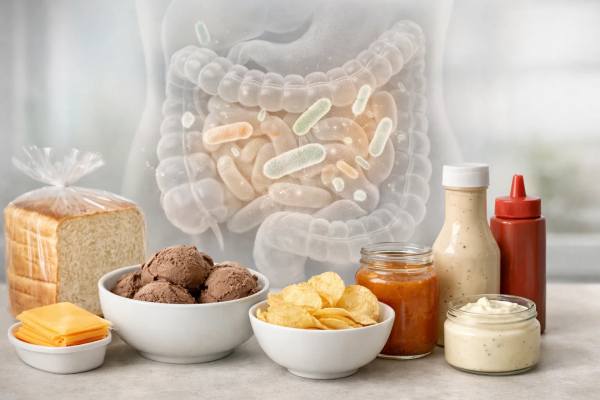
Emulsifiers are one of those “quiet” ingredients that can shape how a food behaves in your mouth and, potentially, how it behaves in your gut. They help keep oil and water mixed, stabilize foams, and prevent separation—useful traits for salad dressings, ice cream, and many packaged foods. In recent years, certain synthetic emulsifiers—notably carboxymethylcellulose and polysorbate 80—have raised questions because of how they interact with gut microbes and the protective mucus layer in experimental models.
The most important nuance is that the science is not one-size-fits-all. Much of what sparked concern came from lab and animal research using controlled exposures. Human studies are fewer and tend to be small, short, and sometimes mixed in their results. Still, the research offers practical lessons about who might consider reducing specific emulsifiers and how to do it without slipping into overly restrictive eating.
Essential Insights
- Not all emulsifiers behave the same; carboxymethylcellulose and polysorbate 80 are the most studied for potential gut effects.
- Experimental research suggests some emulsifiers can shift microbiome activity and disturb the mucus barrier in susceptible settings.
- Human evidence is limited and mixed, so the most reasonable approach is targeted reduction rather than fear-based avoidance.
- A practical trial is a 2–4 week “lower-emulsifier” eating pattern while tracking symptoms and maintaining fiber and protein intake.
Table of Contents
- Why emulsifiers are in foods
- Carboxymethylcellulose and polysorbate 80 explained
- What laboratory and animal studies suggest
- What human research shows so far
- How emulsifiers might affect the gut
- Practical steps and safety basics
Why emulsifiers are in foods
Emulsifiers solve a basic problem: oil and water do not naturally stay mixed. If you shake a vinaigrette, it separates again because the two phases want to pull apart. Emulsifiers reduce surface tension and help create a stable mixture—one reason they are common in dressings, sauces, nut butters, flavored beverages, and dairy-like products.
What they do in real-world products
In packaged foods, emulsifiers can improve:
- Texture: creamier mouthfeel, smoother spreads, less “grittiness.”
- Stability: fewer ice crystals in frozen desserts, less separation in sauces.
- Shelf life: longer time before a product becomes watery, clumpy, or stale.
- Consistency across batches: important for large-scale manufacturing.
It helps to know that emulsifier is a function, not a single ingredient. Some emulsifiers are familiar cooking allies—egg yolk in mayonnaise is a classic example. Others are extracted from plant sources (like lecithins) or made through industrial processing (like polysorbates).
Why labeling can be confusing
Many people expect to see the word “emulsifier” on a label, but ingredient lists usually show the specific compound instead. You might also see emulsifiers grouped with stabilizers, thickeners, or gums. That matters because someone can avoid a couple of targeted ingredients while still eating a varied diet.
A practical way to think about it is: the more a food is engineered to stay perfectly uniform, the more likely it is to contain at least one emulsifier or stabilizer. That does not automatically make the food harmful—it simply signals that the product relies on additives to achieve a certain texture.
Not all emulsifiers deserve equal attention
The concern around gut health is not spread evenly across all emulsifiers. Carboxymethylcellulose and polysorbate 80 stand out because they have been used repeatedly in experiments that measure microbiome changes, mucus barrier effects, and inflammation-related outcomes. Other emulsifiers (including some lecithins) have shown less consistent signals in similar models.
A balanced take is this: emulsifiers are common because they work, but the specific emulsifier, the dose, the food matrix, and the person’s baseline gut environment all appear to influence whether they matter.
Carboxymethylcellulose and polysorbate 80 explained
Carboxymethylcellulose and polysorbate 80 are often discussed together, but they are chemically and functionally different. What they share is that they are widely used in processed foods and are frequently studied in gut-focused research.
Carboxymethylcellulose in plain language
Carboxymethylcellulose is a modified form of cellulose (the structural fiber in plants). You may also see it listed as cellulose gum or sodium carboxymethylcellulose. In foods, it acts as a thickener and stabilizer—helping products feel smooth and consistent.
Common places it appears include:
- Creamy beverages and coffee drinks
- Sauces, gravies, and some salad dressings
- Frozen desserts and certain dairy-like alternatives
- Processed baked goods where moisture retention matters
Because it is a cellulose-derived compound, many people assume it behaves like dietary fiber. That is not a safe assumption. Some forms are not fermented like classic fibers, and its physical properties (including how it interacts with water and surfaces) can be quite different from whole-food plant fibers.
Polysorbate 80 basics
Polysorbate 80 is a surfactant-like emulsifier used to keep mixtures stable, especially when fats, flavors, or color compounds would otherwise separate. It is sometimes used in:
- Ice cream and whipped toppings
- Flavor-rich sauces and dressings
- Certain baked goods and fillings
- Some meal replacements and protein drinks
Polysorbate 80 can also appear in non-food products (for example, pharmaceuticals and personal care). That does not prove it is harmful in foods, but it does mean exposure can come from multiple sources.
What makes these two “research magnets”
These ingredients are repeatedly used in studies for a few reasons:
- They are chemically consistent and easy to dose in controlled settings.
- They can reach the gut lumen (the interior space of the intestine), which is where microbes and mucus barriers interact with food components.
- They are functional at low concentrations, so even small amounts can plausibly affect the physical environment of the gut contents.
A key limitation for real-life interpretation is that ingredient labels rarely show the amount used. That makes it hard to translate experimental doses into everyday exposure. So, when you see headlines about these emulsifiers, the most important question is not just “Is it present?” but “What is the realistic exposure, and in whom?”
What laboratory and animal studies suggest
The modern concern about emulsifiers and gut health largely began with animal and lab studies designed to answer a focused question: can certain emulsifiers change the microbiome or the gut barrier in ways that resemble inflammatory conditions?
Signals seen in experimental models
Across multiple experimental approaches, researchers have observed patterns such as:
- Shifts in microbiome composition and microbial gene activity
- Changes in microbial byproducts that can influence immune signaling
- Thinning or disruption of the mucus layer in some models
- Inflammation-like changes in susceptible animals
In several rodent studies, emulsifier exposure was associated with features that resemble low-grade gut inflammation or worsened colitis in predisposed settings. In lab systems that use human stool communities grown outside the body, some emulsifiers appeared to push microbes toward producing more inflammation-linked molecules.
These findings are worth attention because the gut’s protective design relies on distance. The mucus layer and epithelial barrier help keep dense microbial communities from directly interacting with immune cells. If anything routinely reduces that buffer, it becomes a plausible mechanism for irritation or immune activation in people already prone to gut symptoms.
Why animal and lab data can overestimate risk
Even strong experimental signals do not automatically translate to everyday human harm. There are several reasons:
- Dose and exposure pattern: animals may receive a consistent dose daily, sometimes at levels that exceed typical human exposure.
- Food matrix effects: many experiments deliver emulsifiers in water or simplified diets, not embedded in complex meals.
- Microbiome differences: rodents and humans share some microbial functions, but community structure and baseline resilience can differ.
- Susceptibility matters: inflammation-prone animals may react in ways that healthy humans do not.
In other words, experimental studies are excellent for identifying “what could happen” and mapping mechanisms. They are less reliable for answering “what usually happens” in a typical diet.
How to interpret the experimental evidence responsibly
A practical interpretation looks like this:
- The concern is plausible—especially regarding mucus barrier interactions and microbiome shifts.
- The strength of evidence is higher for mechanisms than for real-world clinical outcomes.
- The risk, if present, is likely unevenly distributed, affecting some people more than others.
This sets the stage for human research: do these signals show up when real people eat real food patterns, and do they translate to symptoms or measurable gut changes?
What human research shows so far
Human data is the part most people care about—and it is also where the story becomes more nuanced. Compared with animal studies, human trials are harder to run: you need tightly controlled diets, careful monitoring, and enough participants to detect modest effects.
Controlled-feeding studies in healthy adults
In a controlled-feeding design, researchers provide most or all food so that the diet is consistent except for the ingredient being tested. This matters because gut outcomes can change simply from altering fiber intake, fat type, or overall food processing.
Short controlled-feeding work with carboxymethylcellulose suggests that responses may include:
- Measurable shifts in microbiome features and stool metabolites in some participants
- Increased gut symptoms in a subset (for example, bloating or discomfort)
- Signs that not everyone responds the same way, even on the same diet
That variability is one of the most clinically useful takeaways. It supports a model where emulsifiers may act more like a “stressor” than a universal toxin: some guts adapt easily, while others show clearer changes.
Studies in inflammatory bowel disease contexts
People with Crohn’s disease or ulcerative colitis often ask whether avoiding emulsifiers can reduce flares. Recent controlled diet work in Crohn’s disease, structured as a blinded feeding trial comparing diets higher versus lower in emulsifiers, did not show a clear short-term advantage of the low-emulsifier approach when both diets were otherwise designed to be broadly healthful.
That result does not prove emulsifiers are irrelevant. It does suggest that:
- The overall dietary pattern (fiber, food quality, balance) may outweigh the effect of emulsifier content in the short term.
- Short trials may miss longer-term effects, especially if the baseline diet was already relatively improved.
- “Emulsifiers” as a category may be too broad; the effect might depend on specific compounds, combinations, and doses.
What is still unknown
Human research is still limited in ways that matter:
- Many trials are small and short.
- Real-life diets contain multiple additives, not one.
- Labels do not disclose additive amounts, making exposure tracking difficult.
- Outcomes vary: symptoms, stool markers, imaging, and microbiome data do not always move together.
A grounded conclusion is that human evidence supports cautious interest, not certainty. If you are symptom-prone, a personalized trial can be reasonable. If you are symptom-free, there is no strong basis for alarm—especially if your diet is rich in minimally processed foods.
How emulsifiers might affect the gut
To understand why emulsifiers draw attention, it helps to zoom in on how the gut is organized. The intestine is not only a tube for digestion—it is a barrier surface with a complex ecosystem on one side (microbes) and immune tissue on the other.
Mucus layer and microbial “distance”
One recurring hypothesis is that some emulsifiers may reduce the protective separation between microbes and the intestinal lining. The mucus layer is partly built from mucin proteins and acts like a selective filter. When that layer is altered, microbes can get closer to the epithelium, increasing immune stimulation in people who are sensitive.
This does not require an emulsifier to “kill” bacteria. A smaller physical change—like shifting how microbes cluster or how mucus behaves—could be enough to change the immune tone of the gut.
Microbiome shifts and fermentation patterns
The microbiome thrives on what you do not digest—especially diverse fibers and resistant starches. In a diet low in fermentable fibers, microbes may rely more on mucus-derived sugars and proteins, which can make the mucus layer more vulnerable over time.
In that context, an emulsifier might function as a second hit:
- A lower-fiber baseline reduces microbial diversity and resilience.
- The emulsifier changes microbial activity or surface interactions.
- The combined effect increases gas, bloating, stool changes, or low-grade inflammation signals.
This helps explain why emulsifiers are rarely discussed in isolation by clinicians focused on gut health. The additive may matter most when the diet is already skewed toward ultra-processed patterns and low plant diversity.
Barrier function and permeability
People often use the term “leaky gut,” but the more precise concept is altered intestinal permeability and barrier regulation. The gut barrier is dynamic: tight junction proteins and immune signals change day to day. Some experimental work suggests emulsifiers could influence this regulation, but in humans the signal may be subtle and context-dependent.
Stress, bile acids, and symptom perception
Gut symptoms are not purely mechanical. Stress can change motility, secretion, and visceral sensitivity. Some evidence suggests that diet patterns higher in additives may interact with stress responses, which could amplify symptoms even when inflammation markers are stable.
Bile acids are another piece. Because emulsifiers interact with fats and water, they can influence how fats are dispersed in the gut and potentially how bile acids circulate and are metabolized by microbes—an area that is promising but not yet clinically settled.
The big picture: emulsifiers are plausible “modifiers” of the gut environment. Whether that becomes a problem depends on dose, diet quality, and individual susceptibility.
Practical steps and safety basics
If you are curious about emulsifiers and symptoms, the most helpful approach is structured and calm: aim for clarity, not perfection. The goal is to learn whether reducing specific emulsifiers improves how you feel—without creating nutrient gaps or food anxiety.
Who might consider a trial reduction
A lower-emulsifier trial may be worth considering if you have:
- Persistent bloating, abdominal discomfort, or unpredictable stool patterns
- A diagnosed inflammatory bowel condition and you are testing dietary triggers alongside medical care
- A history of heightened sensitivity to ultra-processed foods
- A desire to reduce additives as part of an overall diet upgrade (more whole foods, more plants)
If you are pregnant, underweight, have a history of disordered eating, or have complex medical conditions, it is wise to involve a clinician or dietitian before any restriction-focused plan.
A sensible 2–4 week experiment
Try this structure:
- Pick a narrow target: focus on avoiding carboxymethylcellulose (cellulose gum) and polysorbate 80 first, rather than “all additives.”
- Keep the diet nourishing: include adequate protein and calories; do not replace processed foods with “nothing.”
- Track basics daily: symptoms, stool frequency and form, and any major stress or sleep disruptions.
- Reassess at week 2 and week 4: look for trends, not single-day changes.
If symptoms improve, you have useful data. If nothing changes, that is also useful—you can move on to more likely triggers (fiber type, lactose, fermentable carbohydrates, fat load, meal timing).
How to lower exposure without missing nutrients
Practical swaps that preserve nutrition:
- Choose plain yogurt, kefir, or simple dairy alternatives with short ingredient lists.
- Use olive oil, vinegar, mustard, and herbs for homemade dressings.
- Pick breads with fewer additives and pair with fiber-rich fillings (beans, vegetables, eggs, fish).
- Build snacks around fruit, nuts, cheese, hummus, or leftovers rather than packaged bars and desserts.
Also consider what not to do: do not remove entire food groups unless you have a clear reason and a replacement plan.
Safety reminders
- Do not stop prescribed IBD or other medications because of dietary changes.
- Seek medical advice promptly for red flags such as unintentional weight loss, blood in stool, persistent fever, nighttime diarrhea, or severe pain.
- Avoid turning “clean labels” into a moral test. For gut health, consistency and adequacy beat purity.
A lower-emulsifier pattern is best viewed as one tool—most effective when paired with a diet that is rich in whole foods and diverse plant fibers.
References
- Randomized Controlled-Feeding Study of Dietary Emulsifier Carboxymethylcellulose Reveals Detrimental Impacts on the Gut Microbiota and Metabolome 2022 (RCT). ([PMC][1])
- Clinical Trial: The Effects of Emulsifiers in the Food Supply on Disease Activity in Crohn’s Disease: An Exploratory Double‐Blinded Randomised Feeding Trial 2025 (RCT). ([PMC][2])
- Direct impact of commonly used dietary emulsifiers on human gut microbiota 2021 (Experimental human microbiota model). ([PMC][3])
- Food Additives: Emerging Detrimental Roles on Gut Health 2025 (Review). ([PMC][4])
- Dietary emulsifiers impact the mouse gut microbiota promoting colitis and metabolic syndrome 2015 (Preclinical study). ([PMC][5])
Disclaimer
This article is for educational purposes and does not provide medical advice, diagnosis, or treatment. Research on emulsifiers and gut health is evolving, and findings from laboratory and animal studies do not always apply directly to real-world human diets. If you have ongoing digestive symptoms, inflammatory bowel disease, unexplained weight loss, blood in stool, or any severe or persistent symptoms, seek individualized guidance from a qualified healthcare professional. Do not start, stop, or change prescribed medications based on dietary information alone.
If you found this helpful, consider sharing it on Facebook, X (formerly Twitter), or any platform you prefer so others can read and decide what fits their needs.