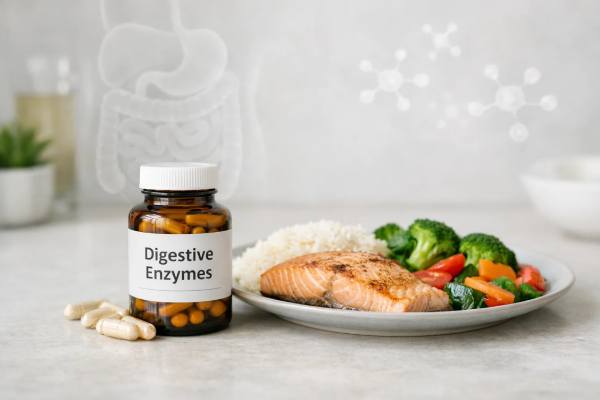
Digestive enzymes sit at the crossroads of two very different worlds: essential prescription therapy for people who cannot properly absorb nutrients, and a booming supplement category marketed for everyday bloating and “slow digestion.” That overlap creates confusion. Enzymes are not vitamins you can simply “top up.” They are proteins that need the right target, the right dose, and the right timing to matter. When the match is correct—such as pancreatic enzyme replacement for true pancreatic insufficiency—benefits can be substantial, including better stool quality, improved nutrition, and less meal-related distress. When the match is wrong, enzymes may do nothing, irritate symptoms, or delay diagnosis of a problem that needs medical care. This article clarifies what digestive enzymes actually do, who is most likely to benefit, which over-the-counter options are reasonable to trial, and when enzymes are a poor fit or should be avoided.
Key Insights
- Targeted enzyme therapy can meaningfully improve nutrient absorption in confirmed enzyme deficiencies, especially pancreatic exocrine insufficiency.
- Over-the-counter multi-enzyme blends may help select symptoms (often upper abdominal heaviness), but effects are inconsistent and product quality varies.
- Avoid unsupervised enzyme use with persistent weight loss, anemia symptoms, severe pain, or ongoing diarrhea, since these need evaluation.
- If you trial an enzyme, use it with the first bites of a meal for 7–14 days and track specific symptoms to judge whether it truly helps.
Table of Contents
- What digestive enzymes actually do
- Who truly needs enzyme replacement
- Targeted enzymes for common food triggers
- Over-the-counter blends what to expect
- When to avoid or use caution
- How to choose and use enzymes well
What digestive enzymes actually do
Digestive enzymes are proteins that break large food molecules into smaller pieces your body can absorb. Think of them as specialized scissors: each one cuts a specific type of chemical bond. If you have enough of the right enzymes in the right place at the right time, digestion runs smoothly. If you do not, food may pass through partially digested, leading to symptoms and—more importantly—nutrient deficiencies over time.
The main enzyme jobs
Your digestive system relies on a coordinated set of enzymes:
- Amylases break down starches into smaller sugars.
- Proteases break proteins into peptides and amino acids.
- Lipases break fats into fatty acids and monoglycerides.
- Disaccharidases (such as lactase) break specific sugars into absorbable units.
Many enzymes are produced in the mouth and stomach, but the pancreas is the major “enzyme factory” for digestion. When pancreatic output is low—or when enzymes cannot mix with food properly—fat digestion often suffers first, because lipase is especially sensitive to disruption.
Why timing and location matter more than most people realize
Enzymes are not like probiotics that may act broadly in the gut environment. They need contact with the food they are meant to digest. If an enzyme capsule dissolves too early, too late, or not at all, it may have little effect. That is why some prescription pancreatic enzymes are designed with coatings so enzymes are released where they can work best.
The stomach’s acidity also matters. Many enzymes are degraded by strong acid. Some supplement formulas add coatings or include enzymes that tolerate a wider pH range, but these features are not standardized across products. This is one reason why people can have wildly different results with two products that appear similar.
Symptoms are not proof of enzyme deficiency
Bloating, gas, and indigestion are common. They can come from reflux, constipation, food intolerances, gut-brain sensitivity, medication effects, infections, or inflammation—none of which automatically indicate a missing enzyme. Enzyme deficiency is most likely when symptoms cluster with signs of malabsorption, such as greasy stools, persistent diarrhea, weight loss, and nutrient deficiencies. When those are present, it is more important to identify the cause than to experiment.
Who truly needs enzyme replacement
The clearest, highest-value use of digestive enzymes is replacement therapy for people who cannot produce enough of their own enzymes. In these cases, enzymes are not a “wellness upgrade.” They are a core medical treatment that can improve nutritional status and quality of life.
Pancreatic exocrine insufficiency is the main medical indication
Pancreatic exocrine insufficiency means the pancreas does not deliver enough digestive enzymes to the small intestine to digest food normally. Over time, this can lead to maldigestion and malabsorption—especially of fat. Common contexts include:
- Chronic pancreatitis
- Pancreatic cancer
- Pancreatic surgery (partial or total removal, or procedures that alter normal enzyme delivery)
- Cystic fibrosis
- Severe acute pancreatitis with significant pancreatic damage
In these situations, pancreatic enzyme replacement therapy is often used alongside nutrition support and symptom monitoring. The goal is not just to reduce diarrhea or bloating, but to prevent ongoing nutrient loss and weight decline.
Clues that raise suspicion for true malabsorption
Enzyme deficiency is more likely when you notice a pattern like:
- Stools that are pale, bulky, greasy, unusually foul-smelling, or difficult to flush
- Ongoing diarrhea that persists despite simple diet changes
- Unintentional weight loss or muscle loss
- Fat-soluble vitamin deficiencies (A, D, E, K) or easy bruising
- Worsening symptoms after higher-fat meals
- A history of pancreatic disease, pancreatic surgery, or cystic fibrosis
These clues do not confirm a diagnosis, but they are strong reasons to seek evaluation rather than relying on supplements.
Why prescription therapy differs from over-the-counter enzymes
Prescription pancreatic enzymes are standardized and dosed based on lipase activity. They are designed to work reliably with meals and snacks, and dosing is adjusted based on stool symptoms, weight trends, and nutrition markers. Over-the-counter products, by contrast, may contain different enzymes, variable potencies, and ingredients that are not suited for true pancreatic insufficiency.
If you have a known pancreatic condition, it is usually best to treat enzymes as part of a medical plan rather than a self-directed supplement experiment. Getting the dose right can be the difference between “still struggling” and meaningful improvement.
Targeted enzymes for common food triggers
Not all enzyme use is medical replacement. Some enzymes are best understood as targeted tools for specific foods. This approach can be reasonable when symptoms are predictable, the trigger is clear, and there are no warning signs of broader disease.
Lactase for lactose intolerance
Lactase breaks lactose (milk sugar) into glucose and galactose. If you have lactose malabsorption, lactose can draw water into the intestine and be fermented by gut bacteria, leading to gas, cramping, and diarrhea.
Lactase can help when your symptoms are clearly tied to lactose-containing foods. Its success depends on practical details:
- Dose matters: a small dose may help with a splash of milk but fail with ice cream or a large serving of milk.
- Timing matters: take it with the first bites of dairy.
- Food context matters: hard cheeses and lactose-free dairy may reduce the need for lactase.
A useful mindset is “lactase as a seatbelt, not a license.” If you routinely exceed your tolerance, symptoms may persist even with supplementation.
Alpha-galactosidase for bean and vegetable gas
Alpha-galactosidase helps break down certain complex carbohydrates found in beans and some vegetables. These carbohydrates are otherwise fermented by gut bacteria, producing gas. For people who get predictable gas and bloating after beans or similar foods, this enzyme can be a practical, meal-specific option.
However, results vary—especially in people with irritable bowel symptoms, where bloating may be driven more by gut sensitivity and motility than by gas volume alone. It can still be worth trialing when the trigger foods are specific and consistent.
Other targeted enzymes that sometimes apply
Some people have less common carbohydrate digestion issues, including specific disaccharidase deficiencies. In those scenarios, a clinician may recommend targeted approaches or testing. This is one reason to be cautious with self-diagnosis: symptoms can look similar across very different conditions.
For targeted enzyme use, the standard for success should be clear and measurable: fewer symptoms after a known trigger food, without needing broad dietary restriction. If the effect is inconsistent or you find yourself escalating doses across many meals, it is a sign to step back and reassess the underlying cause.
Over-the-counter blends what to expect
Over-the-counter digestive enzyme blends typically combine amylase, protease, lipase, and sometimes additional enzymes marketed for fiber, dairy, or plant proteins. These products are most often used for post-meal heaviness, “food sitting,” occasional bloating, or mild indigestion—not for proven malabsorption.
Who might reasonably consider a short trial
A short, structured trial is most defensible when symptoms are:
- Mild to moderate and clearly meal-related
- Focused in the upper abdomen (fullness, heaviness, nausea, belching)
- Worse with larger or higher-fat meals
- Not accompanied by weight loss, anemia symptoms, persistent diarrhea, or severe pain
In this context, enzymes may help by improving breakdown of macronutrients or by supporting a smoother digestive experience. Some clinical studies of multi-enzyme blends suggest improvements in functional dyspepsia symptoms for certain people, though the evidence is not uniform across products.
Who is unlikely to benefit
Enzyme blends are less likely to help when the primary drivers are:
- Constipation-related bloating and distention
- Significant reflux or burning pain as the main symptom
- High sensitivity to normal gut stretching (common in irritable bowel disorders)
- Food reactions driven by immune mechanisms rather than digestion (such as true food allergy)
They are also unlikely to solve bloating that is mainly caused by meal size, fast eating, carbonated beverages, or high intake of fermentable carbohydrates. In those situations, enzymes can become an expensive substitute for simpler, more effective changes.
Quality and labeling are real limitations
With supplements, the challenge is not only whether enzymes could work in theory, but whether the product delivers consistent potency. Labels may list enzyme types and activities, but standards vary. Blends may also include herbs, sweeteners, or acids that influence tolerance.
A practical way to keep expectations realistic is to treat over-the-counter enzymes as a time-limited experiment. If you do not see a meaningful difference in 1–2 weeks, it is reasonable to stop rather than continuing indefinitely “just in case.”
When to avoid or use caution
Digestive enzymes can be helpful, but they can also be the wrong tool—or an unsafe tool—depending on your symptoms, medical history, and medications. The highest-risk mistake is using enzymes to self-manage symptoms that require diagnosis.
Do not self-treat red-flag symptoms
Avoid relying on enzymes and seek medical evaluation if you have:
- Unintentional weight loss or ongoing poor appetite
- Persistent diarrhea lasting more than 2–3 weeks
- Greasy stools, pale bulky stools, or signs of nutrient deficiency
- Blood in stool, black stools, or vomiting blood
- Progressive difficulty swallowing, persistent vomiting, or severe abdominal pain
- Symptoms that wake you at night or steadily worsen over weeks
These patterns can signal inflammation, infection, malabsorption disorders, gallbladder disease, or other conditions where delaying evaluation is the real risk.
Use caution with allergies and sensitivities
Enzymes are often derived from animal or microbial sources. If you have allergies or asthma, be cautious with products derived from molds or fungi, and be alert to itching, hives, wheezing, or facial swelling. Anyone with a history of severe allergic reactions should approach new supplements conservatively and consider discussing with a clinician first.
Pregnancy, breastfeeding, and children
Because supplement formulations vary and safety data are limited, routine use during pregnancy or breastfeeding should be approached with professional guidance. In children, dosing is not straightforward and symptoms like poor growth, diarrhea, or abdominal pain deserve evaluation rather than guesswork.
Medication interactions and medical complexity
If you take anticoagulants, immunosuppressants, or multiple prescription medications, it is wise to check compatibility before adding a supplement. Even when direct interactions are uncommon, enzymes and combination products may include additional ingredients that affect bleeding risk, blood pressure, or stomach irritation.
Finally, if you have a known pancreatic condition or have had pancreatic surgery, avoid substituting over-the-counter products for prescription therapy. Under-dosing can look like “enzymes do not work,” when the real issue is that the therapy is not matched to clinical needs.
How to choose and use enzymes well
If you decide enzymes are worth trying—or if you are already taking them—the biggest improvements often come from better targeting and better technique rather than switching brands repeatedly.
Step 1 clarify your goal
Be specific. “Better digestion” is hard to measure. Choose a short list of outcomes such as:
- Less post-meal fullness
- Fewer episodes of belching
- Less cramping after a known trigger food
- More normal stool consistency after meals
If you cannot define the goal, it is hard to judge whether the enzyme is helping or simply becoming part of your routine.
Step 2 match the enzyme to the problem
- If symptoms follow dairy reliably, consider lactase with dairy meals.
- If symptoms follow beans or certain vegetables, consider alpha-galactosidase with those meals.
- If you have clear risk factors for malabsorption, prioritize medical evaluation for pancreatic exocrine insufficiency or other causes rather than self-treating.
For multi-enzyme blends, remember they are best suited for mild, meal-related discomfort—not for chronic, progressive symptoms.
Step 3 use correct timing
Enzymes should meet the food. A practical rule is:
- Take enzymes with the first bites of a meal.
- If a meal is long, some people split the dose, taking part at the start and part mid-meal (following label guidance).
- For snacks, use a smaller dose if the product instructions support it.
Taking enzymes long before or after eating is a common reason for disappointing results.
Step 4 run a structured trial and then decide
A useful trial looks like this:
- Choose one product and one clear symptom goal.
- Use it consistently for 7–14 days with the meals most likely to trigger symptoms.
- Record a simple daily score (0–10) for two or three symptoms.
- Stop if symptoms worsen, and stop if there is no meaningful improvement by the end of the trial.
Continuing indefinitely without evidence of benefit is a quiet cost—financially and diagnostically.
When to involve a clinician even if enzymes help
If enzymes provide partial relief but symptoms persist, that can still be useful information for a clinician. It may suggest issues such as food intolerance patterns, functional dyspepsia, or impaired digestion under certain conditions. The goal is not to “prove” enzymes are necessary, but to map your symptoms accurately and protect your long-term health.
References
- European guidelines for the diagnosis and treatment of pancreatic exocrine insufficiency: UEG, EPC, EDS, ESPEN, ESPGHAN, ESDO, and ESPCG evidence‐based recommendations 2024 (Guideline)
- Consensus for the management of pancreatic exocrine insufficiency: UK practical guidelines 2021 (Guideline)
- Lactose Intolerance and Malabsorption Revisited: Exploring the Impact and Solutions 2025 (Review)
- Efficacy of digestive enzyme supplementation in functional dyspepsia: A monocentric, randomized, double-blind, placebo-controlled, clinical trial 2023 (RCT)
- A randomized double-blind placebo-controlled crossover pilot study: Acute effects of the enzyme α-galactosidase on gastrointestinal symptoms in irritable bowel syndrome patients 2021 (RCT)
Disclaimer
This article is for educational purposes and does not replace personalized medical advice, diagnosis, or treatment. Digestive symptoms can have many causes, and using supplements may delay evaluation of conditions that require medical care. Seek urgent care for severe or worsening abdominal pain, persistent vomiting, black stools, blood in stool, dehydration, fainting, or signs of allergic reaction. If you have unintentional weight loss, ongoing diarrhea, greasy stools, anemia symptoms, difficulty swallowing, or a history of pancreatic disease or surgery, consult a qualified clinician before starting or changing enzyme therapy.
If you found this article helpful, please share it on Facebook, X (formerly Twitter), or any platform you prefer so others can make safer, better-informed decisions about digestive enzymes.