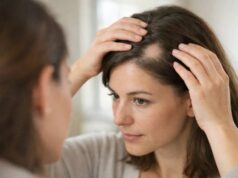
Hair changes tied to low estrogen can be subtle at first: a part that looks wider in bright light, more strands on wash day, hair that grows back finer than it used to, or a texture that suddenly feels less forgiving. What makes this topic tricky is that “low estrogen hair loss” is not one single pattern. In perimenopause, hormone shifts often blend with aging, genetics, iron status, stress, and scalp health. After pregnancy, the drop in estrogen is much sharper, and the result is usually a temporary shedding phase rather than permanent follicle damage.
Understanding which pattern fits your situation changes everything. It helps you set a realistic timeline, avoid treatments that do not match the cause, and know when a reversible shed is revealing a more persistent form of thinning underneath. The real value is not in blaming estrogen for every strand, but in learning how low estrogen changes the hair cycle, how postpartum shedding differs from perimenopausal thinning, and which treatments are worth a serious conversation with a clinician.
Quick Overview
- Low estrogen can shorten the growth-friendly environment around the follicle, but genetics, iron status, thyroid changes, and aging often shape the final pattern.
- Postpartum hair loss is usually a temporary telogen effluvium that starts about 2 to 4 months after delivery and often improves within 6 to 12 months.
- Perimenopausal thinning is more likely to be gradual, centered on reduced density and a wider part, and may overlap with female-pattern hair loss.
- Hormone therapy can be valuable for menopause symptoms, but it is not a universal hair treatment and should not be started for hair alone without individualized risk review.
- Match treatment to the pattern: diffuse shedding calls for trigger review and patience, while chronic central thinning often responds better to proven hair-loss therapies such as minoxidil.
Table of Contents
- How Low Estrogen Affects the Follicle
- Perimenopause and Postpartum Are Not the Same
- What Low Estrogen Hair Loss Usually Looks Like
- How the Right Diagnosis Gets Made
- Treatment Options That Match the Pattern
- Recovery Timelines and When to Get Help
How Low Estrogen Affects the Follicle
Low estrogen is often described as a direct cause of hair loss, but the real picture is more layered. Hair follicles respond to a changing hormonal environment, not to estrogen in isolation. Estrogen appears to help support a longer growth phase and a more favorable balance inside the follicle. When estrogen drops, especially during perimenopause, that support becomes less steady. Hair may spend less time growing, more time resting, and come back finer or slower than before. A quick review of the hair growth cycle makes this easier to visualize.
That said, low estrogen is rarely the only driver. In many women, it acts more like a spotlight than a lone villain. It exposes follicles that were already vulnerable to inherited pattern thinning, chronic inflammation, low iron stores, thyroid shifts, or years of cumulative styling damage. This is why two people can have similar hormone changes and very different hair outcomes.
The hormonal balance also changes in relative terms. As estrogen declines, androgens may have a stronger visible effect even if their absolute level does not rise dramatically. That relative shift can encourage follicle miniaturization in women with a genetic tendency toward female-pattern hair loss. Instead of a dramatic shed, the hair gradually becomes less dense, the strands feel narrower, and scalp show-through becomes easier to notice under overhead light.
Low estrogen can also influence hair indirectly through the wider physiology of midlife:
- sleep becomes less reliable
- hot flashes and night sweats increase stress on recovery
- appetite and diet quality may shift
- menstrual patterns can become heavier before periods stop, raising the chance of low iron
- mood symptoms may worsen grooming habits and treatment consistency
Those secondary effects matter because follicles are metabolically active. They respond not only to hormones, but also to energy availability, inflammation, and nutrient status. This is one reason hair changes can feel disproportionate to a lab value. The hair follicle is reacting to the whole internal environment, not just a single number on a report.
A useful rule is to think in patterns rather than in blame. A broad increase in shedding suggests telogen effluvium. A slower decline in density through the top of the scalp suggests patterned thinning. Many women have both at once. That overlap is common in perimenopause and explains why hair may suddenly look worse after a stressful event even though the underlying thinning had been developing quietly for years.
This is also why treatment choices work best when they target the pattern in front of you, not just the phrase “low estrogen.” Hormones may set the stage, but the visible result depends on the hair cycle, genetics, and the health of the scalp and body around it.
Perimenopause and Postpartum Are Not the Same
Perimenopause and postpartum both involve falling estrogen, but the hair story is not the same. The timing, mechanism, and expected outcome are different enough that they should not be grouped together as one condition.
In perimenopause, hormone changes are uneven. Estrogen does not simply drift downward in a straight line. It fluctuates, sometimes sharply, while cycles become less predictable. Hair changes in this phase are often gradual. A woman may notice that her ponytail feels smaller, her temples are less full, or the center part shows more scalp over a year or two. The pattern may blend age-related thinning with unmasked female-pattern hair loss. For many readers, this overlaps with broader hormone-related thinning after 40 rather than a single short-lived shed.
Postpartum hair loss is usually more abrupt in concept, even if it appears later in real life. During pregnancy, many follicles stay in a longer growth phase. Hair often feels thicker and sheds less. After delivery, that pregnancy support ends, and a larger group of hairs shifts together into the resting phase. The result is postpartum telogen effluvium: diffuse shedding that usually starts around 2 to 4 months after birth, often peaks several months later, and generally improves over the following months.
The contrast is clearer when you break it down:
- Perimenopause tends to be gradual. Density decreases slowly, often with a wider part and finer strands.
- Postpartum shedding tends to be dramatic but diffuse. Hair comes out from all over the scalp rather than from one patterned zone.
- Perimenopausal hair loss often has a chronic component. Without treatment, it may continue or progress.
- Postpartum telogen effluvium is usually self-limited. The follicle is not destroyed; it is cycling.
- Postpartum hair loss can reveal something underneath. If shedding lingers or the top stays noticeably thin, the pregnancy may have unmasked female-pattern hair loss or another ongoing issue.
This last point matters more than many people realize. A temporary shed can expose a preexisting tendency that had not been obvious before. That is why some women do not fully “bounce back” to their old density after childbirth. The postpartum event may have been temporary, but it changed how visible the underlying pattern became.
Another practical difference is the emotional interpretation. Postpartum shedding often feels shocking because it happens after a period of unusually full hair. Perimenopausal thinning feels more ambiguous. Women may spend months wondering whether they are imagining it, whether it is just aging, or whether the texture change is making the density look worse than it is.
Putting these two states in the same bucket can lead to the wrong expectations. Postpartum shedding usually calls for reassurance, nutrition review, and time. Perimenopausal thinning more often needs a longer strategy, because the goal is not simply to wait out a shed but to preserve density and slow miniaturization over the years ahead.
What Low Estrogen Hair Loss Usually Looks Like
The appearance of low-estrogen-related hair changes depends on whether the main process is shedding, miniaturization, or both. This is why people use the same words for very different experiences. One person means handfuls of hair in the shower. Another means a scalp that has become easier to see at the crown.
In perimenopause, the most common presentation is not a bald patch. It is a quieter loss of density. The central part widens. The ponytail shrinks. Styling takes more effort because there is less bulk to hold shape. The scalp may become more visible under bright bathroom lighting even though the hairline is mostly preserved. Individual strands can also seem drier, wavier, frizzier, or less uniform than before. Those cosmetic changes make thinning feel worse because they reduce coverage even when the absolute number of hairs has not plummeted.
This overlap with female-pattern thinning stages is common. Female-pattern hair loss often shows up as:
- widening through the central part
- reduced density over the crown
- less volume near the temples
- shorter regrowth that does not seem to catch up
- finer, softer strands in areas that used to be dense
Postpartum hair loss looks different. It is usually diffuse, not patterned. Women notice hair on the shower wall, the floor, the pillowcase, and the baby’s clothing. The shedding can feel extreme, but the scalp often looks healthy. There is no thick scale, patchy inflammation, or scarring. New regrowth may show up as soft short hairs along the front and temples, which can be encouraging biologically even if it creates awkward flyaways.
Some details help distinguish low-estrogen-associated changes from other problems:
- Diffuse shedding favors telogen effluvium.
- Slow central thinning favors female-pattern hair loss.
- Patchy smooth loss raises concern for alopecia areata.
- Painful, scaly, or inflamed areas point away from hormone shifts and toward scalp disease.
- Broken hairs at different lengths suggest breakage more than true follicle shedding.
It is also important not to over-read every extra strand. Hair density is easiest to judge in consistent photos, not from day-to-day emotion. Wash frequency, curl pattern, hair length, and styling habits all affect how dramatic shedding looks. Someone who washes twice a week will often see a more frightening pile of hair than someone who washes daily, even if their average daily shedding is similar.
A helpful way to frame the signs is this: low estrogen tends to change quality, cycle, and density more than it causes sudden discrete baldness. If the scalp shows clear inflammation, sharply defined patches, or fast recession, another diagnosis needs attention. Hormones may still be part of the background, but they are probably not the whole answer.
How the Right Diagnosis Gets Made
The right diagnosis usually comes from a focused story and a good scalp exam, not from an oversized lab panel. That matters because women with hormone-related hair changes are often sent down a long path of supplements and vague reassurance without anyone deciding whether the real pattern is telogen effluvium, female-pattern hair loss, or a mix of the two.
A clinician will usually start with timing. The key questions are simple:
- Did shedding begin 2 to 4 months after childbirth?
- Has density been declining gradually for a year or longer?
- Are menstrual cycles changing, getting heavier, or becoming irregular?
- Is there a family history of patterned thinning?
- Have there been recent triggers such as illness, surgery, major weight loss, or medication changes?
Those answers already narrow the field. Next comes the scalp exam. In telogen effluvium, the scalp often looks normal and the shedding is diffuse. In female-pattern hair loss, there is often more visible scalp through the midline and crown, while the frontal hairline is relatively maintained. Dermoscopy or trichoscopy can help show whether the follicle openings are present and whether the hairs in a region are becoming more variable in diameter, a common clue to miniaturization.
Laboratory testing can be helpful, but only when it matches the history. Reasonable tests often include:
- complete blood count
- ferritin or iron studies when periods are heavy, diet is restricted, or fatigue is present
- thyroid testing when symptoms or history suggest it
- pregnancy or postpartum-related review when relevant
- selected nutrient tests only if diet, absorption, or medication history points that way
This is where checking ferritin and hair targets becomes more useful than chasing every supplement trend. Iron depletion does not explain every case, but it is common enough to matter, especially in perimenopause when bleeding can become heavier before periods stop.
Not every woman with thinning needs hormone testing. In many cases, estrogen levels are hard to interpret because they fluctuate widely in perimenopause, and one reading may not reflect the pattern over time. Hormone tests may be more useful when the picture includes signs of androgen excess, such as new facial hair, severe acne, or menstrual patterns that suggest another endocrine issue.
Just as important is knowing when the picture does not fit simple low-estrogen changes. A dermatologist should think beyond hormones when there is:
- scalp pain, redness, or scale
- patchy hair loss
- eyebrow loss
- rapid recession
- pustules or scarring
- no improvement months after a supposed postpartum shed
The most helpful diagnosis is the one that explains both the timeline and the pattern. That sounds basic, but it prevents a lot of wasted money. Hair that is shedding needs a different plan than hair that is miniaturizing. Many women have both, and that mixed diagnosis is often the missing piece.
Treatment Options That Match the Pattern
Treatment works best when it is matched to the mechanism. That sounds obvious, yet it is where many women lose time. A postpartum shed is often treated like chronic pattern loss. A long-standing miniaturization problem is treated like a temporary stress response. The result is disappointment with treatments that were never aimed at the right target.
For postpartum telogen effluvium, the backbone of treatment is supportive care:
- correct obvious iron or nutritional problems
- keep protein intake consistent
- avoid crash dieting while recovering from pregnancy
- use gentle styling and avoid aggressive heat
- give the follicles time to cycle back
This kind of shedding usually improves without intensive medical therapy. The harder part is distinguishing it from a postpartum event that has uncovered underlying female-pattern hair loss. When the shedding slows but density does not recover, the diagnosis often needs to expand.
For chronic perimenopausal thinning or female-pattern hair loss, the most established first-line treatment remains topical minoxidil. It helps extend the growth phase and can improve density over time. Results are slow, and early shedding can happen as follicles shift cycles, but consistent use over several months matters more than perfection for one week. Women considering prescription alternatives often want a clearer sense of low-dose oral minoxidil side effects before deciding whether an off-label oral option is a better fit than topical therapy.
Low-dose oral minoxidil is increasingly used by dermatologists, but it is still an off-label treatment. It may help women who cannot tolerate topical products or who need a more practical routine. It also carries systemic side effects, including swelling, dizziness, palpitations, and unwanted facial or body hair, so it is not a casual choice.
Other options may enter the discussion depending on life stage and medical history:
- Spironolactone may be considered when androgen-sensitive patterned thinning is part of the picture, especially in premenopausal or perimenopausal women who are not pregnant and are using appropriate contraception.
- Finasteride or dutasteride are generally approached more cautiously in women of childbearing potential and are used more selectively.
- Menopausal hormone therapy may improve overall menopause symptoms and may help some women’s hair indirectly or modestly, but it is not the standard primary treatment for hair thinning.
- Camouflage strategies such as powders, fibers, and style changes can provide immediate confidence while slower treatments work.
The most important nuance is about hormone therapy. Replacing estrogen can be the right decision for hot flashes, sleep disruption, bone protection in selected patients, or premature ovarian insufficiency. It should not be sold as a guaranteed hair regrowth solution. Hair-specific evidence is still limited, and benefit varies. For some women, improving sleep, vasomotor symptoms, and quality of life helps the hair environment overall. For others, the better hair-focused treatment is still minoxidil-based therapy plus correction of contributing factors.
Supplements deserve restraint. Unless a deficiency is documented or strongly suspected, more pills do not necessarily mean better hair. Hair treatment is usually most successful when it is boringly consistent, medically grounded, and realistic about the time follicles need to respond.
Recovery Timelines and When to Get Help
Hair recovery is slower than most people expect, and that gap between biological improvement and visible improvement is where anxiety tends to grow. A follicle can be back in a healthier cycle before the mirror shows a satisfying result.
Postpartum shedding usually follows the kinder timeline. It often begins a few months after delivery, peaks later, and then eases over several more months. Many women notice meaningful improvement within 6 to 12 months, though fullness can take longer to feel “normal” because regrowing hairs need time to add bulk. The return of short regrowth around the hairline and temples is often a good sign, even if it creates fuzz that is hard to style.
Perimenopausal thinning is different. If the main process is female-pattern hair loss, recovery is not usually about waiting for a shed to end. It is about preserving follicles, thickening miniaturized hairs, and slowing future loss. That means expectations should shift from “When will it all grow back?” to “What steady plan gives me the best density a year from now?” For many women, checking realistic hair growth timelines is more useful than reading dramatic before-and-after stories.
A few signs suggest that you should stop monitoring alone and seek a dermatology visit:
- shedding lasts beyond 6 months
- the center part keeps widening even after a postpartum shed should be calming down
- the scalp becomes painful, red, or scaly
- you develop bald patches, eyebrow loss, or lash loss
- there is new facial hair, severe acne, or cycle changes that suggest a broader hormonal issue
- fatigue, palpitations, major weight change, or heavy bleeding point to iron or thyroid problems
Photographs help more than memory. Take one front view, one part-line view, and one crown view every 4 weeks in the same lighting. That monthly rhythm shows trend without feeding daily panic. Avoid counting every strand in the drain. Hair sheds in clusters depending on wash schedule, and the visual pile can exaggerate what is happening.
It also helps to resist the urge to stack every possible remedy at once. When five new products start in the same week, no one can tell what helped or what irritated the scalp. A measured plan is more revealing and usually more affordable.
The reassuring truth is that low-estrogen hair changes are common, but they are not all identical and not all permanent. Postpartum telogen effluvium is usually self-limited. Perimenopausal thinning often responds best when it is recognized early and treated like the chronic pattern it is. The sooner the pattern becomes clear, the more realistic and effective the next steps tend to be.
References
- The Menopausal Transition: Is the Hair Follicle “Going through Menopause”? 2023 (Review)
- Female-pattern hair loss: therapeutic update 2023 (Review)
- Postpartum Telogen Effluvium Unmasking Additional Latent Hair Loss Disorders 2024
- The 2022 hormone therapy position statement of The North American Menopause Society 2022 (Position Statement)
- Low-Dose Oral Minoxidil for Alopecia: A Comprehensive Review 2023 (Review)
Disclaimer
This article is for educational purposes only and is not a diagnosis or a substitute for medical care. Hair loss during perimenopause or after pregnancy can reflect more than hormone change alone, including iron deficiency, thyroid disease, scalp disorders, and inherited pattern hair loss. Treatment decisions, especially around hormone therapy, oral minoxidil, antiandrogens, pregnancy, and breastfeeding, should be made with a qualified clinician who can review your symptoms, risks, and medical history.
If this article helped, please share it on Facebook, X, or your preferred platform so more readers can understand the difference between temporary shedding, hormone-related thinning, and treatment options that truly fit the pattern.